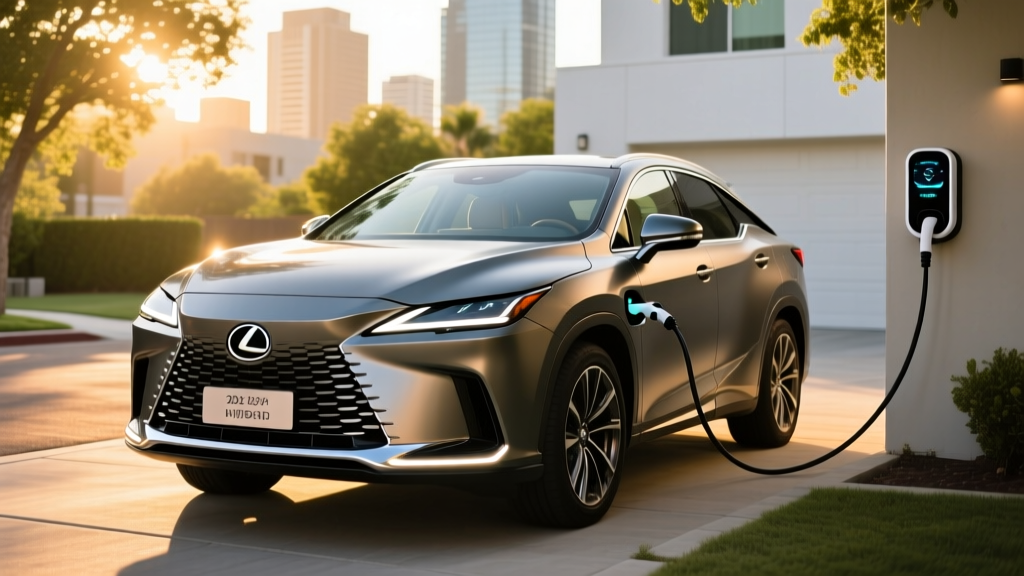
The 2026 Lexus RX 350h hybrid occupies a specific niche: buyers who want luxury-crossover refinement and serious fuel efficiency without ever plugging in. As a conventional hybrid (HEV), the RX 350h generates its own electricity through regenerative braking and engine-driven generators — no charging cable required. For the midsize luxury hybrid segment, it remains the benchmark against which competitors like the BMW X5 xDrive50e (a plug-in hybrid) and the Genesis GV80 are measured.
This guide covers every number that matters: EPA fuel economy, real-world MPG expectations, powertrain output, pricing across trims, battery warranty coverage, and the tax-credit picture for 2026. We also compare the RX 350h against the plug-in hybrid RX 450h+ and full EVs so you can determine which powertrain fits your driving pattern.
HEV vs PHEV: Where the RX 350h Fits
Lexus offers two electrified RX variants for 2026, and confusing them is a common mistake. Here is the fundamental distinction:
RX 350h — Conventional Hybrid (HEV)
- No plug-in required. The 1.1 kWh battery recharges via regenerative braking and the gasoline engine.
- Electric-only driving: Brief, low-speed EV mode (under ~1 mile) — not meaningful electric-only range.
- Refueling: Gas station only, same as any conventional car.
- Best for: Drivers without reliable home or workplace charging access.
RX 450h+ — Plug-In Hybrid (PHEV)
- Plugs in. The 18.1 kWh lithium-ion battery charges via Level 1 or Level 2 AC charging (no DC fast charge).
- Electric-only range: EPA-estimated 37 miles on battery alone before the engine engages.
- Total combined range: Approximately 420 miles (37 electric + ~383 on gasoline).
- Best for: Drivers with home Level 2 charging who commute under 40 miles round-trip.
If your priority is simplicity and you cannot charge at home, the RX 350h HEV is the correct choice. If you have a garage with a 240V outlet and want electric-only commuting, the RX 450h+ PHEV is worth the premium.
Fuel Economy: EPA Ratings and Real-World MPG
The 2026 RX 350h carries over the powertrain introduced with the current generation's refresh. According to fueleconomy.gov, the EPA rates the RX 350h with all-wheel drive (the most common configuration) as follows:
| Metric | RX 350h AWD (HEV) | RX 450h+ AWD (PHEV) |
|---|---|---|
| City MPG | 37 MPG | 38 MPG (charge-sustaining) |
| Highway MPG | 34 MPG | 33 MPG (charge-sustaining) |
| Combined MPG | 36 MPG | 35 MPG (charge-sustaining) |
| MPGe (electric mode, PHEV only) | N/A | 83 MPGe combined |
| Electric-Only Range (PHEV only) | N/A | 37 miles |
| Fuel Tank Capacity | 17.2 gallons | 14.5 gallons |
| Total Driving Range | ~619 miles | ~420 miles combined |
Real-World MPG: What to Actually Expect
Hybrids like the RX 350h often exceed their EPA city rating in stop-and-go traffic because regenerative braking recaptures energy that a conventional car wastes as heat. In real-world mixed suburban driving, owners consistently report 35–38 MPG combined. However, several factors reduce efficiency:
- Sustained highway speeds above 75 mph: Expect 30–32 MPG. Aerodynamic drag dominates, and the hybrid system offers less benefit at constant high speed.
- Cold weather (below 30°F): The engine runs more frequently to provide cabin heat and warm the catalytic converter, dropping city MPG by 3–5 MPG.
- Mountain driving: Regenerative braking on descents partially offsets the energy consumed climbing, but net efficiency still drops versus flat terrain.
- Short trips under 3 miles: The engine stays in its warm-up cycle, reducing efficiency to 28–30 MPG until the powertrain reaches operating temperature.
Powertrain Specs: Engine, Motors, and Performance
The RX 350h pairs a 2.5-liter inline-4 Atkinson-cycle engine with two electric motor-generators and an electronically controlled continuously variable transmission (eCVT). Here is the complete powertrain breakdown:
| Specification | 2026 RX 350h |
|---|---|
| Engine | 2.5L 4-cylinder Atkinson-cycle |
| Engine Output | 184 hp / 184 lb-ft torque |
| Front Electric Motor | 134 hp / 199 lb-ft |
| Rear Electric Motor (AWD) | 54 hp / 89 lb-ft |
| Net Combined System Output | 246 hp |
| Transmission | eCVT (electronically controlled) |
| Drivetrain | AWD (electronic on-demand rear axle) |
| 0–60 mph | 7.4 seconds |
| Hybrid Battery Capacity | 1.1 kWh (nickel-metal hydride) |
| Curb Weight | ~4,575 lbs |
| Towing Capacity | 3,500 lbs (with towing prep package) |
The eCVT is a power-split device, not a belt-driven CVT. It uses a planetary gearset to blend engine and motor power seamlessly — there is no rubber-band effect or drone under acceleration. The rear electric motor engages automatically when the front wheels lose traction or under hard acceleration, providing AWD without a mechanical driveshaft.
For comparison, the non-hybrid RX 350 (turbocharged 2.4L) produces 275 hp and hits 60 mph in 6.9 seconds but returns only 25 MPG combined. The RX 350h sacrifices 0.5 seconds in acceleration to gain 11 MPG combined — a trade most buyers in this segment will gladly accept.
Pricing, Trims, and Tax Credit Eligibility
The 2026 RX 350h is available across five trims. Pricing reflects the MSRP before destination charges ($1,395):
| Trim | MSRP |
|---|---|
| Premium | $52,800 |
| Premium+ | $55,100 |
| Luxury | $58,650 |
| F SPORT Handling | $56,900 |
| F SPORT Design | $54,600 |
Federal Tax Credit: The RX 350h Does NOT Qualify
Under current IRS §30D rules, the federal clean vehicle credit of up to $7,500 applies only to plug-in electric vehicles (BEVs and PHEVs) meeting battery sourcing, critical mineral, MSRP cap, and buyer income requirements. The RX 350h is a conventional hybrid with no plug — it does not qualify for the §30D credit.
- RX 350h (HEV): Not eligible — no plug-in capability
- RX 450h+ (PHEV): Eligible for up to $3,750 if battery sourcing and critical mineral requirements are met (varies by production batch — verify with your dealer and tax professional)
- MSRP cap for SUVs: $80,000 (both RX variants fall under this)
- Buyer income cap: $300,000 joint / $225,000 head of household / $150,000 individual (modified AGI)
- Point-of-sale transfer available for qualifying PHEVs — reduces purchase price at the dealership
Some states offer separate incentives for hybrids. Check your state's energy office or department of revenue for current programs, as these change frequently.
Battery Warranty, Reliability, and Replacement Costs
Hybrid battery longevity is the single most common concern among first-time hybrid buyers. Lexus addresses this with one of the strongest warranty packages in the industry:
- Hybrid battery coverage: 10 years / 150,000 miles (whichever comes first)
- Hybrid system components: 8 years / 100,000 miles (inverters, motor-generators, control modules)
- Capacity retention threshold: Lexus warrants the battery against failure — there is no published minimum capacity percentage, but real-world degradation in Toyota/Lexus NiMH packs is typically 10–15% over 150,000 miles
- Replacement cost (out of warranty): $3,000–$4,500 for a refurbished or new hybrid battery pack, plus $500–$800 in labor
Lexus (and parent company Toyota) has the deepest track record in hybrid technology of any automaker, with over 25 years of production hybrid experience since the 1997 Prius. The RX 350h's NiMH pack is deliberately small (1.1 kWh) and operates within a narrow state-of-charge window — typically between 40% and 80% — which dramatically reduces stress and extends cycle life. This is why Toyota/Lexus hybrid batteries routinely exceed 200,000 miles without replacement.
According to IIHS, the current-generation RX has earned top safety ratings, and Lexus consistently ranks at or near the top of J.D. Power's Vehicle Dependability Study. The hybrid powertrain adds complexity (motor-generators, inverter, eCVT) but eliminates others: there is no traditional automatic transmission with clutch packs or torque converter, no starter motor, and no alternator — all common failure points in conventional vehicles.
RX 350h vs RX 450h+ vs Full EV: Which Should You Choose?
The decision between a conventional hybrid, plug-in hybrid, and battery-electric vehicle depends on your charging access, driving pattern, and budget. Here is a decision framework:
Choose the RX 350h (HEV) if:
- You cannot install a Level 2 charger at home (apartment, street parking, no garage)
- You regularly drive more than 400 miles between stops and don't want to plan charging
- You want the lowest purchase price in the electrified RX lineup
- Your daily commute involves heavy stop-and-go traffic where hybrid efficiency shines
Choose the RX 450h+ (PHEV) if:
- You have a garage or driveway with 240V access for Level 2 charging
- Your daily round-trip commute is under 37 miles (you may rarely use gasoline)
- You want electric-only driving for errands but gasoline flexibility for road trips
- You may qualify for the partial §30D federal tax credit
Choose a full EV (e.g., BMW iX, Tesla Model X, Rivian R1S) if:
- You have reliable home Level 2 charging and access to DC fast charging on road trips
- You want zero tailpipe emissions and minimal maintenance (no oil changes, no gasoline engine)
- Your household has a second vehicle for rare long-distance trips, or you're comfortable with 20–30 minute DC fast-charge stops
Pros and Cons: The Honest Assessment
Pros
- 36 MPG combined in a 4,575-lb luxury crossover — exceptional efficiency
- No charging infrastructure required — fill up at any gas station
- 10-year/150,000-mile hybrid battery warranty provides long-term peace of mind
- Smooth, quiet powertrain with no CVT drone thanks to planetary gearset
- 3,500-lb towing capacity covers small trailers and boats
- Strong resale value — Lexus hybrids hold value better than most competitors
Cons
- 7.4-second 0–60 time is adequate but not sporty for a $53K+ vehicle
- No federal tax credit eligibility (HEV, not PHEV)
- 1.1 kWh battery provides no meaningful electric-only range
- Highway MPG drops to ~30–32 at sustained speeds above 75 mph
- Premium trim starts at $52,800 — significantly more than a Toyota Highlander Hybrid (35 MPG, ~$42K)
- eCVT lacks the direct gear-shift feel some drivers prefer
Frequently Asked Questions
How many MPG does the 2026 Lexus RX 350h hybrid get?
The EPA rates the 2026 RX 350h AWD at 37 city / 34 highway / 36 combined MPG. In real-world mixed driving, expect 35–38 MPG. Highway-only trips above 75 mph typically yield 30–32 MPG.
Does the RX 350h need to be plugged in to charge?
No. The RX 350h is a conventional hybrid (HEV), not a plug-in hybrid. Its 1.1 kWh battery recharges automatically through regenerative braking and the gasoline engine. You never plug it in — you simply refuel at a gas station.
How far can the RX 350h drive on electric power alone?
The RX 350h can operate in EV mode for very short distances (under 1 mile) at low speeds (under 25 mph), such as creeping through a parking lot. It does not have meaningful electric-only range. If you want substantial electric-only driving, the RX 450h+ PHEV offers 37 miles on battery alone.
Is the Lexus RX 350h hybrid reliable?
Lexus and Toyota have the longest production-hybrid track record in the industry, spanning over 25 years. The RX 350h uses proven power-split hybrid architecture with a NiMH battery that operates in a narrow state-of-charge window to maximize longevity. The hybrid battery is warrantied for 10 years/150,000 miles. Independent reliability surveys consistently rank Lexus at or near the top.
What does it cost to replace the hybrid battery?
If the hybrid battery fails outside the 10-year/150,000-mile warranty, replacement costs range from $3,000 to $4,500 for the battery pack plus $500–$800 in labor, totaling approximately $3,500–$5,300. Refurbished packs are available for less. In practice, Toyota/Lexus NiMH hybrid batteries routinely last 200,000+ miles.
Does the 2026 RX 350h qualify for any federal tax credit?
No. The federal §30D clean vehicle credit applies only to plug-in vehicles (BEVs and PHEVs). The RX 350h is a conventional hybrid and does not qualify. The plug-in RX 450h+ may qualify for a partial credit of up to $3,750 depending on battery sourcing compliance — verify current eligibility with your dealer and a tax professional.
How does the RX 350h compare to the non-hybrid RX 350?
The non-hybrid RX 350 (turbo 2.4L, 275 hp) achieves 25 MPG combined and accelerates to 60 mph in 6.9 seconds. The RX 350h (246 hp) delivers 36 MPG combined with a 7.4-second 0–60 time. You gain 11 MPG combined at the cost of 0.5 seconds in acceleration and approximately $3,000 in additional MSRP — a payback period of roughly 4–5 years at 12,000 miles/year and $3.50/gallon fuel.
Can the RX 350h tow?
Yes. With the optional towing prep package, the 2026 RX 350h is rated for up to 3,500 lbs — sufficient for a small utility trailer, a pair of jet skis, or a lightweight pop-up camper. Towing will reduce fuel economy to approximately 22–26 MPG depending on trailer weight and terrain.