The 2026 Lexus PHEV Lineup at a Glance
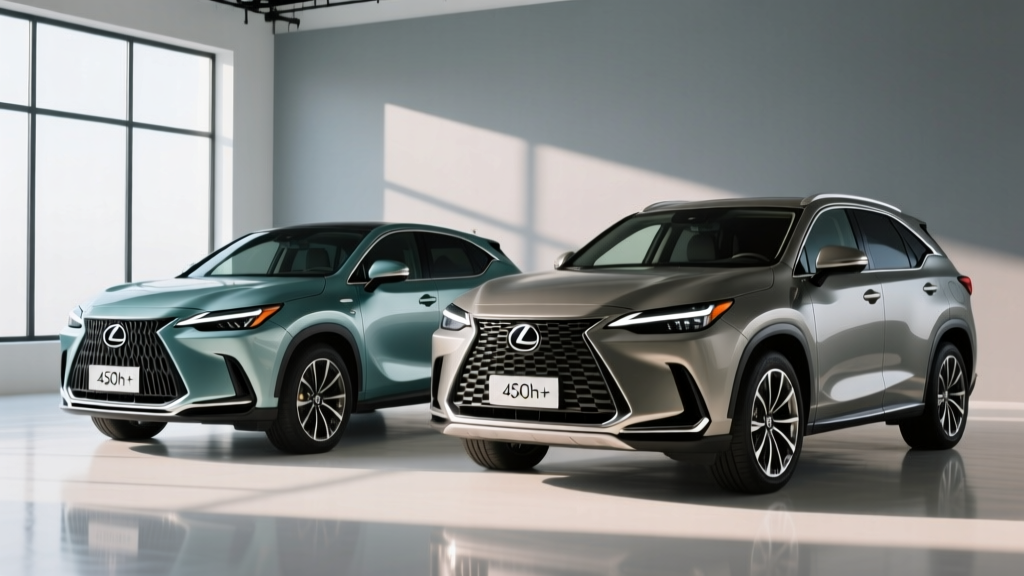
Lexus currently sells two plug-in hybrid electric vehicles in the United States: the compact NX 450h+ and the midsize RX 500h+. Both pair a 2.5-liter four-cylinder engine with front and rear electric motors and a lithium-ion traction battery you can recharge from a wall outlet or public charger. The result is 35–37 miles of electric-only driving for daily commutes, then seamless hybrid operation for longer trips — no range anxiety, no charging-desert stress.
If you've searched for a Lexus PHEV and felt confused by trim names, battery sizes, or whether these vehicles qualify for federal tax credits, this guide breaks down every number that matters for a 2026 purchase decision.
A conventional Lexus hybrid (like the NX 350h or RX 350h) uses a small battery recharged only by the engine and regenerative braking. You never plug it in. A Lexus PHEV (NX 450h+ or RX 500h+) carries a much larger battery — 18.1 kWh usable — that you plug in to recharge, giving you genuine electric-only range before the gas engine engages. Think of a PHEV as an EV for short trips and a hybrid for long ones.
| Spec | NX 450h+ | RX 500h+ |
|---|---|---|
| EPA Electric-Only Range | 37 miles | 35 miles |
| EPA Combined MPGe (EV mode) | 84 MPGe | 83 MPGe |
| EPA Combined MPG (hybrid mode) | 36 MPG | 35 MPG |
| Battery (usable) | 18.1 kWh lithium-ion | 18.1 kWh lithium-ion |
| Combined Horsepower | 304 hp | 302 hp |
| 0–60 mph | 6.0 sec | 6.2 sec |
| Level 2 Charge Time (0–100%) | ~4.5 hours (3.3 kW onboard) | ~4.5 hours (3.3 kW onboard) |
| DC Fast Charging | Not available | Not available |
| Drivetrain | AWD (E-Four electronic) | AWD (E-Four electronic) |
| Starting MSRP | $59,965 | $72,560 |
Electric-Only Range and Real-World MPG
The NX 450h+ earns an EPA-estimated 37 miles of electric-only range, while the heavier RX 500h+ manages 35 miles. In both models, once the battery depletes to its hybrid buffer, the 2.5-liter engine engages and the vehicle operates as a conventional series-parallel hybrid.
The EPA 37-mile figure for the NX 450h+ assumes moderate temperatures and mixed driving. Expect 30–34 miles in summer with A/C running, and as low as 25–28 miles in freezing weather due to cabin heating demands and reduced battery efficiency. Highway-speed electric-only driving (above 65 mph) also cuts range by roughly 15–20% compared to city use.
Once the battery is depleted, both models return strong hybrid fuel economy. The NX 450h+ achieves an EPA-estimated 36 MPG combined (38 city / 33 highway), and the RX 500h+ returns 35 MPG combined (36 city / 33 highway). In real-world city driving, Lexus hybrids frequently exceed their EPA city estimates thanks to aggressive regenerative braking and frequent electric-motor assist at low speeds. Highway fuel economy tends to match or fall slightly below the sticker.
| Model | City MPG | Highway MPG | Combined MPG | Combined MPGe |
|---|---|---|---|---|
| NX 450h+ | 38 | 33 | 36 | 84 |
| RX 500h+ | 36 | 33 | 35 | 83 |
Total combined range — electric plus a full tank of gasoline — exceeds 550 miles in the NX 450h+ and roughly 530 miles in the RX 500h+, eliminating any need to plan trips around charging stations.
Powertrain and Performance
Both Lexus PHEV models use a 2.5-liter Atkinson-cycle inline-four engine paired with two electric motors — one driving the front axle and one driving the rear (Lexus calls this system E-Four). There is no mechanical driveshaft connecting the axles; the rear motor engages electronically when all-wheel-drive traction is needed.
- NX 450h+: 304 combined system horsepower. The gas engine produces 181 hp and 168 lb-ft of torque, supplemented by a 181-hp front motor and a 54-hp rear motor. 0–60 mph in 6.0 seconds.
- RX 500h+: 302 combined system horsepower with the same engine and similar motor output, tuned slightly differently for the larger chassis. 0–60 mph in 6.2 seconds.
The transition between electric-only and hybrid mode is nearly imperceptible — a hallmark of Toyota/Lexus hybrid synergy drive engineering. Under hard acceleration, the engine and both motors deliver combined output seamlessly.
Charging: What You Need to Know
This is where prospective Lexus PHEV buyers most often have questions. Here are the specifics:
- Onboard charger: 3.3 kW (both models). This is the maximum rate the vehicle can accept from a Level 2 AC source.
- Level 1 (120V household outlet): Adds roughly 3–4 miles of range per hour. A full charge from empty takes approximately 12–14 hours. Fine for overnight top-ups if your daily drive is under 30 miles.
- Level 2 (240V home or public charger): A full 0–100% charge takes about 4.5 hours at the 3.3 kW onboard limit. Even if you plug into a 7.2 kW or 11.5 kW Level 2 station, the NX and RX will only draw 3.3 kW.
- DC fast charging: Not available on either model. There is no CCS or NACS DC fast-charge port. This is a deliberate engineering choice — the 18.1 kWh battery is small enough that Level 2 charging is deemed sufficient for overnight replenishment.
The charge port is a standard J1772 connector (the North American AC standard). If you install a Level 2 home charger — typically a 32-amp or 48-amp wall unit — you'll wake up to a full battery every morning, which is the ideal PHEV ownership pattern.
Because the onboard charger is limited to 3.3 kW, spending extra on a high-amperage (48-amp or 80-amp) home charger won't speed up your Lexus PHEV. A quality 16-amp or 32-amp Level 2 unit (like a ChargePoint Home Flex set to 16A) is the most cost-effective match. Budget roughly $400–$600 for the charger and $500–$1,500 for electrician installation, depending on your panel proximity and local permit fees.
Pricing, Trims, and Tax Credit Eligibility
The 2026 NX 450h+ starts at approximately $59,965 (including destination) in Premium trim, with Luxury and F SPORT Handling trims pushing the price above $65,000. The 2026 RX 500h+ begins around $72,560 in Luxury trim, with F SPORT Handling and Executive trims reaching past $80,000.
Federal Tax Credit (§30D) Status
Under current IRS §30D rules, the federal clean vehicle credit offers up to $7,500 for qualifying new PHEVs — but eligibility depends on several factors:
- MSRP cap: SUVs must have an MSRP at or below $80,000. The NX 450h+ clears this cap in most trims; the RX 500h+ in higher trims may exceed it.
- Buyer income cap: Modified adjusted gross income must not exceed $150,000 (single), $225,000 (head of household), or $300,000 (joint filers).
- Battery sourcing: Critical minerals and battery components must meet phased-in domestic-sourcing thresholds that tighten annually. Lexus, as a Japanese automaker using Toyota-sourced battery components, has faced challenges meeting these requirements in prior model years.
- Point-of-sale transfer: If eligible, you can transfer the credit to the dealer at purchase for an immediate price reduction, rather than waiting to claim it on your tax return.
Bottom line: Verify current eligibility on the IRS clean vehicle credit page and with your dealer before assuming the full $7,500 credit applies. Sourcing requirements have disqualified several Toyota/Lexus models in recent years, and the situation can change as supply chains shift. Consult a tax professional for your specific circumstances.
Battery Warranty, Reliability, and Replacement Cost
Both the NX 450h+ and RX 500h+ carry a 10-year / 150,000-mile hybrid battery warranty (whichever comes first), transferable to subsequent owners. This warranty covers battery capacity loss below a defined threshold (typically 70% of original capacity) as well as defects in the hybrid system components — inverter, electric motors, and associated control electronics. The broader powertrain warranty covers 6 years / 70,000 miles.
Lexus and its parent company Toyota have built the strongest track record in the industry for hybrid battery longevity. The first Toyota Prius hybrid batteries, deployed in the early 2000s, routinely lasted 150,000–200,000 miles before needing replacement. Modern lithium-ion PHEV packs benefit from more sophisticated thermal management and charge-buffering (the system never fully depletes or fully charges the battery at the cell level, reducing stress).
Replacement cost if out of warranty: Based on current Toyota/Lexus hybrid battery pricing, expect a PHEV battery replacement to cost between $6,000 and $9,000 (parts and labor) at a dealership. Independent hybrid-battery specialists may offer refurbished replacements for $3,500–$5,500. For context, most owners will never face this cost within typical ownership periods, given the 10-year warranty and proven cell longevity.
Lexus consistently ranks at or near the top of J.D. Power Vehicle Dependability Studies, and the hybrid powertrain is among the brand's most proven systems. There are no timing belts to replace (the Atkinson-cycle engine uses a timing chain), no traditional starter motor to fail, and regenerative braking reduces wear on the friction brake pads — many Lexus hybrid owners report original brake pads lasting 80,000+ miles.
Lexus PHEV vs. Conventional Hybrid vs. Full EV: Which Fits You?
Choosing between a Lexus PHEV, a conventional Lexus HEV (like the NX 350h or RX 350h), and a battery-electric vehicle depends on your daily driving pattern, home charging access, and trip habits.
- Your daily commute is under 35 miles round-trip
- You can install or already have Level 2 home charging
- You take road trips of 200+ miles several times per year
- You want EV-like daily driving without any range planning
- You value Lexus reliability and luxury refinement
- You cannot charge at home (apartment, street parking)
- You want maximum fuel efficiency with zero behavior change
- Your budget is lower (HEV trims start $10,000–$15,000 less)
- You drive mostly highway miles where PHEV electric range adds less value
- You have reliable home charging and good public DC fast-charging access
- You want zero tailpipe emissions and minimal maintenance
- Your longest regular trip is under 300 miles or you don't mind charging stops
- You want to maximize federal/state EV incentives (PHEVs often get partial or no credit)
The PHEV's sweet spot is the driver who wants to run on electricity 80–90% of the time (daily commuting, school runs, errands) but needs the freedom to drive from Chicago to Denver without mapping out DC fast chargers. If you can't charge at home, a PHEV's electric range goes largely unused, and you're carrying dead battery weight — making the conventional HEV a smarter buy.
Frequently Asked Questions
How many MPG does the Lexus PHEV get?
Once the electric-only range is depleted, the NX 450h+ returns an EPA-estimated 36 MPG combined (38 city / 33 highway), and the RX 500h+ returns 35 MPG combined (36 city / 33 highway). In real-world city driving with frequent stops and regenerative braking, owners commonly report 38–42 MPG in hybrid mode. Highway cruising at 75+ mph may yield 30–32 MPG.
How far can a Lexus PHEV go on electric only?
The NX 450h+ is EPA-rated for 37 miles of electric-only range; the RX 500h+ for 35 miles. Real-world range varies from roughly 25 miles in cold weather with highway driving to 40 miles in mild weather with city driving. After electric range depletes, the gas engine engages automatically and the vehicle operates as a standard hybrid with 500+ miles of total range.
Does the Lexus PHEV qualify for a federal tax credit?
Possibly, but it depends on current IRS §30D battery-sourcing requirements, which have historically disqualified many Toyota/Lexus models. The NX 450h+ MSRP falls under the $80,000 SUV cap; the RX 500h+ may exceed it in higher trims. Always verify eligibility with your dealer and the IRS clean vehicle credit page before purchasing, and consult a tax professional regarding income limits and point-of-sale transfer options.
Is the Lexus PHEV reliable, and what does battery replacement cost?
Lexus ranks among the most reliable luxury brands, and the Toyota hybrid powertrain has two decades of proven durability. The PHEV battery is covered by a 10-year / 150,000-mile warranty. Out-of-warranty replacement costs approximately $6,000–$9,000 at a dealer, though most batteries outlast this period. Regenerative braking extends brake pad life, and the timing chain eliminates belt-replacement intervals.
Can the Lexus PHEV use DC fast chargers?
No. Neither the NX 450h+ nor the RX 500h+ has DC fast-charging capability. They charge exclusively via AC — Level 1 (120V) or Level 2 (240V) — with a 3.3 kW onboard charger. A full Level 2 charge takes about 4.5 hours. This is typical for PHEVs with smaller batteries, where overnight home charging is the primary use case.
What happens if I never plug in my Lexus PHEV?
The vehicle will operate perfectly as a conventional hybrid, delivering 35–36 MPG combined. However, you'll be paying a premium (roughly $8,000–$12,000 more than the equivalent HEV trim) for battery capacity you never use, and you'll carry the extra weight of a depleted battery. If you can't plug in regularly, the NX 350h or RX 350h is the more economical choice.