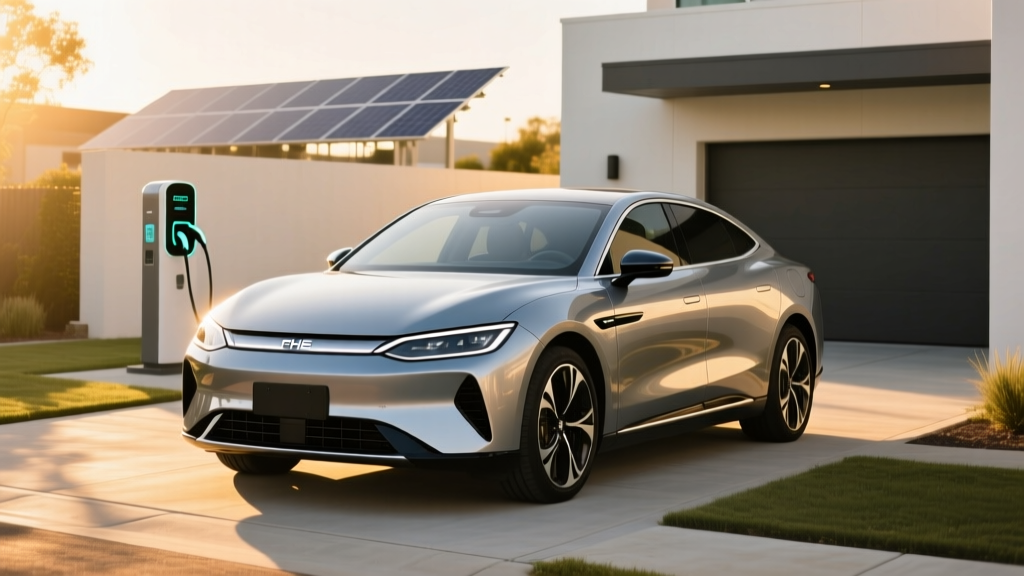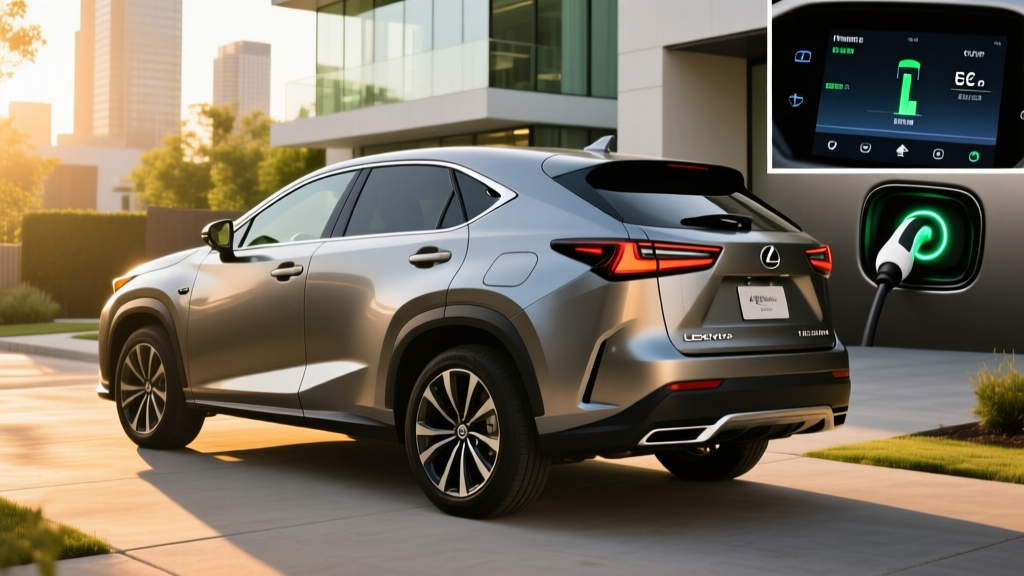
The compact luxury plug-in hybrid segment doesn't have many veterans, but the 2026 Lexus NX 450h+ plug-in hybrid has quietly established itself as one of the most practical electrified SUVs you can buy. With 37 miles of EPA-rated electric-only range, 304 combined horsepower, and the Lexus reputation for long-term reliability, it targets buyers who want electric commuting without the range-commitment of a full battery-electric vehicle.
This guide breaks down everything that matters for a PHEV purchase decision: real-world range and MPG, charging logistics, powertrain specs, battery longevity, and whether the NX 450h+ actually qualifies for federal tax credits under current IRS §30D rules.
HEV vs PHEV: Where the NX 450h+ Fits in the Lexus Lineup
Lexus offers the NX in three distinct powertrain flavors for 2026, and confusing them is easy if you're not reading the badging carefully:
| Model | Type | Needs Plug? | Electric-Only Range | Powertrain Summary |
|---|---|---|---|---|
| NX 250 | Gasoline (ICE) | No | N/A | 2.5L I-4, 203 hp |
| NX 350h | Conventional Hybrid (HEV) | No | ~1 mi at low speed | 2.5L I-4 + motors, 244 hp combined |
| NX 450h+ | Plug-In Hybrid (PHEV) | Yes (for max benefit) | 37 miles EPA | 2.5L I-4 + motors, 304 hp combined |
A conventional hybrid (HEV) like the NX 350h never plugs in. It recovers energy through regenerative braking and the gasoline engine to keep a small battery charged. You simply drive it like a gas car and get better MPG.
A plug-in hybrid (PHEV) like the NX 450h+ carries a much larger battery — 18.1 kWh usable in this case — that you charge from a wall outlet or Level 2 charger. That larger battery enables meaningful electric-only driving for daily commutes. When the battery depletes, the vehicle seamlessly transitions to conventional hybrid operation. You never get stranded.
Fuel Economy and Electric-Only Range: The Numbers
The EPA rates the 2026 Lexus NX 450h+ plug-in hybrid at 84 MPGe (miles per gallon equivalent) when operating on combined battery and gasoline power. Once the battery depletes, it functions as a conventional hybrid rated at 36 MPG combined. Here's the full breakdown:
| Mode | City | Highway | Combined |
|---|---|---|---|
| Charge-Depleting (EV + hybrid blend) | 84 MPGe | ||
| Charge-Sustaining (hybrid only) | 38 MPG | 33 MPG | 36 MPG |
How many MPG does this hybrid get in practice? PHEV owners who charge daily and drive less than 35 miles between charges may go weeks without visiting a gas station, effectively achieving 100+ MPGe in blended use. Owners who rarely charge and rely on the gasoline engine will see the charge-sustaining figure of 36 MPG combined — still strong for a 4,300-pound luxury SUV, and notably better than the gas-only NX 250's 28 MPG combined.
Powertrain and Performance Specs
The NX 450h+ pairs a 2.5-liter inline-four Atkinson-cycle engine with two electric motors and an electronically controlled continuously variable transmission (eCVT). All-wheel drive is standard — the rear axle is powered exclusively by an electric motor, meaning there's no mechanical driveshaft connecting front and rear.
| Specification | 2026 Lexus NX 450h+ |
|---|---|
| Combined Horsepower | 304 hp |
| Gas Engine | 2.5L I-4 Atkinson-cycle, 181 hp |
| Front Electric Motor | 180 hp |
| Rear Electric Motor | 54 hp |
| 0–60 mph | 6.0 seconds |
| Drivetrain | AWD (eCVT) |
| Battery Capacity (Usable) | 18.1 kWh, lithium-ion (NMC chemistry) |
| EPA Electric Range | 37 miles |
| EPA MPGe (Blended) | 84 MPGe |
| EPA MPG (Charge-Sustaining) | 36 combined |
| Fuel Tank | 14.5 gallons |
| Total System Range | ~470+ miles |
| Towing Capacity | 2,000 lbs |
The 304 combined horsepower puts the NX 450h+ well ahead of the NX 350h (244 hp) and the turbocharged gas NX 350 (275 hp). The 6.0-second 0–60 time is quick enough for confident highway merging and passing, though the eCVT tuning prioritizes smoothness over sportiness. Electric-only driving is quiet and adequate for neighborhood and suburban speeds, though full-throttle acceleration on battery alone will feel modest compared to the blended powertrain.
Charging: Level 1, Level 2, and the DC Fast-Charging Question
The NX 450h+ uses a J1772 connector for AC charging. Here's what you need to know about keeping the 18.1 kWh battery topped up:
| Charging Level | Power | Time (0–100%) | Connector |
|---|---|---|---|
| Level 1 (120V household outlet) | ~1.4 kW | ~12–13 hours | J1772 |
| Level 2 (240V home/work charger) | ~3.3 kW (onboard charger limit) | ~5.5 hours | J1772 |
| DC Fast Charging | Not supported | ||
The onboard charger is limited to 3.3 kW, which means even if you connect to a 7.2 kW or 11.5 kW Level 2 station, the NX 450h+ will only accept 3.3 kW. A full charge from empty takes roughly 5.5 hours on Level 2 — adequate for overnight replenishment but slow compared to PHEVs with 6.6 kW or 7.2 kW onboard chargers (like the Toyota RAV4 Prime or Jeep Wrangler 4xe).
DC fast charging is not available on the NX 450h+. This is typical for plug-in hybrids — the smaller battery size makes DC charging infrastructure less necessary, and most PHEV owners charge exclusively at home. For road trips, you simply drive on gasoline and hybrid power.
Pricing, Trims, and Federal Tax Credit Eligibility
The 2026 Lexus NX 450h+ is available in two trims, both well-equipped:
- NX 450h+ Premium: Starting at approximately $59,950 (including destination)
- NX 450h+ F SPORT Handling: Starting at approximately $63,050 (including destination)
Does the 2026 NX 450h+ Qualify for the Federal Tax Credit?
Under IRS §30D rules, the NX 450h+ is classified as a plug-in hybrid and is eligible for a partial federal tax credit — up to $3,750 — provided it meets critical-mineral and battery-component sourcing requirements. The full $7,500 credit requires meeting both the critical-minerals and battery-component thresholds, and many PHEVs assembled in North America with partially qualifying supply chains land at the $3,750 tier.
- Vehicle MSRP must not exceed $80,000 for SUVs (NX 450h+ qualifies)
- Buyer AGI must not exceed $150,000 (single) / $300,000 (joint filing)
- Credit amount depends on battery sourcing compliance — confirm current status at IRS.gov eligible vehicle list
- Point-of-sale transfer is available through participating dealers (reduces purchase price directly)
- Vehicle must be new and placed in service for your own use
Tax credit rules and eligible model lists update periodically. Always confirm the NX 450h+ appears on the current IRS eligible-vehicle list at the time of purchase, and consult a tax professional regarding your specific income and filing situation.
Battery Longevity, Warranty, and Replacement Costs
Is this hybrid reliable, and what does battery replacement cost? Lexus (and parent company Toyota) has built the strongest track record in hybrid battery durability over two decades of production. The NMC lithium-ion pack in the NX 450h+ is liquid-cooled and conservatively managed — Lexus typically limits the usable state-of-charge window to reduce stress on the cells.
Real-world data from Toyota and Lexus PHEVs and HEVs shows hybrid batteries routinely lasting 150,000–200,000+ miles with gradual capacity loss of 10–15% over a decade. Complete battery failure within the warranty period is uncommon.
If replacement is eventually needed outside warranty, a new OEM high-voltage battery for the NX 450h+ is estimated at $5,000–$8,000 including labor at a Lexus dealer. Third-party hybrid battery rebuild services may offer lower-cost alternatives in the $3,000–$5,000 range as the vehicle ages. For most owners, the 10-year/150,000-mile warranty provides ample coverage through the vehicle's prime ownership years.
Who Should Buy the NX 450h+ vs. a Full EV or Gas Car?
Choose the 2026 Lexus NX 450h+ plug-in hybrid if:
- Your daily commute is under 35 miles and you can charge at home overnight
- You want electric commuting but take road trips where charging infrastructure is uncertain
- You live in a cold climate where EV range loss is a concern (the gas engine provides heat and unlimited range)
- You value Lexus reliability and don't want to risk first-generation EV platform concerns
- You lack access to reliable DC fast charging for longer trips
Choose a full BEV (like the Tesla Model Y, Genesis GV60, or BMW iX) if:
- You want zero gasoline use and minimal maintenance (no oil changes, no engine)
- You have reliable home charging and access to DC fast chargers for road trips
- You want to maximize the $7,500 federal tax credit (more BEVs qualify fully)
- You drive in a region with cheap electricity and expensive gasoline
Choose the conventional NX 350h hybrid if:
- You cannot install a home charger (apartment, street parking, no garage)
- You want hybrid fuel savings without any plugging-in behavior change
- You want a lower purchase price (~$7,000–$9,000 less than the 450h+)
Pros
- 37 miles electric range covers most daily commutes
- 304 hp — quickest NX in the lineup
- 36 MPG hybrid mode when battery is depleted
- 10-year/150,000-mile battery warranty
- Standard AWD with electric rear axle
- Lexus reliability and resale value track record
Cons
- 3.3 kW onboard charger is slow for a PHEV
- No DC fast charging capability
- Premium starting near $60K before options
- Only partial federal tax credit (~$3,750)
- Electric range drops to ~25–28 mi in cold weather
- eCVT can drone under hard acceleration
Frequently Asked Questions
How many MPG does the 2026 Lexus NX 450h+ get?
The EPA rates the NX 450h+ at 84 MPGe in blended electric/gasoline operation and 36 MPG combined (38 city / 33 highway) once the battery is depleted and it operates as a conventional hybrid. In real-world driving, many owners report exceeding the city MPG figure during stop-and-go traffic thanks to regenerative braking, while highway-heavy driving tends to land closer to 31–33 MPG in charge-sustaining mode. Source: fueleconomy.gov.
How far can the NX 450h+ go on electric only?
The EPA rates it at 37 miles of electric-only range. Real-world results vary: expect 30–34 miles in moderate conditions, and as low as 25–28 miles in cold weather or at sustained highway speeds. For a daily commute under 30 miles round-trip with overnight charging, you may use little to no gasoline on weekdays.
Does the NX 450h+ need to be plugged in?
No — the NX 450h+ will operate as a conventional hybrid if you never plug it in, delivering 36 MPG combined. However, you lose the primary advantage of the PHEV: 37 miles of electric driving. If you cannot charge at home or work, the less expensive NX 350h conventional hybrid is a more sensible purchase that delivers similar hybrid MPG without the PHEV price premium.
Is the Lexus NX 450h+ reliable, and what does battery replacement cost?
Lexus has one of the strongest reliability records in the industry, backed by Toyota's two decades of hybrid system development. The high-voltage battery is covered by a 10-year/150,000-mile warranty. Out-of-pocket battery replacement, if ever needed, is estimated at $5,000–$8,000 at a dealer, with third-party options potentially lower. Most Lexus/Toyota hybrid batteries outlast 150,000 miles with manageable degradation.
Hybrid vs PHEV vs EV — which is right for me?
A conventional hybrid (HEV) suits drivers who want better MPG without changing any habits — no plugging in, no range planning. A plug-in hybrid (PHEV) like the NX 450h+ is ideal for drivers with home charging who want electric commutes but gasoline flexibility for road trips. A full EV (BEV) is best for drivers who want zero tailpipe emissions, lowest operating costs, and have reliable charging access. The PHEV is the bridge option — it works even if your charging situation changes or you take an unexpected long trip.
Does the 2026 NX 450h+ qualify for any tax credit?
The NX 450h+ may qualify for up to $3,750 under the IRS §30D federal plug-in vehicle credit, depending on current battery-sourcing compliance. Eligibility also requires buyer income under $150,000 (single) or $300,000 (joint) and an MSRP under $80,000 for SUVs — both of which the NX 450h+ satisfies. The point-of-sale transfer option allows the credit to reduce your purchase price directly at a participating dealer. Always verify current eligibility at IRS.gov before purchasing.
Can I charge the NX 450h+ at a Tesla Supercharger?
No. The NX 450h+ uses a J1772 connector for AC charging only and does not support DC fast charging of any kind, including Tesla's NACS, CCS, or CHAdeMO connectors. You can charge at any Level 1 (120V) or Level 2 (240V J1772) station, which covers home chargers, workplace chargers, and most public Level 2 networks like ChargePoint and EVgo's Level 2 locations.