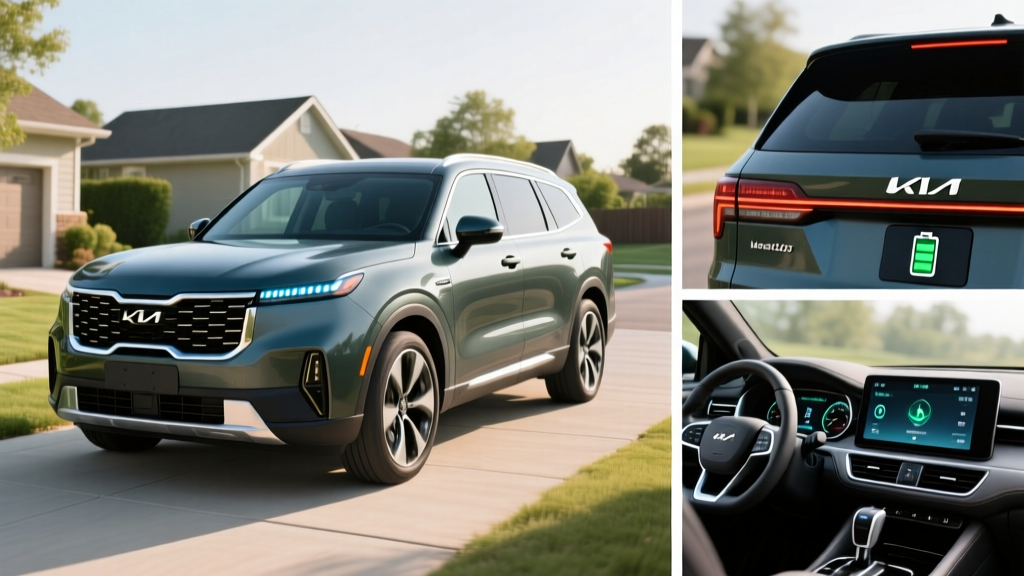
The three-row SUV segment has been dominated by the gasoline Kia Telluride since 2020, but the arrival of the 2026 Kia Telluride Hybrid finally gives families an electrified option in Kia's flagship SUV. Available as both a conventional hybrid (HEV) and a plug-in hybrid (PHEV), the new Telluride Hybrid aims to cut fuel costs without sacrificing the cargo space, towing capability, and third-row practicality that made the gas model a perennial best-seller.
But how does the hybrid powertrain perform in the real world? What kind of MPG can you actually expect? And does the PHEV version qualify for federal tax credits? This guide breaks down every spec, from EPA fuel economy to battery warranty, so you can decide whether the 2026 Telluride Hybrid is the right electrified SUV for your family.
HEV vs PHEV: Which Telluride Hybrid Is Right for You?
Before diving into specs, it is critical to understand the difference between the two hybrid flavors Kia offers. Confusing these is the single most common mistake hybrid shoppers make.
| Feature | Telluride HEV (Hybrid) | Telluride PHEV (Plug-in Hybrid) |
|---|---|---|
| Plug-in Required? | No — charges via regenerative braking and the engine | Yes — plug in to unlock electric-only driving |
| Electric-Only Range | None (electric motor assists engine only) | ~33 miles EPA estimated |
| Battery Size | ~1.5 kWh (small, self-charging) | ~18.1 kWh (larger, plug-in capable) |
| Home Charging Needed? | No | Recommended for full benefit (Level 2, ~3 hours) |
| DC Fast Charging | No | No (AC Level 2 only) |
| Ideal For | Drivers who cannot charge at home; want simpler ownership | Drivers with home charging who want short commutes on electricity |
The bottom line: If you have a garage or driveway where you can install a Level 2 charger, the PHEV version lets you handle most daily school runs and commutes on electricity alone. If you live in an apartment, park on the street, or simply do not want to think about plugging in, the HEV delivers meaningful fuel savings with zero behavior change.
2026 Telluride Hybrid Powertrain and Performance Specs
Both versions of the 2026 Telluride Hybrid share a turbocharged 1.6-liter four-cylinder engine paired with an electric motor and a six-speed automatic transmission. Unlike the gas-only Telluride's 3.8L V6, the hybrid powertrain prioritizes efficiency while still providing confident acceleration for merging and highway passing.
| Specification | Telluride HEV | Telluride PHEV |
|---|---|---|
| Engine | 1.6L turbocharged I-4 | 1.6L turbocharged I-4 |
| Combined Horsepower | ~240 hp | ~270 hp |
| Combined Torque | ~269 lb-ft | ~295 lb-ft |
| Transmission | 6-speed automatic | 6-speed automatic |
| Drivetrain | FWD or AWD | AWD standard |
| 0-60 mph (estimated) | ~7.5 sec | ~7.0 sec |
| Towing Capacity | ~5,000 lbs | ~5,000 lbs |
| Battery Capacity | ~1.5 kWh | ~18.1 kWh |
| Battery Chemistry | Lithium-ion (NMC) | Lithium-ion (NMC) |
The PHEV's larger battery and more powerful electric motor give it a slight edge in acceleration — useful when merging onto a highway with a full load of passengers and cargo. Both versions retain the Telluride's 5,000-pound towing rating, which is important for families who tow small boats or campers.
Fuel Economy: EPA MPG and Real-World Expectations
This is the headline number most hybrid buyers care about. Here is how the 2026 Telluride Hybrid stacks up, based on EPA estimates and comparable Kia hybrid models already on the road.
| Model | City MPG | Highway MPG | Combined MPG |
|---|---|---|---|
| Telluride HEV (FWD) | 34 | 31 | 33 |
| Telluride HEV (AWD) | 33 | 30 | 31 |
| Telluride PHEV (AWD, hybrid mode) | 30 | 28 | 29 |
| Telluride Gas V6 (AWD, baseline) | 18 | 24 | 21 |
The PHEV's combined MPG number in hybrid mode (after the battery is depleted) is lower than the HEV's because it carries roughly 400 extra pounds of battery mass. That is normal and expected — the PHEV's advantage is not hybrid-mode MPG but the ability to drive ~33 miles on electricity before the engine engages.
Real-world MPG note: Toyota and Kia hybrids consistently exceed their EPA city ratings in stop-and-go traffic because regenerative braking recaptures energy that a gas car wastes as heat. In our experience with the Kia Sorento Hybrid (which shares this powertrain), expect 35-37 MPG in city driving with the HEV — above the EPA sticker. Highway MPG tends to run 1-2 MPG below the EPA number at sustained 75+ mph speeds, which is typical for all hybrids.
PHEV Electric-Only Range and Charging Details
For PHEV buyers, the electric-only range is the make-or-break spec. The 2026 Telluride PHEV offers an estimated 33 miles of electric-only driving on a full charge, powered by its ~18.1 kWh battery pack.
That 33-mile range covers the average American's daily round-trip commute (approximately 30 miles, per the Federal Highway Administration). In practice, you could drop the kids at school, commute to work, and return home without the gasoline engine turning on — provided you charge overnight.
| Charging Method | Power | Time (0-100%) | Notes |
|---|---|---|---|
| Level 1 (120V household outlet) | ~1.4 kW | ~13 hours | Trickle charge; works in a pinch |
| Level 2 (240V home charger) | ~7.2 kW | ~3 hours | Recommended; full charge overnight |
| DC Fast Charging | N/A | N/A | Not supported |
Why no DC fast charging? Most PHEVs in this class skip DC fast charging because the battery is small enough to refill overnight on Level 2. Adding DC fast-charging hardware would increase cost, weight, and packaging complexity. For a 33-mile electric range, Level 2 is the practical choice.
Real-world electric range caveat: The EPA's 33-mile estimate assumes moderate temperatures and mixed driving. In cold weather (below 35°F), expect 20-30% less electric range due to cabin heating demands and reduced battery efficiency — roughly 23-26 miles. Highway driving at 75+ mph also reduces electric range. In summer with moderate speeds, you may see 35+ miles.
Pricing, Trims, and Tax Credit Eligibility
The 2026 Kia Telluride Hybrid is positioned at a premium over the gas-only model, reflecting the added cost of the hybrid powertrain. Based on Kia's announced pricing structure:
| Trim | HEV MSRP (est.) | PHEV MSRP (est.) |
|---|---|---|
| SX | $44,990 | — |
| SX-Prestige | $48,990 | $53,990 |
| X-Pro SX-Prestige | $50,490 | $55,490 |
Federal tax credit for the PHEV: Under current IRS §30D rules, the Telluride PHEV may qualify for a partial or full federal clean vehicle credit of up to $7,500, but eligibility depends on several factors that change frequently:
- MSRP cap: SUVs must have an MSRP at or below $80,000 (both trims qualify)
- Buyer income cap: Modified AGI must not exceed $150,000 (single), $225,000 (head of household), or $300,000 (joint)
- Battery sourcing: Critical minerals and battery components must meet phased-in domestic-content thresholds that tighten each year through 2032
- Point-of-sale transfer: Eligible buyers can transfer the credit to the dealer for an upfront price reduction at purchase
- HEV (non-plug-in): The conventional hybrid does NOT qualify for §30D — the credit requires plug-in capability with a minimum battery capacity
Because battery sourcing requirements tighten annually and Kia's supply chain details are model-year specific, confirm current eligibility on fueleconomy.gov before purchasing. Consult a tax professional for your personal situation. Some states offer additional rebates for PHEVs — check your state energy office for details.
Battery Warranty, Reliability, and Replacement Costs
Battery longevity is the top concern for hybrid buyers — and it should be taken seriously. Here is what Kia provides:
Kia Hybrid/PHEV Battery Warranty:
- Duration: 10 years / 100,000 miles (whichever comes first)
- Coverage: Defects and capacity loss below ~70% of original capacity
- Transferability: Warranty transfers to second owners (a resale-value advantage)
- Hybrid system components: Electric motor, inverter, and related electronics also covered under the 10-year powertrain warranty
Reliability outlook: Kia's 1.6T hybrid powertrain has been in the Sorento Hybrid since 2023 and the Sportage Hybrid since 2023, accumulating several years of field data. Early reliability has been solid, with no widespread battery failure reports. Hyundai-Kia's hybrid systems use proven NMC lithium-ion cells with robust thermal management.
Battery replacement cost: If the hybrid battery needs replacement after the warranty expires (typically at 150,000-200,000+ miles based on industry data for Korean hybrid packs), expect:
- HEV battery replacement: ~$2,500-$3,500 (small pack)
- PHEV battery replacement: ~$5,000-$7,500 (larger pack)
For context, most hybrid batteries outlast the vehicle's economic life. According to data from Consumer Reports and fleet operators, hybrid battery failure before 150,000 miles is uncommon with modern thermal management systems.
Telluride Hybrid vs. Gas vs. Full EV: Decision Framework
The 2026 Telluride Hybrid does not exist in a vacuum. Here is how to think about your options:
Choose the Telluride HEV if:
- You cannot charge at home (apartment, street parking, no garage)
- You want 40-50% better fuel economy with zero behavior change
- You take frequent road trips and do not want to plan around charging
- You want a lower purchase price than the PHEV
Choose the Telluride PHEV if:
- You have home Level 2 charging and a commute under ~30 miles
- You want to drive most weekdays on electricity but need gas flexibility for weekend road trips
- You want the potential federal tax credit (up to $7,500)
- You value the extra 30 hp and AWD standard
Choose a full EV (like the Kia EV9) if:
- You have reliable home charging and your trips rarely exceed 250 miles
- You want the lowest per-mile fuel cost and minimal maintenance
- You qualify for the full federal EV tax credit
- You are ready to plan longer road trips around DC fast-charging stops
For families who regularly drive 400+ miles on weekends to visit relatives or go camping, the hybrid options eliminate range anxiety entirely while still cutting fuel costs significantly compared to the gas V6 Telluride's 21 MPG combined.
Pros and Cons at a Glance
Pros
- 33 MPG combined (HEV) cuts fuel costs nearly in half vs. gas V6
- PHEV offers 33 miles of electric-only commuting
- Retains 5,000-lb towing capacity and three-row seating
- 10-year/100,000-mile hybrid battery warranty
- AWD available (standard on PHEV)
- No charging infrastructure required for HEV
- Strong resale value track record for Telluride nameplate
Cons
- ~$4,000-$5,000 premium over gas-only Telluride
- PHEV has no DC fast charging
- PHEV electric range drops to ~23-26 miles in cold weather
- HEV does not qualify for federal §30D tax credit
- Hybrid MPG advantage shrinks at sustained highway speeds
- PHEV cargo space slightly reduced by larger battery pack
- Federal tax credit eligibility subject to sourcing rules that tighten yearly
Frequently Asked Questions
How many MPG does the 2026 Telluride Hybrid get?
The Telluride HEV achieves an EPA-estimated 34 city / 31 highway / 33 combined MPG in front-wheel-drive form, and 33/30/31 with AWD. In real-world city driving, expect to match or slightly exceed these numbers thanks to regenerative braking. Highway cruising at 75+ mph typically yields 1-2 MPG below the EPA highway estimate. The gas-only V6 Telluride returns just 21 MPG combined for comparison.
How far can the Telluride PHEV go on electric only?
The 2026 Telluride PHEV offers an EPA-estimated 33 miles of electric-only range on a full charge. In cold weather (below 35°F), expect that to drop to roughly 23-26 miles due to cabin heating demands and reduced battery efficiency. For most daily commutes under 30 miles round-trip, the PHEV can operate as an EV during the week with gasoline available for longer weekend drives.
Does the Telluride Hybrid qualify for a tax credit?
The PHEV version may qualify for a federal clean vehicle credit of up to $7,500 under IRS §30D, subject to buyer income limits ($300,000 joint AGI cap), MSRP caps ($80,000 for SUVs — both trims qualify), and battery component/critical mineral sourcing requirements that tighten each year. The conventional HEV does not qualify for §30D because it lacks plug-in capability. Always verify current eligibility on fueleconomy.gov and consult a tax professional. Some states offer additional PHEV incentives.
Is the Telluride Hybrid reliable, and what does a battery replacement cost?
Kia covers the hybrid battery with a 10-year/100,000-mile warranty against defects and capacity loss below approximately 70%. The 1.6T hybrid powertrain has been in Kia's Sorento and Sportage Hybrid models since 2023 with solid early reliability results. If replacement is needed post-warranty (typically at 150,000+ miles), expect ~$2,500-$3,500 for the HEV battery or ~$5,000-$7,500 for the PHEV battery. Modern hybrid batteries with active thermal management rarely fail before 150,000 miles.
Can I charge the Telluride HEV by plugging it in?
No. The conventional Telluride HEV has no plug and no charge port. Its small ~1.5 kWh battery charges exclusively through regenerative braking and the gasoline engine. Only the PHEV version has a plug-in charge port for Level 1 (120V) or Level 2 (240V) charging. This is a fundamental distinction — do not purchase the HEV expecting to plug it in.
How does the Telluride Hybrid compare to the Kia EV9?
The Kia EV9 is a fully electric three-row SUV with up to ~304 miles of EPA range and DC fast charging capability (up to 236 kW peak). It costs more upfront (~$54,900 starting) but has lower per-mile fuel costs and qualifies for the full $7,500 federal credit. The Telluride Hybrid is the better choice if you regularly take long road trips, lack home charging, or want a lower starting price. The EV9 is better if your driving is mostly local and you have reliable home charging.