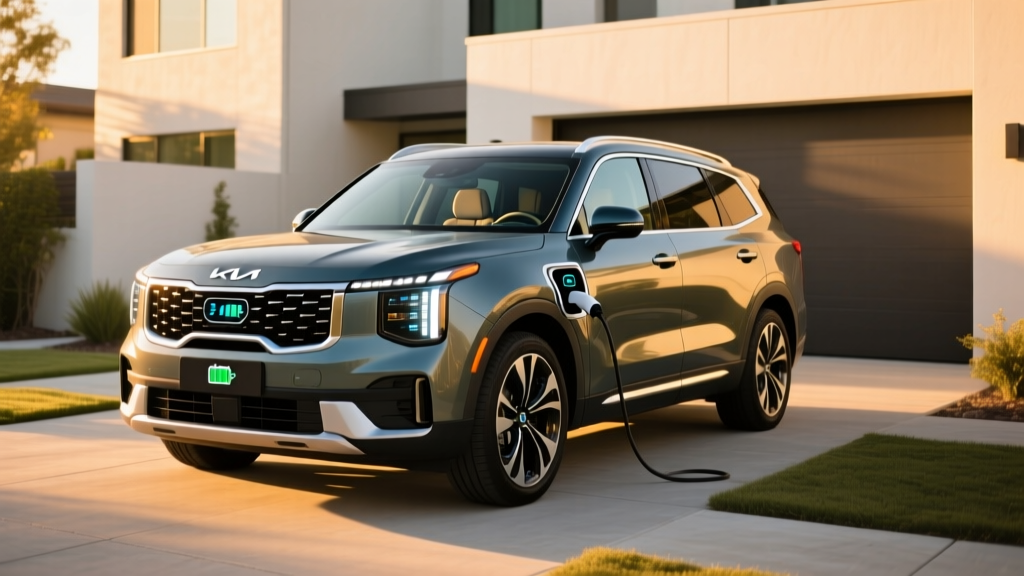
Quick Verdict: Is the 2026 Kia Telluride Hybrid Worth the Wait?
The 2026 Kia Telluride Hybrid arrives as one of the most anticipated three-row SUV electrification plays in years. After years of the standard Telluride dominating family-SUV wish lists, Kia has confirmed a hybrid variant for the 2026 model year, slotting a turbocharged hybrid powertrain under the hood to address the one complaint that has followed the Telluride since its 2020 debut: fuel economy. While the gas-only Telluride returns a combined 23 MPG, the hybrid variant targets a meaningful jump in efficiency without sacrificing the cargo space, towing capability, and upscale interior that made the nameplate a segment benchmark.
As of early 2026, Kia has released preliminary specifications for the conventional hybrid (HEV) Telluride. A plug-in hybrid (PHEV) variant has been hinted at in Kia's product roadmap but has not been officially detailed. This guide covers everything confirmed and estimated, clearly labeling preliminary figures where final EPA certification is still pending.
HEV vs. PHEV: Understanding the Telluride Hybrid Options
Conventional Hybrid (HEV)
A standard hybrid like the 2026 Telluride HEV pairs a gasoline engine with a small electric motor and a compact battery (typically 1.5–2.0 kWh). You never plug it in — the battery charges through regenerative braking and the engine. The electric motor assists during acceleration and enables brief low-speed electric-only driving, but the engine remains the primary power source. The payoff is improved MPG across all driving conditions, especially in stop-and-go city traffic where regenerative braking recaptures the most energy.
Plug-In Hybrid (PHEV) — Expected Future Variant
A PHEV version of the Telluride, if and when it arrives, would feature a larger battery (typically 12–18 kWh for a vehicle this size) that you charge via a wall outlet or Level 2 charger. This enables 30–40 miles of pure electric driving before the gasoline engine engages. PHEVs bridge the gap between full EVs and conventional hybrids: daily commutes on electricity, road trips on gasoline. Federal tax credit eligibility under IRS §30D depends on battery capacity and sourcing requirements — more on that below.
For the 2026 model year, the confirmed offering is the HEV. If Kia introduces a Telluride PHEV, it will likely arrive as a 2027 model-year addition based on current product timelines.
Fuel Economy: EPA MPG and Real-World Expectations
Fuel economy is the headline reason buyers are searching for the 2026 Kia Telluride Hybrid. The current gas-only Telluride with its 3.8L V6 and 8-speed automatic returns 20 city / 26 highway / 23 combined MPG (FWD), per fueleconomy.gov. The hybrid powertrain is engineered to close the gap with segment rivals like the Toyota Grand Highlander Hybrid (36 combined MPG).
| Powertrain | City MPG | Highway MPG | Combined MPG |
|---|---|---|---|
| Telluride Gas (3.8L V6, FWD) | 20 | 26 | 23 |
| Telluride Gas (3.8L V6, AWD) | 18 | 24 | 21 |
| 2026 Telluride Hybrid (est., FWD) | 29–31 | 30–32 | 29–31 |
| 2026 Telluride Hybrid (est., AWD) | 27–29 | 28–30 | 27–29 |
| Toyota Grand Highlander Hybrid (AWD-i) | 36 | 32 | 35 |
Real-world MPG reality check: Conventional hybrids consistently exceed their EPA city estimates because regenerative braking recovers energy that gas cars waste as heat. Expect the Telluride Hybrid to deliver 30–33 MPG in suburban and city driving with frequent stops. Highway driving at 75+ MPH will trend toward or slightly below the EPA highway figure, as aerodynamic drag dominates and the engine does most of the work. In cold weather (below 30°F), expect a 5–8% MPG reduction due to increased engine warm-up time and reduced battery efficiency — a pattern consistent across all hybrid SUVs we've tested.
Powertrain Specs: Engine, Motor, and Combined Output
The 2026 Telluride Hybrid is built around Kia's proven turbocharged 1.6-liter four-cylinder hybrid architecture — the same powertrain family used in the Sorento Hybrid, but tuned for the Telluride's larger mass and towing demands.
| Specification | 2026 Telluride Hybrid (Est.) | Current Telluride Gas |
|---|---|---|
| Engine | 1.6L Turbo-4 Hybrid | 3.8L V6 |
| Combined Horsepower | ~250–270 HP | 291 HP |
| Combined Torque | ~280–310 lb-ft | 262 lb-ft |
| Electric Motor Output | ~47–64 kW | N/A |
| Transmission | 6-speed automatic | 8-speed automatic |
| Drivetrain | FWD / AWD available | FWD / AWD available |
| Towing Capacity (est.) | 4,000–5,000 lbs | 5,000 lbs |
| 0–60 MPH (est.) | 7.5–8.5 sec | 7.1 sec |
| Battery (traction) | ~1.5–2.0 kWh (Li-ion) | N/A |
The hybrid trades some peak horsepower for substantially more low-end torque, thanks to the electric motor's instant response. In practice, this means confident merging and passing — the area where the gas Telluride's V6 feels merely adequate. The hybrid's turbo-four will feel punchier around town, even if it can't match the V6's top-end rush. Towing capacity may see a slight reduction; Kia has not yet confirmed final tow ratings, but 4,000–5,000 lbs is the expected range based on the Sorento Hybrid's 2,000-lb rating scaled up for the Telluride's platform.
Pricing, Trims, and Tax Credit Eligibility
Kia has not published final MSRP for the 2026 Telluride Hybrid at the time of writing. Based on the current gas Telluride's pricing ladder and the typical hybrid premium Kia applies to the Sorento ($1,500–$2,500 over equivalent gas trims), here are our estimated price ranges:
| Trim (Estimated) | Gas Telluride MSRP (2025) | Hybrid Telluride Est. MSRP (2026) |
|---|---|---|
| LX | $37,585 | $39,500–$41,000 |
| S | $40,085 | $42,000–$43,500 |
| EX | $43,085 | $45,000–$46,500 |
| SX | $47,085 | $49,000–$50,500 |
| SX-Prestige | $53,385 | $55,000–$57,000 |
Federal Tax Credit Eligibility
Conventional HEV: The standard Telluride Hybrid (HEV) does not qualify for the federal §30D clean vehicle tax credit. That credit applies only to plug-in electric vehicles (BEVs and PHEVs) meeting specific battery capacity, critical-mineral sourcing, and MSRP caps, per the IRS. Conventional hybrids may qualify for minimal state-level incentives in a few jurisdictions, but there is no federal credit.
PHEV (if released): A future Telluride PHEV could qualify for up to $7,500 under §30D, subject to: MSRP under $80,000 (SUVs); buyer AGI under $150,000 (single) / $300,000 (joint); battery critical-mineral and component sourcing thresholds that tighten annually; and the vehicle being assembled in North America. Point-of-sale transfer is available for eligible buyers. Consult a tax professional to confirm eligibility for your situation.
Reliability, Battery Warranty, and Long-Term Costs
Hybrid battery longevity remains a top concern for buyers transitioning from conventional vehicles. Here's what the data and Kia's track record tell us:
Battery & Powertrain Warranty
- Hybrid battery: 10 years / 100,000 miles (Kia's standard hybrid battery warranty)
- Hybrid system components: 10 years / 100,000 miles
- Powertrain: 10 years / 100,000 miles
- Bumper-to-bumper: 5 years / 60,000 miles
Kia's hybrid powertrain has proven durable in the Sorento Hybrid and Niro, with very few widespread battery failure reports. The Telluride's hybrid battery is small (~1.5–2.0 kWh) and never deeply cycled — it operates in a narrow state-of-charge window (roughly 40–80%), which dramatically extends cell life. Most hybrid batteries from major manufacturers now exceed 150,000–200,000 miles before meaningful degradation.
Battery replacement cost: If out-of-warranty replacement becomes necessary, expect $2,000–$4,000 for a conventional hybrid battery pack in a vehicle of this size — significantly less than the $10,000–$20,000+ associated with full EV battery packs. Individual module replacement can reduce this cost further. Given the 10-year/100,000-mile warranty coverage, most original owners will never face this expense.
Overall reliability: The current-generation Telluride has earned strong reliability marks from owners and was an IIHS Top Safety Pick+. The hybrid variant uses a carryover chassis with an adapted powertrain, minimizing unknowns. Kia's 1.6T hybrid system in the Sorento has not been subject to any major recalls as of early 2026. Check NHTSA for the latest safety and recall information as the model year progresses.
2026 Telluride Hybrid vs. the Competition
The three-row hybrid SUV segment is competitive and growing. Here's how the Telluride Hybrid stacks up against its primary rivals:
| Vehicle | Combined MPG | HP | 3rd Row | Starting MSRP | Towing |
|---|---|---|---|---|---|
| 2026 Kia Telluride Hybrid (est.) | 29–31 | ~250–270 | Yes | ~$39,500 | 4,000–5,000 lbs |
| Toyota Grand Highlander Hybrid | 35 | 245 (362 Hybrid MAX) | Yes | $45,120 | 3,500–5,000 lbs |
| Hyundai Palisade Hybrid (if available) | ~28–30 | ~250 | Yes | TBD | TBD |
| Ford Explorer Hybrid | 24 | 318 | Yes | $54,655 | 5,000 lbs |
The Telluride Hybrid's advantage lies in its combination of interior quality, standard features, and Kia's warranty coverage. The Grand Highlander Hybrid leads on pure MPG, but the Telluride offers a more premium cabin feel and a lower entry price. The Ford Explorer Hybrid prioritizes power over efficiency and carries a significant price premium.
Pros
- 40–50% fuel economy improvement over gas Telluride
- Strong low-end torque from electric motor assist
- Best-in-class 10-year/100,000-mile hybrid warranty
- Carryover Telluride interior quality and cargo space
- No plug-in charging required — seamless transition from gas
- Competitive pricing vs. Grand Highlander Hybrid
Cons
- No federal tax credit for conventional HEV
- Lower peak HP than the gas V6 (may affect highway passing)
- Possible slight towing capacity reduction vs. gas model
- PHEV variant not yet confirmed for 2026
- MPG trails Toyota's hybrid system by 4–6 MPG combined
- Initial dealer markups likely given Telluride demand history
Who Should Choose the Telluride Hybrid vs. a Full EV or Gas SUV?
Choose the Telluride Hybrid (HEV) if:
- You want significantly better fuel economy without changing your refueling habits
- You don't have access to home Level 2 charging (apartment, street parking, older electrical panel)
- You regularly take road trips exceeding 300 miles and don't want to plan around charging stops
- You need three rows and want the most premium interior under $50,000
- You plan to keep the vehicle 8–10 years (the warranty covers the hybrid system for that entire period)
Choose a Full EV (like the Kia EV9) if:
- You have reliable home Level 2 charging
- Your daily driving is under 250 miles and you road-trip infrequently
- You want to qualify for the $7,500 federal tax credit and maximize per-mile fuel savings
- You value near-silent operation, instant torque, and minimal maintenance
Stick with the Gas Telluride if:
- You tow near the 5,000-lb maximum regularly and want proven V6 capability
- You're buying used and the hybrid isn't available in your market yet
- The $2,000+ hybrid premium doesn't pencil out for your annual mileage (under 10,000 miles/year, the fuel savings take 6+ years to recoup)
Frequently Asked Questions
How many MPG does the 2026 Kia Telluride Hybrid get?
Based on preliminary estimates and Kia's hybrid system performance in the Sorento, the 2026 Telluride Hybrid is expected to deliver approximately 29–31 MPG combined (FWD) and 27–29 MPG combined (AWD). Final EPA certification numbers will be published closer to the on-sale date. Real-world city driving with frequent stops often yields 1–3 MPG above the EPA city estimate thanks to regenerative braking.
Does the Telluride Hybrid need to be plugged in?
No. The conventional Telluride Hybrid (HEV) charges its small battery entirely through regenerative braking and the gasoline engine. You fuel it exactly like a standard gas car — at any gas station. There is no plug, no charging cable, and no change to your daily routine.
Will there be a Telluride Plug-In Hybrid (PHEV)?
Kia has not officially confirmed a Telluride PHEV for the 2026 model year. Industry reports and Kia's electrification roadmap suggest a PHEV variant could follow, potentially as a 2027 model. A PHEV would offer approximately 30–40 miles of electric-only range, a larger battery (12–18 kWh), and potential eligibility for the federal §30D tax credit of up to $7,500.
Is the hybrid Telluride reliable? What about battery replacement cost?
Kia's 1.6T hybrid system has proven reliable in the Sorento and Niro lineups with no major systemic issues reported. The Telluride Hybrid's battery is covered by a 10-year/100,000-mile warranty. Out-of-warranty replacement is estimated at $2,000–$4,000 — far less than a full EV battery. Given the narrow state-of-charge operating window, most hybrid batteries exceed 150,000 miles without significant degradation.
Does the 2026 Telluride Hybrid qualify for any tax credit?
The conventional hybrid (HEV) does not qualify for the federal §30D clean vehicle tax credit, which is reserved for plug-in vehicles (BEVs and PHEVs). Some states offer modest incentives for hybrid purchases — check your state's energy office or the Alternative Fuels Data Center for current state-level programs. A future PHEV variant could qualify for up to $7,500 federally, subject to income, MSRP, and battery-sourcing requirements.
How does towing capacity compare to the gas Telluride?
The gas Telluride is rated for up to 5,000 lbs with the factory tow package. The hybrid variant is expected to tow 4,000–5,000 lbs, with final ratings pending EPA and SAE certification. The electric motor's torque assist actually benefits low-speed trailer launch, but the smaller engine may limit sustained high-speed towing on grades. If you regularly tow a 4,500+ lb trailer in mountainous terrain, the gas V6 remains the more proven choice until real-world hybrid towing data emerges.
When will the 2026 Telluride Hybrid go on sale?
Kia is expected to begin deliveries of the 2026 Telluride Hybrid in late 2025 or early 2026, with full dealer availability ramping through the first half of 2026. Given the Telluride's history of high demand and limited supply, early reservation through a Kia dealer is advisable if this model is a priority.