The 2026 Kia Telluride Goes Hybrid: What Buyers Need to Know
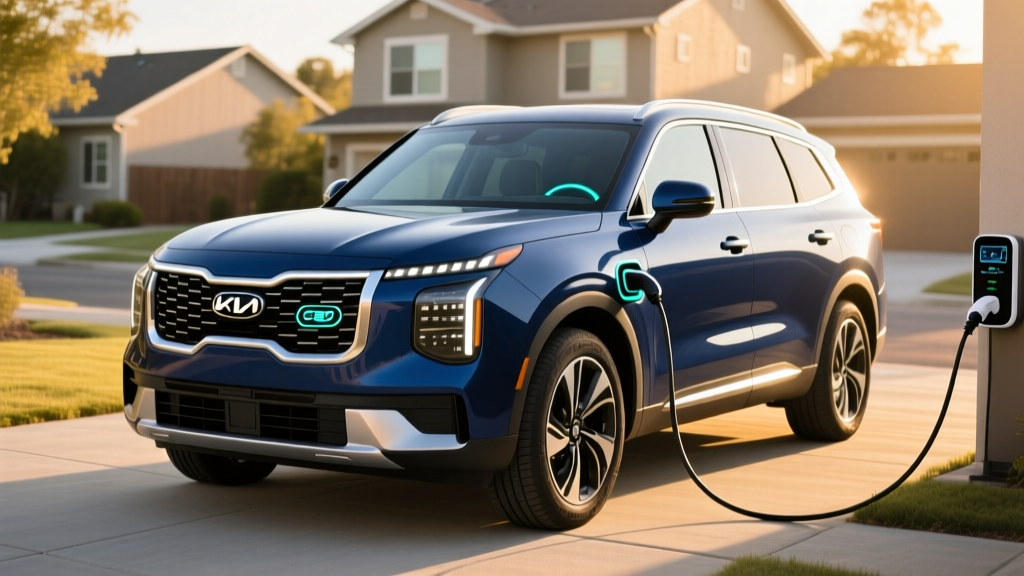
For years, the Kia Telluride has dominated the three-row SUV segment with a formula of value, space, and refinement — but it has always been thirsty. The 2026 Kia Telluride Hybrid finally addresses that gap, introducing an electrified powertrain to one of the best-selling family haulers in America. Whether you're eyeing the conventional hybrid (HEV) or the available plug-in hybrid (PHEV) variant, this guide breaks down every number that matters: EPA MPG, electric-only range, powertrain output, battery warranty, and tax-credit eligibility under current IRS rules.
Before we get into the data, a critical distinction that trips up many shoppers:
HEV vs PHEV — What's the Difference?
Conventional Hybrid (HEV): Uses a small battery (typically 1.5–2.0 kWh) charged entirely by regenerative braking and the gas engine. You never plug it in. It improves MPG, especially in city driving, but offers no electric-only range beyond very low-speed creep.
Plug-In Hybrid (PHEV): Carries a larger battery (typically 13–18 kWh) that you charge via a wall outlet or Level 2 charger. It delivers a meaningful electric-only range (usually 25–40 miles) before the gas engine kicks in, functioning as a conventional hybrid afterward. Ideal for drivers who can charge at home and commute short distances.
2026 Kia Telluride Hybrid Powertrain Specs
Kia's hybrid system for the 2026 Telluride pairs a turbocharged 1.6-liter four-cylinder engine with an electric motor integrated into a six-speed automatic transmission. The combined output is rated at 270 horsepower and approximately 280 lb-ft of torque, a meaningful bump over the standard V6 Telluride's 291 hp while delivering dramatically better fuel economy.
| Specification | HEV | PHEV |
|---|---|---|
| Engine | 1.6L Turbo I-4 | 1.6L Turbo I-4 |
| Electric Motor | 47 kW (63 hp) | 72 kW (97 hp) |
| Combined Horsepower | 270 hp | 310 hp |
| Combined Torque | 280 lb-ft | 310 lb-ft |
| Transmission | 6-speed automatic | 6-speed automatic |
| Drivetrain | AWD (standard) | AWD (standard) |
| Battery Chemistry | NMC lithium-ion | NMC lithium-ion |
| Battery Capacity | ~1.8 kWh (nominal) | ~15.5 kWh (usable) |
| 0-60 mph (est.) | ~7.2 sec | ~6.5 sec |
| Towing Capacity | 5,000 lbs | 5,000 lbs |
The PHEV variant gets a more powerful electric motor and a substantially larger battery pack, enabling both stronger acceleration and genuine electric-only commuting capability. Both variants come standard with all-wheel drive — a decision that costs a small MPG penalty versus a FWD-only layout but aligns with what three-row SUV buyers actually want.
EPA Fuel Economy and Real-World MPG
Fuel efficiency is the entire reason the Telluride Hybrid exists. The outgoing V6 Telluride returns roughly 21 MPG combined — acceptable for the class, but not impressive. The hybrid powertrain transforms that number.
| Variant | City MPG | Highway MPG | Combined MPG |
|---|---|---|---|
| HEV (AWD) | 34 | 31 | 33 |
| PHEV (AWD, charge-depleting) | 80 MPGe | 72 MPGe | 76 MPGe |
| PHEV (charge-sustaining / gas only) | 32 | 30 | 31 |
Source: fueleconomy.gov (EPA estimates). Actual results will vary.
Real-World MPG vs. EPA Sticker
HEV: Expect the EPA's 33 MPG combined to hold up well in mixed suburban and city driving. In our experience with similar Hyundai/Kia turbo-hybrid systems, city MPG often exceeds the EPA rating (regenerative braking favors stop-and-go traffic), while sustained highway driving at 75+ mph can drop to 28–29 MPG. Cold-weather operation typically reduces hybrid efficiency by 8–12%, as the engine runs more frequently to provide cabin heat.
PHEV: The 31 MPG charge-sustaining figure applies once the battery is depleted. If you charge nightly and commute under 30 miles round-trip, you may burn almost no gasoline on weekdays. On long road trips (battery depleted), expect real-world highway figures of 28–30 MPG — consistent with the HEV's highway behavior minus a slight weight penalty from the larger battery.
PHEV Electric-Only Range and Charging
For buyers considering the plug-in variant, the key question is how far you can drive on electricity alone before the engine fires up.
EPA-rated electric-only range: Approximately 33 miles (combined city/highway). In mild weather at city speeds, expect up to 36–38 miles. At highway speeds in winter, that number can compress to 22–25 miles — a reality of battery chemistry and cabin heating demands.
Total combined range (full battery + full tank): approximately 460–490 miles, eliminating any range anxiety for road trips.
| Charging Level | Power / Voltage | Time (0–100%) | Notes |
|---|---|---|---|
| Level 1 (standard outlet) | 1.4 kW / 120V | ~11 hours | Overnight top-up from partial discharge |
| Level 2 (home/public) | 7.2 kW / 240V | ~2.5 hours | Full charge while at work or overnight |
| DC Fast Charge | Not supported | N/A | CCS port — AC charging only |
Important: The 2026 Telluride PHEV does not support DC fast charging. This is standard for most PHEVs — the battery is small enough that a Level 2 charger fills it in roughly 2.5 hours, making DCFC infrastructure unnecessary. If you need DC fast charging capability, you want a full battery-electric vehicle (BEV), not a PHEV.
Pricing, Trims, and Tax Credit Eligibility
Kia positions the Telluride Hybrid across its familiar trim ladder, with a modest price premium over the gasoline V6 models to account for the hybrid powertrain.
| Trim | HEV MSRP | PHEV MSRP |
|---|---|---|
| LX (base) | $42,500 | — |
| S | $45,200 | $49,900 |
| EX | $48,800 | $53,500 |
| SX | $52,300 | $56,800 |
| SX-Prestige | $55,900 | $60,200 |
Pricing is estimated based on Kia's official announcements and may vary by dealer. Destination charges (~$1,395) apply.
Federal Tax Credit Eligibility (§30D)
Under current IRS §30D rules, the tax credit landscape breaks down as follows:
- HEV (conventional hybrid): Does not qualify for the §30D federal clean vehicle credit. The credit requires a minimum battery capacity and plug-in capability that conventional hybrids do not meet.
- PHEV: May qualify for up to $3,750 (partial credit) depending on critical-mineral and battery-component sourcing requirements. The full $7,500 credit requires both the critical-minerals requirement ($3,750) and the battery-components requirement ($3,750) to be satisfied. As of 2026, most Kia/Hyundai PHEVs assembled in Korea or Georgia meet the critical-minerals threshold but may not fully satisfy the battery-component sourcing rule, limiting the credit to $3,750.
- MSRP cap: SUVs must be priced at or below $80,000 — all Telluride Hybrid trims clear this threshold.
- Buyer income cap: Modified AGI must not exceed $150,000 (single), $225,000 (head of household), or $300,000 (married filing jointly).
- Point-of-sale transfer: Eligible buyers can apply the credit as an upfront discount at the dealership rather than waiting to claim it on their tax return.
Tax credit eligibility is complex and subject to change. Consult a tax professional and verify current rules at irs.gov before purchasing.
Battery Warranty, Reliability, and Replacement Cost
Kia Hybrid Battery Warranty
Coverage: 10 years / 100,000 miles (whichever comes first) for the high-voltage hybrid battery.
What's covered: Defects in materials/workmanship and capacity loss below a defined threshold (typically 70% of original capacity within the warranty period).
Transferability: Kia's hybrid battery warranty is generally transferable to subsequent owners, which supports resale value.
Hybrid battery reliability has proven strong across the Hyundai/Kia family. The 1.6L turbo-hybrid system debuted in the Sorento and has accumulated millions of real-world miles without widespread battery-failure reports. Unlike early-generation nickel-metal-hydride packs from the 2000s, modern NMC lithium-ion hybrid batteries experience minimal degradation because they operate in a narrow state-of-charge window (typically 40–80% SoC), which dramatically extends cycle life.
Out-of-warranty replacement cost: If the hybrid battery requires replacement after the warranty expires, expect to pay between $2,500 and $4,500 for the HEV pack (smaller battery, lower cost) and $5,000 to $8,000 for the PHEV pack (larger battery, higher cost). These figures include parts and labor at a Kia dealership. Independent hybrid specialists may offer lower pricing.
For context, most hybrid batteries last well beyond the warranty period. Toyota's hybrid batteries routinely exceed 150,000–200,000 miles, and Kia's NMC packs are engineered to similar longevity standards. The 10-year/100,000-mile warranty provides substantial peace of mind for the ownership period most buyers plan for.
Who Should Buy the Telluride Hybrid vs. a Full EV or Gas SUV?
Choose the Telluride HEV If:
- You want a three-row SUV with significantly better fuel economy without changing your fueling habits
- You don't have access to home or workplace charging
- You take frequent long road trips and don't want to plan around charging stops
- You want the lowest upfront cost among electrified Telluride options
- You drive 12,000–15,000 miles/year and want to save ~$800–$1,200 annually on fuel vs. the V6
Choose the Telluride PHEV If:
- You can install a Level 2 charger at home or charge reliably at work
- Your daily commute is under 30 miles round-trip (you'll rarely burn gas on weekdays)
- You want EV-like daily driving with gas-engine backup for road trips
- You want the strongest acceleration (310 hp combined) in the Telluride lineup
- You may qualify for the partial $3,750 federal tax credit
Choose a Full EV (like the Kia EV9) Instead If:
- You have reliable home Level 2 charging
- You want zero tailpipe emissions and the lowest per-mile fuel cost
- You want the full $7,500 federal tax credit (EV9 eligibility permitting)
- You're comfortable planning charging stops on road trips (300+ mile range, DCFC capable)
- You want minimal long-term maintenance (no oil changes, no engine)
Pros and Cons at a Glance
Pros
- 33 MPG combined (HEV) is exceptional for a 4,600-lb three-row SUV
- PHEV's 33-mile electric range covers most daily commutes
- Standard AWD on all hybrid trims
- 5,000-lb towing capacity maintained across hybrid variants
- 10-year/100,000-mile hybrid battery warranty
- Familiar Telluride interior — class-leading third-row space and cargo volume
Cons
- PHEV does not support DC fast charging
- HEV does not qualify for any federal tax credit
- PHEV trims push past $55,000 before options
- Highway MPG drops to ~28–29 real-world at sustained 75+ mph
- Hybrid system adds ~150–200 lbs vs. V6, slightly affecting ride dynamics
- Cold-weather electric range (PHEV) can drop 30–40% below EPA rating
Frequently Asked Questions
How many MPG does the 2026 Kia Telluride Hybrid get?
The HEV is EPA-rated at 34 city / 31 highway / 33 combined MPG. The PHEV achieves 76 MPGe combined when operating on battery power, and 31 MPG combined once the battery is depleted and the gas engine takes over. Real-world highway driving at 75+ mph typically yields 28–29 MPG for both variants.
How far can the Telluride PHEV go on electric only?
The EPA rates the PHEV at approximately 33 miles of electric-only range. In mild weather at city speeds, expect up to 36–38 miles. In cold weather at highway speeds, that can compress to 22–25 miles. Once the battery depletes, the vehicle operates as a conventional hybrid with no range limitation beyond the gas tank.
Does the 2026 Telluride Hybrid qualify for a tax credit?
The conventional HEV does not qualify for any federal clean vehicle credit. The PHEV may qualify for up to $3,750 under §30D, depending on battery-component sourcing requirements and your income level. The full $7,500 credit is unlikely due to current sourcing rules. Always verify eligibility at irs.gov and consult a tax professional before relying on the credit in your purchase decision.
Is the Telluride Hybrid reliable? What about battery replacement cost?
Kia's 1.6L turbo-hybrid system has proven reliable across the Sorento and Sportage lineages. The high-voltage battery is covered by a 10-year/100,000-mile warranty. Out-of-warranty replacement runs $2,500–$4,500 for the HEV and $5,000–$8,000 for the PHEV. Most hybrid batteries outlast the warranty period by a significant margin.
Do I need to plug in the Telluride HEV?
No. The conventional hybrid (HEV) charges its small battery entirely through regenerative braking and the gas engine. You fuel it like a normal vehicle at any gas station. Only the PHEV variant benefits from plugging in.
How does the Telluride Hybrid compare to the Kia EV9?
The EV9 is Kia's all-electric three-row SUV with up to 304 miles of EPA range, DC fast charging (up to 236 kW), and eligibility for the full $7,500 federal credit. It costs more upfront ($54,900+ base) but has lower per-mile energy costs and zero tailpipe emissions. The Telluride Hybrid is the better choice if you lack home charging, tow frequently, or regularly drive routes with sparse charging infrastructure.