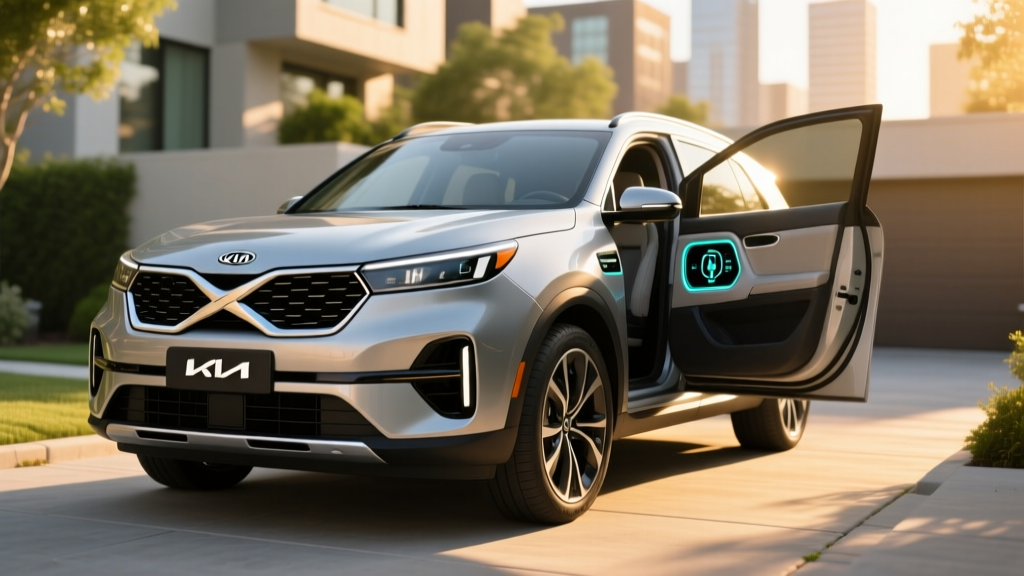
If you want the lifted, rugged styling of Kia's X-Line trim but aren't ready to commit to a full battery-electric vehicle, the 2026 Kia Sportage X-Line Hybrid threads a practical needle. It pairs a turbocharged 1.6-liter engine with an electric motor for 232 combined horsepower, standard all-wheel drive, and an EPA-estimated 43 MPG combined — numbers that make it one of the most efficient compact SUVs on the market. But spec sheets only tell part of the story. Below, we break down real-world fuel economy expectations, the hybrid powertrain's behavior, warranty coverage, and how the X-Line Hybrid stacks up against the Sportage Plug-In Hybrid and competing full EVs.
2026 Kia Sportage X-Line Hybrid: Key Specifications
| Spec | Value |
|---|---|
| Powertrain | 1.6L Turbo 4-cyl + electric motor (HEV) |
| Combined Horsepower | 232 hp / 258 lb-ft torque |
| Transmission | 6-speed automatic |
| Drivetrain | AWD (standard on X-Line Hybrid) |
| EPA Fuel Economy | 43 city / 42 highway / 43 combined MPG |
| Fuel Tank | 13.7 gallons |
| Total Driving Range | ~589 miles (EPA est.) |
| 0-60 mph | ~7.4 seconds (est.) |
| Cargo Volume | 39.6 cu ft (rear seats up) |
| Towing Capacity | 2,000 lbs |
| Starting MSRP | $33,590 (X-Line Hybrid, incl. destination) |
| Hybrid Battery Warranty | 10 years / 100,000 miles |
| Federal Tax Credit (§30D) | Not eligible (HEV) |
HEV vs PHEV: Which Sportage Hybrid Is Right for You?
Kia offers the Sportage in two electrified flavors for 2026, and confusing them is easy — so let's make the distinction explicit.
| Feature | Sportage Hybrid (HEV) | Sportage Plug-In Hybrid (PHEV) |
|---|---|---|
| Plug-in Charging Required? | No — self-charging via regen and engine | Yes — plug in to access electric-only range |
| Battery Capacity | ~1.49 kWh (small buffer) | 13.8 kWh (usable) |
| Electric-Only Range | N/A (motor assists engine) | 34 miles (EPA est.) |
| Combined Horsepower | 232 hp | 261 hp |
| EPA Combined | 43 MPG | 84 MPGe (elec+gas) / 38 MPG (gas only) |
| Federal Tax Credit | None | Not eligible for §30D (PHEV battery <16 kWh capacity threshold for full credit under current sourcing rules) |
| Starting MSRP | $33,590 (X-Line) | $39,590 (X-Line PHEV) |
The bottom line: The conventional HEV is simpler and cheaper — you never plug it in, and it delivers strong MPG automatically. The PHEV rewards owners who can charge at home daily with ~34 miles of electric-only commuting, but it costs $6,000 more upfront and adds weight.
Fuel Economy: EPA Estimates vs Real-World MPG
| Driving Condition | EPA Estimate | Real-World Expectation |
|---|---|---|
| City | 43 MPG | 44-48 MPG (hybrids often exceed EPA in stop-and-go) |
| Highway (70 mph) | 42 MPG | 36-40 MPG (aero drag and sustained speeds reduce hybrid advantage) |
| Combined | 43 MPG | 39-44 MPG (depends on driving mix) |
| Cold Weather (below 30°F) | — | 34-38 MPG (engine runs more for cabin heat, battery less efficient) |
Hybrids shine in city driving where regenerative braking recaptures energy at every stoplight. On the EPA's fueleconomy.gov listing, the Sportage Hybrid's 43/42/43 split is remarkably flat — meaning the powertrain is well-optimized across conditions. However, sustained highway driving at 75-80 mph erodes the hybrid advantage because the electric motor contributes less at constant high speed and aerodynamic drag dominates. Expect 36-40 MPG on a long interstate trip.
In cold weather, all hybrids lose efficiency. The engine must run more frequently to generate cabin heat (the Sportage Hybrid lacks the heat pump found in Kia's EV6), and the battery's charge/discharge efficiency drops. Budget 10-15% below EPA in winter months if you live north of the 40th parallel.
Powertrain Deep Dive: 232 HP Turbo-Hybrid AWD
The 2026 Sportage Hybrid pairs a 1.6-liter turbocharged four-cylinder (178 hp on its own) with a 47.7 kW electric motor integrated into the 6-speed automatic transmission housing. Combined output is 232 horsepower and 258 lb-ft of torque, routed through a standard all-wheel-drive system.
This is a parallel hybrid architecture — both the engine and motor can drive the wheels simultaneously, or the motor can assist during acceleration while the engine handles cruising. A small ~1.49 kWh lithium-ion battery stores energy captured from regenerative braking and engine-generated surplus. You never plug it in; the system manages state of charge autonomously.
The 6-speed automatic is a deliberate choice over the continuously variable transmissions (CVTs) used in the Toyota RAV4 Hybrid and Honda CR-V Hybrid. The result is more natural-feeling acceleration without the "rubber band" drone of a CVT under hard throttle, though shift logic can occasionally hunt for gears during part-throttle highway merging.
The X-Line trim adds 0.6 inches of ground clearance (8.3 inches total) and unique front/rear bumpers with skid-plate styling, giving it a more rugged stance than the standard Sportage Hybrid. However, the X-Line is a cosmetic and ride-height package, not an off-road system — there's no locking differential or low-range gearing. The AWD system uses an electro-mechanical coupling to send torque rearward when slip is detected, adequate for snow and gravel but not technical trails.
Battery Warranty, Reliability, and Replacement Cost
Hybrid Battery Coverage
- Warranty: 10 years / 100,000 miles (original owner, transferable to 5 yr/60k for subsequent owners)
- Coverage threshold: Kia covers the hybrid battery if capacity drops below ~70% of original or if any cell fails
- Replacement cost (out of warranty): $2,500–$4,000 for the hybrid battery pack (parts + labor, based on current dealer pricing)
- 12V auxiliary battery: Separate — standard AGM, ~$200-$300 replacement
Kia's 10-year/100,000-mile hybrid battery warranty is among the best in the segment, matching Hyundai's coverage and exceeding Toyota's 10-year/150,000-mile hybrid battery warranty on the RAV4 Hybrid only in the mileage cap. The small ~1.49 kWh battery in the HEV undergoes shallow charge/discharge cycles — it rarely drops below 40% or above 80% state of charge — which significantly extends cell longevity. Most hybrid batteries from Korean and Japanese manufacturers last well beyond 150,000 miles in real-world use.
Reliability data specific to the 2026 model year is not yet available from IIHS or J.D. Power at time of writing, but the Sportage Hybrid's powertrain is a carryover from the 2023-2025 generation, which has shown average-to-above-average reliability in owner surveys. The 6-speed automatic is a known quantity, and the turbo 1.6L has been in Kia/Hyundai products since 2018 with no widespread failure patterns.
Pricing, Trims, and Tax Credit Eligibility
The 2026 Kia Sportage X-Line Hybrid starts at $33,590 including destination. Kia bundles the X-Line appearance package (unique bumpers, satin chrome grille, roof rails, 19-inch wheels, 0.6-inch lift) as standard on this trim — there's no stripped-down base Hybrid with X-Line styling.
Available upgrades include the X-Line Prestige package (~$36,590), which adds a panoramic sunroof, leatherette seats, heated/ventilated front seats, a 12.3-inch dual panoramic display, and Highway Driving Assist 2 (Kia's Level 2 ADAS with lane-centering and adaptive cruise).
Federal Tax Credit Status (§30D)
- Conventional Hybrid (HEV): NOT eligible for the §30D New Clean Vehicle Credit. This credit applies only to plug-in EVs and PHEVs with ≥7 kWh battery capacity.
- Sportage PHEV: The PHEV variant has a 13.8 kWh battery, meeting the capacity threshold, but eligibility for the full $7,500 depends on current-year critical mineral and battery component sourcing requirements per IRS §30D rules. As of 2026, many Korean-built PHEVs face partial or full credit phase-out due to battery sourcing restrictions. Verify eligibility at the point of sale with the dealer's IRS compliance report.
- State incentives: Some states (CA, CO, NY, others) offer separate rebates for hybrids or PHEVs. Check your state energy office for current programs.
Sportage Hybrid vs PHEV vs Full EV: Decision Framework
Choose the Sportage Hybrid (HEV) if:
- You cannot charge at home (apartment, street parking, no garage outlet)
- You want maximum simplicity — no plug, no charging apps, no range planning
- Your budget caps around $34,000-$37,000
- You take frequent long road trips and don't want to rely on public DC charging
Choose the Sportage PHEV if:
- You have Level 2 home charging and a commute under 34 miles round-trip
- You want to drive on electricity most weekdays but keep gas flexibility for weekend trips
- You can absorb the ~$6,000 premium and potentially recoup some via state incentives
Choose a full EV (e.g., Kia EV6, Hyundai Ioniq 5) if:
- You have reliable home Level 2 charging
- Your daily driving is under 250 miles and you're comfortable with public DC fast charging for road trips
- You want the lowest per-mile fuel cost (~$0.04/mi on home electricity vs ~$0.10/mi for this hybrid at 43 MPG and $3.50/gal gas)
- You qualify for the full $7,500 §30D federal credit, narrowing the price gap
Pros and Cons at a Glance
Pros
- 43 MPG combined is excellent for an AWD compact SUV
- 232 hp provides confident highway merging and passing
- No plug-in required — zero lifestyle change from a gas car
- 10-year/100,000-mile hybrid battery warranty
- X-Line styling and 8.3 inches of ground clearance
- Spacious interior with 39.6 cu ft cargo volume
Cons
- No federal tax credit eligibility (HEV)
- Highway MPG drops noticeably above 75 mph
- X-Line trim is mid-range only — no base Hybrid X-Line option
- Towing limited to 2,000 lbs
- 6-speed auto can hunt for gears under light throttle
- Cold-weather MPG loss is more pronounced than in a gas-only car
Frequently Asked Questions
How many MPG does the 2026 Kia Sportage X-Line Hybrid get?
The EPA rates it at 43 city / 42 highway / 43 combined MPG. In real-world driving, expect 44-48 MPG in city traffic (where regen braking excels), 36-40 MPG on sustained highway drives at 70-80 mph, and 34-38 MPG in cold weather below 30°F.
Does the Sportage Hybrid need to be plugged in?
No. The conventional HEV charges its small battery through regenerative braking and the gasoline engine. You simply drive it like any other car and refuel at gas stations. Only the Sportage PHEV (Plug-In Hybrid) variant requires plugging in to access its 34-mile electric-only range.
How far can the Sportage PHEV go on electric only?
The 2026 Sportage Plug-In Hybrid delivers an EPA-estimated 34 miles of electric-only range on its 13.8 kWh battery. Once depleted, it operates as a conventional hybrid at approximately 38 MPG combined. Total range (electric + gas) exceeds 430 miles. Note: this applies to the PHEV variant, not the X-Line Hybrid reviewed here.
Is the hybrid battery reliable, and what does replacement cost?
Kia covers the hybrid battery for 10 years / 100,000 miles. The small HEV battery undergoes shallow cycling, which promotes longevity — most last well beyond 150,000 miles. Out-of-warranty replacement runs $2,500–$4,000 at a Kia dealer, though independent hybrid specialists may offer refurbished packs for less.
Does the 2026 Sportage X-Line Hybrid qualify for any tax credit?
No. The federal §30D New Clean Vehicle Credit applies only to plug-in electric vehicles (BEVs and PHEVs with ≥7 kWh batteries). The conventional Sportage Hybrid does not qualify. Some state-level programs offer modest rebates for hybrid purchases — check your state's energy office or AFDC state law database for current programs.
How does the Sportage Hybrid compare to the Toyota RAV4 Hybrid?
The RAV4 Hybrid (39 city / 38 highway / 40 combined MPG) trails the Sportage on EPA paper, though it has a longer track record of reliability and a higher 10-year/150,000-mile battery warranty mileage cap. The Sportage Hybrid offers more horsepower (232 vs 219), a more modern interior, and slightly better fuel economy. The RAV4 Hybrid starts around $33,575, making them closely matched on price. Choose the Kia for power and efficiency; choose the Toyota for proven long-term reliability data.
The 2026 Kia Sportage X-Line Hybrid is a compelling choice for buyers who want SUV practicality, all-wheel drive, and strong fuel economy without altering their refueling habits. It won't qualify for federal tax credits, and highway efficiency drops at sustained speeds, but 43 MPG combined with no plug-in requirement is a strong value proposition at $33,590. If you can charge at home and want electric-only commuting, the $6,000 step up to the PHEV — or a pivot to a full EV like the Kia EV6 — may serve you better. But for the apartment dweller, the road tripper, or the buyer who simply wants to fill up and go, the X-Line Hybrid delivers.