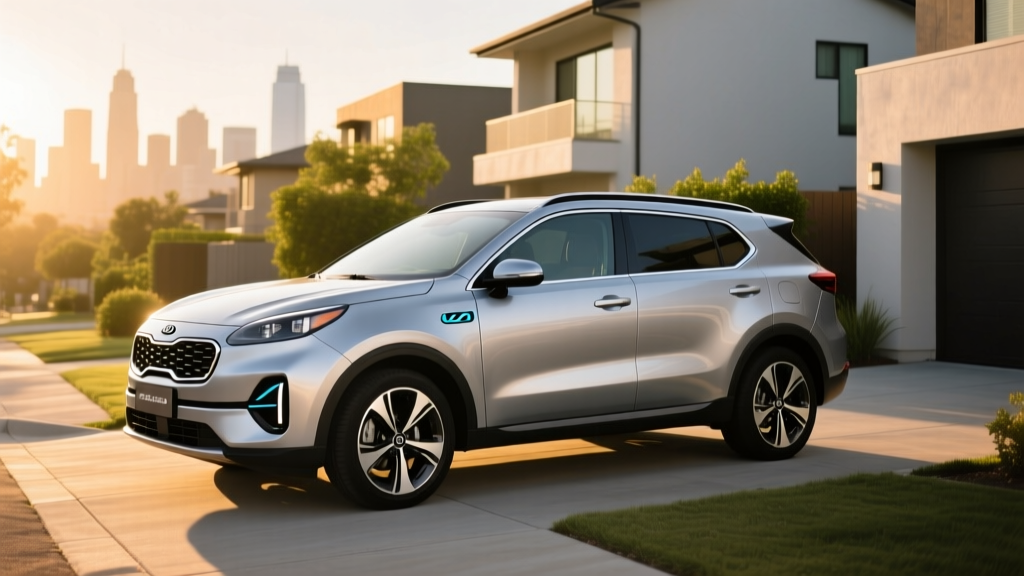
Quick Verdict: The 2026 Kia Sportage Hybrid EX at a Glance
The 2026 Kia Sportage Hybrid EX occupies a practical middle ground for compact SUV buyers who want serious fuel savings without changing how they refuel. With an EPA-estimated 43 MPG combined, 261 combined horsepower, and a starting MSRP around $34,090, the EX trim sits at the value sweet spot in Kia's hybrid lineup. It is a conventional hybrid (HEV) — meaning you never plug it in — and it uses regenerative braking and an electric motor assist to slash fuel consumption in stop-and-go driving. For buyers weighing a full EV against a gas-only compact SUV, the Sportage Hybrid EX eliminates range anxiety entirely while still cutting fuel costs by roughly 35% compared to its non-hybrid sibling.
The 2026 Sportage is sold in three powertrain variants: a gas-only model, a conventional hybrid (HEV) like the one reviewed here, and a plug-in hybrid (PHEV). The HEV charges its small battery through regenerative braking and the engine — you never plug it in. The PHEV variant carries a larger 13.8 kWh battery, offers about 34 miles of electric-only driving, and requires plugging in to access its full efficiency benefit. This review focuses on the HEV EX trim, with PHEV comparisons noted throughout.
EPA Fuel Economy and Real-World MPG
Fuel economy is the primary reason buyers choose the Sportage Hybrid, and the EX trim's numbers are competitive with the best in the compact hybrid SUV segment — the Toyota RAV4 Hybrid and Honda CR-V Hybrid.
| Metric | EPA Estimate | Real-World Expectation |
|---|---|---|
| City MPG | 42 MPG | 43–46 MPG |
| Highway MPG | 44 MPG | 38–42 MPG |
| Combined MPG | 43 MPG | 40–44 MPG |
| Fuel Tank Capacity | 13.7 gallons | — |
| Total Driving Range | ~589 miles | ~520–580 miles |
Why real-world MPG diverges from EPA: Hybrid systems thrive in city driving, where the electric motor handles low-speed propulsion and regenerative braking recaptures energy at every stop. Expect to meet or even exceed the EPA city figure in suburban commuting. Highway driving, however, relies more heavily on the gasoline engine, and sustained 75+ mph speeds, headwinds, and cold weather can pull real-world highway MPG into the upper 30s. According to fueleconomy.gov, the Sportage Hybrid's combined 43 MPG translates to an estimated annual fuel cost of approximately $1,250 based on 15,000 miles driven per year — roughly $650 less per year than the gas-only Sportage AWD at 28 MPG combined.
Powertrain Specs: Engine, Motor, and Combined Output
The Sportage Hybrid EX pairs a turbocharged 1.6-liter four-cylinder engine with a 47.7 kW (64 hp) electric motor integrated into a 6-speed automatic transmission. This is not a CVT — a choice that gives the Sportage Hybrid a more natural, stepped acceleration feel that many drivers prefer over the drone associated with continuously variable transmissions in competitors.
| Specification | Value |
|---|---|
| Engine | 1.6L turbocharged 4-cylinder |
| Engine Output | 178 hp / 195 lb-ft torque |
| Electric Motor | 47.7 kW (64 hp) / 195 lb-ft |
| Combined System Output | 261 hp / 258 lb-ft |
| Transmission | 6-speed automatic |
| Drivetrain (EX trim) | AWD (standard on EX) |
| 0–60 mph (est.) | ~7.0 seconds |
| Hybrid Battery | 1.49 kWh lithium-ion (HEV) |
| Towing Capacity | 2,000 lbs |
The 261 combined horsepower figure puts the Sportage Hybrid ahead of the RAV4 Hybrid (219 hp) and CR-V Hybrid (204 hp) on paper. In practice, that advantage shows up most in highway merging and passing situations. The turbocharged engine provides strong low-end torque, and the electric motor fills in any turbo lag off the line. The result is a compact hybrid SUV that feels genuinely quick — not just efficient.
HEV vs. PHEV vs. Full EV: Which Sportage Fits You?
Kia offers the Sportage in three electrified flavors, and choosing the right one depends on your driving habits, home charging access, and budget.
Sportage Hybrid (HEV)
- No plug-in required
- 43 MPG combined
- ~589 miles total range
- Starts ~$34,090
- No federal tax credit
Best for: Drivers without home charging access, apartment dwellers, or those who want fuel savings with zero behavioral change.
Sportage Plug-In Hybrid (PHEV)
- ~34 miles electric-only range
- 13.8 kWh battery (Level 2 chargeable)
- 84 MPGe combined (EV mode)
- ~430 miles total range
- Starts ~$40,590
- Eligible for up to $3,750 federal credit (§30D, subject to income/MSRP caps)
Best for: Commuters with home Level 2 charging who drive under 35 miles daily and want EV-like daily driving with a gas backup for road trips.
Full EV (e.g., Kia EV6)
- ~310 miles EPA range
- 77.4 kWh battery, DC fast charging to 239 kW
- 117 MPGe combined
- Starts ~$42,600
- Eligible for up to $7,500 federal credit (§30D)
Best for: Homeowners with Level 2 charging who want the lowest per-mile fuel cost and zero tailpipe emissions.
If your daily commute is under 30 miles and you can install a Level 2 charger at home, the PHEV variant is worth the premium — you'll drive most days on electricity alone and only use gasoline on longer trips. If you can't charge at home or your commute involves extensive highway miles, the HEV EX reviewed here is the more practical choice.
Pricing, Trims, and Tax Credit Eligibility
The 2026 Kia Sportage Hybrid EX starts at an MSRP of approximately $34,090 (including destination). This positions it between the base Hybrid LX (~$31,090) and the top-tier Hybrid SX-Prestige (~$39,490). The EX trim adds features like a 12.3-inch dual panoramic display, heated front seats, Smart Power Liftgate, and Kia's Highway Driving Assist (HDA) — making it the trim most buyers should target.
The conventional Sportage Hybrid does not qualify for the federal §30D clean vehicle tax credit. That credit applies only to plug-in electric vehicles (BEVs and PHEVs) with sufficient battery capacity and meeting critical-mineral and battery-component sourcing requirements under current IRS rules.
The Sportage PHEV variant may qualify for a partial credit (up to $3,750 depending on sourcing compliance), subject to buyer income caps ($150K single / $300K joint) and the $80,000 MSRP cap for SUVs. Always verify eligibility with a tax professional before purchase, as sourcing rules change annually.
Even without a federal credit, the HEV EX's fuel savings add up. At 15,000 miles per year and $3.40/gallon average fuel cost, the hybrid saves approximately $650 annually versus the gas-only Sportage — recouping a typical $2,000 hybrid premium in about three years.
Battery Warranty, Reliability, and Replacement Costs
Hybrid battery longevity is consistently a top concern for first-time hybrid buyers. Kia addresses this with one of the strongest hybrid battery warranties in the industry.
Kia Hybrid Battery & Powertrain Warranty
- Hybrid/EV Battery: 10 years / 100,000 miles (whichever comes first)
- Hybrid System Components: 10 years / 100,000 miles (inverter, motor, controller)
- Powertrain: 10 years / 100,000 miles
- Basic Bumper-to-Bumper: 5 years / 60,000 miles
Kia's warranty covers battery capacity loss below a defined threshold (typically 70% state of health). If the hybrid battery degrades beyond that point within the warranty period, Kia replaces it at no cost.
Real-world reliability: Kia's 1.6L turbo hybrid powertrain has been in production since the 2023 model year across the Sportage, Sorento, and Tucson (corporate cousin Hyundai) lineups. The lithium-ion hybrid battery pack in the HEV is small (1.49 kWh) and operates within a narrow state-of-charge window managed by the vehicle's thermal management system — a design that significantly extends cycle life. Most hybrid batteries in modern vehicles last well beyond 150,000 miles before meaningful degradation occurs.
Out-of-warranty replacement cost: If a hybrid battery does require replacement after the 10-year/100,000-mile coverage, expect to pay between $2,500 and $4,500 for parts and labor at a Kia dealer. Independent hybrid specialists may offer refurbished packs for $1,500–$2,500. This is substantially less than a full EV battery replacement because the HEV pack is far smaller.
Driving Impressions and Practical Ownership Notes
From behind the wheel, the 2026 Sportage Hybrid EX drives like a well-sorted compact SUV that happens to be efficient — rather than an efficiency appliance. The turbocharged engine and electric motor together produce confident acceleration, and the 6-speed automatic avoids the rubber-band sensation of CVTs found in the RAV4 Hybrid. Ride quality is compliant, cabin noise is well-managed, and the EX's standard AWD system provides reassurance in rain and light snow.
Cargo and practicality: The hybrid battery pack is mounted under the rear seat area, preserving cargo space. You get approximately 39.6 cubic feet behind the second row and 73.7 cubic feet with the rear seats folded — competitive with the segment. The HEV does not sacrifice any interior volume compared to the gas-only model.
ADAS and technology: The EX includes Kia's DriveWise suite: Forward Collision-Avoidance Assist, Lane Keeping Assist, Blind-Spot Collision-Avoidance, and Highway Driving Assist. Note that HDA is an SAE Level 2 driver-assistance system — it provides steering and speed support on divided highways but requires you to keep your hands on the wheel and eyes on the road at all times. It is not autonomous driving.
Pros
- 43 MPG combined with no plug-in hassle
- 261 hp — strongest in compact hybrid SUV class
- 10-year/100,000-mile hybrid battery warranty
- 6-speed auto (no CVT drone)
- Standard AWD on EX trim
- Competitive cargo space and tech features
Cons
- No federal tax credit (HEV)
- Highway MPG drops noticeably above 75 mph
- Base LX hybrid trim lacks premium features
- Towing limited to 2,000 lbs
- Some competitors offer more rear-seat legroom
Who Should Buy the 2026 Kia Sportage Hybrid EX?
Choose the Sportage Hybrid EX if:
- You commute in mixed city/highway driving and want 40+ MPG without plugging in
- You live in an apartment or lack access to home EV charging
- You want more power than the RAV4 or CR-V hybrids offer
- You plan to keep the vehicle 8+ years (the 10-year warranty has your back)
- You want AWD and a tech-loaded cabin under $36,000
Look elsewhere if:
- Your daily commute is under 30 miles and you have home charging — consider the Sportage PHEV for EV-mode commuting
- You want the lowest possible fuel cost — a full BEV like the Kia EV6 costs roughly $0.04/mile in electricity vs. $0.08/mile in gas for this hybrid
- You need more than 2,000 lbs of towing — look at the Sportage PHEV (2,000 lbs) or a body-on-frame SUV
Frequently Asked Questions
How many MPG does the 2026 Kia Sportage Hybrid EX get?
The EPA rates the 2026 Sportage Hybrid EX at 42 MPG city, 44 MPG highway, and 43 MPG combined. In real-world city and suburban driving, many owners report meeting or slightly exceeding the city figure thanks to aggressive regenerative braking. Highway fuel economy tends to run 38–42 MPG at sustained speeds above 70 mph.
Do I need to plug in the Sportage Hybrid?
No. The Sportage Hybrid (HEV) charges its 1.49 kWh battery entirely through regenerative braking and the gasoline engine. You fuel it like any conventional vehicle. Only the Sportage PHEV variant requires plug-in charging to access its electric-only range.
How far can the Sportage PHEV go on electric only?
The Sportage PHEV variant offers approximately 34 miles of electric-only driving on a full charge of its 13.8 kWh battery. That covers most daily commutes. Once the battery is depleted, it operates as a conventional hybrid with an estimated 35 MPG combined in hybrid mode. The PHEV can accept Level 2 (240V) charging and reaches a full charge in approximately 3 hours and 45 minutes at 3.3 kW. It does not support DC fast charging.
Is the Sportage Hybrid reliable, and what does battery replacement cost?
Kia's turbo-hybrid powertrain has proven reliable since its 2023 introduction, and the hybrid battery is covered by a 10-year/100,000-mile warranty. Out-of-warranty hybrid battery replacement typically costs $2,500–$4,500 at a dealer. The small HEV battery pack is far less expensive to replace than a full EV traction battery.
Does the 2026 Sportage Hybrid qualify for any tax credit?
The conventional Sportage Hybrid (HEV) does not qualify for the federal §30D clean vehicle tax credit — that credit is reserved for plug-in vehicles (BEVs and PHEVs). Some states and utilities offer rebates for hybrid purchases; check your state energy office or fueleconomy.gov's incentives page for local programs. The Sportage PHEV may qualify for a partial federal credit (up to $3,750) depending on battery sourcing compliance, buyer income, and MSRP caps under current IRS rules.
How does the Sportage Hybrid compare to the RAV4 Hybrid?
The Sportage Hybrid EX produces 261 hp versus the RAV4 Hybrid's 219 hp, giving it a clear power advantage. EPA combined MPG is comparable (43 for the Kia vs. 39–41 for the Toyota depending on trim). The RAV4 Hybrid offers slightly more cargo space and a longer track record of reliability. The Kia counters with a longer warranty (10yr/100K vs. Toyota's 10yr/150K hybrid battery but 5yr/60K powertrain vs. 5yr/60K basic) and a more premium interior at the EX price point.