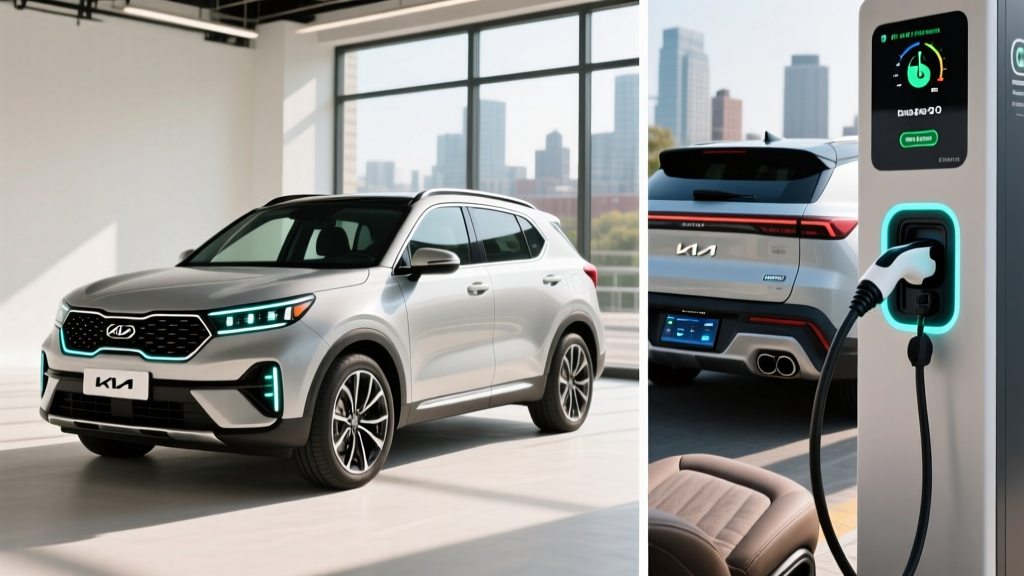
The compact hybrid SUV segment is crowded, but the 2026 Kia Sportage EX Hybrid occupies a compelling middle ground: it pairs a turbocharged powertrain with genuine fuel economy, offers more cargo room than most rivals, and undercuts the Toyota RAV4 Hybrid on price. If you're researching the 2026 Kia Sportage EX Hybrid, you need hard numbers — not brochure superlatives. This guide covers EPA fuel economy, real-world MPG expectations, powertrain specs, pricing, warranty coverage, and exactly who should pick this over a PHEV or full EV.
Quick Verdict: Is the 2026 Kia Sportage EX Hybrid Worth It?
The Sportage EX Hybrid is a conventional hybrid (HEV), meaning it charges its own battery through regenerative braking and the gasoline engine — you never plug it in. For buyers who want better fuel economy without changing their fueling habits, this is the right setup. The EX trim hits a sweet spot: it adds premium features like a panoramic sunroof and heated front seats over the base LX Hybrid without jumping to the top-tier SX Prestige price tag. With 232 combined horsepower, it's one of the most powerful compact hybrid SUVs available, and the 38 MPG combined EPA rating keeps fuel costs modest.
| Spec | 2026 Kia Sportage EX Hybrid |
|---|---|
| Powertrain | 1.6L Turbo I4 + Electric Motor (HEV) |
| Combined Horsepower | 232 hp / 258 lb-ft torque |
| Transmission | 6-Speed Automatic |
| EPA Fuel Economy | 38 city / 38 highway / 38 combined MPG |
| Drivetrain | AWD (standard on EX Hybrid) |
| Cargo Volume | 39.5 cu ft (rear seats up) / 73.7 cu ft (folded) |
| Towing Capacity | 2,000 lbs |
| Battery Warranty | 10 years / 100,000 miles |
| Starting MSRP (EX Hybrid AWD) | ~$34,590 |
HEV vs PHEV: Which Sportage Hybrid Is Right for You?
Kia sells the Sportage in three electrified forms: the Sportage Hybrid (HEV), the Sportage Plug-in Hybrid (PHEV), and the all-electric Sportage EV (available in select global markets). The EX trim is only offered as a conventional HEV, so understanding the difference matters before you buy.
| Feature | Sportage Hybrid (HEV) | Sportage PHEV |
|---|---|---|
| Plug-in Required? | No — self-charging | Yes — plug in for EV range |
| Electric-Only Range | N/A (motor assists engine) | ~34 miles (EPA est.) |
| Combined MPG / MPGe | 38 MPG | 84 MPGe (electric) / 35 MPG (gas) |
| Battery Size | ~1.5 kWh (small buffer) | 13.8 kWh |
| Combined HP | 232 hp | 261 hp |
| Federal Tax Credit (§30D) | Not eligible | Up to $7,500 (if eligible) |
| Starting MSRP | ~$34,590 | ~$40,490 |
Bottom line: If you can charge at home and your daily commute is under 30 miles, the PHEV lets you drive mostly on electricity and only burns gas on longer trips. If you lack reliable charging access — apartment dwellers, street parkers, frequent road-trippers — the HEV is the practical choice. The EX Hybrid gives you the fuel savings without any infrastructure changes.
Fuel Economy: EPA Numbers vs Real-World MPG
The EPA rates the 2026 Kia Sportage EX Hybrid AWD at 38 MPG city / 38 highway / 38 combined. That flat city/highway split is typical of modern hybrids where the electric motor handles low-speed driving efficiently, while the turbo engine kicks in seamlessly at highway speeds.
| Driving Scenario | EPA Estimate | Real-World Expectation |
|---|---|---|
| City (stop-and-go) | 38 MPG | 39–42 MPG (regen braking excels here) |
| Highway (70+ mph) | 38 MPG | 33–36 MPG (aero drag, turbo spooling) |
| Combined | 38 MPG | 35–39 MPG (mixed driving) |
| Cold Weather (below 30°F) | — | 30–34 MPG (engine runs more for heat) |
Why real-world varies: Hybrids actually tend to beat their EPA city ratings because regenerative braking recovers energy that gas cars waste as brake heat. Highway driving is where you'll see lower numbers — the turbocharged 1.6L works harder at sustained speeds, and the boxy SUV shape creates aerodynamic drag. In winter, expect a 10–15% drop because the gasoline engine must run more frequently to provide cabin heat.
For context, the competing Toyota RAV4 Hybrid AWD achieves 41 MPG combined but produces only 219 hp. The Honda CR-V Hybrid AWD lands at 40 MPG combined with 204 hp. The Sportage trades 2–3 MPG for noticeably more power and a roomier cabin.
Powertrain Deep Dive: 232 HP Turbo Hybrid
The Sportage Hybrid's powertrain pairs a 1.6-liter turbocharged inline-4 gasoline engine with a 47.7 kW (64 hp) electric motor integrated into the transmission housing. Combined output is 232 horsepower and 258 lb-ft of torque, routed through a 6-speed automatic transmission to standard all-wheel drive.
This setup is distinctly different from the Toyota Hybrid Synergy Drive or Honda's two-motor system, both of which use CVTs (continuously variable transmissions). Kia's conventional 6-speed automatic delivers more natural shift feel and avoids the "rubber band" drone that some drivers dislike in CVT-equipped hybrids. The trade-off is slightly less seamless low-speed electric assist, though the difference is subtle in daily driving.
The AWD system uses an electronically controlled coupling to send torque rearward when slip is detected — it's a reactive system, not a full-time torque-vectoring setup. For snow and rain, it's entirely adequate. For aggressive off-roading, look elsewhere.
Pricing, Trims, and Tax Credit Eligibility
The 2026 Kia Sportage EX Hybrid AWD starts at approximately $34,590 (including destination). Here's how the hybrid trim stack looks:
- LX Hybrid AWD: ~$31,590 — base hybrid with cloth seats, 12.3" touchscreen
- EX Hybrid AWD: ~$34,590 — panoramic sunroof, heated front seats, smart power liftgate, leatherette upholstery
- SX Prestige Hybrid AWD: ~$38,590 — ventilated front seats, heated steering wheel, premium Harman Kardon audio, highway driving assist
Does the 2026 Kia Sportage EX Hybrid Qualify for a Federal Tax Credit?
No. Under IRS §30D Clean Vehicle Credit rules, conventional hybrids (HEVs) do not qualify for the federal plug-in vehicle tax credit. Only plug-in hybrids (PHEVs) and battery electric vehicles (BEVs) with sufficient battery capacity are eligible — and even then, they must meet MSRP caps, buyer income limits, and critical-mineral/battery-component sourcing requirements.
If the federal tax credit is a priority, you'd need to step up to the Sportage PHEV (up to $7,500 credit, if you meet all eligibility criteria) or consider a fully electric vehicle. Always verify current-year rules on IRS.gov or consult a tax professional before making a purchase decision based on incentive assumptions.
Reliability, Battery Lifespan, and Replacement Cost
The Sportage Hybrid uses a relatively small ~1.5 kWh lithium-ion battery pack. Unlike a full EV's massive 70+ kWh battery, this pack is designed for frequent shallow charge/discharge cycles — it buffers energy from regenerative braking and feeds it to the electric motor for acceleration assist. Because it never fully depletes or fully charges (the system manages a narrow state-of-charge window), degradation is minimal.
Expected battery lifespan: Based on data from Hyundai/Kia's hybrid platforms (which share architecture), these packs routinely exceed 150,000–200,000 miles before any meaningful capacity loss. Many first-generation Hyundai Sonata Hybrids from 2011–2015 are still running on original batteries past 200,000 miles.
Replacement cost: If the hybrid battery does fail outside warranty, replacement runs approximately $2,000–$3,500 including labor at a dealership. Independent hybrid specialists can sometimes source refurbished packs for $1,200–$2,000. Compare this to EV battery replacements at $10,000–$20,000+ — the HEV battery is a fraction of the cost because it's a fraction of the capacity.
Kia's hybrid reliability ratings have been solid. The IIHS typically awards the Sportage strong crash-test scores, and Kia's powertrain warranty provides a long safety net. J.D. Power and Consumer Reports ratings for the hybrid powertrain have trended positively in recent model years, though the turbo-hybrid system is more complex than Toyota's naturally aspirated hybrid setups.
Who Should Buy the 2026 Kia Sportage EX Hybrid?
Choose the Sportage EX Hybrid If:
- You can't charge at home (apartment, street parking, no garage outlet)
- You want better MPG without any behavior change — just fill up and go
- You need AWD for snow/rain but don't want a heavy, expensive EV
- You want more power (232 hp) than the RAV4 or CR-V hybrids offer
- You value cargo space — 39.5 cu ft beats most compact hybrid rivals
Choose the Sportage PHEV Instead If:
- You have Level 2 home charging and a commute under 34 miles
- You want to drive mostly on electricity and only use gas for road trips
- You qualify for the §30D federal tax credit (offsetting the ~$6,000 higher MSRP)
Choose a Full EV (e.g., Kia EV6, Hyundai Ioniq 5) If:
- You have reliable home charging and want zero tailpipe emissions
- Your daily driving is under 250 miles and you road-trip infrequently
- You want the lowest per-mile "fuel" cost (electricity vs. gasoline)
- You're ready to plan around DC fast charging on longer trips
Pros and Cons at a Glance
Pros
- 232 hp — significantly more powerful than RAV4/CR-V hybrids
- 38 MPG combined without plugging in
- Class-leading cargo room (39.5 cu ft behind rear seats)
- 10-year/100,000-mile hybrid battery warranty
- 6-speed automatic avoids CVT drone
- Standard AWD across all hybrid trims
Cons
- 2–3 MPG below Toyota RAV4 Hybrid and Honda CR-V Hybrid
- No federal tax credit eligibility (HEV)
- Turbo engine adds complexity vs. naturally aspirated competitors
- Real-world highway MPG drops to ~33–36 at sustained 70+ mph
- 2,000-lb towing limit is modest for the segment
- Regen braking feel takes adjustment from a gas car
Frequently Asked Questions
How many MPG does the 2026 Kia Sportage EX Hybrid get?
The EPA rates it at 38 MPG city, 38 highway, and 38 combined. In real-world driving, expect 39–42 MPG in city traffic (where regenerative braking shines) and 33–36 MPG at sustained highway speeds above 70 mph. Cold weather can drop combined MPG to 30–34.
Do I need to plug in the Sportage EX Hybrid?
No. The EX Hybrid is a conventional hybrid (HEV). The battery charges through regenerative braking and the gasoline engine. You fuel it exactly like a regular gas car — there's no plug, no charging cable, and no electric-only driving range to manage.
How far can the Sportage PHEV go on electric only?
The Sportage PHEV (a separate model) offers approximately 34 miles of electric-only range on a full charge, per the EPA. That's enough for most daily commutes. The EX Hybrid (HEV) discussed in this article does not offer electric-only driving — the motor always works in tandem with the gas engine.
Is the hybrid battery reliable, and what does replacement cost?
Kia's hybrid battery packs have proven reliable well past 150,000 miles, and the 10-year/100,000-mile warranty provides strong coverage. Out-of-warranty replacement costs approximately $2,000–$3,500 at a dealer, or $1,200–$2,000 through independent hybrid specialists using refurbished packs.
Does the 2026 Sportage EX Hybrid qualify for any tax credit?
Not the federal §30D Clean Vehicle Credit — that's reserved for plug-in hybrids and electric vehicles. Some states or local utilities may offer small rebates for hybrid purchases, but these vary widely by jurisdiction. Check your state energy office or utility provider for current programs.
How does the Sportage Hybrid compare to the RAV4 Hybrid?
The RAV4 Hybrid wins on fuel economy (41 vs. 38 MPG combined) and has a longer track record of hybrid reliability. The Sportage Hybrid wins on power (232 hp vs. 219 hp), cargo space (39.5 vs. 37.5 cu ft), and warranty length (10 yr vs. 8 yr hybrid battery). If MPG is your top priority, the RAV4 edges ahead. If power, space, and warranty matter more, the Sportage is the stronger pick.
What's the real cost to fuel the Sportage Hybrid vs. a gas-only Sportage?
The gas-only Sportage AWD gets roughly 26 MPG combined. At 15,000 miles/year and $3.40/gallon, that's ~$1,962 annually in fuel. The Hybrid at 38 MPG combined costs ~$1,342 — saving approximately $620 per year or about $3,100 over five years. That nearly offsets the hybrid's modest price premium over the gas model.