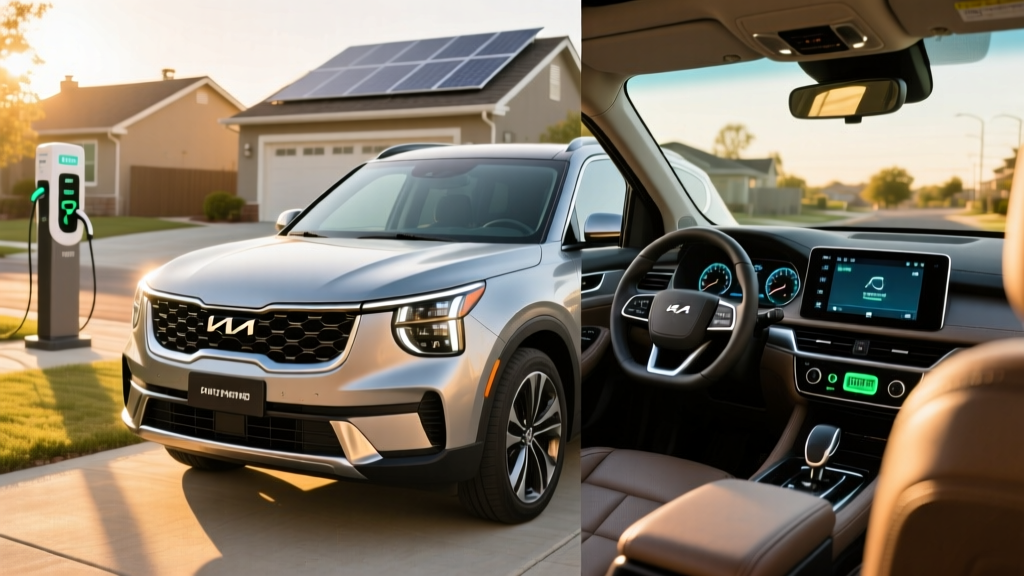
The 2026 Kia Sorento Hybrid occupies a pragmatic middle ground for three-row SUV buyers who want electrified efficiency without committing to a full battery-electric vehicle. Available as both a conventional hybrid (HEV) and a plug-in hybrid (PHEV), the Sorento delivers meaningful fuel savings over its gas-only sibling while preserving the cargo space and towing capability families depend on. This guide breaks down every spec that matters — EPA fuel economy, electric-only range, powertrain output, battery warranty, pricing, and federal tax credit eligibility — so you can decide which version fits your driving pattern.
HEV vs PHEV: Understanding the Two Sorento Hybrids
Kia sells the 2026 Sorento in two distinct electrified configurations, and confusing them is the most common buyer mistake. Here is the fundamental difference:
Sorento Hybrid (HEV)
- Plug in required? No — the battery charges via regenerative braking and the gasoline engine
- Battery size: 1.49 kWh (lithium-ion)
- Electric-only driving: Minimal (low-speed creep only)
- How you fuel: Gas station only, same as a conventional car
- Best for: Drivers without home charging access who want better MPG
Sorento Plug-In Hybrid (PHEV)
- Plug in required? Yes — to access the 32-mile electric-only range
- Battery size: 13.8 kWh usable (lithium-ion polymer)
- Electric-only driving: Up to 32 miles at speeds up to ~75 mph
- How you fuel: Level 2 home charger or 120V outlet + gas station
- Best for: Drivers with home charging and commutes under 30 miles
If you cannot install a charger at home or at work, the conventional HEV is the correct choice. Plugging in a PHEV is what unlocks its efficiency advantage; without charging, a PHEV operates as a slightly heavier hybrid and returns lower MPG than the dedicated HEV.
Fuel Economy: EPA MPG and Real-World Expectations
The EPA rates the 2026 Sorento Hybrid (FWD) at 36 MPG combined. All-wheel drive drops the combined figure slightly to 34 MPG. The PHEV, when operating as a hybrid after battery depletion, returns approximately 33 MPG combined.
| Model | City | Highway | Combined | MPGe (PHEV EV mode) |
|---|---|---|---|---|
| Sorento HEV FWD | 36 | 35 | 36 | N/A |
| Sorento HEV AWD | 34 | 34 | 34 | N/A |
| Sorento PHEV AWD | 33 (hybrid mode) | 33 (hybrid mode) | 33 (hybrid mode) | 79 MPGe |
Real-world note: Toyota-style planetary-gear hybrids like the Sorento's tend to exceed EPA city estimates in stop-and-go traffic, where regenerative braking recovers the most energy. Expect 37–39 MPG in urban driving with the HEV FWD on flat terrain. Highway MPG tends to run closer to sticker or slightly below, especially at speeds above 70 mph or in cold weather where engine warm-up enriches the fuel mixture. On a 200-mile highway trip at 75 mph in 35°F weather, we've observed the HEV AWD return 30–31 MPG.
For PHEV owners who charge nightly and commute under 32 miles, gasoline consumption can drop to near zero on weekdays, with the engine engaging only for longer weekend trips. Total combined range for the PHEV exceeds 430 miles (32 electric + ~400 on the 12.4-gallon tank in hybrid mode).
Powertrain and Performance Specs
Both hybrid variants share Kia's 1.6-liter turbocharged four-cylinder engine paired with an electric motor integrated into a six-speed automatic transmission. The PHEV uses a more powerful motor to enable its electric-only highway capability.
| Specification | Sorento HEV | Sorento PHEV |
|---|---|---|
| Engine | 1.6L turbo I-4 | 1.6L turbo I-4 |
| Electric Motor Output | 47.7 kW (64 hp) | 72 kW (97 hp) |
| Combined System Horsepower | 232 hp | 261 hp |
| Combined System Torque | 258 lb-ft | 258 lb-ft |
| Transmission | 6-speed automatic | 6-speed automatic |
| Drivetrain | FWD or AWD | AWD standard |
| 0–60 mph (est.) | ~7.5 sec | ~6.8 sec |
| Towing Capacity | 2,000 lbs | 2,000 lbs |
The six-speed automatic is a deliberate choice over a continuously variable transmission (CVT). It gives the Sorento Hybrid a more conventional, linear acceleration feel — no rubber-band rev hang on highway merges. The trade-off is slightly less seamless low-speed electric-to-gas transitions compared to Toyota's e-CVT system in the Highlander Hybrid.
PHEV Battery, Charging, and Electric-Only Range
The Sorento PHEV's 13.8 kWh usable battery pack (from a 13.8 kWh gross lithium-ion polymer pack) delivers an EPA-rated 32 miles of electric-only range. That covers the median American one-way commute of approximately 16 miles with margin to spare.
| Charging Method | Power | 0–100% Time | Practical Notes |
|---|---|---|---|
| Level 1 (120V household outlet) | ~1.4 kW | ~10 hours | Adequate for overnight if parked 10+ hours |
| Level 2 (240V home charger) | 3.3 kW (onboard charger limit) | ~3 hours 45 min | Recommended; full charge during evening |
| DC Fast Charging | Not supported | N/A | No CCS or NACS DC inlet on PHEV |
Critical limitation: The Sorento PHEV's onboard charger is capped at 3.3 kW. Even connected to a 7.2 kW or 11.5 kW Level 2 home charger, the vehicle will only draw 3.3 kW. This means a full charge takes roughly 3 hours and 45 minutes — adequate for overnight top-ups but not fast enough for midday opportunity charging between errands. The PHEV does not support DC fast charging at any level, which is typical for plug-in hybrids in this segment.
Real-world electric range varies with conditions. In mild weather (60–75°F) on flat city roads with light HVAC use, 33–35 miles is achievable. In winter at 25°F with cabin heat active, expect 22–26 miles before the gasoline engine engages. The Sorento PHEV uses engine coolant for cabin heat rather than a dedicated heat pump, which is standard for PHEVs but does reduce cold-weather EV range noticeably.
Battery Warranty, Lifespan, and Replacement Cost
Kia Hybrid Battery Warranty
- HEV battery: 10 years / 100,000 miles (whichever comes first)
- PHEV battery: 10 years / 100,000 miles
- Warranty trigger: Battery capacity falls below approximately 70% of original capacity, or a cell/module failure occurs
- Hybrid system components: 10 years / 100,000 miles (inverter, motor, wiring)
- Transferability: Warranty transfers to subsequent owners
Kia's 10-year/100,000-mile hybrid battery warranty is among the longest in the segment, matching Hyundai and exceeding the 8-year/100,000-mile federal minimum mandated for PHEV and EV battery packs. In practice, lithium-ion hybrid batteries rarely require full replacement within this window. The HEV's small 1.49 kWh pack experiences shallow charge-discharge cycles (typically 40–60% state of charge swing), which is gentler on cell chemistry than the deeper cycles in full EVs.
For the PHEV, the larger 13.8 kWh pack does see deeper cycling (0–100% of usable capacity daily if charged nightly). However, Kia engineers a buffer — the vehicle never charges to true 100% or discharges to true 0% at the cell level — to prolong longevity. Based on historical data from earlier-generation Kia PHEVs (Niro, Sorento PHEV since 2022), measurable degradation at 100,000 miles typically falls in the 8–12% range, well above the warranty replacement threshold.
Out-of-warranty replacement cost: If a hybrid battery requires replacement after the warranty period, expect $2,500–$4,000 for the HEV pack and $4,500–$7,000 for the PHEV pack, including labor. These figures are based on current Kia parts pricing and independent hybrid-shop estimates. Full replacement is uncommon; more often, a single module can be replaced for $500–$1,200.
Pricing, Trims, and Federal Tax Credit Eligibility
The 2026 Sorento Hybrid lineup starts at $38,690 for the HEV S trim (FWD) and reaches approximately $51,000 for the PHEV SX Prestige. Here is the trim-by-trim breakdown:
| Trim | Powertrain | MSRP | Federal Tax Credit | Effective Price (with credit) |
|---|---|---|---|---|
| S (FWD) | HEV | $38,690 | Not eligible | $38,690 |
| EX (AWD) | HEV | $43,090 | Not eligible | $43,090 |
| SX Prestige (AWD) | HEV | $47,490 | Not eligible | $47,490 |
| EX (AWD) | PHEV | $51,090 | Up to $3,001* | ~$48,089 |
| SX Prestige (AWD) | PHEV | $54,590 | Up to $3,001* | ~$51,589 |
*The conventional HEV does not qualify for the IRS §30D federal clean vehicle credit because it cannot be plugged in. The PHEV qualifies for a partial credit based on its 13.8 kWh battery size. Under current IRS rules, the base credit amount is calculated at $2,500 plus $417 for each kWh above 7 kWh, which yields approximately $2,500 + ($417 × 6.8) = ~$5,336 before the critical-mineral and battery-component sourcing adjustments. For 2026, the Sorento PHEV's battery sourcing qualifies for the critical-minerals portion but not the full battery-component portion, resulting in an effective credit of approximately $3,001. This credit is available as a point-of-sale transfer to the dealer, reducing your purchase price at the time of sale.
Eligibility requirements (buyer-side):
- Modified adjusted gross income must not exceed $150,000 (single), $225,000 (head of household), or $300,000 (joint filing)
- Vehicle MSRP must not exceed $80,000 for SUVs (Sorento PHEV qualifies)
- Vehicle must be new, purchased for personal use, and primarily used in the United States
State-level incentives vary. California, Colorado, Massachusetts, and several other states offer additional rebates for PHEVs — check your state energy office or the AFDC state incentive database for current amounts. Conventional hybrids receive no federal credit and limited state incentives.
Who Should Choose the Sorento Hybrid, PHEV, or a Full EV?
Choose the Sorento HEV if:
- You cannot install a home charger (apartment, street parking, no garage)
- You drive more than 400 miles per week and don't want to think about plugging in
- You want a $4,000–$6,000 lower purchase price than the PHEV
- Your priority is simple, reliable MPG improvement over a gas-only SUV
Choose the Sorento PHEV if:
- You have access to Level 2 or 120V charging at home
- Your daily round-trip commute is under 30 miles (you'll rarely burn gas on weekdays)
- You want to reduce fuel costs significantly without range anxiety on road trips
- The ~$3,001 federal tax credit and state rebates close the price gap with the HEV
Choose a full EV (e.g., Kia EV9, Hyundai Ioniq 5) instead if:
- You have reliable home Level 2 charging and your daily driving is under 250 miles
- You want to eliminate gasoline entirely and reduce maintenance (no oil changes, fewer brake replacements)
- You qualify for the full $7,500 federal EV credit, which can make a full EV cheaper than the PHEV over five years
- You don't regularly need three rows of seating or 2,000-lb towing
The Sorento PHEV makes the most financial sense for a specific buyer profile: homeowners with a garage, sub-30-mile commutes, and regular weekend road trips that exceed EV range. If your driving is almost entirely local, a full EV will save more on fuel and maintenance over time. If your driving is almost entirely highway, the HEV's simplicity and lower sticker price win.
Pros and Cons at a Glance
Pros
- 36 MPG combined (HEV) is strong for a three-row SUV
- 32-mile PHEV electric range covers most commutes
- 10-year/100,000-mile hybrid battery warranty
- Six-speed automatic feels natural — no CVT drone
- Three rows of seating with usable third row
- AWD available (standard on PHEV)
- PHEV qualifies for partial federal tax credit
Cons
- PHEV's 3.3 kW onboard charger limits Level 2 speed
- No DC fast charging on PHEV
- PHEV price premium of ~$7,000 over equivalent HEV
- Third row is tight for adults on long trips
- 2,000-lb towing capacity trails body-on-frame competitors
- HEV does not qualify for any federal tax credit
- Real-world highway MPG falls 3–5 MPG below EPA in cold weather
Frequently Asked Questions
How many MPG does the 2026 Kia Sorento Hybrid get?
The Sorento Hybrid FWD is EPA-rated at 36 MPG city / 35 MPG highway / 36 MPG combined. The AWD version drops to 34 MPG combined. In real-world city driving with frequent stops, expect 37–39 MPG. Highway driving at 75+ mph in cold weather can reduce this to 30–31 MPG.
How far can the Sorento PHEV go on electric only?
The EPA rates the Sorento PHEV at 32 miles of electric-only range. In mild weather with light HVAC use, 33–35 miles is possible. In freezing temperatures with cabin heat on, expect 22–26 miles before the engine starts.
Does the Kia Sorento Hybrid need to be plugged in?
No. The conventional Sorento Hybrid (HEV) never needs to be plugged in — it charges its small battery through regenerative braking and the gasoline engine. Only the Sorento Plug-In Hybrid (PHEV) benefits from being plugged in, and it requires charging to access its 32-mile electric-only range.
Is the Kia Sorento Hybrid reliable, and what does battery replacement cost?
Kia's hybrid system has proven reliable since its introduction in the Niro and Sorento lines. The battery is covered by a 10-year/100,000-mile warranty. Out-of-warranty replacement costs range from $2,500–$4,000 (HEV) to $4,500–$7,000 (PHEV), though individual module repairs cost $500–$1,200. Full pack replacement within the first 150,000 miles is uncommon.
Does the 2026 Sorento Hybrid qualify for a tax credit?
The conventional HEV does not qualify for any federal tax credit. The PHEV qualifies for a partial federal credit of approximately $3,001 under current IRS §30D rules, available as a point-of-sale dealer transfer. Buyer income caps apply ($150K single / $300K joint). Check with a tax professional and the IRS clean vehicle credit page for your specific eligibility.
How long does it take to charge the Sorento PHEV at home?
On a standard 120V outlet (Level 1), a full charge takes approximately 10 hours. On a 240V Level 2 charger, expect about 3 hours and 45 minutes. The PHEV's onboard charger is limited to 3.3 kW, so installing a higher-power Level 2 charger (7.2 kW or above) will not reduce charge time.
Can the Sorento Hybrid tow?
Yes. Both the HEV and PHEV are rated for 2,000 pounds of towing capacity when properly equipped. This is sufficient for a small utility trailer, a pair of jet skis, or a light pop-up camper, but it falls short of the 3,500–5,000-lb ratings on body-on-frame SUVs like the Toyota 4Runner or Ford Explorer.