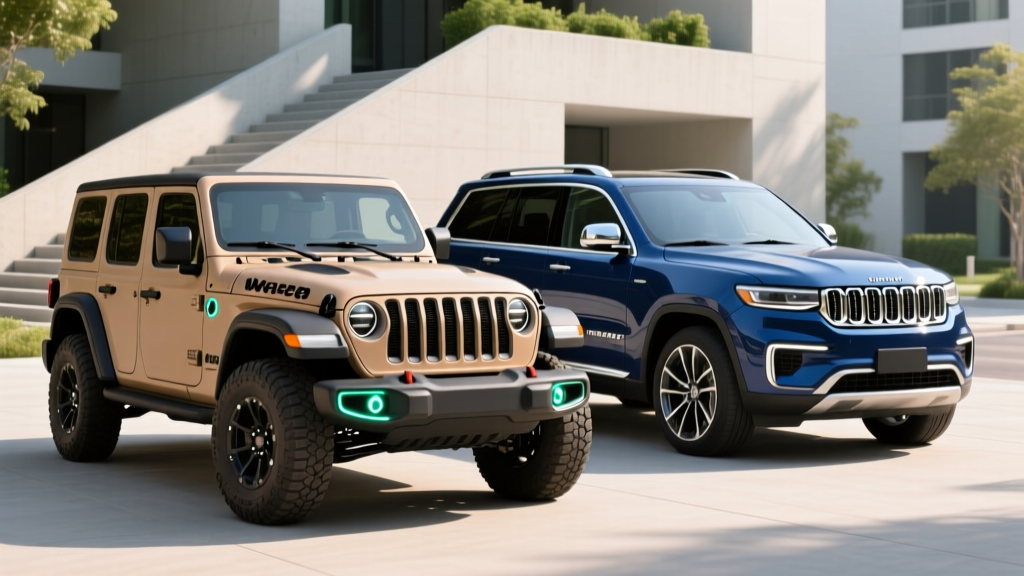
If you want Jeep off-road capability without burning through fuel like it's 2006, the brand's plug-in hybrid (PHEV) lineup — badged 4xe (pronounced "four-by-e") — is where to look. For the 2026 model year, Jeep offers two core PHEVs: the iconic Wrangler 4xe and the family-oriented Grand Cherokee 4xe. Both pair a turbocharged gas engine with electric motors and a battery you can charge from a wall outlet, delivering short electric-only commutes and dramatically better fuel economy than their gas-only siblings.
This guide breaks down exactly what each 2026 Jeep hybrid delivers in EPA-estimated MPG, electric-only range, charging logistics, pricing, federal tax credit eligibility, and long-term battery reliability — so you can decide whether a 4xe PHEV fits your driveway or whether a full EV or conventional hybrid makes more sense.
HEV vs PHEV: What Jeep Actually Offers in 2026
Before we get into the specs, a critical distinction every buyer needs to understand:
Conventional Hybrid (HEV)
A standard hybrid uses a small battery and electric motor to assist the gas engine. You never plug it in — the battery charges through regenerative braking and the engine. Think Toyota RAV4 Hybrid. Jeep does not currently offer a conventional HEV in the US market for 2026.
Plug-In Hybrid (PHEV) — Jeep's 4xe
A PHEV has a much larger battery (typically 14–25 kWh) that you plug in to charge. It can drive on electricity alone for a set range (usually 20–50 miles) before the gas engine kicks in. Once the battery is depleted, it operates like a conventional hybrid. Both the Wrangler 4xe and Grand Cherokee 4xe are PHEVs.
This matters because PHEV tax credit eligibility, charging requirements, and daily driving experience differ significantly from a conventional hybrid. If you see "Jeep hybrid" in marketing, it means 4xe PHEV — not a self-charging HEV.
2026 Jeep Wrangler 4xe: Specs, Range, and Real-World MPG
The Wrangler 4xe remains the best-selling PHEV in America for good reason: it's a genuine off-roader that also handles a 20-mile electric commute. Here's the full spec breakdown for the 2026 model year.
| Spec | Value |
|---|---|
| Powertrain | 2.0L turbo I4 + two electric motors + 8-speed auto |
| Combined Horsepower | 375 hp / 470 lb-ft torque |
| Battery (usable) | ~17 kWh NMC lithium-ion |
| EPA Electric-Only Range | ~22 miles |
| EPA Combined (hybrid mode) | ~49 MPGe / ~20 MPG gas-only |
| Total Range (electric + gas) | ~370 miles |
| Level 2 Charging (240V) | ~2.0–2.5 hours (0–100%) |
| DC Fast Charging | Not available |
| 0–60 mph | |
| Towing Capacity | 3,500 lbs |
| Starting MSRP | ~$51,790 (Willys 4xe) |
Real-World Range Reality Check
The EPA estimates ~22 miles of electric-only range, but real-world results vary. In mild weather (60–75°F) with city driving and light regen, owners commonly report 24–26 miles. On the highway at 70+ mph or in cold weather (below 35°F), expect that electric range to drop to 15–18 miles. The gas-only MPG similarly dips from ~20 combined to roughly 17–18 on sustained highway trips due to the Wrangler's brick-like aerodynamics and heavy curb weight (~5,100 lbs).
Who the Wrangler 4xe Is For
If you want a Wrangler for weekend trail runs but also have a short commute (under 20 miles each way) and access to home charging, the 4xe is a compelling package. The electric mode is nearly silent, which is a bonus on trails and in neighborhoods alike. The instant torque from the electric motors actually improves low-speed rock crawling.
2026 Jeep Grand Cherokee 4xe: Specs, Range, and Real-World MPG
The Grand Cherokee 4xe trades the Wrangler's removable doors for a more refined, family-friendly SUV with a longer electric range and better highway manners.
| Spec | Value |
|---|---|
| Powertrain | 2.0L turbo I4 + two electric motors + 8-speed auto |
| Combined Horsepower | 375 hp / 470 lb-ft torque |
| Battery (usable) | ~17.3 kWh NMC lithium-ion |
| EPA Electric-Only Range | ~25 miles |
| EPA Combined (hybrid mode) | ~56 MPGe / ~23 MPG gas-only |
| Total Range (electric + gas) | ~440 miles |
| Level 2 Charging (240V) | ~2.0 hours (0–100%) |
| DC Fast Charging | Not available |
| 0–60 mph | ~6.0 seconds |
| Towing Capacity | 6,000 lbs |
| Starting MSRP | ~$60,490 (base 4xe) |
Real-World Range Reality Check
The Grand Cherokee 4xe's ~25-mile EPA electric range holds up reasonably well in mixed city/suburban driving — expect 22–27 miles in moderate temperatures. Highway-only driving at 75 mph drops that to roughly 18–20 miles. Gas-only MPG in hybrid mode after battery depletion is typically 21–23 combined in real-world use, a meaningful improvement over the gas-only V6 Grand Cherokee's ~19 MPG combined. Cold weather (below freezing) can reduce electric range by 20–30% due to cabin heating demands and battery chemistry limitations.
Who the Grand Cherokee 4xe Is For
Families who need three rows of seating (available in the 4xe L variant), want a premium interior, and have a commute within the ~25-mile electric envelope. The Grand Cherokee 4xe also qualifies for some state-level HOV lane access programs, which can be a significant daily quality-of-life upgrade in congested metro areas.
Charging the 2026 Jeep 4xe: What You Need at Home
Neither the Wrangler 4xe nor the Grand Cherokee 4xe supports DC fast charging. That's a limitation worth understanding before you buy.
| Level | Power | Time (0–100%) | Practical Notes |
|---|---|---|---|
| Level 1 (120V household) | ~1.4 kW | ~12–14 hours | Trickle charge; overnight top-up only |
| Level 2 (240V home/public) | ~7.2 kW | ~2.0–2.5 hours | Recommended for daily use |
| DC Fast Charge | N/A | N/A | Not supported on 4xe models |
Home charging setup: Most 4xe owners install a Level 2 (240V) home charger, which fully replenishes the battery in about two hours. A typical Level 2 home installation (charger + electrician + permit) runs $800–$2,000 depending on your electrical panel's capacity and the distance from the panel to the charging location. If your home has a 200-amp panel with spare capacity, you're usually looking at the lower end of that range.
The no-DCFC limitation: Without DC fast charging, the 4xe models can't take advantage of highway fast-charging stations (Electrify America, EVgo, etc.) for quick top-ups. For a PHEV with ~22–25 miles of electric range, this is less of a dealbreaker than it would be for a full EV — the gas engine covers long trips. But if you were hoping to charge rapidly on a road trip, that's not an option here.
Pricing and Federal Tax Credit Eligibility
Pricing for the 2026 Jeep hybrid lineup reflects the premium of PHEV technology over gas-only models, but the federal tax credit can narrow the gap substantially.
| Model / Trim | MSRP (approx.) | Est. After $3,750 Credit |
|---|---|---|
| Wrangler 4xe Willys | $51,790 | ~$48,040 |
| Wrangler 4xe Sahara | $56,290 | ~$52,540 |
| Wrangler 4xe Rubicon | $58,790 | ~$55,040 |
| Grand Cherokee 4xe (base) | $60,490 | ~$56,740 |
| Grand Cherokee 4xe Overland | $68,490 | ~$64,740 |
Federal Tax Credit (§30D) — What Applies in 2026
Under the current IRS §30D Clean Vehicle Credit rules, PHEVs can qualify for up to $7,500 — but the actual amount depends on critical mineral sourcing and battery component manufacturing requirements that have tightened significantly since 2023.
- Credit amount: Up to $7,500 ($3,750 for critical minerals + $3,750 for battery components). As of 2026, most Jeep 4xe models qualify for $3,750 due to battery component sourcing rules that phase out Chinese-manufactured components.
- MSRP cap: SUVs must be under $80,000 MSRP. All 2026 4xe trims fall within this cap.
- Buyer income cap: Modified AGI must not exceed $150,000 (single), $225,000 (head of household), or $300,000 (joint).
- Point-of-sale transfer: You can transfer the credit to the dealer at purchase, reducing your out-of-pocket cost immediately rather than waiting for tax filing.
- Battery capacity: Must be at least 7 kWh — both 4xe models exceed this at ~17 kWh.
Important: Tax credit eligibility changes frequently as sourcing rules tighten. Always verify current eligibility on fueleconomy.gov and consult a tax professional before relying on credit amounts for your purchase decision.
Battery Warranty, Reliability, and Replacement Cost
Jeep 4xe Battery Warranty
Both the Wrangler 4xe and Grand Cherokee 4xe carry Stellantis's hybrid battery warranty: 10 years / 100,000 miles (whichever comes first) for the high-voltage battery pack. The warranty covers defects and capacity loss below 70% of original capacity. The powertrain (engine, electric motors, transmission) is covered for 5 years / 60,000 miles.
Real-World Reliability
The 4xe powertrain has been in production since the 2021 model year, giving us roughly five years of field data. The most commonly reported issues center around:
- Electrical system gremlins: Some owners report intermittent infotainment and instrument cluster reboots — more annoying than critical.
- Hybrid system transitions: A small number of reports of rough transitions between electric and gas modes, typically addressed through software updates.
- Battery degradation: PHEV batteries are smaller and cycle more frequently than full EV batteries, but the ~17 kWh pack in the 4xe has shown minimal degradation in most owner reports through 60,000+ miles. Expect to retain 90%+ capacity at the 5-year mark under normal use.
Battery Replacement Cost
Out-of-warranty replacement for the 4xe high-voltage battery is estimated at $8,000–$12,000 including labor, based on current Stellantis parts pricing. This is a significant expense, but the 10-year/100,000-mile warranty provides substantial coverage. Most original purchasers will never face this cost during ownership.
2026 Jeep Hybrid vs Full EV vs Gas: Decision Framework
Choose a Jeep 4xe PHEV If:
- Your daily commute is under 25 miles round-trip and you can charge at home
- You want genuine off-road capability (Wrangler) or 6,000-lb towing (Grand Cherokee) without range anxiety on road trips
- You don't have reliable access to public DC fast chargers for long trips
- You want to reduce fuel consumption by 40–60% on daily driving without going full electric
Choose a Full EV (e.g., Rivian R1S, Tesla Model Y) If:
- You have home charging and your daily driving is under 250 miles
- You want maximum fuel cost savings ($0.04–$0.06/mile on electricity vs $0.15–$0.20/mile on gas)
- You want minimal maintenance (no oil changes, no transmission fluid, fewer moving parts)
- You qualify for the full $7,500 federal credit on eligible EVs
Choose a Gas-Only Jeep If:
- You can't install a home charger (apartment, street parking, no 240V access)
- Your budget is tight and the PHEV premium ($5,000–$8,000 over gas models) doesn't pencil out
- You drive mostly long highway trips where the PHEV's electric range provides minimal benefit
| Cost Factor | Wrangler 4xe | Wrangler Gas (V6) | Full EV (e.g., Model Y) |
|---|---|---|---|
| Purchase (after credit) | ~$48,000 | ~$40,000 | ~$40,000 |
| Fuel/Energy (5 yr) | ~$5,500 | ~$10,500 | ~$3,000 |
| Maintenance (5 yr) | ~$3,500 | ~$4,000 | ~$1,500 |
| Insurance (5 yr est.) | ~$9,000 | ~$7,500 | ~$8,500 |
| Estimated Total | ~$66,000 | ~$62,000 | ~$53,000 |
The 4xe narrows the cost gap with gas through fuel savings but carries a higher upfront premium and slightly higher insurance. A full EV wins on total cost if you qualify for incentives and have charging access.
Pros and Cons of the 2026 Jeep 4xe Lineup
Pros
- 22–25 miles of electric-only range covers most commutes
- 375 hp / 470 lb-ft delivers strong acceleration and towing
- Wrangler 4xe retains serious off-road hardware (locking diffs, sway-bar disconnect on Rubicon)
- Home Level 2 charging in ~2 hours is convenient and fast for a PHEV
- Federal tax credit of $3,750 available at point of sale
- 10-year / 100,000-mile hybrid battery warranty
- Silent electric mode enhances trail driving and neighborhood courtesy
Cons
- No DC fast charging — limits road-trip electric top-ups
- Gas-only MPG (17–23) is only modestly better than non-hybrid versions once battery is depleted
- PHEV premium of $5,000–$8,000 over gas trims takes years to recoup in fuel savings
- Heavy curb weight (~5,100–5,400 lbs) hurts efficiency and tire wear
- Electric range drops to 15–18 miles in cold weather or sustained highway use
- Reliability track record shorter than Toyota/Honda hybrid systems
- Full $7,500 credit not available due to battery sourcing rules
Frequently Asked Questions
How many MPG does the 2026 Jeep Wrangler 4xe get?
The EPA rates the Wrangler 4xe at approximately 49 MPGe when combining electric and gas operation, and about 20 MPG combined when running on gas alone after the battery is depleted. In real-world city driving with regular charging, many owners see effective fuel consumption equivalent to 30–40 MPG because so many miles are covered on electricity. On sustained highway trips without charging, expect 17–18 MPG.
How far can the 2026 Jeep Grand Cherokee 4xe go on electric only?
The EPA estimates ~25 miles of electric-only range for the Grand Cherokee 4xe. In real-world conditions, expect 22–27 miles in moderate weather with mixed driving, dropping to 18–20 miles on the highway or 15–18 miles in freezing temperatures. The total combined range (electric + gas tank) is approximately 440 miles.
Does the 2026 Jeep 4xe qualify for a federal tax credit?
Yes, but not the full $7,500. Under current IRS §30D rules, most 2026 Jeep 4xe models qualify for $3,750 (the critical minerals portion) due to battery component sourcing restrictions that disqualify the other $3,750 tranche. You can transfer this credit to the dealer at point of sale. Eligibility also depends on your income (AGI caps apply) and the vehicle's MSRP (must be under $80,000 for SUVs — all 4xe trims qualify). Always verify current eligibility on fueleconomy.gov before purchasing.
Is the Jeep 4xe hybrid reliable, and what does battery replacement cost?
The 4xe powertrain has been in production since 2021 and has shown acceptable reliability, though it doesn't yet match the decades-long track record of Toyota's hybrid systems. The most common complaints are electrical/software-related rather than fundamental powertrain failures. The high-voltage battery is warrantied for 10 years / 100,000 miles against defects and excessive capacity loss. Out-of-warranty replacement is estimated at $8,000–$12,000. Most owners will not face this cost during the warranty period.
Can I charge the Jeep 4xe at a public fast-charging station?
No. Neither the Wrangler 4xe nor the Grand Cherokee 4xe supports DC fast charging. You can use public Level 2 chargers (J1772 connector, 240V) at locations like ChargePoint or Blink stations, which will fully charge the battery in about 2 hours. But the 350 kW Electrify America or Tesla Supercharger stalls are not compatible — those are designed for full battery-electric vehicles with DC fast-charge capability.
Hybrid vs PHEV vs EV — which should I choose?
If you want Jeep capability, your options are PHEV (4xe) or gas — Jeep doesn't offer a conventional hybrid or full EV Wrangler/Grand Cherokee in 2026. The 4xe PHEV is ideal if you have home charging, a short commute, and still want the freedom for long road trips without planning around chargers. If you primarily drive in the city, can charge at home, and don't need off-road hardware, a full EV like the Rivian R1S or Tesla Model Y will save more on fuel and maintenance over time. If you can't charge at home, a gas-only Jeep is the simpler, lower-upfront-cost choice.
Does the Jeep 4xe require premium fuel?
The 2.0L turbocharged engine in the 4xe is rated for regular 87-octane unleaded fuel. Premium is not required, though some owners report slightly smoother operation with 89-octane mid-grade. This is a cost advantage over some competitors that require premium.
The 2026 Jeep hybrid lineup isn't for everyone. The PHEV premium is real, the electric range is modest by modern standards, and the lack of DC fast charging is a genuine limitation. But if your priorities include off-road capability, towing capacity, short electric commutes, and the flexibility of a gas engine for road trips, the Wrangler 4xe and Grand Cherokee 4xe fill a niche that no full EV currently matches. Just go in with realistic expectations about the ~22–25 mile electric envelope and the actual fuel savings — and make sure you can install a Level 2 charger at home to get the most out of the platform.