What the 2026 Jeep Cherokee Hybrid SUV Brings to the Compact Crossover Segment
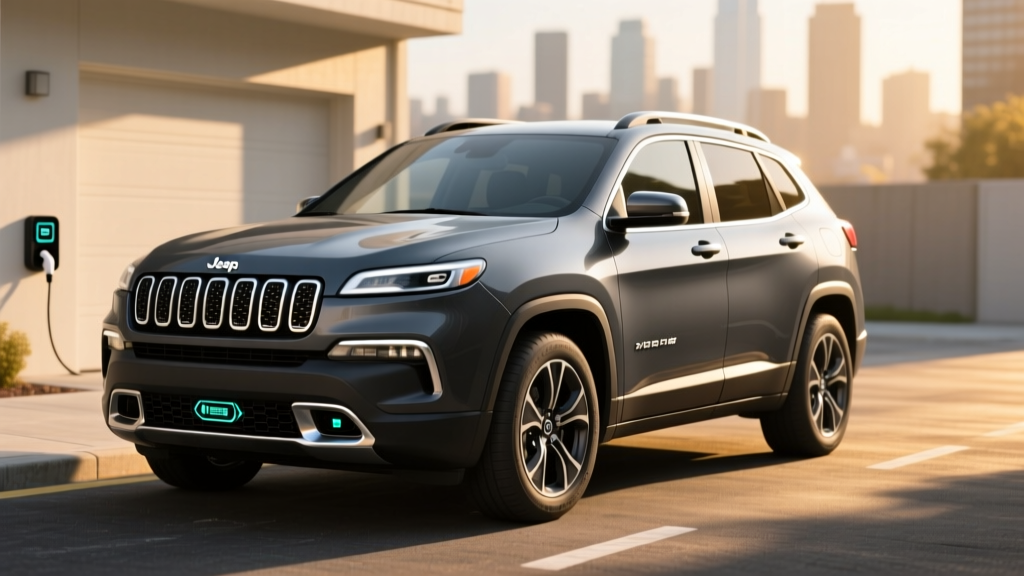
After a multi-year hiatus, Jeep reintroduced the Cherokee nameplate for the 2026 model year with a compact SUV platform that includes a hybrid powertrain option. The 2026 Jeep Cherokee Hybrid SUV arrives at a moment when buyers are scrutinizing every dollar at the pump, and Jeep's answer is a two-pronged approach: a conventional hybrid (HEV) that requires no plug-in charging, and a plug-in hybrid (PHEV) variant branded as the Cherokee 4xe that adds meaningful electric-only range for daily commuting.
Both versions share the same 1.6-liter turbocharged inline-four engine paired with an electric motor integrated into Jeep's updated six-speed automatic transaxle. The distinction between them matters enormously for your fuel budget, charging routine, and tax-credit eligibility. Below, we break down every spec that matters — from EPA MPG to battery warranty to real-world efficiency — so you can decide whether the 2026 Cherokee Hybrid fits your driveway.
HEV vs PHEV: Which Cherokee Hybrid Is Which?
Cherokee Hybrid (HEV)
- No plug required. Regenerative braking and the engine recharge a small 1.8 kWh lithium-ion battery.
- Best for: Drivers without home-charging access who want better MPG without changing their fueling routine.
- Tax credit: Does not qualify for the federal §30D EV credit (HEVs are excluded under current IRS rules).
Cherokee 4xe (PHEV)
- Plugs in. A 17.3 kWh usable battery delivers EPA-rated electric-only miles before the engine kicks on.
- Best for: Households with Level 2 home charging who can cover most weekday driving on electricity alone.
- Tax credit: May qualify for up to $3,750 under §30D if battery-sourcing and MSRP caps are met (details below).
Confusing the two is easy at the dealership — the badges look similar, and sales staff sometimes conflate "hybrid" with "plug-in." Always verify the fuel-door area: the PHEV has a charge-port door on the driver-side rear quarter panel; the HEV does not.
Fuel Economy: EPA MPG and Real-World Expectations
| Variant | City MPG | Highway MPG | Combined MPG | Combined MPGe (PHEV) |
|---|---|---|---|---|
| Cherokee Hybrid (HEV) | 37 | 34 | 36 | N/A |
| Cherokee 4xe (PHEV) | 35 (gas-only) | 32 (gas-only) | 33 (gas-only) | 82 MPGe |
Real-world caveat: Like most hybrids, the Cherokee HEV tends to exceed its EPA city figure in stop-and-go traffic where regenerative braking recovers the most energy. Expect 38–41 MPG in urban commuting. Highway efficiency drops to roughly 31–33 MPG at 75+ mph because the electric motor contributes less at sustained high speeds and the turbo-four operates under heavier load.
For the 4xe PHEV, the 82 MPGe rating applies only while the battery has charge. Once the battery is depleted and the vehicle operates as a conventional hybrid, expect 33 MPG combined — slightly less than the dedicated HEV because of the PHEV's heavier battery pack.
Electric-Only Range and Total Range (4xe PHEV)
The 2026 Cherokee 4xe carries a 17.3 kWh usable lithium-ion battery (NMC chemistry) that delivers an EPA-rated 32 miles of electric-only driving. That figure assumes moderate temperatures (65–75°F), flat terrain, and speeds under 55 mph.
EPA Electric-Only Range: 32 miles
Real-World Expectation: 25–29 miles in mixed driving; as low as 20 miles in sub-freezing temperatures or sustained highway speeds above 65 mph.
Total Combined Range (electric + gas): ~430 miles with a full 13.2-gallon tank and a fully charged battery.
For context, a 26-mile round-trip commute falls within the 4xe's electric envelope on most days, meaning many owners will visit a gas station only for longer weekend trips. If your daily driving exceeds 35 miles, the HEV's simpler setup — and lower purchase price — may make more financial sense.
Powertrain, Battery, and Charging Specs
| Specification | Cherokee Hybrid (HEV) | Cherokee 4xe (PHEV) |
|---|---|---|
| Engine | 1.6L turbo I-4 | 1.6L turbo I-4 |
| Electric Motor | Integrated starter-generator (44 hp) | Permanent-magnet synchronous (134 hp) |
| Combined Horsepower | 210 hp | 275 hp |
| Combined Torque | 250 lb-ft | 330 lb-ft |
| Battery Capacity | 1.8 kWh | 17.3 kWh usable |
| Battery Chemistry | NMC | NMC |
| Transmission | 6-speed automatic | 6-speed automatic |
| Drivetrain | AWD standard | AWD standard |
| 0–60 mph | 7.8 sec (est.) | 6.5 sec (est.) |
| Level 1 Charging (120V) | N/A | ~12 hours (0–100%) |
| Level 2 Charging (240V, 7.2 kW) | N/A | ~2.5 hours (0–100%) |
| DC Fast Charging | N/A | Not available |
A critical note on DC fast charging: the Cherokee 4xe does not support DC fast charging. The onboard charger maxes out at 7.2 kW on Level 2 AC. This is typical for compact PHEVs — the battery is small enough that a full charge in 2.5 hours on Level 2 is practical for overnight or workplace top-ups. If you need rapid 20-minute DC charging, you are looking at a full battery-electric vehicle (BEV), not a PHEV.
Pricing, Trims, and Tax Credit Eligibility
| Trim | Variant | MSRP (incl. destination) |
|---|---|---|
| Latitude | HEV | $34,495 |
| Latitude Lux | HEV | $38,295 |
| Limited | HEV | $41,595 |
| Limited | 4xe PHEV | $43,995 |
| Trailhawk | 4xe PHEV | $46,495 |
Federal Tax Credit for the Cherokee 4xe
Under the current IRS §30D rules, the Cherokee 4xe PHEV may qualify for a federal tax credit of up to $3,750 — not the full $7,500. The reduction reflects battery-component and critical-mineral sourcing requirements that many PHEVs only partially satisfy for the 2026 tax year. Key eligibility constraints:
- MSRP cap: SUVs must be under $80,000 — all Cherokee 4xe trims qualify.
- Buyer income cap: Modified AGI must not exceed $150,000 (single), $225,000 (head of household), or $300,000 (joint).
- Battery sourcing: The credit amount depends on the percentage of critical minerals and battery components sourced from the U.S. or FTA partners. Verify current-year compliance on the IRS clean vehicle credit page before purchasing.
- Point-of-sale transfer: You can transfer the credit to the dealer at purchase to reduce your out-of-pocket cost, but you must still meet income requirements when you file taxes — if your AGI exceeds the cap, you will owe the credit back.
The conventional HEV models do not qualify for any federal purchase credit. Some states and utilities offer rebates for hybrids — check your local programs via the Alternative Fuels Data Center.
Battery Warranty, Reliability, and Replacement Cost
Hybrid/PHEV Battery Warranty: 10 years / 100,000 miles (whichever comes first), covering capacity loss below 70% of original rated capacity.
Powertrain Warranty: 5 years / 60,000 miles.
Bumper-to-Bumper: 3 years / 36,000 miles.
Jeep's hybrid battery warranty aligns with the industry standard set by Toyota and Hyundai — 10 years or 100,000 miles. The warranty guarantees that the high-voltage battery will retain at least 70% of its original capacity. In practice, NMC batteries in PHEVs with active thermal management typically degrade 1.5–2.5% per year under normal use, meaning you should still see 80–85% capacity at the 10-year mark.
Out-of-warranty replacement cost: If the high-voltage battery requires full replacement after the warranty period, expect a dealer-installed cost between $6,500 and $9,000 for the PHEV pack and $2,500–$3,500 for the smaller HEV pack. Independent hybrid-battery shops can sometimes refurbish individual modules for $1,500–$3,000.
For reliability context, the 2026 Cherokee is too new for long-term data. However, Jeep's parent company Stellantis has deployed this 1.6L turbo hybrid architecture in European-market models since 2023 with no widespread battery-failure reports. Jeep's overall brand reliability has historically ranked mid-to-low in Consumer Reports surveys, though hybrid-specific powertrain complaints remain rare across the industry.
Who Should Choose the Cherokee Hybrid — and Who Shouldn't?
Choose the Cherokee Hybrid (HEV) if:
- You lack access to home or workplace Level 2 charging.
- You want better MPG without changing your fueling habits.
- Your budget is under $40,000 and you don't want to rely on tax-credit eligibility.
- You drive mostly in the city where hybrid efficiency peaks.
Choose the Cherokee 4xe (PHEV) if:
- You can install a Level 2 charger at home (240V, 30–40A circuit).
- Your daily commute is under 30 miles round-trip.
- You want EV-like daily driving with gas-engine flexibility for road trips.
- You meet §30D income and sourcing requirements to capture the $3,750 credit.
Choose a Full BEV Instead if:
- You want zero tailpipe emissions and access to DC fast charging for road trips.
- Your daily driving regularly exceeds 40 miles and you want to avoid burning gas entirely.
- You qualify for the full $7,500 federal credit on a BEV like the Hyundai Ioniq 5 or Tesla Model Y.
Pros
- Standard AWD across all trims — rare for the compact hybrid SUV segment.
- HEV achieves 37 city MPG without any charging infrastructure.
- 4xe PHEV's 32-mile electric range covers most commutes.
- Trailhawk 4xe offers genuine off-road capability (2.0:1 low-range, skid plates, 8.7" ground clearance) with hybrid efficiency.
- 10-year/100,000-mile battery warranty provides long-term peace of mind.
Cons
- No DC fast charging on the 4xe — limits electric driving to home/work charging.
- PHEV trims start above $43,000 before options — steep for a compact SUV.
- HEV does not qualify for any federal purchase credit.
- Cargo space reduced by ~3 cu ft in 4xe due to battery placement (25.2 cu ft vs 28.4 cu ft in HEV).
- Brand reliability history lags Toyota and Honda in third-party surveys.
Frequently Asked Questions
How many MPG does the 2026 Jeep Cherokee Hybrid get?
The conventional Cherokee Hybrid (HEV) is EPA-rated at 37 city / 34 highway / 36 combined MPG. The Cherokee 4xe PHEV delivers 82 MPGe while operating on battery power and 33 MPG combined once the battery is depleted and the gasoline engine takes over.
How far can the Cherokee 4xe go on electric only?
The EPA rates the 2026 Cherokee 4xe at 32 miles of electric-only range. In real-world mixed driving, expect 25–29 miles; in cold weather or at highway speeds, that can drop to around 20 miles before the engine engages.
Does the Cherokee Hybrid need to be plugged in?
No. The conventional Cherokee Hybrid (HEV) recharges its small battery entirely through regenerative braking and the gasoline engine. Only the Cherokee 4xe (PHEV) variant benefits from plug-in charging — and it can still operate as a standard hybrid if you never plug it in.
Is the hybrid battery reliable and what does replacement cost?
Jeep covers the high-voltage battery with a 10-year / 100,000-mile warranty against capacity loss below 70%. Out-of-warranty full replacement runs $6,500–$9,000 for the 4xe PHEV and $2,500–$3,500 for the HEV. Industry-wide, hybrid battery failures before 150,000 miles are uncommon when the thermal management system is maintained.
Does the 2026 Cherokee Hybrid qualify for a tax credit?
The Cherokee 4xe PHEV may qualify for up to $3,750 under the federal §30D credit, subject to buyer income caps ($300,000 joint / $150,000 single), MSRP limits (under $80,000 for SUVs), and battery-sourcing requirements. The conventional HEV does not qualify for any federal purchase credit. Always verify current-year rules on IRS.gov before committing to a purchase.
Can I tow with the Cherokee Hybrid?
Yes. The Cherokee HEV is rated for 2,000 pounds of towing capacity. The Cherokee 4xe PHEV is rated for 1,750 pounds due to the added battery weight reducing payload margin. Neither matches the 4,000-pound rating of the larger Grand Cherokee, so plan accordingly if you haul a small trailer or boat.