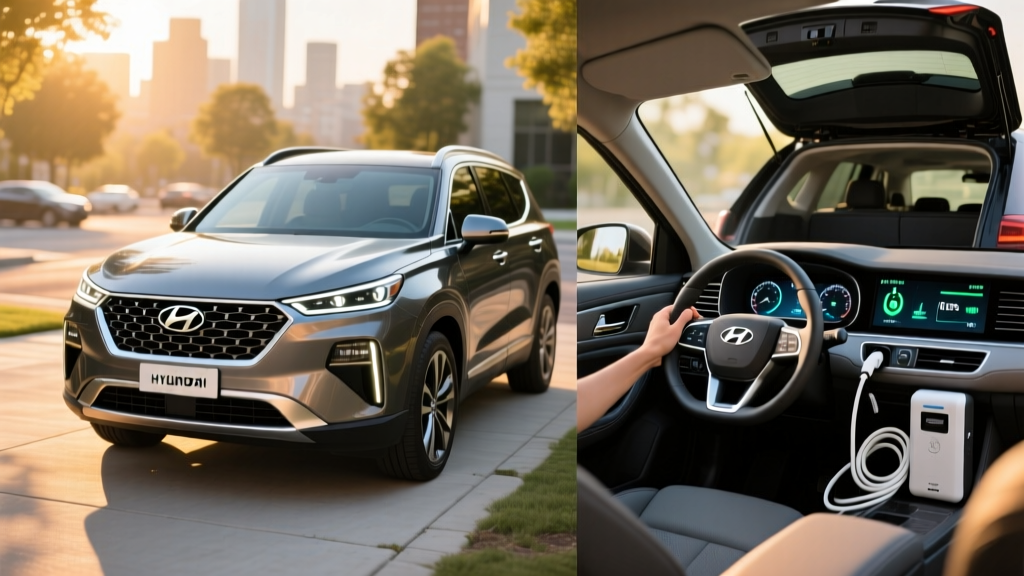
The 2026 Hyundai Santa Fe Hybrid SE arrives as the value-oriented entry point into Hyundai's boxy, three-row midsize SUV lineup — but "value" doesn't mean stripped-down. With a turbocharged 1.6-liter hybrid powertrain producing 230 horsepower, standard all-wheel drive, and an EPA-estimated 36 MPG combined, the SE trim targets families who want three-row practicality without the fuel bill of a conventional gas SUV or the charging logistics of a full battery-electric vehicle.
This guide breaks down the exact specs, real-world fuel economy expectations, warranty coverage, tax credit eligibility, and whether the Santa Fe Hybrid SE is the right fit compared to its plug-in hybrid sibling or a full EV like the Hyundai Ioniq 5.
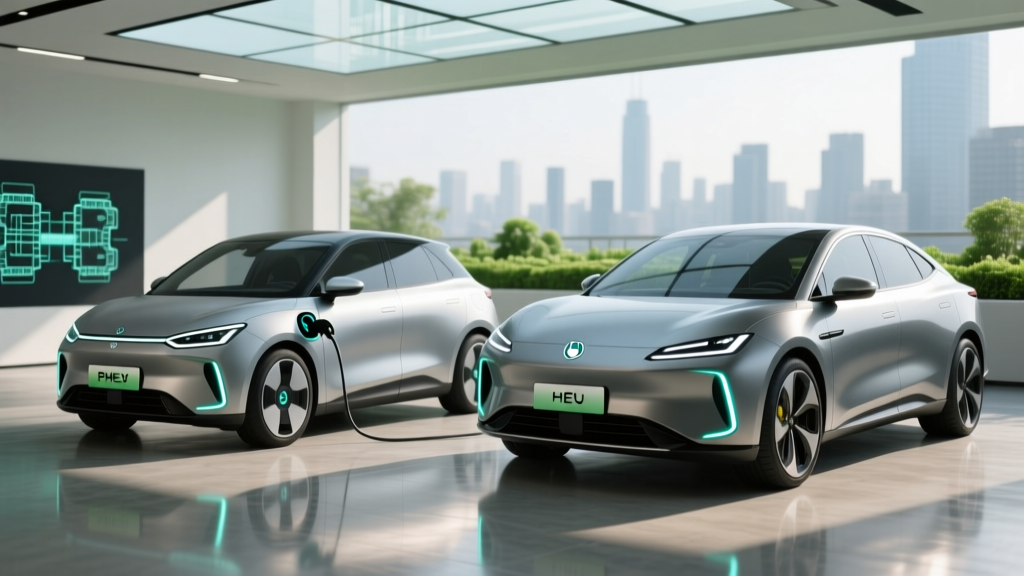
HEV vs PHEV: Which Santa Fe Hybrid Are We Talking About?
Hyundai sells the Santa Fe in two electrified flavors for 2026, and confusing them is the single most common buyer mistake:
| Feature | Santa Fe Hybrid (HEV) | Santa Fe Plug-In Hybrid (PHEV) |
|---|---|---|
| Needs to plug in? | No — self-charging via engine + regen | Yes — has a larger battery you charge at home or public stations |
| Battery capacity | ~1.5 kWh (small, assists engine) | ~13.8 kWh usable (enables EV-only driving) |
| Electric-only range | Not applicable (motor only assists) | ~30 miles EPA-estimated |
| EPA combined MPG / MPGe | 36 MPG combined | 79 MPGe (electric mode) / 33 MPG (gas-only) |
| Starting MSRP (2026) | ~$38,000 (SE trim) | ~$44,500 (SEL trim minimum) |
| Federal tax credit | Not eligible (§30D requires plug-in) | Up to $7,500 if §30D sourcing/income rules met |
This article focuses on the conventional hybrid (HEV) SE trim. If you're interested in the plug-in variant's electric-only range and tax credit potential, we cover the comparison later in this guide.
Fuel Economy: EPA Numbers vs Real-World MPG
The 2026 Santa Fe Hybrid SE carries the following EPA fuel economy estimates, per fueleconomy.gov:
| Driving Cycle | EPA Estimate |
|---|---|
| City | 36 MPG |
| Highway | 35 MPG |
| Combined | 36 MPG |
That flat city/highway split is typical of Toyota and Hyundai hybrid systems — the electric motor handles low-speed driving where gas engines are least efficient, effectively erasing the traditional city MPG penalty.
Real-World MPG: What to Actually Expect
EPA numbers are a baseline, not a guarantee. Here's how the Santa Fe Hybrid SE performs in practice:
- City and suburban driving: Expect to match or slightly exceed the 36 MPG city figure. Hybrids thrive in stop-and-go traffic where regenerative braking recovers energy constantly. Owners on mixed suburban commutes routinely report 37–39 MPG in warm weather.
- Highway cruising (70–80 mph): Aerodynamic drag on the Santa Fe's boxy, SUV-profile body works against it. Expect 32–34 MPG at sustained interstate speeds — roughly 2–3 MPG below the EPA highway figure.
- Cold weather (below 30°F): The engine runs more often to heat the cabin and maintain battery temperature. Plan for a 10–15% fuel economy drop, landing around 30–32 MPG combined in winter conditions.
- Mountainous terrain: Regenerative braking on descents partially offsets climbing fuel consumption, but loaded with passengers and cargo at altitude, expect 28–31 MPG on steep routes.
For a three-row AWD SUV, these are genuinely strong numbers. A comparably sized gas-only midsize SUV (like the non-hybrid Santa Fe or Kia Telluride) averages 22–24 MPG combined — meaning the hybrid saves roughly 3–4 gallons per 100 miles driven.
Powertrain and Performance Specs
| Specification | 2026 Santa Fe Hybrid SE |
|---|---|
| Engine | 1.6L Turbocharged 4-cylinder |
| Electric motor | 47.7 kW (64 hp) permanent-magnet synchronous |
| Combined system output | 230 hp / 271 lb-ft torque |
| Transmission | 6-speed automatic |
| Drivetrain | AWD (standard on all trims) |
| 0–60 mph | ~7.8 seconds (est.) |
| Towing capacity | 2,000 lbs |
| Hybrid battery | ~1.5 kWh lithium-ion (self-charging) |
| Fuel tank | 17.7 gallons |
| Total driving range | ~637 miles (EPA combined) |
The turbocharged 1.6L paired with Hyundai's hybrid system delivers confident acceleration for highway merging and loaded driving. The 230 hp figure isn't sports-SUV territory, but the 271 lb-ft of torque — available low in the rev range thanks to electric motor assist — makes the Santa Fe Hybrid feel more responsive than the horsepower number suggests.
Standard HTRAC all-wheel drive uses the electric motor to power the rear axle, providing traction without the mechanical drag of a traditional driveshaft. This system contributes to the hybrid's strong efficiency numbers.
Pricing, Trims, and Tax Credit Eligibility
The 2026 Hyundai Santa Fe Hybrid SE starts at approximately $38,000 MSRP (including destination charge). This positions it roughly $3,000–$4,000 above the gas-only Santa Fe SE but $6,000+ below the plug-in hybrid variant.
Does the Santa Fe Hybrid SE Qualify for a Federal Tax Credit?
No. The conventional Santa Fe Hybrid (HEV) does not qualify for the IRS §30D Clean Vehicle Credit. That credit is reserved for plug-in electric vehicles with a battery capacity of at least 7 kWh — the Santa Fe Hybrid's ~1.5 kWh battery falls well short of this threshold.
The Santa Fe Plug-In Hybrid, however, may qualify for up to $7,500 under §30D, subject to current-year rules including:
- MSRP cap: SUVs must be priced at or below $80,000
- Buyer income limits: $150,000 single / $225,000 head of household / $300,000 joint filers (modified AGI)
- Battery sourcing: Critical minerals and battery components must meet phased-in domestic/free-trade-agreement sourcing percentages — check the latest IRS guidance for current-year eligible VINs
- Point-of-sale transfer: Eligible buyers can apply the credit as a down payment reduction at the dealership rather than waiting for tax filing
If the $7,500 credit applies to the PHEV, the effective price gap between the Hybrid SE (~$38,000) and the PHEV (~$44,500 – $7,500 = ~$37,000) nearly disappears — making the plug-in variant a compelling alternative if you can charge at home.
Battery Warranty, Reliability, and Replacement Costs
Hyundai Hybrid Battery Warranty
Hyundai covers the Santa Fe Hybrid's battery system with a 10-year / 100,000-mile warranty (whichever comes first). This covers the hybrid battery pack, battery control module, and related power electronics against defects and excessive capacity loss.
For original owners in CARB-adopting states (California, New York, Colorado, and others), the hybrid battery may also fall under 10-year / 150,000-mile emissions warranty provisions.
Is the Santa Fe Hybrid Reliable?
Hyundai's turbocharged 1.6L hybrid powertrain has been in service across the Tucson Hybrid, Sonata Hybrid, and Santa Fe Hybrid since the early 2020s. The system has proven generally dependable, with no widespread battery failure patterns. Hyundai's hybrid battery chemistry and management system is conservative — the small ~1.5 kWh pack is never deeply cycled, which dramatically extends cell life.
Unlike full EVs, where the traction battery is the single most expensive component, the hybrid battery in the Santa Fe is small and relatively affordable to replace out of warranty. Based on current parts and labor estimates:
- Hybrid battery replacement cost: $2,500–$4,000 (parts + labor at a dealership)
- Expected lifespan: Most hybrid batteries outlast the vehicle itself — 150,000–200,000+ miles is common with normal use
For comparison, a full EV battery replacement (like the Ioniq 5's 77.4 kWh pack) can cost $12,000–$20,000+ out of warranty. The hybrid's small battery is a fraction of that risk.
Hybrid vs PHEV vs Full EV: Which Fits Your Life?
Decision Framework: Which Santa Fe Powertrain Is Right for You?
Choose the Santa Fe Hybrid (HEV) SE if:
- You cannot charge at home (apartment, street parking, no garage)
- You want maximum simplicity — no plugs, no charging apps, no route planning
- Your budget is firm around $38,000 and you don't qualify for the PHEV tax credit
- You drive a mix of city and highway and want consistent 33–38 MPG without thinking about it
Choose the Santa Fe Plug-In Hybrid if:
- You can install a Level 2 home charger (240V) and most daily trips are under 30 miles
- You qualify for the §30D tax credit (income and sourcing rules met), making the effective price competitive with the HEV
- You want to drive on electricity for daily commuting but need gas flexibility for longer road trips
Choose a full EV (like the Hyundai Ioniq 5 or Kia EV9) if:
- You can charge at home and have access to DC fast charging for road trips
- You want zero tailpipe emissions, minimal maintenance (no oil changes, no transmission fluid), and the lowest per-mile fuel cost
- Your household has a second gas or hybrid vehicle for rare long trips, or your road trips are within the EV's 250–300 mile range
Pros and Cons of the 2026 Santa Fe Hybrid SE
Pros
- 36 MPG combined is exceptional for a three-row AWD SUV
- Standard AWD with no efficiency penalty vs FWD
- 10-year / 100,000-mile hybrid battery warranty
- No plug-in charging required — works with your existing routine
- 637-mile total range means fewer fuel stops on road trips
- Boxy design yields strong cargo volume and third-row headroom
Cons
- No federal tax credit eligibility (unlike the PHEV variant)
- Highway MPG drops to ~32–34 at sustained 75+ mph speeds
- 2,000-lb towing capacity is limited for boat or camper trailers
- SE trim lacks premium features (ventilated seats, premium audio) found on higher trims
- 230 hp is adequate but not quick for a loaded three-row SUV
Ownership Costs: 5-Year Fuel Savings vs Gas-Only Santa Fe
Here's what the hybrid premium actually buys you in fuel savings, assuming 15,000 miles per year and $3.50/gallon regular unleaded:
| Cost Factor | Santa Fe Hybrid SE (36 MPG) | Santa Fe Gas AWD (24 MPG) |
|---|---|---|
| Annual fuel cost | ~$1,458 | ~$2,188 |
| 5-year fuel cost | ~$7,292 | ~$10,938 |
| 5-year fuel savings | ~$3,646 saved with hybrid | |
| MSRP difference | ~$3,500 hybrid premium | |
| Net 5-year savings | ~$146 (break-even point reached around year 5) | |
The hybrid essentially pays for its own premium within five years of average driving — and that's before factoring in potentially stronger resale value as fuel prices fluctuate. If gas prices rise above $4.00/gallon, the payback period shortens to roughly 3.5 years.
Frequently Asked Questions
How many MPG does the 2026 Hyundai Santa Fe Hybrid SE get?
The EPA rates the 2026 Santa Fe Hybrid SE at 36 MPG city, 35 MPG highway, and 36 MPG combined. In real-world driving, city and suburban commuters often see 37–39 MPG, while sustained highway driving at 75+ mph typically yields 32–34 MPG. Cold weather can reduce combined efficiency to around 30–32 MPG.
Does the Santa Fe Hybrid need to be plugged in?
No. The conventional Santa Fe Hybrid (HEV) is a self-charging system. The small ~1.5 kWh battery recharges through regenerative braking and the gas engine. You never plug it in — you simply fill up at the gas station as you would with any other vehicle. Only the Santa Fe Plug-In Hybrid (PHEV) requires a charging cable.
Is the hybrid battery expensive to replace?
Out of warranty, a Santa Fe Hybrid battery replacement runs approximately $2,500–$4,000 including labor. However, Hyundai's 10-year/100,000-mile hybrid battery warranty covers defects and excessive degradation. In practice, Toyota and Hyundai hybrid batteries routinely last 150,000–200,000+ miles without requiring replacement, because the small battery is never deeply discharged.
How far can the Santa Fe Hybrid drive on a full tank?
With a 17.7-gallon fuel tank and a 36 MPG combined EPA rating, the Santa Fe Hybrid SE has a theoretical range of approximately 637 miles. In real-world mixed driving, expect 550–600 miles between fill-ups. Highway-only road trips may stretch that to 580–620 miles if you maintain moderate speeds.
Hybrid vs PHEV vs EV — which Santa Fe should I buy?
If you can't charge at home, the Hybrid (HEV) is the clear choice — zero lifestyle change required. If you have home charging and qualify for the §30D tax credit, the Plug-In Hybrid (PHEV) offers ~30 miles of electric-only commuting at an effective price near the HEV after the credit. If you want the lowest running costs and can charge at home with access to DC fast charging, a full EV like the Ioniq 5 eliminates gas entirely — but requires planning for road trips beyond its ~260-mile real-world range.
Does the 2026 Santa Fe Hybrid SE qualify for any tax credit?
The conventional hybrid (HEV) does not qualify for the federal §30D Clean Vehicle Credit, which requires a plug-in vehicle with at least 7 kWh of battery capacity. Some states and utilities offer small rebates for hybrid purchases — check your state energy office or local utility for current programs. The Santa Fe Plug-In Hybrid may qualify for up to $7,500 federally if you meet income, MSRP, and battery sourcing requirements per current IRS rules.
What's the towing capacity of the Santa Fe Hybrid?
The 2026 Santa Fe Hybrid is rated to tow up to 2,000 pounds when properly equipped. That's sufficient for a small utility trailer or a pair of jet skis, but not enough for most boat trailers or travel campers. If you need 3,500+ lb towing, you'll need to look at body-on-frame SUVs or the gas-only Santa Fe with the 2.5T engine (rated at 3,500 lbs).
Specs and pricing reflect 2026 model-year data available at time of publication. Always verify current MSRP, EPA ratings, and tax credit eligibility on Hyundai's official site and fueleconomy.gov before purchasing.