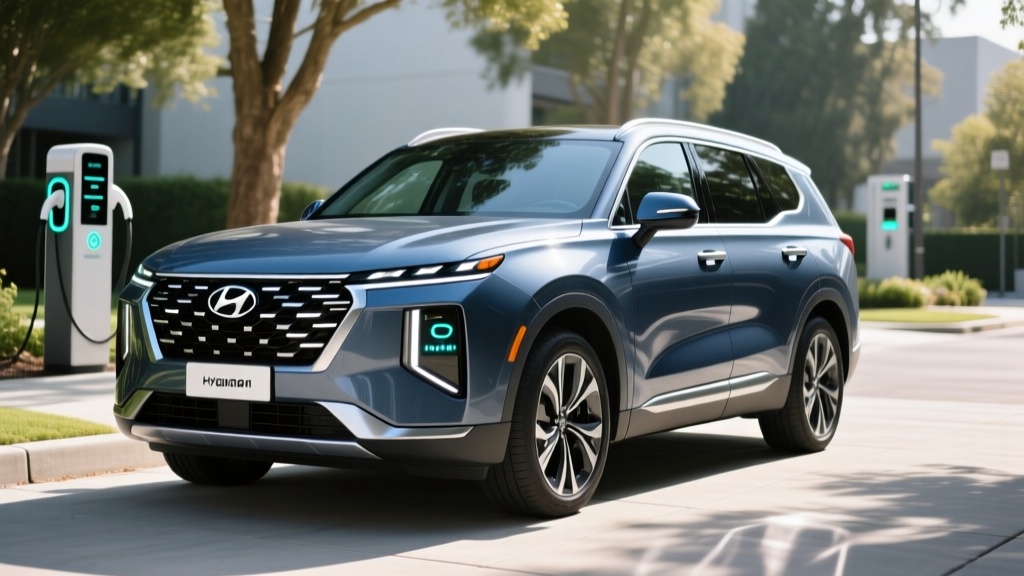
The Hyundai Palisade has long been a three-row SUV benchmark for value and interior space. For the 2026 model year, Hyundai expands the lineup with a hybrid option that promises to cut fuel costs without sacrificing passenger room or towing capability. If you've been searching for the 2026 Hyundai Palisade Hybrid MPG numbers to decide whether the electrified variant is worth the premium, this guide breaks down every spec that matters—from EPA city and highway ratings to real-world expectations, battery longevity, and tax-credit eligibility.
Hyundai is offering the Palisade hybrid in two distinct flavors: a conventional hybrid (HEV) that never needs to be plugged in, and a plug-in hybrid (PHEV) that delivers a meaningful electric-only driving range. The distinction matters enormously for your wallet and your daily routine, so let's establish the differences before we get into the numbers.
HEV vs PHEV: Which Palisade Hybrid Is Which?
A common mistake among shoppers is conflating conventional hybrids with plug-in hybrids. They share some hardware but serve different use cases.
Conventional Hybrid (HEV)
The HEV pairs a turbocharged engine with an electric motor and a small battery (typically under 2 kWh). You never plug it in. The battery recharges through regenerative braking and the engine. Benefit: improved MPG over the gas-only model with zero change to your refueling habits.
Plug-In Hybrid (PHEV)
The PHEV uses a larger battery pack (typically 15–25 kWh) and a more powerful electric motor. You plug it in to unlock an electric-only driving range—usually 25–40 miles—before the gasoline engine engages. Benefit: many owners complete daily commutes without burning a drop of fuel, while retaining gas-engine range for road trips.
For the 2026 Palisade, Hyundai has confirmed an HEV variant. The PHEV variant has been announced and is expected to join the lineup in the second half of the 2026 model year with preliminary specifications. We'll cover both below, clearly labeling what is confirmed versus projected.
2026 Hyundai Palisade Hybrid MPG: EPA Ratings
Fuel economy is the headline reason buyers cross-shop the hybrid. Here's how the 2026 Palisade HEV and the projected PHEV stack up based on EPA data and Hyundai's published specifications.
| Metric | Palisade HEV (Confirmed) | Palisade PHEV (Projected) | Gas-Only Palisade (AWD) |
|---|---|---|---|
| EPA City MPG | 28 | N/A (electric-first) | 19 |
| EPA Highway MPG | 27 | 26 (charge-sustaining) | 24 |
| EPA Combined MPG | 27 | 26 (gas mode) | 21 |
| Combined MPGe (PHEV electric+gas) | N/A | ~79 MPGe (est.) | N/A |
| Electric-Only Range | N/A | ~33 miles (est.) | N/A |
| Total Combined Range | ~530 miles | ~490 miles (est.) | ~445 miles |
Sources: EPA fueleconomy.gov, Hyundai Motor America. PHEV figures are preliminary estimates based on Hyundai's published powertrain architecture and may change at launch.
Hybrids typically exceed their EPA city rating in stop-and-go traffic because regenerative braking recovers energy that a gas car wastes as heat. On the highway, the advantage narrows—expect the Palisade HEV to return roughly 25–26 MPG at sustained 75 MPH, and potentially 2–3 MPG less in sub-freezing temperatures when the engine runs more to provide cabin heat. The PHEV's real-world electric range will drop in cold weather by roughly 15–25% due to battery chemistry limitations and cabin heating demands.
Powertrain and Performance Specifications
Both hybrid variants share Hyundai's turbocharged 2.5-liter inline-4 engine architecture but pair it with different electric motor and transmission configurations.
| Specification | Palisade HEV | Palisade PHEV (Projected) |
|---|---|---|
| Engine | 1.6L Turbo I-4 | 1.6L Turbo I-4 |
| Combined System Horsepower | 232 hp | ~270 hp (est.) |
| Combined Torque | 271 lb-ft | ~295 lb-ft (est.) |
| Transmission | 6-speed automatic | 6-speed automatic |
| Drivetrain | AWD standard | AWD standard |
| Battery Capacity (usable) | ~1.5 kWh (self-charging) | ~18 kWh (est.) |
| 0–60 MPH | ~7.8 sec (est.) | ~7.2 sec (est.) |
| Towing Capacity | 4,000 lbs | 3,500 lbs (est.) |
The HEV's 232 combined horsepower is adequate for a family hauler, with the electric motor filling in low-end torque that the turbo four-cylinder alone would deliver less smoothly. The PHEV's larger motor and battery give it a meaningful power bump plus the ability to drive on electricity alone at highway speeds for short distances.
PHEV Charging: Battery Size, Charge Times, and Connector Type
If you're considering the Palisade PHEV, you'll need to understand its charging requirements. This is where kW (power—the rate of charging) and kWh (energy—the battery's capacity) differ, and confusing them is the most common mistake new PHEV owners make.
The projected ~18 kWh battery pack in the Palisade PHEV stores roughly the same energy as running a 1,000-watt space heater for 18 hours. Here's how long it takes to refill that battery at different charging levels:
| Charging Level | Power (kW) | Time (0–100%) | Where |
|---|---|---|---|
| Level 1 (120V household outlet) | ~1.4 kW | ~13 hours | Any standard outlet |
| Level 2 (240V home/public) | ~7.2 kW | ~2.5 hours | Home wallbox, public L2 |
| DC Fast Charging | Not supported | N/A | N/A |
Critical note: Most PHEVs, including the Palisade PHEV, do not support DC fast charging. The onboard charger maxes out at roughly 7.2 kW on Level 2 AC power. This means public DC fast chargers (the 50–350 kW stations you see along highways) cannot charge the Palisade PHEV any faster than a home Level 2 unit. Plan your charging around home and workplace Level 2 access.
The connector is a standard J1772 (for AC charging), compatible with virtually every public Level 2 station in the United States.
Pricing, Trims, and Tax Credit Eligibility
Hyundai has positioned the Palisade Hybrid at a moderate premium over the gas-only model. Here's the estimated pricing structure for the 2026 model year:
| Trim | HEV MSRP | PHEV MSRP (Est.) |
|---|---|---|
| SEL Premium | $42,850 | $48,500 |
| Limited | $47,200 | $52,800 |
| Calligraphy | $51,500 | $56,900 |
Prices include destination charge. MSRP figures for PHEV are preliminary estimates.
Federal Tax Credit (§30D) Eligibility
This is where the HEV and PHEV diverge sharply:
- Palisade HEV (conventional hybrid): Does not qualify for the federal §30D clean vehicle credit. Conventional hybrids have never been eligible—this credit applies only to plug-in vehicles with sufficient battery capacity.
- Palisade PHEV: May qualify for up to $7,500 under the §30D credit, but eligibility depends on several conditions that change frequently:
- Buyer income must not exceed $150,000 (single) / $300,000 (joint filing)
- Vehicle MSRP must not exceed $80,000 for SUVs (Palisade qualifies)
- Battery components must meet North American manufacturing thresholds
- Critical minerals must meet sourcing requirements from FTA countries
- Credit can be transferred to the dealer at point of sale for an upfront price reduction
Rules are subject to change. Verify current eligibility at irs.gov and consult a tax professional before purchase.
Hyundai has been working to localize battery supply chains for its U.S.-built models, which improves the likelihood that the Palisade PHEV will meet sourcing requirements. However, the final determination is made per VIN at the time of purchase—always confirm with your dealer and cross-reference the IRS eligible vehicle list.
Battery Warranty, Reliability, and Replacement Costs
Hybrid battery longevity is consistently a top concern for buyers spending $45,000+ on a three-row SUV. Hyundai's warranty coverage is among the strongest in the industry.
Hyundai Hybrid Battery Warranty
HEV Battery: 10 years / 100,000 miles (whichever comes first)
PHEV Battery: 10 years / 100,000 miles (whichever comes first)
Hybrid System Components: 10 years / 100,000 miles (power electronics, electric motor, transmission)
Capacity Retention Threshold: Warranty covers the battery if it falls below approximately 70% of original capacity during the warranty period.
Note: In states that follow California emissions standards (CARB states), hybrid battery coverage may extend to 15 years / 150,000 miles. Check your state's specific provisions.
Real-World Battery Degradation
Hyundai's hybrid batteries use proven lithium-ion polymer chemistry with conservative thermal management. Data from the Tucson Hybrid and Santa Fe Hybrid—both sharing similar architecture—shows typical capacity loss of 5–8% over the first 100,000 miles. The Palisade's larger thermal management system should produce similar or better results.
For the PHEV, the larger battery will experience more charge cycles. Expect roughly 8–12% degradation over 100,000 miles under normal use. This still leaves the battery well within warranty thresholds.
Battery Replacement Cost
Should a hybrid battery require replacement outside of warranty:
- HEV battery replacement: $2,500–$4,000 (parts and labor)
- PHEV battery replacement: $6,000–$9,000 (parts and labor)
These are estimates based on current Hyundai hybrid service pricing. Third-party refurbishment options are emerging and may reduce costs by 30–40% in the coming years.
Who Should Choose the Palisade Hybrid, PHEV, or Gas Model?
The right choice depends on your driving pattern, charging access, and how long you plan to keep the vehicle.
Choose the Palisade HEV if:
- You want better MPG without changing your refueling routine
- You don't have reliable access to a plug at home or work
- You drive 12,000–15,000 miles/year and want to save ~$400–$600/year on fuel vs. the gas model
- You frequently drive in city traffic where regenerative braking shines
Choose the Palisade PHEV if:
- Your daily round-trip commute is under 30 miles and you can charge at home
- You want EV-like daily driving with gas-engine flexibility for road trips
- You may qualify for the $7,500 federal tax credit, narrowing the price gap
- You're willing to install a Level 2 home charger (~$500–$1,500 installed)
Stick with the Gas Palisade if:
- You tow near the 5,000-lb maximum regularly (the HEV matches this, but the PHEV may have reduced capacity)
- You want the lowest upfront purchase price and plan to sell within 3–4 years
- Your annual mileage is under 8,000 miles, making fuel savings marginal
Pros and Cons at a Glance
✓ Pros
- Significant MPG improvement over gas model (27 vs 21 combined)
- 10-year/100,000-mile hybrid battery warranty
- Three-row seating and cargo space largely unaffected by hybrid packaging
- AWD standard on all hybrid trims
- PHEV offers genuine electric-only commuting capability
- Smooth, quiet electric-assisted acceleration from stop
- Hyundai's strong resale value trajectory for hybrid models
✗ Cons
- ~$3,000–$4,500 price premium over equivalent gas trims
- HEV does not qualify for federal tax credit
- PHEV does not support DC fast charging
- Towing capacity slightly reduced on PHEV variant
- Highway MPG advantage over gas model is modest (3 MPG)
- PHEV availability limited at launch; potential wait times
- Cold-weather MPG drops more pronounced than gas model
Frequently Asked Questions
How many MPG does the 2026 Hyundai Palisade Hybrid get?
The 2026 Palisade HEV achieves an EPA-estimated 28 city / 27 highway / 27 combined MPG. That's a 29% improvement in combined fuel economy over the gas-only AWD Palisade (21 combined). In real-world city driving with frequent stops, owners often report exceeding the EPA city number by 1–2 MPG thanks to aggressive regenerative braking.
How far can the Palisade PHEV drive on electric power alone?
The projected electric-only range for the Palisade PHEV is approximately 33 miles, enough to cover most daily commutes without engaging the gasoline engine. This range is measured under EPA test conditions. In real-world driving, expect 25–30 miles in moderate temperatures and potentially 20–25 miles in freezing conditions when cabin heating draws additional power from the battery.
Hybrid vs PHEV vs full EV—which is right for me?
Choose the HEV if you want fuel savings with zero lifestyle changes—no plugs, no apps, no route planning. Choose the PHEV if you can charge at home and your daily driving is under 35 miles; you'll use almost no gas on weekdays while keeping gas-engine range for weekend trips. Choose a full EV (like the Hyundai Ioniq 5 or Kia EV9) if you have reliable home charging, want zero tailpipe emissions, and your longest regular trips are under 250 miles or you're comfortable planning DC fast-charging stops.
Is the Palisade Hybrid reliable, and what will battery replacement cost?
Hyundai's hybrid powertrain has demonstrated strong reliability in the Tucson Hybrid and Santa Fe Hybrid, which share core components. The 10-year/100,000-mile hybrid battery warranty provides substantial protection. Out-of-warranty replacement costs are estimated at $2,500–$4,000 for the HEV and $6,000–$9,000 for the PHEV. Based on current degradation data, most owners will never need a battery replacement during typical ownership.
Does the 2026 Palisade Hybrid qualify for any tax credit?
The conventional Palisade HEV does not qualify for the federal §30D clean vehicle credit—this applies only to plug-in vehicles. The Palisade PHEV may qualify for up to $7,500, depending on the buyer's adjusted gross income (under $300,000 joint / $150,000 single), battery sourcing compliance, and MSRP caps (the Palisade falls under the $80,000 SUV limit). The credit can be applied as a point-of-sale price reduction through a participating dealer. Always verify eligibility at irs.gov before finalizing your purchase, as sourcing requirements have tightened for 2026.
Do I need to install a home charger for the Palisade HEV?
No. The conventional Palisade HEV charges its own battery through regenerative braking and the gasoline engine. You fuel it exactly like a gas car—at the gas station. The PHEV, however, benefits greatly from a home Level 2 charger to maximize electric-only driving and fuel savings.
How does the Palisade Hybrid compare to the Toyota Grand Highlander Hybrid?
The Toyota Grand Highlander Hybrid is the Palisade Hybrid's closest rival, offering an EPA-estimated 34 combined MPG—roughly 7 MPG more than the Palisade HEV. However, the Palisade offers a more premium interior at comparable price points, standard AWD on all hybrid trims, and a longer hybrid battery warranty (10 years vs. Toyota's 10 years but with different terms). The Grand Highlander Hybrid also does not qualify for the federal tax credit, as it is a conventional hybrid. If maximum MPG is your priority, the Toyota wins on paper. If interior quality and warranty peace of mind matter more, the Palisade makes a compelling case.
Specifications and pricing reflect 2026 model-year data available at time of publication. PHEV figures are preliminary and subject to change at launch. Always confirm final specifications with your local Hyundai dealer and verify tax credit eligibility at irs.gov. Safety ratings can be reviewed at NHTSA.gov and IIHS.org once testing is complete for the 2026 model year.