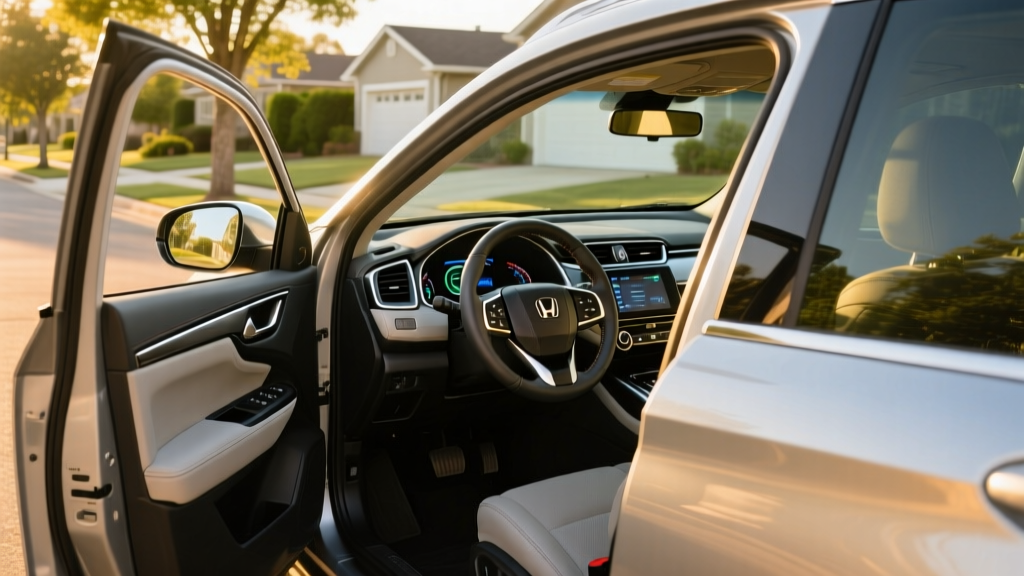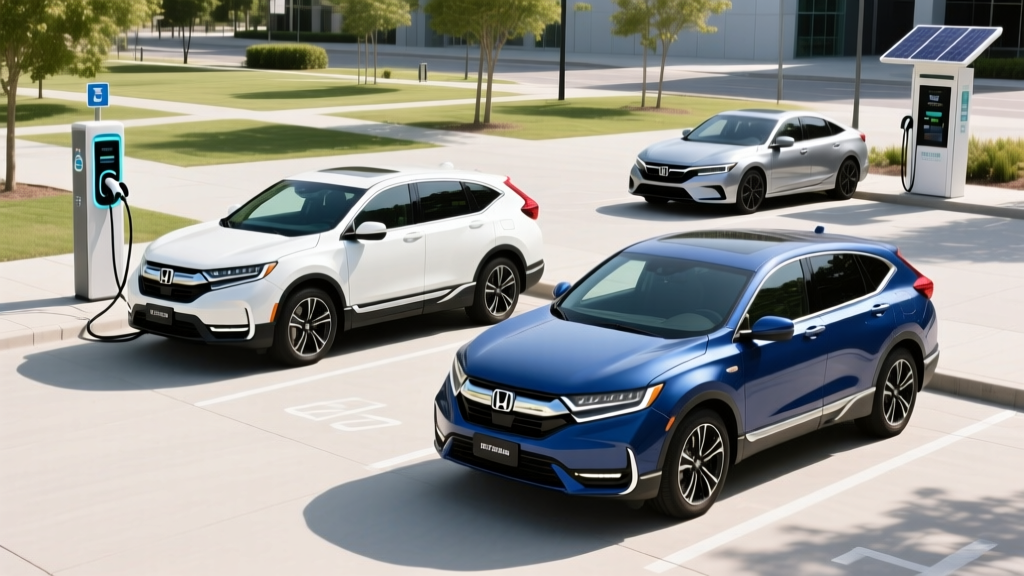
Honda's 2026 hybrid lineup spans three of the best-selling nameplates in America: the CR-V Hybrid compact SUV, the Accord Hybrid midsize sedan, and the Civic Hybrid compact sedan. None of them plug in. All three use Honda's fourth-generation two-motor hybrid system to deliver 40+ MPG in real-world driving without any change to how you refuel. For buyers weighing a hybrid against a plug-in hybrid or a battery-electric vehicle, Honda's approach trades electric-only range for simplicity, lower upfront cost, and proven long-term reliability.
This guide breaks down every 2026 Honda hybrid model by the numbers — EPA MPG, powertrain output, pricing, battery warranty, and ownership economics — so you can decide which one fits your commute, budget, and charging access.
HEV vs PHEV vs EV: Where Honda Hybrids Fit
Before comparing models, it's critical to understand what you're buying. Honda's 2026 hybrids are conventional hybrid electric vehicles (HEVs). They generate electricity onboard through regenerative braking and a gasoline engine — you never plug them in. This distinguishes them from plug-in hybrids (PHEVs) like the Toyota RAV4 Prime or Hyundai Tucson PHEV, which offer 30–40 miles of electric-only range but require home charging to realize their efficiency advantage.
| Attribute | Honda HEV (2026) | Typical PHEV | Battery EV (BEV) |
|---|---|---|---|
| Plug-in charging required? | No | Yes (for EV range) | Yes (always) |
| Electric-only range | ~1 mile (low-speed) | 25–45 miles | 220–400+ miles |
| Typical combined efficiency | 40–51 MPG | 28–38 MPG + 85–100 MPGe | 100–135 MPGe |
| Base price range | $29,000–$36,000 | $38,000–$50,000 | $38,000–$70,000+ |
| Federal tax credit (§30D) | Not eligible | Up to $7,500 (if qualified) | Up to $7,500 (if qualified) |
| Home charger needed? | No | Strongly recommended | Essential |
The decision framework is straightforward: if you have reliable Level 2 home charging and a sub-40-mile commute, a PHEV or BEV can eliminate most or all gasoline use. If you live in an apartment, street-park, or simply want maximum efficiency with zero infrastructure changes, Honda's HEVs deliver 50%+ fuel savings over comparable gas-only models with no behavioral adjustment.
2026 Honda CR-V Hybrid: MPG, Powertrain & Pricing
The CR-V Hybrid is Honda's volume leader and one of the best-selling hybrid SUVs in the U.S. For 2026, it carries over the proven fourth-generation two-motor hybrid powertrain paired with a 2.0-liter Atkinson-cycle inline-four.
| Specification | 2026 CR-V Hybrid (AWD, Sport/L Sport Touring) |
|---|---|
| Combined horsepower | 204 hp |
| Engine | 2.0L Atkinson-cycle I-4 + 2 electric motors |
| EPA city / highway / combined MPG | 40 / 34 / 37 |
| Real-world observed (mixed driving) | 35–42 MPG |
| Fuel tank capacity | 15.3 gallons |
| Total driving range | ~566 miles (EPA combined) |
| 0–60 mph (est.) | 7.6 seconds |
| Cargo volume (behind rear seats) | 36.3 cu ft |
| Starting MSRP (Sport Hybrid AWD) | $36,350 |
| Sport Touring Hybrid AWD MSRP | $40,850 |
| Hybrid battery warranty | 8 years / 100,000 miles (10 yr/150k in CARB states) |
On the EPA cycle, the CR-V Hybrid AWD posts 40 city / 34 highway / 37 combined MPG. In real-world testing, city-heavy commutes frequently push the CR-V into the low-to-mid 40s because the hybrid system relies heavily on the electric motor at low speeds. Highway-heavy road trips at 75+ mph typically return 32–35 MPG, where the gasoline engine operates more often. According to fueleconomy.gov, the combined 37 MPG figure represents a 35% improvement over the gas-only CR-V AWD (28 combined).
Honda offers the CR-V Hybrid exclusively in Sport and Sport Touring trims with standard AWD. At $36,350 for the Sport Hybrid, the premium over the gas-only EX AWD (~$33,350) is roughly $3,000. At current national fuel averages, that premium pays back in approximately 3.5–4 years for a driver covering 15,000 miles annually.
2026 Honda Accord Hybrid: Efficiency King of the Lineup
The Accord Hybrid remains the efficiency benchmark in Honda's lineup. Its aerodynamic sedan profile and refined two-motor system deliver EPA numbers that rival many PHEVs in blended driving — without a plug.
| Specification | 2026 Accord Hybrid (Sport-L / Sport Touring) |
|---|---|
| Combined horsepower | 204 hp |
| Engine | 2.0L Atkinson-cycle I-4 + 2 electric motors |
| EPA city / highway / combined MPG | 51 / 44 / 48 |
| Real-world observed (mixed driving) | 44–55 MPG |
| Fuel tank capacity | 12.4 gallons |
| Total driving range | ~595 miles (EPA combined) |
| 0–60 mph (est.) | 7.1 seconds |
| Trunk volume | 16.7 cu ft |
| Starting MSRP (Sport-L Hybrid) | $33,650 |
| Sport Touring Hybrid MSRP | $38,890 |
| Hybrid battery warranty | 8 years / 100,000 miles (10 yr/150k in CARB states) |
The 48 MPG combined EPA rating is exceptional for a midsize sedan with 204 hp. In city driving, the Accord Hybrid routinely exceeds its sticker — owners and independent testers regularly report 50–55 MPG on urban routes where the electric motor handles the majority of propulsion. Highway driving at sustained 70–80 mph drops efficiency to roughly 40–44 MPG, still ahead of most compact gas cars.
The Accord Hybrid is available in Sport-L and Sport Touring trims. The $33,650 starting price undercuts many non-hybrid midsize competitors when you factor in standard features like Honda Sensing (adaptive cruise, lane-keeping, automatic emergency braking), wireless Apple CarPlay/Android Auto, and a 12.3-inch infotainment display. Per Honda's official Accord Hybrid page, the Sport Touring adds Bose audio, heated rear seats, and low-speed braking control at $38,890.
2026 Honda Civic Hybrid: Compact Efficiency Standout
Reintroduced for the 2025 model year, the Civic Hybrid slots into the compact segment with impressive numbers. It uses the same two-motor hybrid architecture as its larger siblings but in a lighter, more aerodynamic package.
| Specification | 2026 Civic Hybrid (Sport / Sport Touring) |
|---|---|
| Combined horsepower | 200 hp |
| Engine | 2.0L Atkinson-cycle I-4 + 2 electric motors |
| EPA city / highway / combined MPG | 50 / 47 / 49 |
| Real-world observed (mixed driving) | 45–54 MPG |
| Fuel tank capacity | 10.6 gallons |
| Total driving range | ~519 miles (EPA combined) |
| 0–60 mph (est.) | 6.8 seconds |
| Starting MSRP (Sport Hybrid) | $29,845 |
| Sport Touring Hybrid MSRP | $32,845 |
| Hybrid battery warranty | 8 years / 100,000 miles (10 yr/150k in CARB states) |
At 49 MPG combined and under $30,000 to start, the Civic Hybrid offers one of the lowest cost-per-mile ratios in the new-car market. The 200 hp output also makes it genuinely quick for the segment — the 6.8-second 0–60 time outpaces the gas-only Civic Sport. Real-world MPG closely tracks the EPA figure in mixed driving, with city commutes frequently hitting the low 50s.
Side-by-Side MPG and Price Comparison
| Model | City MPG | Hwy MPG | Combined MPG | Total Range | Starting MSRP |
|---|---|---|---|---|---|
| Civic Hybrid Sport | 50 | 47 | 49 | ~519 mi | $29,845 |
| Accord Hybrid Sport-L | 51 | 44 | 48 | ~595 mi | $33,650 |
| CR-V Hybrid Sport AWD | 40 | 34 | 37 | ~566 mi | $36,350 |
The Civic Hybrid wins on pure efficiency and price. The Accord Hybrid offers more interior space and a longer total range. The CR-V Hybrid sacrifices some MPG for SUV utility, AWD traction, and higher cargo capacity. All three share the same hybrid architecture, meaning maintenance familiarity and parts availability are consistent across the lineup.
Honda's Two-Motor Hybrid System: How It Works
Honda's hybrid powertrain operates differently from Toyota's planetary-gear e-CVT system. The two-motor setup uses one motor primarily as a generator and the second as the primary drive motor. In most driving conditions — especially below 50 mph — the gasoline engine generates electricity that powers the drive motor, making the car behave much like an EV with smooth, linear torque delivery. At sustained highway speeds, a lock-up clutch connects the engine directly to the wheels for maximum efficiency.
This architecture explains why Honda hybrids consistently exceed their EPA city ratings: the electric motor handles stop-and-go propulsion, while the engine operates only in its most efficient RPM range as a generator. The system also enables strong regenerative braking with selectable levels via steering-wheel paddles, recovering energy that would otherwise be lost.
Battery Warranty, Lifespan, and Replacement Cost
Honda Hybrid Battery Warranty: 8 years / 100,000 miles nationwide. In CARB states (California, New York, Massachusetts, and 12+ others adopting California emissions standards), coverage extends to 10 years / 150,000 miles. The warranty covers defects and capacity loss below a functional threshold.
Honda's hybrid batteries are significantly smaller than those in PHEVs or BEVs — typically around 1.0–1.5 kWh — because they serve as a buffer for regenerative energy and short electric-motor assists, not extended electric-only driving. This smaller size means lower thermal stress, fewer charge cycles, and historically excellent longevity. Data from long-term ownership suggests Honda hybrid battery packs routinely last 150,000–200,000+ miles before significant degradation.
If replacement is needed out of warranty, a refurbished Honda hybrid battery pack typically costs $2,000–$4,000 installed, while a new OEM pack runs $3,500–$6,000 depending on the model. These figures are substantially lower than BEV battery replacements ($10,000–$20,000+) because of the smaller pack size. Third-party refurbishers and hybrid specialists have driven aftermarket costs down further.
Tax Credits and Ownership Economics
Because Honda's 2026 hybrids are conventional HEVs — not plug-in hybrids or battery-electric vehicles — they do not qualify for the federal §30D clean vehicle tax credit. The IRS restricts that credit (up to $7,500) to PHEVs with at least 7 kWh of battery capacity and BEVs. Honda's hybrid batteries fall well below that threshold.
However, the total cost of ownership story still favors the hybrid in many scenarios:
- Fuel savings: At 48 MPG combined (Accord Hybrid) vs. 30 MPG for a comparable gas midsize sedan, a driver covering 15,000 miles/year saves roughly $450–$600 annually at $3.50/gallon.
- Lower upfront cost: The Civic Hybrid starts under $30,000 — thousands less than most PHEVs or BEVs even after the $7,500 credit.
- No home charging investment: Level 2 home charger installation typically costs $500–$2,000. Honda HEVs eliminate this expense entirely.
- Insurance parity: Hybrid insurance premiums are generally comparable to gas equivalents, unlike BEVs which can carry 15–25% higher premiums.
- Resale value: Honda hybrids hold value well, with the CR-V Hybrid retaining approximately 55–60% of MSRP after five years based on current depreciation trends.
For current federal incentive rules, always verify eligibility on the IRS §30D page, as credit parameters, MSRP caps, and battery-sourcing requirements are subject to legislative change.
Who Should Choose a 2026 Honda Hybrid?
Honda Hybrid Is Right For You If:
- You lack access to home or workplace charging (apartment dwellers, street parkers)
- Your commute involves heavy stop-and-go traffic where hybrid efficiency shines
- You want maximum MPG with zero change to your refueling habits
- Upfront budget is under $35,000 and you want a new car with a full warranty
- You drive 15,000+ miles/year and want to minimize fuel cost without a plug
- You value proven long-term reliability and low maintenance costs
Consider a PHEV or BEV Instead If:
- You have reliable Level 2 home charging and a sub-35-mile commute (PHEV eliminates most gas use)
- You want zero tailpipe emissions for daily driving (BEV)
- You qualify for the full $7,500 federal credit and can absorb higher upfront cost
- You want access to HOV/carpool lane stickers (available for PHEVs/BEVs in many states, not HEVs)
- You're ready for one-pedal driving and instant EV torque with no engine noise
Choose the Civic Hybrid if you want the lowest price, highest MPG, and a nimble compact for commuting.
Choose the Accord Hybrid if you need midsize sedan space, highway comfort, and nearly 600 miles of total range.
Choose the CR-V Hybrid if you need SUV cargo room, AWD confidence, and family versatility with a meaningful MPG upgrade over the gas model.
Frequently Asked Questions
How many MPG do 2026 Honda hybrids get?
The Civic Hybrid leads at 49 MPG combined (50 city / 47 highway). The Accord Hybrid posts 48 combined (51 city / 44 highway). The CR-V Hybrid AWD delivers 37 combined (40 city / 34 highway). In real-world city driving, both the Civic and Accord frequently exceed their EPA ratings by 3–6 MPG thanks to Honda's electric-motor-dominant hybrid architecture.
Do Honda hybrids need to be plugged in?
No. All 2026 Honda hybrids are conventional HEVs. The battery charges through regenerative braking and the onboard gasoline engine. You refuel exclusively at gas stations, exactly as you would with a non-hybrid vehicle.
How long do Honda hybrid batteries last?
Honda's hybrid battery packs are warrantied for 8 years / 100,000 miles (10 years / 150,000 miles in CARB states). Real-world data indicates most packs last 150,000–200,000+ miles. The small 1.0–1.5 kWh battery experiences less thermal and cycle stress than larger PHEV or BEV packs, contributing to strong longevity.
What does a Honda hybrid battery replacement cost?
Out-of-warranty replacement runs $2,000–$4,000 for a refurbished pack or $3,500–$6,000 for a new OEM unit, depending on the model. This is significantly less than BEV battery replacement, which typically exceeds $10,000.
Does the 2026 Honda CR-V Hybrid qualify for a tax credit?
No. The federal §30D clean vehicle credit applies only to plug-in hybrids (PHEVs) with 7+ kWh batteries and battery-electric vehicles. Honda's conventional hybrids do not meet this requirement. Some states may offer minor incentives for high-efficiency vehicles, but these vary by jurisdiction — check your state's energy office for current programs.
Is a Honda hybrid better than a full EV?
It depends on your situation. If you have home charging, a shorter commute, and want zero tailpipe emissions, a BEV will cost less per mile to operate. If you lack charging access, drive long distances frequently, or want lower upfront cost and no behavioral change, the Honda hybrid delivers excellent efficiency with none of the infrastructure requirements.
Which 2026 Honda hybrid gets the best gas mileage?
The Civic Hybrid at 49 MPG combined, followed closely by the Accord Hybrid at 48 combined. The CR-V Hybrid's taller SUV profile and AWD system reduce its combined rating to 37 MPG — still a major improvement over the gas-only CR-V AWD at 28 combined.