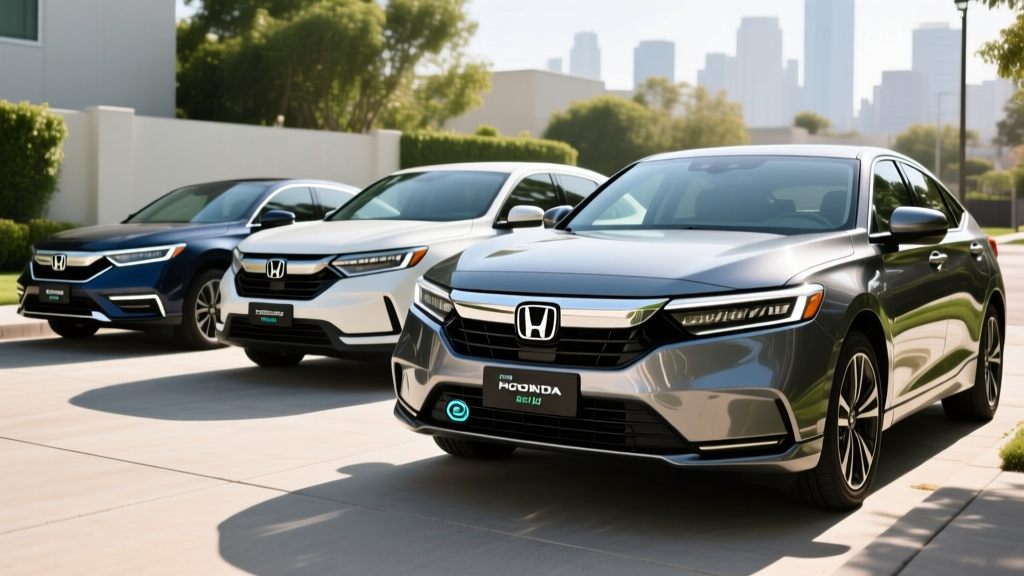
Honda has committed heavily to hybridization across its core lineup, and for 2026, three models carry the torch: the Accord Hybrid sedan, the CR-V Hybrid compact SUV, and the Civic Hybrid. All three use Honda's fourth-generation two-motor hybrid system — conventional hybrids (HEVs) that never need to be plugged in. There is currently no Honda plug-in hybrid (PHEV) sold in the United States, which simplifies the buying decision but also means you won't find any electric-only driving range here.
This guide breaks down every 2026 Honda hybrid vehicle by the numbers: EPA fuel economy, real-world MPG behavior, powertrain output, pricing by trim, battery warranty coverage, and whether any qualify for federal tax incentives. If you're cross-shopping Toyota's hybrid dominance or weighing a hybrid against a full battery-electric vehicle, the data below will clarify where Honda fits.
HEV vs. PHEV: Where Honda Stands in 2026
Before evaluating specific models, it's critical to understand what Honda is — and isn't — offering.
Conventional Hybrid (HEV) — Honda's Current Approach
- How it works: A gasoline engine paired with one or more electric motors and a small battery (typically 1.0–1.5 kWh). The battery recharges through regenerative braking and the engine — you never plug it in.
- Electric-only driving: Minimal. The motor assists at low speeds and during acceleration, but sustained electric-only travel is limited to brief low-speed bursts (under ~1 mile).
- Primary benefit: Significantly improved fuel economy, especially in city driving, with zero behavior change from the driver.
Plug-in Hybrid (PHEV) — Not Currently in Honda's US Lineup
- How it works: Larger battery (typically 12–20 kWh) that charges via a plug. Offers 20–40+ miles of electric-only range before the gas engine engages.
- Electric-only driving: Meaningful daily commutes on electricity alone, with a gas engine as backup for longer trips.
- Honda's history: The Clarity Plug-In Hybrid was discontinued after the 2021 model year. As of 2026, Honda has not announced a successor PHEV for the US market.
The practical takeaway: every 2026 Honda hybrid vehicle is a self-charging HEV. You fuel it like a normal gas car, and the hybrid system silently improves your mileage — particularly in stop-and-go traffic where electric motor assist shines.
2026 Honda Accord Hybrid: MPG, Specs, and Pricing
The Accord Hybrid remains Honda's efficiency flagship. For 2026, it continues with the two-motor hybrid system pairing a 2.0-liter Atkinson-cycle four-cylinder engine with two electric motors.
| Spec | 2026 Accord Hybrid |
|---|---|
| Powertrain | 2.0L 4-cyl + 2 electric motors |
| Combined Horsepower | 204 hp |
| Combined Torque | 247 lb-ft (motor) |
| Transmission | e-CVT (direct-drive) |
| EPA MPG (City / Hwy / Combined) | 51 / 44 / 48 (Sport/LX trims) |
| EPA MPG (Sport-L / EX-L trims) | 48 / 41 / 44 |
| Fuel Tank | 12.8 gallons |
| Total Range | ~560–615 miles |
| 0–60 mph | ~7.5 seconds |
| Battery Type | Lithium-ion, ~1.3 kWh |
| Starting MSRP | ~$34,395 (Sport trim) |
Real-World MPG vs. EPA Sticker
Hybrids consistently outperform their EPA ratings in city driving, and the Accord Hybrid is no exception. Owners and independent testers regularly report 50–55 MPG in urban and suburban conditions at moderate speeds. Highway fuel economy, however, tends to fall slightly short of the EPA estimate — expect 40–43 MPG at 70–75 mph on the interstate, particularly with headwinds or hilly terrain. The combined real-world figure for most drivers lands between 44 and 50 MPG, depending on driving mix.
The trim-level MPG split matters: Sport and LX trims ride on smaller 17-inch wheels with lower rolling resistance, earning the higher 51/44/48 rating. Moving up to Sport-L or EX-L with 19-inch wheels drops the rating to 48/41/44 — a meaningful 4 MPG combined difference if highway commuting dominates your routine. Check the EPA's fueleconomy.gov database for verified trim-specific figures.
2026 Honda CR-V Hybrid: MPG, Specs, and Pricing
The CR-V Hybrid has become one of the best-selling hybrid SUVs in America, and for good reason: it offers the cargo utility buyers want with fuel economy that undercuts most compact crossovers by 10+ MPG.
| Spec | 2026 CR-V Hybrid |
|---|---|
| Powertrain | 2.0L 4-cyl + 2 electric motors |
| Combined Horsepower | 204 hp |
| Combined Torque | 247 lb-ft (motor) |
| Drivetrain | FWD or AWD (standard on Sport Touring) |
| EPA MPG — FWD (City / Hwy / Combined) | 43 / 36 / 40 |
| EPA MPG — AWD (City / Hwy / Combined) | 40 / 34 / 37 |
| Fuel Tank | 14.0 gallons |
| Total Range | ~500–560 miles |
| 0–60 mph | ~8.0 seconds |
| Cargo Volume (behind rear seats) | 36.3 cu ft |
| Starting MSRP | ~$36,695 (Sport FWD) |
Real-World MPG vs. EPA Sticker
The CR-V Hybrid excels in city and suburban driving, where the electric motors handle low-speed propulsion and the engine stays off during stops. Real-world city MPG of 42–46 is common. Highway driving is less favorable — at sustained 70+ mph speeds, expect 32–36 MPG with AWD, which is still strong for a compact SUV but below the EPA's 34 MPG highway estimate for AWD trims.
The AWD penalty is real: choosing all-wheel drive costs you roughly 3 MPG combined versus FWD. If you live in a mild climate and don't need AWD traction, the FWD Sport trim is the efficiency sweet spot.
2026 Honda Civic Hybrid: MPG, Specs, and Pricing
Reintroduced for the 2025 model year and carried into 2026, the Civic Hybrid fills the compact sedan segment with exceptional efficiency at an accessible price point. It uses a smaller displacement version of Honda's two-motor system.
| Spec | 2026 Civic Hybrid |
|---|---|
| Powertrain | 2.0L 4-cyl + 2 electric motors |
| Combined Horsepower | 200 hp |
| Combined Torque | 232 lb-ft (motor) |
| EPA MPG (City / Hwy / Combined) | 50 / 43 / 47 (Sport Hybrid) |
| Fuel Tank | 10.6 gallons |
| Total Range | ~490–530 miles |
| 0–60 mph | ~7.2 seconds |
| Starting MSRP | ~$30,845 (Sport Hybrid) |
Real-World MPG vs. EPA Sticker
The Civic Hybrid is a city-driving star. Real-world testers consistently achieve 50–56 MPG in urban environments with frequent stops, thanks to aggressive regenerative braking and the engine shut-off at idle. Highway numbers tend to land at 40–43 MPG at 70 mph. For mixed driving, most owners report a combined 45–50 MPG — closely tracking or slightly exceeding the EPA's 47 MPG combined estimate.
Battery Warranty and Long-Term Reliability
Honda Hybrid Battery Warranty Coverage
Every 2026 Honda hybrid vehicle includes the following battery and powertrain warranty:
- Hybrid Battery: 8 years / 100,000 miles (10 years / 150,000 miles in CARB states including CA, CT, ME, MA, NJ, NY, OR, RI, VT, WA, and others adopting California emissions standards)
- Hybrid System Components: 8 years / 100,000 miles (inverters, converters, control modules)
- Powertrain: 5 years / 60,000 miles
- Capacity retention threshold: Honda covers the hybrid battery if it falls below approximately 70% of original capacity within the warranty period
How Long Do Honda Hybrid Batteries Actually Last?
Honda's hybrid battery packs are small (roughly 1.0–1.5 kWh) and operate within a conservative state-of-charge window — typically 40% to 80% — which dramatically reduces degradation stress. Real-world data from earlier-generation Honda hybrids (Insight, previous Accord Hybrid) shows battery packs routinely lasting 150,000–200,000+ miles before significant capacity loss. The small battery also means replacement costs are far lower than a full EV battery.
Out-of-warranty replacement cost: A Honda hybrid battery replacement typically runs $2,000–$4,000 including labor at a dealership. Independent hybrid specialists may offer refurbished packs for $1,200–$2,500. Compare this to EV battery replacements that can exceed $10,000–$15,000 — the hybrid's small battery is a significant long-cost advantage.
Honda's hybrid system reliability track record is strong. The two-motor design has fewer mechanical complexity points than traditional planetary-gear hybrid systems, and the engine operates primarily in its most efficient RPM range, reducing wear. According to long-term reliability surveys from sources like Consumer Reports, Honda's hybrid powertrains rank among the more dependable in the segment.
Tax Credits and Incentives for Honda Hybrids
This is where hybrid buyers need a reality check:
Federal Tax Credit Status for 2026 Honda Hybrids
- §30D New Clean Vehicle Credit ($7,500): NOT eligible. The federal credit under IRS §30D requires a minimum battery capacity of 7 kWh and plug-in charging capability. Honda's conventional hybrids have ~1.3 kWh batteries and cannot be plugged in.
- Used EV Credit (§25E, up to $4,000): NOT eligible. Same battery-capacity and plug-in requirements apply.
- State incentives: A small number of states offer rebates or HOV lane access for conventional hybrids, but these programs have largely shifted focus to PHEVs and BEVs. Check your state's energy office or DMV for current programs.
- Insurance discounts: Some insurers offer modest hybrid vehicle discounts (typically 5–10%) — worth asking about at policy renewal.
The bottom line: you buy a Honda hybrid for fuel savings, not tax incentives. At current gas prices (~$3.20–$3.80/gal national average in early 2026), the Accord Hybrid's 48 MPG combined versus a comparable gas-only midsize sedan at ~30 MPG combined saves roughly $600–$900 per year for a driver covering 15,000 miles annually. Over five years, that's $3,000–$4,500 in fuel savings — effectively offsetting much of the hybrid premium over a gas-only equivalent.
Hybrid vs. PHEV vs. Full EV: Which Fits You?
Choose a Honda Hybrid (HEV) If:
- You cannot charge at home (apartment, street parking, no garage)
- You want maximum fuel efficiency with zero lifestyle changes
- You frequently take long road trips and don't want to plan around charging stations
- You want a lower purchase price than a comparable EV
- You drive in extreme cold regularly, where EV range loss of 20–40% is a concern
Choose a Plug-in Hybrid (PHEV) If:
- You can charge at home (Level 1 or Level 2) and want 25–40 miles of electric-only commuting
- You want EV-like daily driving with gas-engine backup for road trips
- You want to qualify for the $7,500 federal tax credit (if income and sourcing requirements are met)
- Note: Honda does not currently offer a PHEV in the US — look at the Toyota RAV4 Prime, Chrysler Pacifica PHEV, or Hyundai Tucson PHEV
Choose a Full Battery Electric Vehicle (BEV) If:
- You have reliable home charging (Level 2 strongly recommended)
- Your daily driving is under 200 miles and you want zero tailpipe emissions
- You want the lowest per-mile "fuel" cost (electricity at $0.12–$0.18/kWh = ~$0.04–$0.06/mile vs. hybrid gas at ~$0.07–$0.09/mile)
- You want to qualify for federal and state EV incentives
- You're comfortable with DC fast charging for road trips (300+ mile range recommended)
2026 Honda Hybrid Lineup: Side-by-Side Comparison
| Attribute | Accord Hybrid | CR-V Hybrid | Civic Hybrid |
|---|---|---|---|
| Body Style | Midsize Sedan | Compact SUV | Compact Sedan |
| Combined HP | 204 | 204 | 200 |
| EPA Combined MPG | 44–48 | 37–40 | 47 |
| EPA City MPG | 48–51 | 40–43 | 50 |
| EPA Highway MPG | 41–44 | 34–36 | 43 |
| AWD Available? | No | Yes | No |
| Total Range (mi) | 560–615 | 500–560 | 490–530 |
| Cargo (cu ft) | 16.7 (trunk) | 36.3 (behind rear) | 14.8 (trunk) |
| Starting MSRP | ~$34,395 | ~$36,695 | ~$30,845 |
| Federal Tax Credit | None | None | None |
| Battery Warranty | 8 yr / 100k mi | 8 yr / 100k mi | 8 yr / 100k mi |
Pros and Cons: Honda's Hybrid Strategy
Pros
- Best-in-class city MPG: Accord and Civic Hybrids hit 50+ MPG city, beating most competitors in stop-and-go driving
- No behavior change: Fuel it like any gas car — no charging infrastructure needed
- Strong total range: 500–615 miles per tank eliminates range anxiety entirely
- Low battery replacement risk: Small ~1.3 kWh packs cost $2,000–$4,000 to replace vs. $10,000+ for EV batteries
- Proven reliability: Honda's two-motor system has a strong long-term track record
- Competitive pricing: Hybrid premiums are modest ($1,000–$2,500 over gas trims), with fuel payback in 3–5 years
Cons
- No PHEV option: If you want electric-only commuting with a Honda badge, you're out of luck in 2026
- No federal tax credit: HEVs don't qualify for §30D — the full $7,500 credit goes to PHEVs and BEVs only
- Highway MPG less impressive: Hybrid advantage shrinks at sustained highway speeds; some diesel and efficient gas engines close the gap
- No AWD on sedans: Accord and Civic Hybrid are FWD only — a limitation for snow-belt buyers
- e-CVT driving feel: The direct-drive system can produce a droning sensation under hard acceleration that some drivers dislike
Frequently Asked Questions
How many MPG does a Honda hybrid get?
It depends on the model and trim. The 2026 Accord Hybrid achieves up to 51 city / 44 highway / 48 combined MPG on Sport and LX trims. The CR-V Hybrid rates at 43 city / 36 highway / 40 combined (FWD) or 40/34/37 (AWD). The Civic Hybrid delivers 50 city / 43 highway / 47 combined. In real-world city driving, all three models tend to meet or slightly exceed their EPA city estimates.
Do Honda hybrids need to be plugged in?
No. Every 2026 Honda hybrid is a conventional hybrid (HEV), not a plug-in hybrid (PHEV). The small lithium-ion battery recharges automatically through regenerative braking and the gasoline engine. You simply fill the gas tank and drive — no charging cable or outlet required.
Is Honda making a plug-in hybrid (PHEV)?
As of early 2026, Honda has not announced a new PHEV for the US market. The Clarity Plug-In Hybrid was discontinued after 2021. Honda's global strategy has shifted toward full battery-electric vehicles (the Prologue SUV, built on GM's Ultium platform) rather than PHEVs. If plug-in capability is a priority, you'll need to look at competitors like Toyota, Hyundai, or Stellantis.
How long will a Honda hybrid battery last and what does replacement cost?
Honda's hybrid batteries are designed to last the life of the vehicle. Real-world data from previous generations shows packs commonly lasting 150,000–200,000+ miles. The battery is covered by an 8-year/100,000-mile warranty (10 years/150,000 miles in CARB states). If replacement is needed out of warranty, expect to pay $2,000–$4,000 at a dealer or $1,200–$2,500 for a refurbished pack from an independent hybrid specialist.
Does any Honda hybrid qualify for a federal tax credit?
No. The federal §30D New Clean Vehicle Credit requires a battery capacity of at least 7 kWh and plug-in charging capability. Honda's conventional hybrids have approximately 1.3 kWh batteries and cannot be plugged in, making them ineligible. The credit is available only for qualifying PHEVs and BEVs, subject to MSRP caps, buyer income limits, and battery-sourcing requirements detailed on IRS.gov.
Is a Honda hybrid better than a full EV?
It depends on your situation. A Honda hybrid is better if you can't charge at home, take frequent long road trips, live in extreme cold, or want a lower purchase price. A full EV is better if you have home charging, want the lowest per-mile energy cost, need to qualify for tax credits, and want zero tailpipe emissions. For a driver covering 15,000 miles/year, a Honda Hybrid saves roughly $600–$900 annually versus a gas-only car, while a comparable EV could save $1,000–$1,400 annually depending on local electricity rates.
Are Honda hybrids reliable?
Yes. Honda's two-motor hybrid system has demonstrated strong reliability across multiple model generations. The system has fewer moving parts than traditional transmission-based hybrid designs, and the gasoline engine operates primarily in its most efficient RPM range, reducing mechanical wear. Honda's hybrid components carry an 8-year/100,000-mile warranty. Long-term owner surveys and reliability data from organizations like IIHS and Consumer Reports consistently rate Honda's hybrid powertrains favorably.
The Verdict: Who Should Buy a 2026 Honda Hybrid?
Honda's 2026 hybrid lineup makes sense for a specific buyer: someone who wants substantially better fuel economy than a gas-only car, has no ability or desire to plug in, and values proven reliability with low long-term maintenance risk. The Accord Hybrid is the standout — 51 MPG city in a spacious midsize sedan at under $35,000 is difficult to beat. The CR-V Hybrid serves families who need SUV cargo space without the fuel penalty. The Civic Hybrid is the entry point, delivering 50 MPG city for under $31,000.
If you need plug-in electric commuting, Honda doesn't have an answer in 2026 — you'll need to cross-shop Toyota's PHEV lineup or consider a full EV like Honda's own Prologue. But if your goal is simple, reliable fuel savings with no infrastructure dependency, Honda's hybrid vehicles are among the most compelling options on the market.