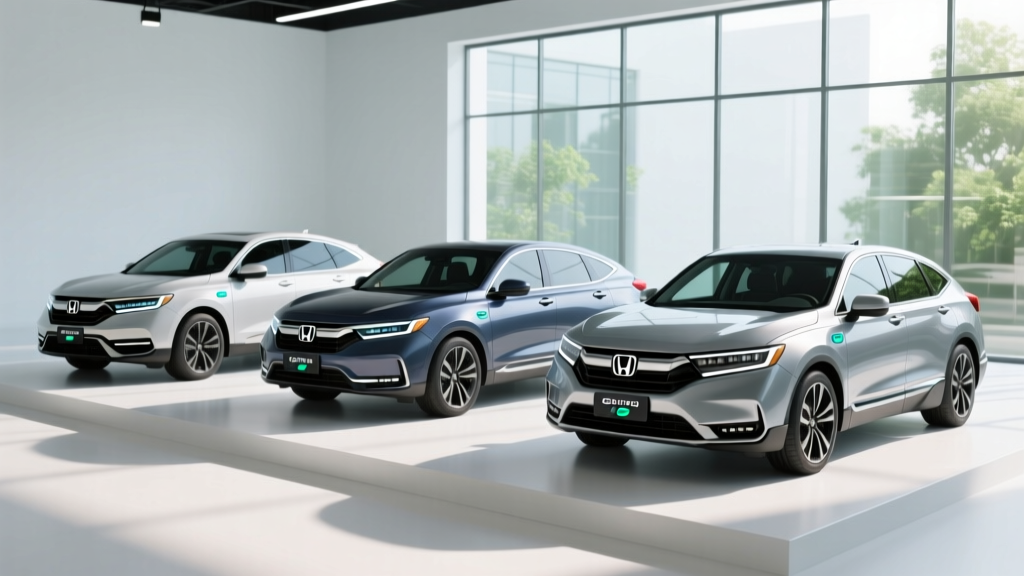
Honda has committed heavily to hybridization across its core lineup for the 2026 model year, offering two-motor hybrid systems in three of its highest-volume nameplates: the Accord, Civic, and CR-V. Unlike some competitors chasing plug-in hybrid (PHEV) complexity, Honda's 2026 strategy centers on conventional hybrid electric vehicles (HEVs) that require no plug-in charging and deliver substantial fuel economy gains over their gasoline-only counterparts.
This guide covers every 2026 Honda hybrid model currently on sale, with exact EPA figures, powertrain specs, pricing, and the practical ownership data you need to decide which one fits your driving pattern — or whether a full EV might serve you better.
HEV vs PHEV: What Honda Offers in 2026
Conventional Hybrid (HEV): Uses a small battery (typically 1–2 kWh) charged exclusively through regenerative braking and the gasoline engine. You never plug it in. The electric motor assists the engine and enables brief electric-only driving at low speeds. Honda's 2026 Accord, Civic, and CR-V hybrids are all HEVs.
Plug-in Hybrid (PHEV): Carries a larger battery (typically 12–20 kWh) that charges via a wall outlet or public charger, delivering 20–50 miles of electric-only range before the gas engine engages. Honda does not currently sell a PHEV in the US market for 2026. The Clarity Plug-in Hybrid was discontinued after the 2021 model year. If plug-in capability is a priority, you'll need to look at competitors like the Toyota RAV4 Prime or Hyundai Tucson PHEV.
2026 Honda Accord Hybrid
The Accord Hybrid remains Honda's efficiency flagship for sedan buyers. For 2026, it carries over the fourth-generation two-motor hybrid system paired with a 2.0-liter Atkinson-cycle four-cylinder engine. The system operates primarily in electric-drive mode at low and moderate speeds, with the engine acting as a generator. At highway cruising speeds, a lock-up clutch connects the engine directly to the wheels for optimal efficiency.
| Attribute | Value |
|---|---|
| Powertrain | 2.0L 4-cyl + two-motor hybrid system |
| Combined Horsepower | 204 hp |
| Combined Torque | 247 lb-ft (electric motor) |
| EPA MPG (City / Hwy / Combined) | 51 / 44 / 48 (Sport/LX trims); 48 / 41 / 44 (Sport-L/EX-L trims) |
| Fuel Tank | 12.8 gallons |
| Total Range (estimated) | ~550–615 miles depending on trim |
| Hybrid Battery | Lithium-ion, ~1.1 kWh (not plug-in) |
| 0–60 mph | ~7.0 seconds |
| Starting MSRP | ~$33,650 (Sport trim) |
| Battery Warranty | 8 years / 100,000 miles (10 yr/150,000 mi in CARB states) |
Real-World MPG vs EPA
The Accord Hybrid's EPA ratings tell most of the story, but real-world results depend heavily on your driving mix. In city-heavy commuting (stop-and-go, speeds under 45 mph), owners routinely report 50–55 MPG because the electric motor handles most propulsion while the engine runs only as a generator. On sustained highway trips at 75+ mph, expect figures closer to 38–42 MPG as the engine takes a more direct role and aerodynamic drag increases. Cold weather (below 35°F) typically shaves 3–5 MPG as the engine runs more frequently for cabin heat and battery warming.
2026 Honda CR-V Hybrid
The CR-V Hybrid is Honda's best-selling electrified vehicle and the most popular hybrid compact SUV in its segment. For 2026, it uses the same two-motor hybrid architecture as the Accord but tuned for the CR-V's higher ride height and available all-wheel drive. The hybrid powertrain is standard on the Sport and Sport Touring trims and unavailable on the base LX and EX.
| Trim / Drivetrain | City MPG | Highway MPG | Combined MPG |
|---|---|---|---|
| Sport (FWD) | 43 | 36 | 40 |
| Sport (AWD) | 40 | 34 | 37 |
| Sport Touring (AWD standard) | 40 | 34 | 37 |
| Attribute | Value |
|---|---|
| Powertrain | 2.0L 4-cyl + two-motor hybrid system |
| Combined Horsepower | 204 hp |
| Combined Torque | 247 lb-ft (electric motor) |
| Fuel Tank | 14.5 gallons |
| Total Range (AWD, estimated) | ~535 miles |
| Hybrid Battery | Lithium-ion, ~1.1 kWh (not plug-in) |
| 0–60 mph | ~7.6 seconds |
| Cargo Volume (behind rear seats) | 36.3 cu ft |
| Starting MSRP | ~$37,295 (Sport FWD) |
| Battery Warranty | 8 years / 100,000 miles (10 yr/150,000 mi in CARB states) |
Real-World MPG vs EPA
The CR-V Hybrid excels in suburban and city driving, where regenerative braking recovers energy at every stop. Real-world city figures of 42–46 MPG are common for FWD models in moderate weather. Highway efficiency drops more noticeably than the Accord due to the CR-V's boxier profile and taller tires — expect 30–34 MPG at 70–80 mph. AWD models in cold climates with winter fuel blends may see combined figures dip to the low 30s. For SUV buyers, this still represents a 30–40% improvement over the non-hybrid CR-V's 28 MPG combined.
2026 Honda Civic Hybrid
The Civic Hybrid returns for 2026 as a compact sedan option for buyers who want hybrid efficiency in a smaller, more affordable package than the Accord. Honda pairs a 2.0-liter Atkinson-cycle engine with its two-motor hybrid system, delivering class-leading fuel economy for the compact segment.
| Attribute | Value |
|---|---|
| Powertrain | 2.0L 4-cyl + two-motor hybrid system |
| Combined Horsepower | 200 hp |
| Combined Torque | 232 lb-ft (electric motor) |
| EPA MPG (City / Hwy / Combined) | 50 / 47 / 49 |
| Fuel Tank | 10.6 gallons |
| Total Range (estimated) | ~520 miles |
| Hybrid Battery | Lithium-ion, ~1.1 kWh (not plug-in) |
| 0–60 mph | ~7.3 seconds |
| Starting MSRP | ~$29,850 (Sport trim) |
| Battery Warranty | 8 years / 100,000 miles (10 yr/150,000 mi in CARB states) |
Real-World MPG vs EPA
The Civic Hybrid's 49 MPG combined EPA rating is among the highest of any non-plug-in vehicle sold in the US. In real-world city driving, many owners report 52–58 MPG, particularly in warm weather and at speeds under 40 mph where the electric motor dominates. Highway cruising at 70 mph yields approximately 42–46 MPG. The Civic Hybrid's lighter curb weight (roughly 3,200 lbs) is the key advantage over the Accord and CR-V hybrids, which share similar powertrains but carry more mass.
2026 Honda Hybrid Lineup: Side-by-Side Comparison
| Model | Type | Combined MPG | HP | 0–60 | Starting MSRP |
|---|---|---|---|---|---|
| Civic Hybrid | HEV | 49 | 200 | ~7.3s | ~$29,850 |
| Accord Hybrid | HEV | 44–48 | 204 | ~7.0s | ~$33,650 |
| CR-V Hybrid (FWD) | HEV | 40 | 204 | ~7.6s | ~$37,295 |
| CR-V Hybrid (AWD) | HEV | 37 | 204 | ~7.8s | ~$39,295 |
Hybrid Battery Longevity and Replacement Cost
Honda Hybrid Battery Warranty: All 2026 Honda hybrid models carry a lithium-ion traction battery warranty of 8 years / 100,000 miles nationwide, extended to 10 years / 150,000 miles in states that follow California Air Resources Board (CARB) emissions standards — which includes California, New York, Massachusetts, Colorado, Washington, Oregon, and several others. The warranty covers defects and capacity loss below a functional threshold (Honda does not publish a specific percentage, but industry standard is approximately 60–70% of original capacity).
How Long Do Honda Hybrid Batteries Actually Last?
Honda's hybrid battery packs are designed to last the life of the vehicle under normal use. Real-world data from earlier-generation Honda hybrids (Insight, previous-gen Accord Hybrid) shows most batteries retaining functional capacity well past 150,000 miles. The lithium-ion chemistry used in 2026 models is more stable than the nickel-metal hydride (NiMH) packs in older hybrids.
If replacement is needed out of warranty, a Honda hybrid battery pack typically costs between $2,000 and $4,000 for the part, plus $500–$1,000 in labor, depending on the model and dealer. Third-party refurbished packs are available for $1,000–$2,000 but come with shorter warranties. Because Honda's hybrid system uses a relatively small battery (~1.1 kWh), replacement costs are significantly lower than a full EV battery, which can run $8,000–$20,000+.
General Hybrid Reliability
Honda's two-motor hybrid system has proven durable. The system eliminates the traditional transmission — there is no multi-speed gearbox to fail. The engine operates primarily as a generator at lower speeds, reducing mechanical wear. According to long-term owner data and reliability surveys, the hybrid components (inverter, electric motors, battery) have lower failure rates than conventional automatic transmissions. Honda's hybrid vehicles consistently earn high marks from IIHS for safety and from consumer reliability trackers.
Tax Credits and Incentives for Honda Hybrids
Here's where conventional hybrids face a disadvantage: none of the 2026 Honda hybrid models qualify for the federal §30D Clean Vehicle Credit. Under current IRS rules, the §30D credit (up to $7,500) is available only for plug-in electric vehicles — battery electric vehicles (BEVs) and plug-in hybrids (PHEVs) with a minimum battery capacity of 7 kWh. Since Honda's 2026 hybrids are conventional HEVs with ~1.1 kWh batteries and no plug-in capability, they are ineligible.
- Federal tax credit: $0 — Honda's HEVs do not meet §30D requirements
- State incentives: Vary by jurisdiction. Some states offer rebates for hybrids (e.g., Colorado's innovative motor vehicle income tax credit covers certain hybrid purchases). Check your state's energy office or DMV for current programs.
- Dealer/manufacturer incentives: Honda periodically offers cash-back or low-APR financing on hybrid trims. Check Honda's current offers page.
If the federal tax credit is a priority for your purchase, you would need to consider a PHEV (such as the Toyota RAV4 Prime or Chrysler Pacifica Hybrid) or a full BEV (such as the Honda Prologue, which is a battery-electric SUV and may qualify depending on your income, the vehicle's MSRP, and battery-sourcing compliance).
Hybrid vs PHEV vs EV: Which Is Right for You?
Choose a 2026 Honda Hybrid (HEV) if:
- You cannot install a home charger (apartment, street parking, no garage)
- You want maximum simplicity — no plug-in routine, no charging apps, no range planning
- Your commute is long and mixed (city + highway) and you want 500+ miles of total range
- You want a lower purchase price than a comparable EV or PHEV
- You regularly drive in areas with sparse public charging infrastructure
Consider a PHEV (non-Honda) if:
- You can charge at home and your daily commute is under 30–40 miles (covering most trips on electricity)
- You want to qualify for the $7,500 federal tax credit (income and sourcing rules permitting)
- You want electric-only driving for daily errands but gas flexibility for road trips
Consider a full EV (BEV) if:
- You have reliable home Level 2 charging
- Your daily driving is under 250 miles and you're comfortable planning DC fast-charging stops on road trips
- You want the lowest per-mile fuel cost (electricity at $0.13/kWh ≈ $0.04/mile vs. gas at $3.50/gal and 45 MPG ≈ $0.08/mile)
- You want zero tailpipe emissions and minimal maintenance (no oil changes, no spark plugs)
Pros and Cons of the 2026 Honda Hybrid Lineup
Pros
- Class-leading fuel economy — up to 51 MPG city in the Accord Hybrid
- No plug-in charging required; operates exactly like a conventional car
- Strong electric torque (232–247 lb-ft) for responsive acceleration
- Proven, reliable two-motor hybrid architecture with no traditional transmission
- 8-year/100,000-mile battery warranty (10 yr/150,000 mi in CARB states)
- 500+ miles of total range — no range anxiety on road trips
- Competitive pricing starting under $30,000 (Civic Hybrid)
Cons
- No federal tax credit eligibility (HEVs excluded from §30D)
- No PHEV option in Honda's US lineup — can't drive on electricity alone for extended distances
- Highway MPG drops significantly vs. city (especially CR-V Hybrid AWD at 34 MPG highway)
- Hybrid trims cost $1,500–$3,000 more than equivalent gas-only trims
- No DC fast charging or plug-in capability of any kind
- Engine drone under hard acceleration (common to Atkinson-cycle hybrid systems)
Frequently Asked Questions
How many MPG does the 2026 Honda Civic Hybrid get?
The 2026 Honda Civic Hybrid is EPA-rated at 50 city / 47 highway / 49 combined MPG. In real-world city driving, owners frequently report 52–58 MPG, while highway trips at 70+ mph typically yield 42–46 MPG.
Do any 2026 Honda hybrids need to be plugged in?
No. All 2026 Honda hybrid models are conventional hybrids (HEVs). The battery charges through regenerative braking and the gasoline engine. There is no plug, no charging cable, and no electric-only range to manage. You simply fuel up at a gas station as you would with any other car.
Does the 2026 Honda CR-V Hybrid qualify for a tax credit?
No. The CR-V Hybrid is a conventional HEV and does not qualify for the federal §30D Clean Vehicle Credit, which requires plug-in capability and a minimum 7 kWh battery. Some state-level incentives may apply — check your state's energy office for details.
How much does it cost to replace a Honda hybrid battery?
Out-of-warranty replacement for a Honda hybrid battery pack typically costs $2,000–$4,000 for the part plus $500–$1,000 in labor. However, most Honda hybrid batteries last well beyond 150,000 miles, and the factory warranty covers 8 years/100,000 miles (10 years/150,000 miles in CARB states).
Is the Honda hybrid system reliable long-term?
Yes. Honda's two-motor hybrid system eliminates the conventional automatic transmission, reducing mechanical complexity. The electric motors and inverter have low failure rates, and the lithium-ion battery is designed for the vehicle's full lifespan. Long-term data from earlier Honda hybrids supports strong durability past 150,000 miles.
Does Honda sell a plug-in hybrid in 2026?
No. Honda discontinued the Clarity Plug-in Hybrid after 2021 and does not offer a PHEV in the US market for 2026. Honda's US electrification strategy currently focuses on conventional hybrids (Accord, Civic, CR-V) and the battery-electric Honda Prologue SUV.
How does the Accord Hybrid perform on the highway?
The Accord Hybrid uses a lock-up clutch to connect the engine directly to the front wheels at highway cruising speeds, bypassing the electric generator loop for better efficiency. EPA highway ratings are 41–44 MPG depending on trim. Real-world highway driving at 70–80 mph typically yields 38–42 MPG, with cold weather reducing that by 3–5 MPG.
Is the CR-V Hybrid worth the premium over the gas CR-V?
The CR-V Hybrid costs approximately $1,500–$2,000 more than a comparably equipped gas-only CR-V. With a combined 37–40 MPG versus the gas model's 28 MPG, a driver covering 15,000 miles per year at $3.50/gallon would save roughly $550–$700 annually in fuel. The hybrid also delivers noticeably stronger low-speed torque (247 lb-ft electric motor vs. 179 lb-ft from the turbo gas engine). Most buyers recoup the price premium within 3–4 years while enjoying a more responsive driving experience.
For official EPA fuel economy data, visit fueleconomy.gov. For current federal tax credit rules, see the IRS Clean Vehicle Credits page. Always verify 2026 model-year pricing and specifications on Honda's official site, as trim availability and MSRP can shift during the model year.