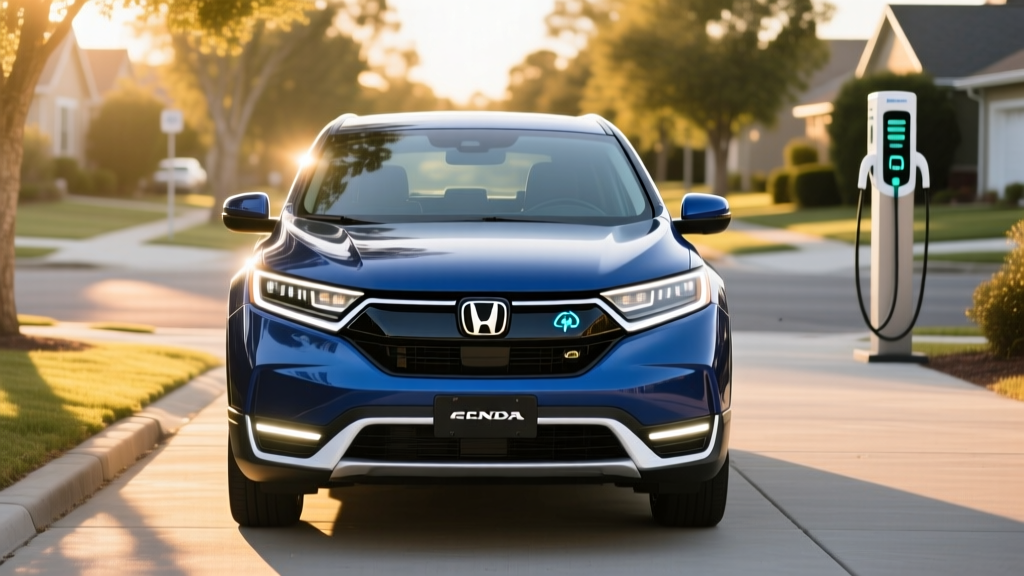
The Honda CR-V Hybrid has been one of the best-selling compact SUVs in America for good reason: it delivers genuine fuel savings without asking you to change how you drive. If you're researching 2026 Honda CR-V Hybrid lease deals, you're likely weighing monthly payments against real-world fuel economy, reliability, and whether Honda's hybrid system is worth it over a conventional gas CR-V or a plug-in alternative. This guide covers the exact specs, pricing, and lease math you need before stepping into a dealership.
2026 Honda CR-V Hybrid Powertrain and Performance
The 2026 CR-V Hybrid uses Honda's two-motor hybrid system, pairing a 2.0-liter Atkinson-cycle four-cylinder engine with two electric motors. The combined system output is 204 horsepower and 247 lb-ft of torque, routed through an electronically controlled continuously variable transmission (e-CVT). Front-wheel drive is standard, with available real-time all-wheel drive on all hybrid trims.
| Specification | 2026 CR-V Hybrid |
|---|---|
| Engine | 2.0L Atkinson-cycle I-4 + two electric motors |
| Combined Output | 204 hp / 247 lb-ft |
| Transmission | e-CVT (direct-drive) |
| Drivetrain | FWD standard, AWD available |
| 0-60 mph | ~7.6 seconds (FWD) |
| Towing Capacity | 1,000 lbs |
| Hybrid Battery | Lithium-ion, ~1.1 kWh (self-charging HEV) |
This is a conventional hybrid (HEV), not a plug-in. You never plug it in — the battery recharges through regenerative braking and the gasoline engine. If you want plug-in capability from Honda, you'd look at the discontinued Clarity PHEV (no longer in production) or wait for Honda's next-generation PHEV offerings. The CR-V lineup does not currently include a plug-in hybrid variant for the US market.
EPA Fuel Economy: How Many MPG Does the CR-V Hybrid Get?
According to fueleconomy.gov, the 2026 Honda CR-V Hybrid achieves:
| Configuration | City | Highway | Combined |
|---|---|---|---|
| FWD Hybrid | 43 MPG | 36 MPG | 40 MPG |
| AWD Hybrid | 40 MPG | 34 MPG | 37 MPG |
| Gas-only CR-V (AWD) | 27 MPG | 32 MPG | 29 MPG |
Real-world MPG note: Honda's two-motor hybrid system excels in city driving, where it can operate on electric power alone at low speeds. Many owners report exceeding the EPA city estimate of 43 MPG in stop-and-go traffic. Highway efficiency is lower because the gasoline engine must do more work at sustained speeds. On a 70-mph highway cruise, expect closer to 32-34 MPG with AWD. In cold weather (below 30°F), expect a 5-10% reduction as the engine runs more frequently for cabin heat.
2026 CR-V Hybrid Pricing and Lease Deal Breakdown
The 2026 CR-V Hybrid is available in four trims, all well-equipped. Here's the MSRP breakdown before destination charges:
| Trim | MSRP (FWD) | MSRP (AWD) |
|---|---|---|
| Sport Hybrid | $35,350 | $36,850 |
| Sport-L Hybrid | $38,350 | $39,850 |
| Sport Touring Hybrid | $42,350 | $42,350 (AWD only) |
Typical Lease Structure
As of early 2026, Honda Financial Services is offering competitive lease rates on the CR-V Hybrid. A typical 36-month lease with 12,000 miles/year on the Sport Hybrid FWD breaks down roughly as follows:
- Monthly payment: $379-$429 (varies by region and dealer)
- Due at signing: $2,999-$3,999 (first month + down payment + fees)
- Money factor: ~0.00210 (equivalent to ~5.0% APR)
- Residual value: ~58-60% at 36 months
Honda frequently offers lease loyalty incentives ($500-$750) for returning Honda lessees and conquest cash for competitive brand trade-ins. Check Honda's current offers page for region-specific deals. Remember: advertised lease prices often exclude tax, title, registration, and dealer-installed accessories.
Hybrid vs. PHEV vs. Full EV: Which CR-V Fits You?
Choose the CR-V Hybrid (HEV) if:
- You can't charge at home or work (no plug-in required)
- You want lower fuel costs without behavior change
- You drive 12,000-15,000 miles/year in mixed city/highway conditions
- You want proven reliability with minimal maintenance
Consider a PHEV (plug-in hybrid) if:
- You can charge at home (Level 1 or Level 2)
- Your daily commute is under 30 miles round-trip
- You want electric-only commuting with gas-engine flexibility for road trips
- You qualify for the §30D federal tax credit (up to $7,500 for eligible PHEVs)
Go full EV (like the Honda Prologue or Tesla Model Y) if:
- You have reliable home Level 2 charging
- You want the lowest per-mile fuel cost and zero tailpipe emissions
- You're eligible for federal/state EV incentives
- Your daily driving is under 250 miles with access to DC fast charging for road trips
Honda does offer the CR-V e:FCEV (hydrogen fuel cell) in California only, but hydrogen infrastructure remains extremely limited. For most buyers, the conventional CR-V Hybrid is the pragmatic choice.
Battery Warranty, Reliability, and Replacement Cost
Honda Hybrid Battery Warranty: 8 years / 100,000 miles (10 years / 150,000 miles in California and states that follow CARB emissions standards). The warranty covers capacity loss below approximately 70% of original capacity.
Honda's hybrid system has proven exceptionally reliable. The lithium-ion hybrid battery is small (~1.1 kWh) and operates within a narrow state-of-charge window (typically 40-60%), which dramatically reduces stress and degradation compared to full EV batteries. Based on data from earlier-generation CR-V Hybrids and the Accord Hybrid, battery replacement before 150,000 miles is uncommon.
Battery replacement cost (out of warranty): $2,500-$4,000 including labor, based on current Honda dealer pricing. However, individual module replacement (if only one cell group fails) can reduce this to $500-$1,200 at independent hybrid specialists.
The e-CVT transmission is actually a direct-drive system with no traditional belt or pulleys — it's essentially bulletproof. Honda's hybrid system has fewer wear components than a conventional gas powertrain (no alternator, starter motor, or traditional transmission to fail).
Does the 2026 CR-V Hybrid Qualify for Tax Credits?
No federal tax credit for conventional hybrids. The §30D Clean Vehicle Credit applies only to plug-in electric vehicles (BEVs and PHEVs) with a minimum battery capacity of 7 kWh. Since the CR-V Hybrid is a self-charging HEV with a ~1.1 kWh battery, it does not qualify for the federal credit.
However, check your state and local incentives. Some states offer rebates for high-efficiency hybrids:
- California: No current state rebate for HEVs (Clean Vehicle Rebate Project focuses on PHEVs/BEVs)
- Colorado: Innovative Motor Vehicle Credit may apply to certain efficient vehicles (check current year rules)
- Utility rebates: Some municipal utilities offer $100-$300 rebates for purchasing vehicles over 40 MPG combined
For definitive federal credit rules, consult IRS.gov §30D guidance. For state incentives, check the Alternative Fuels Data Center database.
Pros and Cons: The Honest Assessment
Pros
- 40 MPG combined (FWD) with no plug-in required
- Strong reliability record and 8-10 year battery warranty
- Spacious interior with 36.3 cu ft cargo volume (rear seats up)
- Standard Honda Sensing ADAS suite (Level 2 driver assist)
- Competitive lease rates and strong resale value
- AWD available on all trims
Cons
- No plug-in hybrid option in CR-V lineup
- Highway MPG (34-36) trails city MPG significantly
- e-CVT can feel sluggish during hard acceleration
- 1,000-lb towing capacity limits utility
- Hybrid trims start ~$4,000 higher than gas-only CR-V LX
- No federal tax credit eligibility
Frequently Asked Questions
How much can I save on fuel with the CR-V Hybrid vs. the gas model?
At 15,000 miles/year and $3.50/gallon, the Hybrid (40 MPG) costs ~$1,313 annually vs. ~$1,810 for the gas AWD (29 MPG) — a savings of about $497/year. Over a 3-year lease, that's roughly $1,490 in fuel savings, which helps offset the hybrid's higher MSRP.
Is the CR-V Hybrid slower than the gas version?
No. The hybrid's 204 hp and instant electric torque give it a 0-60 time of ~7.6 seconds, comparable to the gas model's ~7.8 seconds. The hybrid feels more responsive in city driving due to electric motor assist.
Does the hybrid battery affect cargo space?
Minimally. The hybrid battery is located under the rear cargo floor. Cargo volume is 36.3 cu ft (rear seats up) and 76.5 cu ft (rear seats folded), compared to 36.3/76.5 for the gas model. You do lose the spare tire — hybrids include a tire repair kit instead.
What happens if the hybrid battery fails after the warranty?
Replacement runs $2,500-$4,000 at a Honda dealer. However, hybrid batteries rarely fail catastrophically — they gradually lose capacity. Many 2017-2020 CR-V Hybrids are still on their original batteries at 100,000+ miles. Independent hybrid shops can often replace individual modules for $500-$1,200.
Should I buy or lease the 2026 CR-V Hybrid?
Lease if: you want lower monthly payments, plan to upgrade in 3 years, and drive under 12,000-15,000 miles/year. Buy if: you plan to keep the vehicle 5+ years, drive high miles (lease overage fees add up), or want to build equity. The hybrid's strong resale value (~60% at 3 years) makes both options reasonable.
Is Honda Sensing (driver assist) standard on all hybrid trims?
Yes. All 2026 CR-V Hybrid trims include Honda Sensing: adaptive cruise control, lane-keeping assist, collision mitigation braking, and traffic sign recognition. This is SAE Level 2 automation — you must remain engaged and keep hands on the wheel. It's not self-driving.
Bottom Line: Who Should Lease the 2026 CR-V Hybrid?
The 2026 Honda CR-V Hybrid makes sense if you want a practical, fuel-efficient compact SUV without the complexity of plug-in charging. With 40 MPG combined (FWD), a proven hybrid system, and competitive lease rates around $379-$429/month, it's one of the most rational choices in the segment.
It's not the right fit if you want electric-only commuting (look at a PHEV or full EV) or if you need serious towing capacity (consider a body-on-frame SUV). But for daily commuting, family hauling, and road trips with minimal fuel cost, the CR-V Hybrid delivers exactly what it promises — no range anxiety, no behavior change, just better fuel economy.