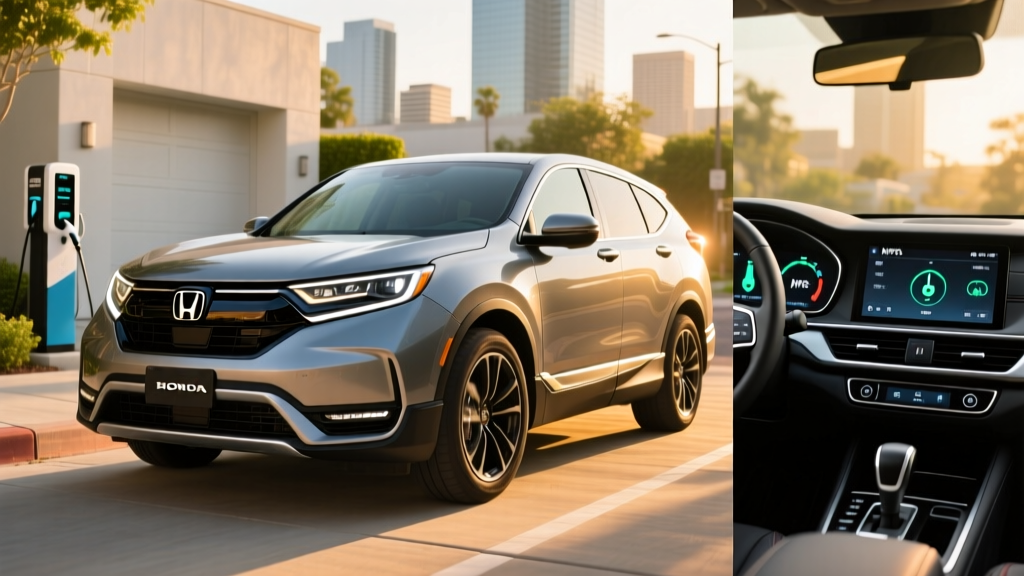
The 2026 Honda CR-V Hybrid Sport sits at the intersection of practicality and efficiency—a compact SUV that doesn't require a plug, a lifestyle overhaul, or a charging app. Honda's two-motor hybrid system pairs a 2.0-liter Atkinson-cycle four-cylinder with electric motors for a combined 204 horsepower, routing power through an e-CVT to all four wheels. If you've been searching for the 2026 CR-V Hybrid Sport to see whether it delivers on the hybrid promise without the plug-in complexity, this guide covers every number that matters.
| Attribute | Value |
|---|---|
| Powertrain | 2.0L Atkinson I-4 + two-motor hybrid system |
| Combined Horsepower | 204 hp |
| Combined Torque | 247 lb-ft (electric motor) |
| Drivetrain | AWD (standard on Sport Hybrid) |
| Transmission | e-CVT (direct-drive) |
| EPA MPG (City / Hwy / Combined) | 43 / 36 / 40 |
| Fuel Tank Capacity | 14.0 gallons |
| Total Range | ~560 miles |
| 0-60 mph | ~7.6 seconds |
| Cargo Volume (rear seats up / down) | 36.3 / 76.5 cu ft |
| Base MSRP | $36,350 (incl. $1,350 destination) |
| Battery Warranty | 8 years / 100,000 miles |
HEV vs. PHEV: The CR-V Hybrid Is a Conventional Hybrid
Before diving into fuel economy, it's essential to distinguish what the 2026 CR-V Hybrid Sport is—and what it isn't.
| Feature | HEV (CR-V Hybrid Sport) | PHEV (e.g., Toyota RAV4 Prime) |
|---|---|---|
| Plug-in charging required? | No — regenerative braking + engine charges battery | Yes — plug in for electric-only range |
| Electric-only range | None (motor assists engine at all times) | 25–42 miles typical |
| Battery size | ~1.1 kWh (small buffer) | 14–18 kWh usable |
| Federal tax credit (§30D) | Not eligible (no plug-in capability) | Up to $7,500 if sourcing/income rules met |
| Best for | Drivers without home charging access | Drivers with home charging + short commutes |
The 2026 CR-V Hybrid Sport is a conventional hybrid electric vehicle (HEV). You never plug it in. The small lithium-ion traction battery charges through regenerative braking and the gasoline engine. Honda does not currently offer a plug-in hybrid (PHEV) version of the CR-V in the U.S. market. If you need electric-only commuting, you'd need to look at competitors like the Toyota RAV4 Prime or consider a full battery-electric vehicle (BEV).
Fuel Economy: EPA Ratings and Real-World MPG
The EPA rates the 2026 CR-V Hybrid Sport AWD at 43 mpg city, 36 mpg highway, and 40 mpg combined per fueleconomy.gov. That's a significant improvement over the gas-only CR-V AWD, which returns roughly 28 mpg combined.
| Driving Scenario | EPA Rating | Real-World Expectation |
|---|---|---|
| City | 43 mpg | 42–46 mpg (hybrids often beat EPA in stop-and-go) |
| Highway (70 mph) | 36 mpg | 33–36 mpg (aero drag limits electric assist at speed) |
| Combined | 40 mpg | 37–42 mpg depending on driving mix |
| Cold weather (below 32°F) | — | 34–38 mpg (engine runs more for cabin heat) |
Why Hybrids Often Exceed EPA City Estimates
Unlike gas cars, hybrids thrive in stop-and-go traffic. Every brake application regenerates energy back into the battery, and the electric motor handles low-speed propulsion where gasoline engines are least efficient. In warm-weather city driving, owners frequently report 44–46 mpg. Highway driving is where the hybrid advantage narrows—at sustained 70+ mph speeds, the 2.0L engine does most of the work with minimal electric assist.
Cold weather is the equalizer. Below freezing, the engine must run continuously to provide cabin heat (the CR-V Hybrid lacks a heat pump, which is reserved for full EVs). Expect a 10–15% fuel economy reduction in winter months, bringing combined figures closer to 34–38 mpg in northern climates.
Powertrain Deep Dive: Honda's Two-Motor Hybrid System
Honda's fourth-generation two-motor hybrid system operates differently from a traditional parallel hybrid. Here's how it works across driving scenarios:
- EV Drive (low speed, light load): The electric propulsion motor drives the wheels using battery energy alone. The gasoline engine is off. This happens at parking-lot speeds and gentle acceleration from stops.
- Hybrid Drive (moderate acceleration): The gasoline engine spins a generator motor that produces electricity, which feeds the propulsion motor. The engine doesn't directly drive the wheels—it acts as a generator. This is the dominant mode in city and suburban driving.
- Engine Drive (highway cruising): At steady highway speeds, a lock-up clutch connects the 2.0L engine directly to the front wheels, bypassing the electric motors for maximum efficiency. The propulsion motor provides torque fill during passing maneuvers.
The combined system output is 204 horsepower and 247 lb-ft of torque (the torque figure comes from the electric motor, available from zero RPM). The e-CVT isn't a belt-and-pulley CVT—it's a direct-drive system with a fixed gear ratio for engine-drive mode, eliminating the rubber-band effect that plagues some hybrid competitors.
Acceleration to 60 mph takes approximately 7.6 seconds. That's competitive with the turbocharged gas CR-V (7.5 seconds for the 1.5T AWD) and noticeably quicker off the line thanks to electric motor torque fill. Merging onto highways and overtaking at 45–65 mph feels confident, though the engine does drone under hard acceleration when the generator motor demands maximum output.
Pricing, Trims, and Tax Credit Eligibility
The 2026 CR-V Hybrid is available in three trims, all with standard AWD:
| Trim | MSRP (incl. destination) | Key Additions Over Base Hybrid |
|---|---|---|
| Sport | $36,350 | 18" black alloy wheels, gloss black accents, heated front seats, dual-zone climate |
| Sport-L | $38,700 | Leather-trimmed seats, power liftgate, wireless CarPlay/Android Auto |
| Sport Touring | $42,350 | Bose 12-speaker audio, navigation, heated steering wheel, wireless charging pad |
Federal Tax Credit: Not Eligible
Because the CR-V Hybrid Sport is a conventional HEV (no plug-in capability), it does not qualify for the IRS §30D Clean Vehicle Credit. That credit—up to $7,500—is reserved for plug-in electric vehicles (BEVs and PHEVs) meeting battery sourcing, MSRP caps, and buyer income requirements per irs.gov.
Some states offer modest rebates for conventional hybrids, but these vary by jurisdiction and are typically $500–$1,500 at most. Check your state's energy or environmental agency for current programs. A few states also offer HOV lane access for hybrids, though many have phased this out as hybrid adoption has grown.
Battery Warranty and Replacement Cost
Honda covers the CR-V Hybrid's lithium-ion traction battery under its Hybrid Battery Limited Warranty: 8 years or 100,000 miles (whichever comes first). In California Air Resources Board (CARB) states, that extends to 10 years or 150,000 miles.
If the battery fails outside warranty, replacement costs typically range from $2,000 to $4,000 including labor at a Honda dealer. Independent hybrid specialists may offer refurbished pack replacements for $1,500–$2,500. In practice, Honda's hybrid battery packs have proven durable—most retain well over 80% capacity at 150,000 miles, and wholesale failures before 200,000 miles are uncommon.
Reliability, Ownership Costs, and the Competition
Honda's hybrid powertrain has matured over multiple generations, and the CR-V Hybrid benefits from that development. The two-motor system has fewer wear components than a traditional automatic transmission—there's no torque converter, no multi-speed gearset, and regenerative braking significantly extends brake pad life (many owners report 80,000+ miles on original pads).
At 40 mpg combined and a national average of $3.50/gallon for regular unleaded, the CR-V Hybrid Sport costs roughly $0.0875 per mile in fuel. Compare that to the gas-only CR-V AWD at 28 mpg ($0.125/mile) and you're saving approximately $570 per year at 15,000 miles annually. Over a typical 7-year ownership cycle, that's about $4,000 in fuel savings—enough to offset much of the hybrid premium over the gas EX AWD trim.
Pros
- 43 mpg city — best-in-class among compact hybrid SUVs
- Standard AWD with no fuel-economy penalty vs. FWD
- Smooth electric-motor torque in city driving
- No plug-in required — works for apartment/condo dwellers
- Strong cargo space (36.3 cu ft) with no battery-pack intrusion
- Proven hybrid system with 8-year/100k-mile battery warranty
Cons
- Engine drone under hard acceleration (generator mode)
- No PHEV option for electric-only commuting
- Highway MPG drops to 36 — less advantage over gas at speed
- No federal tax credit eligibility
- Cold-weather fuel economy drops 10–15%
- Base Sport trim lacks wireless CarPlay (wired only)
Who Should Choose the 2026 CR-V Hybrid Sport?
The CR-V Hybrid Sport makes the most sense for buyers who:
- Can't charge at home: If you live in an apartment, park on the street, or lack a dedicated garage outlet, a conventional hybrid gives you efficiency gains without infrastructure changes.
- Drive a mix of city and highway: The two-motor system excels in urban and suburban duty cycles where regenerative braking is frequent.
- Want AWD without the fuel penalty: Honda's hybrid AWD system uses a rear electric motor, adding traction with minimal efficiency loss.
- Plan to keep the vehicle 7+ years: The fuel savings compound over time, and Honda's hybrid reliability record supports long-term ownership.
Consider a PHEV instead if you have home charging and a commute under 35 miles round-trip—you could run mostly on electricity and only burn gas on road trips. Consider a full EV if your daily driving is predictable, you have reliable home charging access, and you want to eliminate gasoline entirely while qualifying for the §30D federal credit.
Frequently Asked Questions
How many MPG does the 2026 CR-V Hybrid Sport get?
The EPA rates it at 43 mpg city, 36 mpg highway, and 40 mpg combined. In real-world city driving, many owners see 42–46 mpg. Highway driving at 70+ mph typically returns 33–36 mpg. Cold weather reduces combined figures to roughly 34–38 mpg.
Can I plug in the CR-V Hybrid Sport to charge it?
No. The 2026 CR-V Hybrid Sport is a conventional hybrid (HEV), not a plug-in hybrid (PHEV). The small traction battery charges automatically through regenerative braking and the gasoline engine. There is no charging port and no electric-only driving range.
Is the CR-V Hybrid reliable, and what does battery replacement cost?
Honda's hybrid system has a strong reliability track record across multiple model generations. The hybrid battery is warranted for 8 years/100,000 miles (10 years/150,000 miles in CARB states). Out-of-warranty replacement typically costs $2,000–$4,000 at a dealer, though most packs last well beyond 150,000 miles without significant degradation.
Does the 2026 CR-V Hybrid Sport qualify for any tax credit?
No. The IRS §30D Clean Vehicle Credit applies only to plug-in electric vehicles (BEVs and PHEVs). Since the CR-V Hybrid is a conventional HEV with no plug-in capability, it does not qualify for the federal credit. Some states may offer small hybrid rebates—check your local programs.
How does the CR-V Hybrid compare to the RAV4 Hybrid?
The Toyota RAV4 Hybrid AWD returns 41 mpg city/38 mpg highway/40 mpg combined—very close to the CR-V. The RAV4 offers a PHEV variant (RAV4 Prime, 42 miles electric range) that the CR-V does not. The CR-V Hybrid has a slight edge in city MPG and a more refined interior; the RAV4 Hybrid offers a more rugged aesthetic and the PHEV upgrade path.
Is the CR-V Hybrid Sport slower than the gas CR-V?
No. The hybrid's 204 hp and instant electric torque deliver a 0–60 mph time of approximately 7.6 seconds, essentially matching the 1.5T gas CR-V AWD. The hybrid feels quicker in city driving due to electric motor response, though the engine note under hard acceleration is more noticeable than the turbo gas engine.
The 2026 Honda CR-V Hybrid Sport is a no-compromise efficiency play for compact SUV buyers who want hybrid fuel savings without changing how they refuel. At 40 mpg combined with standard AWD, 560 miles of total range, and a starting price of $36,350, it's one of the most practical vehicles in its segment—provided you don't need plug-in electric capability.