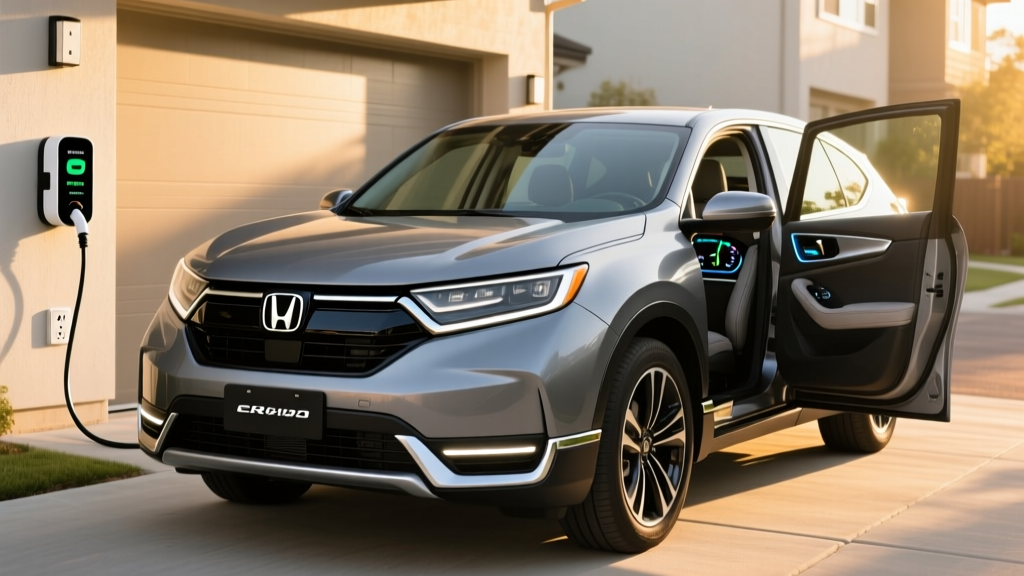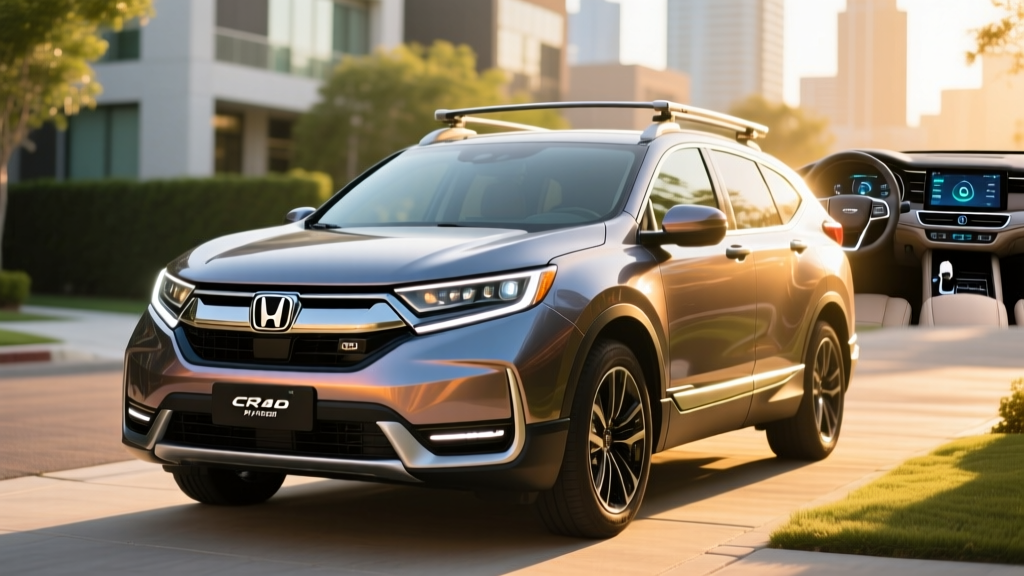
The Honda CR-V Hybrid has become one of the best-selling electrified compact SUVs in America, and for good reason: it delivers strong fuel economy without requiring any change to your daily routine. No plugs, no range anxiety, no charging apps. For 2026, Honda continues the sixth-generation CR-V Hybrid lineup with refinements to pricing and standard equipment. If you're researching the 2026 Honda CR-V Hybrid MSRP, this guide covers every trim, the real-world MPG you can expect, powertrain details, battery longevity, and whether this HEV is the right choice versus a PHEV or full EV.
2026 Honda CR-V Hybrid MSRP by Trim
Honda offers the CR-V Hybrid across four trims for 2026, all built on the same two-motor hybrid system. Here is the manufacturer's suggested retail pricing before destination charges:
| Trim | Drivetrain | MSRP (2026) | Key Additions Over Base |
|---|---|---|---|
| Sport Hybrid | FWD | $36,395 | Hybrid powertrain, 19" wheels, heated seats, wireless CarPlay/Android Auto |
| Sport Hybrid | AWD | $37,895 | Real-time AWD with torque vectoring |
| Sport-L Hybrid | AWD | $40,395 | Leather-trimmed seats, power liftgate, wireless charging pad |
| Sport Touring Hybrid | AWD | $43,895 | Bose 12-speaker audio, navigation, heated steering wheel, hands-free liftgate, parking sensors |
Destination charge: approximately $1,395 additional. Prices reflect Honda's published 2026 MSRP and may vary by dealer.
At these price points, the CR-V Hybrid commands roughly a $2,500–$3,000 premium over equivalent gas-only CR-V trims. The fuel savings typically close that gap within three to four years for drivers covering 12,000–15,000 miles annually, depending on local gas prices.
EPA MPG Ratings and Real-World Fuel Economy
The 2026 CR-V Hybrid uses Honda's fourth-generation two-motor hybrid system, which is optimized for city efficiency. Here are the official EPA figures:
| Drivetrain | City MPG | Highway MPG | Combined MPG |
|---|---|---|---|
| FWD (Sport Hybrid) | 43 | 36 | 40 |
| AWD (Sport, Sport-L, Sport Touring) | 40 | 34 | 37 |
Source: EPA Fuel Economy
For context, the gas-only 2026 CR-V AWD is rated at 27 city / 32 highway / 29 combined — meaning the hybrid delivers roughly 28% better combined fuel economy with AWD.
Powertrain: How Honda's Hybrid System Works
The 2026 CR-V Hybrid pairs a 2.0-liter Atkinson-cycle four-cylinder engine with two electric motors in Honda's e:HEV configuration:
| Component | Specification |
|---|---|
| Gasoline Engine | 2.0L DOHC Atkinson-cycle 4-cylinder |
| Engine Output | 146 hp / 134 lb-ft torque |
| Drive Motor | 181 hp / 247 lb-ft torque |
| Combined System Output | 204 hp / 247 lb-ft torque |
| Transmission | Direct-drive (no traditional CVT or gears) |
| Hybrid Battery | ~1.06 kWh lithium-ion (self-charging HEV) |
| 0–60 MPH | ~7.6 seconds |
The key distinction here: the CR-V Hybrid is a conventional hybrid (HEV), not a plug-in hybrid. The small battery recharges through regenerative braking and the gasoline engine. You never plug it in. The system operates primarily as a series hybrid at low speeds (the engine acts as a generator, and the electric motor drives the wheels) and switches to a direct mechanical connection at highway cruising speeds where the gasoline engine is most efficient.
Conventional Hybrid (HEV): Small battery (~1 kWh). Charges itself via regenerative braking and the engine. No plug. No electric-only range to speak of. Improves MPG by 25–40% over gas-only. Example: 2026 Honda CR-V Hybrid.
Plug-in Hybrid (PHEV): Larger battery (typically 12–20 kWh). Plugs into a wall outlet or charger. Offers 25–45 miles of electric-only driving before the gas engine kicks in. Example: Toyota RAV4 Prime, Hyundai Tucson PHEV.
Honda does not currently offer a CR-V PHEV in the United States for the 2026 model year. If you want plug-in capability in this segment, you'll need to look at competitors.
Hybrid Battery Warranty and Longevity
Battery replacement anxiety is the number one concern we hear from prospective hybrid buyers. Here are the facts for the 2026 CR-V Hybrid:
• Duration: 8 years / 100,000 miles (10 years / 150,000 miles in CARB states including CA, CO, CT, ME, MA, NJ, NY, OR, RI, VT, WA)
• Coverage: Defects and capacity loss below a defined threshold
• Hybrid System Components: Also covered under the 8yr/100k powertrain warranty
• Replacement Cost (out of warranty): Approximately $3,000–$4,500 for the hybrid battery pack, plus labor
In practice, Honda's hybrid batteries have proven quite durable. The company's hybrid systems have been in production since the 1999 Insight, and real-world data from third-generation CR-V Hybrids (now reaching 150,000+ miles) shows minimal capacity degradation. Unlike full EVs where the battery represents 30–40% of vehicle cost, the CR-V Hybrid's small ~1 kWh battery is relatively inexpensive to replace if it ever fails outside warranty.
The hybrid system's power control unit (PCU) and electric motors are also covered under the powertrain warranty and have no routine maintenance requirements. There is no "hybrid-specific" service interval — you follow the same maintenance schedule as a gas CR-V (oil changes, tire rotations, brake fluid). In fact, regenerative braking often extends brake pad life well beyond what gas-only vehicles experience.
Does the 2026 CR-V Hybrid Qualify for a Tax Credit?
This is where conventional hybrids differ sharply from plug-in vehicles:
- Federal §30D Clean Vehicle Credit ($7,500): The CR-V Hybrid does not qualify. The IRS §30D credit requires a minimum battery capacity of 7 kWh and plug-in capability. The CR-V Hybrid's ~1 kWh battery and HEV architecture make it ineligible.
- Federal Used Clean Vehicle Credit (§25E, up to $4,000): Also does not apply — same battery/plug-in requirements, plus the vehicle must be purchased used from a dealer for under $25,000.
- State Incentives: Some states offer modest rebates or tax credits for conventional hybrids, though these are increasingly rare as incentive programs shift toward PHEVs and BEVs. Check your state's energy or environmental agency website for current programs.
The lack of federal tax credits means the CR-V Hybrid's value proposition rests entirely on fuel savings and lower maintenance costs rather than purchase-price incentives. For buyers who want tax credit eligibility in a similar vehicle, the Toyota RAV4 Prime PHEV (if you can find one at MSRP) or a full EV like the Hyundai Ioniq 5 would qualify, subject to income and sourcing requirements.
CR-V Hybrid vs. Competitors: Where It Stands
| Vehicle | Type | Combined MPG / MPGe | Starting MSRP | Federal Credit |
|---|---|---|---|---|
| 2026 Honda CR-V Hybrid AWD | HEV | 37 MPG | $37,895 | None |
| 2026 Toyota RAV4 Hybrid AWD | HEV | 39 MPG | $35,495 | None |
| 2026 Toyota RAV4 Prime AWD | PHEV | 42 mi EV + 38 MPG | $45,490 | Up to $7,500* |
| 2026 Hyundai Tucson Hybrid AWD | HEV | 38 MPG | $36,490 | None |
| 2026 Ford Escape Hybrid AWD | HEV | 39 MPG | $36,995 | None |
*RAV4 Prime federal credit eligibility depends on battery sourcing, buyer income caps, and MSRP limits per current IRS §30D rules. Verify before purchase.
The CR-V Hybrid sits in the middle of this competitive set on MPG and near the top on interior space (39.3 cubic feet of cargo room behind the second row). The RAV4 Hybrid edges it out by 2 MPG combined, while the Tucson Hybrid is nearly identical. The CR-V's advantages include Honda's strong reliability reputation, excellent Honda Sensing safety suite (standard on all trims), and a more car-like driving feel compared to some competitors.
Who Should Choose the CR-V Hybrid vs. a PHEV or Full EV?
Choose the CR-V Hybrid If:
- You don't have access to home or workplace charging
- You want better MPG without changing any habits
- You frequently take long road trips and don't want to plan around chargers
- You live in an apartment or rent and can't install a charger
- Your budget is $36K–$44K and you want a proven, low-risk purchase
Look at a PHEV or Full EV Instead If:
- You have reliable home Level 2 charging and a short commute (PHEV covers it on electricity)
- You want to qualify for the $7,500 federal tax credit
- You want to minimize or eliminate gasoline use entirely
- Local electricity rates make EV charging significantly cheaper than gas
- You want one-pedal driving and instant EV torque
Frequently Asked Questions
How many MPG does the 2026 Honda CR-V Hybrid actually get?
The EPA rates the AWD CR-V Hybrid at 40 city / 34 highway / 37 combined, and the FWD model at 43/36/40. Real-world owners commonly see 38–42 MPG combined in moderate climates, with city driving often exceeding the EPA estimate. Highway-heavy driving and cold weather reduce these figures.
Does the CR-V Hybrid need to be plugged in?
No. The CR-V Hybrid is a conventional self-charging hybrid (HEV). Its small battery recharges through regenerative braking and the gasoline engine. You fuel it exactly like a regular car — just with better MPG.
Is there a plug-in version of the CR-V?
Honda does not sell a CR-V plug-in hybrid in the United States for 2026. If you want a PHEV compact SUV, the closest competitors are the Toyota RAV4 Prime (42 miles electric-only), Hyundai Tucson PHEV (33 miles), and Mitsubishi Outlander PHEV (38 miles).
How long will the CR-V Hybrid battery last?
Honda warranties the hybrid battery for 8 years/100,000 miles (10 years/150,000 miles in CARB states). Based on historical data from previous-generation Honda hybrids, these batteries routinely last 150,000–200,000+ miles before requiring replacement. Out-of-warranty replacement costs approximately $3,000–$4,500.
Is the CR-V Hybrid AWD system good in snow?
The Real-Time AWD system on Hybrid trims can send up to 50% of torque to the rear wheels and includes torque vectoring. It performs well in moderate snow and rain. For severe winter conditions, dedicated winter tires make a larger difference than the AWD system alone. Note that FWD is available only on the base Sport Hybrid trim; all other trims are AWD-only.
What's the towing capacity of the CR-V Hybrid?
The 2026 CR-V Hybrid is rated to tow up to 1,000 pounds — adequate for a small utility trailer or a pair of dirt bikes, but not suitable for boat towing or campers. If you need more towing capacity, you'll need to look at larger SUVs or trucks.