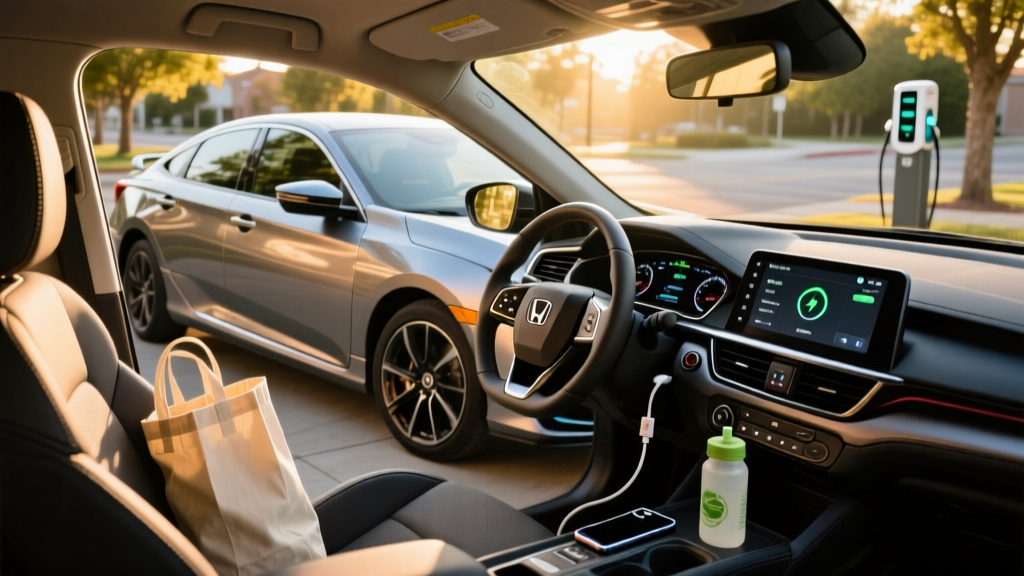
The 2026 Honda Civic Sport Touring Hybrid sits at the top of Honda's compact hybrid lineup, pairing a two-motor hybrid system with the Civic's most feature-rich trim. For buyers who want electric-like city efficiency without plugging in, this conventional hybrid (HEV) delivers 50 MPG EPA combined while avoiding the range and charging logistics of a full battery-electric vehicle. Below, we break down every number that matters — from real-world fuel economy to battery warranty — so you can decide if this is the right electrified car for your daily drive.
HEV vs PHEV: What the Civic Sport Touring Hybrid Actually Is
Before diving into specs, it's critical to understand what you're buying. The 2026 Civic Sport Touring Hybrid is a conventional hybrid (HEV), not a plug-in hybrid (PHEV). That distinction shapes everything about ownership:
| Feature | HEV (Civic Hybrid) | PHEV (e.g., Toyota Prius Prime) | BEV (e.g., Chevy Bolt EV) |
|---|---|---|---|
| Plug-in charging required? | No — self-charging via regen & engine | Yes — Level 1 or Level 2 | Yes — Level 1, 2, or DC fast |
| Electric-only driving | Brief low-speed EV mode (<1 mi) | 25–45 miles typical | 200–350+ miles |
| Fuel economy (combined) | 50 MPG EPA | 48–52 MPG (gas) + 114–127 MPGe (elec) | 100–120 MPGe |
| Total range | ~500+ miles | ~550–640 miles | 200–350+ miles |
| Federal tax credit (§30D) | Not eligible | Up to $7,500 (if eligible) | Up to $7,500 (if eligible) |
| Battery size | ~1.1 kWh (small buffer) | 10–14 kWh | 50–85+ kWh |
The Civic Hybrid's small lithium-ion battery charges entirely through regenerative braking and the gasoline engine. You never plug it in. This makes it ideal for drivers who lack home charging access — apartment dwellers, street parkers, or anyone who wants zero charging hassle while still cutting fuel costs significantly compared to a gas-only Civic.
Fuel Economy: EPA Ratings vs Real-World MPG
The EPA rates the 2026 Honda Civic Sport Touring Hybrid at the following fuel economy figures:
| Driving Cycle | EPA Rating | Real-World Expectation |
|---|---|---|
| City | 50 MPG | 52–56 MPG (hybrids excel in stop-and-go) |
| Highway | 47 MPG | 42–46 MPG (engine runs more at sustained speed) |
| Combined | 49 MPG | 46–52 MPG depending on driving mix |
Like most Honda two-motor hybrids, the Civic Sport Touring Hybrid tends to exceed its EPA city rating in real-world stop-and-go driving. The electric motor handles most low-speed acceleration, where gasoline engines are least efficient. On the highway, the engine takes over more directly, so expect slightly lower numbers than the sticker suggests — especially above 75 mph or in mountainous terrain.
In mixed suburban and city driving during moderate temperatures, owners of Honda's two-motor hybrid systems consistently report 48–54 MPG on the combined cycle. Cold weather (below 30°F) will reduce efficiency by roughly 8–12% as the engine runs more frequently for cabin heat and battery warming.
Powertrain and Performance Specs
The 2026 Civic Sport Touring Hybrid uses Honda's fourth-generation two-motor hybrid system, which prioritizes electric-motor-driven acceleration and seamlessly blends in the gasoline engine as needed.
| Specification | Value |
|---|---|
| Engine | 2.0L DOHC Atkinson-cycle 4-cylinder |
| Engine output | 146 HP / 134 lb-ft torque |
| Drive motor output | 184 HP / 232 lb-ft torque |
| Combined system output | 200 HP / 232 lb-ft torque |
| Transmission | e-CVT (no traditional gearbox) |
| Drivetrain | Front-wheel drive |
| 0–60 mph | ~7.2 seconds (est.) |
| Battery type | Lithium-ion, ~1.1 kWh |
| Curb weight | ~3,150 lbs |
| Towing capacity | Not rated for towing |
The 200 combined horsepower makes the Civic Sport Touring Hybrid one of the quicker compact hybrids on the market. The two-motor system delivers strong low-end torque from the electric drive motor, giving it a responsive, EV-like feel around town. The e-CVT avoids the rubber-band sensation of older CVTs because the system primarily uses the motor for propulsion, engaging the engine via a lock-up clutch at highway cruising speeds.
Honda's Sport driving mode sharpens throttle response and adds simulated gear shifts with steering-wheel-mounted paddle shifters for drivers who want more engagement. It doesn't change the mechanical output, but it does make the car feel more responsive on winding roads.
Pricing, Trim Content, and Tax Credit Eligibility
The 2026 Honda Civic Sport Touring Hybrid is the top-of-line Civic trim. Here's the pricing breakdown:
| Item | Amount |
|---|---|
| Base MSRP (Sport Touring Hybrid) | $32,750 |
| Destination charge | $1,095 |
| Total MSRP | $33,845 |
| Federal tax credit (§30D) | Not eligible (HEV) |
| Estimated out-the-door (before state incentives) | ~$36,500–$37,500 (with tax/title/fees) |
Federal tax credit: The Civic Hybrid is a conventional HEV, not a plug-in. The IRS §30D Clean Vehicle Credit applies only to plug-in electric vehicles (PHEVs and BEVs) with qualifying battery capacity. The Civic Hybrid does not qualify for the federal credit. Check your state's energy office for any local hybrid rebates — some states offer modest incentives ($250–$1,000) for high-efficiency hybrids, but these vary by jurisdiction.
What the Sport Touring Hybrid does include for that price is substantial content: a 9-inch touchscreen with wireless Apple CarPlay and Android Auto, Bose premium audio, wireless phone charging, heated front seats, heated steering wheel, Honda Sensing suite (adaptive cruise, lane-keeping, collision mitigation), leather-trimmed seats, and a power moonroof. It's a well-equipped compact car that competes on value against similarly priced small crossovers.
Battery Warranty, Reliability, and Replacement Cost
Hybrid battery longevity remains a top concern for buyers switching from a conventional gas car. Here's what Honda covers:
| Coverage | Terms |
|---|---|
| Hybrid battery warranty | 8 years / 100,000 miles (10 yr / 150,000 mi in CARB states*) |
| Hybrid system components | 8 years / 100,000 miles |
| Powertrain warranty | 5 years / 60,000 miles |
| Limited vehicle warranty | 3 years / 36,000 miles |
*CARB states include CA, CO, CT, DE, ME, MD, MA, NJ, NY, OR, RI, VT, WA, and others adopting California emissions standards. Check your state's status.
Honda's two-motor hybrid system has a strong reliability track record. The small ~1.1 kWh battery operates within a narrow state-of-charge window (roughly 20–80%), which dramatically reduces degradation compared to a full EV battery that cycles through a wider range. Honda has used variations of this system in the Accord Hybrid, CR-V Hybrid, and Insight for years with low failure rates.
Battery replacement cost: If the hybrid battery does fail outside warranty, replacement typically runs $2,500–$4,000 including parts and labor at a Honda dealer. Independent hybrid specialists may offer refurbished units for $1,500–$2,500. Given the conservative charge/discharge cycling and the 8–10 year warranty, most Civic Hybrid owners will never face this expense.
According to IIHS testing, the Civic continues to earn top safety marks, and the hybrid variant carries the same structural ratings. The added weight of the hybrid system (~100 lbs over the gas model) is low in the chassis and doesn't negatively affect crash performance.
Who Should Buy the Civic Sport Touring Hybrid — And Who Shouldn't
Pros
- 49 MPG combined EPA; 52+ MPG real-world in city driving
- 200 HP — quicker than most compact hybrids
- No plug-in charging required; ideal for apartment/street parking
- 500+ mile range per tank
- Premium Sport Touring content (Bose, leather, heated seats) at ~$34K
- 8–10 year hybrid battery warranty
- Strong Honda Sensing ADAS suite standard
Cons
- No federal tax credit (HEV, not PHEV)
- Highway MPG drops to low 40s at sustained 75+ mph
- No electric-only commuting (EV mode limited to very low speed)
- FWD only — no AWD option for snow-belt buyers
- Not rated for towing
- Slightly higher base price than gas Civic Touring (~$3,000 premium)
Choose the 2026 Civic Sport Touring Hybrid if:
- You drive 15,000+ miles/year in mixed city/suburban traffic and want maximum fuel savings without plug-in logistics
- You lack reliable access to home or workplace charging
- You want a compact car with premium features under $35,000
- You plan to keep the car 8+ years and value a proven hybrid system
Consider a PHEV or BEV instead if:
- You have home Level 2 charging and a short commute — a PHEV like the Toyota Prius Prime gives 40+ electric-only miles and qualifies for up to $7,500 in federal credits
- You want zero gasoline use — a BEV like the Hyundai Kona Electric or Chevy Equinox EV eliminates fuel entirely
- You need AWD — consider the Toyota Prius AWD or a compact electric SUV
Frequently Asked Questions
How many MPG does the 2026 Honda Civic Sport Touring Hybrid get?
The EPA rates it at 50 MPG city, 47 MPG highway, and 49 MPG combined. In real-world city driving, many owners report 52–56 MPG thanks to the electric motor handling low-speed acceleration. Highway-only driving at 75+ mph may return 42–45 MPG.
Does the Civic Hybrid need to be plugged in?
No. The 2026 Civic Sport Touring Hybrid is a conventional HEV. Its small lithium-ion battery recharges through regenerative braking and the gasoline engine. You fuel it like any other car — no plug, no charging station, no range anxiety about finding an outlet.
Does the 2026 Civic Hybrid qualify for a federal tax credit?
No. The IRS §30D Clean Vehicle Credit applies only to plug-in electric vehicles (PHEVs and BEVs). Because the Civic Hybrid cannot be plugged in, it does not qualify. Some states may offer small hybrid incentives — check your state energy office or IRS guidance for details.
How long will the hybrid battery last?
Honda warranties the hybrid battery for 8 years/100,000 miles (10 years/150,000 miles in CARB states). Based on Honda's track record with two-motor hybrid systems in the Accord, CR-V, and Insight, most batteries last well beyond the warranty period. The system's narrow charge window (avoiding full 0% or 100% states) significantly extends cell life.
What does hybrid battery replacement cost?
Dealer replacement typically costs $2,500–$4,000 including labor. Independent hybrid shops may offer refurbished batteries for $1,500–$2,500. Given the battery's design and warranty coverage, most original owners never need a replacement.
Is the Civic Sport Touring Hybrid faster than the gas Civic?
Yes. With 200 combined horsepower and 232 lb-ft of electric motor torque, the hybrid is quicker than the 1.5L turbocharged gas Civic (180 HP). The 0–60 mph time of approximately 7.2 seconds puts it ahead of most compact hybrid competitors and makes merging and passing effortless.
Hybrid vs PHEV vs EV — which is right for me?
If you can't plug in at home or work, a conventional hybrid like the Civic gives you the best fuel economy with zero lifestyle change. If you have Level 2 charging and a commute under 40 miles, a PHEV lets you drive most days on electricity alone while keeping a gas engine for road trips. If you have reliable charging and want the lowest operating cost, a full BEV eliminates gasoline entirely but requires charging planning on long trips.