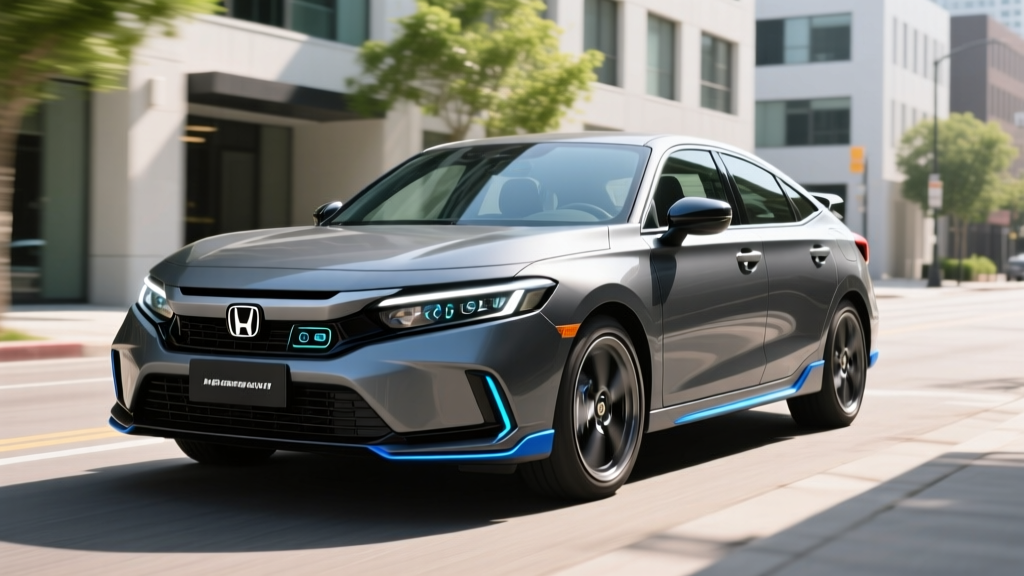
The 2026 Honda Civic Sport Touring Hybrid Hatchback occupies a precise niche: it's a conventional hybrid (HEV) that requires no plug, delivers hatchback cargo versatility, and returns EPA-estimated fuel economy that rivals dedicated hybrids at a price point undercutting most plug-in alternatives. For buyers weighing a full battery-electric vehicle against a gasoline compact, this trim represents the pragmatic middle ground — zero lifestyle change, measurable fuel savings, and Honda's proven two-motor hybrid system.
HEV vs PHEV: What the Civic Hybrid Actually Is
Before diving into specs, it's critical to distinguish what the 2026 Civic Sport Touring Hybrid is — and isn't. This is a conventional hybrid electric vehicle (HEV), not a plug-in hybrid (PHEV). You cannot plug it in. The 1.1 kWh lithium-ion battery pack charges exclusively through regenerative braking and the gasoline engine. There is no electric-only driving range to speak of — the electric motor assists the engine and enables brief low-speed EV mode, but the gas engine is always the primary energy source.
| Feature | HEV (Civic Hybrid) | PHEV (e.g., Toyota Prius Prime) | BEV (e.g., Chevy Equinox EV) |
|---|---|---|---|
| Plug-in charging | No | Yes (Level 1/2) | Yes (Level 1/2/DC) |
| Electric-only range | ~1 mile (low-speed assist) | 30–45 miles typical | 250–350+ miles |
| Battery size | ~1.1 kWh | 10–14 kWh | 60–100+ kWh |
| Fuel economy | 50 MPG combined | 45–52 MPG + MPGe | N/A (kWh/100mi) |
| Federal tax credit (§30D) | No — HEVs excluded | Up to $7,500 (if eligible) | Up to $7,500 (if eligible) |
| Home charger needed | No | Recommended | Essential |
If you're comparing the Civic Hybrid to a PHEV like the Toyota Prius Prime, the tradeoff is straightforward: PHEVs offer 30–45 miles of pure electric commuting but cost more upfront and benefit from a home Level 2 charger. The Civic HEV asks nothing of your garage infrastructure and delivers consistent efficiency regardless of charging access.
EPA Fuel Economy and Real-World MPG
The 2026 Honda Civic Sport Touring Hybrid Hatchback carries an EPA-estimated 50 MPG city / 47 MPG highway / 50 MPG combined rating, per fueleconomy.gov. These figures apply to the Sport Touring trim specifically, which includes 18-inch alloy wheels and a sport-tuned suspension that marginally impacts efficiency versus lower trims with smaller wheels.
| Metric | EPA Estimate | Real-World Expectation |
|---|---|---|
| City MPG | 50 | 50–55 (hybrids excel in stop-and-go) |
| Highway MPG | 47 | 42–46 (sustained 75+ mph reduces regen benefit) |
| Combined MPG | 50 | 46–52 (depends on city/highway split) |
| Fuel tank capacity | 10.6 gallons | — |
| Total driving range | ~530 miles | ~470–550 miles |
Real-world MPG in the Civic Hybrid often exceeds the EPA city estimate. Honda's two-motor hybrid system recovers significant energy during braking and low-speed driving, making urban commutes the efficiency sweet spot. Owners in heavy-traffic metro areas routinely report 52–56 MPG on city-heavy routes. Highway driving is the opposite story: at sustained speeds above 70 mph, aerodynamic drag dominates and regenerative braking opportunities disappear, pulling observed economy into the low-to-mid 40s.
Cold weather also matters. In sub-freezing conditions, expect a 5–10% reduction in fuel economy due to increased engine idling for cabin heat, thicker fluids, and reduced battery efficiency. This is far less severe than the 20–40% range loss a full EV experiences in winter, but it's worth noting for northern-climate buyers.
Powertrain: 200 Horsepower from Honda's Two-Motor System
The 2026 Civic Hybrid uses Honda's fourth-generation two-motor hybrid system, pairing a 2.0-liter Atkinson-cycle four-cylinder engine with two electric motors. Combined system output is 200 horsepower and 232 lb-ft of torque, routed to the front wheels through an e-CVT (electronically controlled continuously variable transmission).
| Specification | Value |
|---|---|
| Engine | 2.0L Atkinson-cycle inline-4 |
| Engine power | 143 hp @ 5,800 rpm |
| Drive motor power | 184 hp (135 kW) |
| Combined system output | 200 hp / 232 lb-ft torque |
| Transmission | e-CVT (no traditional gears) |
| Drivetrain | Front-wheel drive |
| 0–60 mph | ~7.4 seconds (est.) |
| Battery type | Lithium-ion (~1.1 kWh) |
| Battery location | Under rear seats (preserves cargo space) |
The powertrain operates in three modes: EV Drive (battery powers the motor for brief low-speed movement), Hybrid Drive (engine generates electricity to power the drive motor), and Engine Drive (engine directly drives the wheels at efficient highway cruising speeds). The transitions are seamless and largely imperceptible. The 232 lb-ft of torque from the electric motor provides immediate off-the-line response that makes the Civic Hybrid feel noticeably quicker than its EPA 0–60 time suggests in everyday driving.
Cargo, Interior, and Sport Touring Trim Features
The Sport Touring Hybrid Hatchback sits at the top of the Civic Hybrid lineup. For 2026, this trim includes a 9-inch touchscreen with wireless Apple CarPlay and Android Auto, a 12-speaker Bose premium audio system, wireless phone charging, heated front seats, a heated steering wheel, leather-trimmed seats, and Honda Sensing (the brand's ADAS suite including adaptive cruise control, lane-keeping assist, and automatic emergency braking).
The hatchback body style delivers 24.5 cubic feet of cargo space behind the rear seats — a significant advantage over the Civic Hybrid sedan's 14.8 cu ft trunk. With the 60/40-split rear seats folded, cargo volume expands to approximately 46 cu ft, enough for weekend trip luggage for four or a full run of home-improvement supplies.
Honda Sensing on the 2026 Civic is a SAE Level 2 driver-assistance system. It is not autonomous driving. The driver must keep hands on the wheel and eyes on the road at all times. Adaptive cruise with low-speed follow and lane-centering assist reduce fatigue on long highway stretches, but the system will issue warnings and disengage if it detects driver inattention.
Pricing, Trim Levels, and Tax Credit Reality
The 2026 Honda Civic Sport Touring Hybrid Hatchback carries a starting MSRP of approximately $34,395 (including destination charge). This positions it roughly $5,000–$7,000 below comparably equipped PHEVs and $8,000–$12,000 below most compact electric crossovers.
| Trim | MSRP (incl. destination) | Key Additions |
|---|---|---|
| Sport Hybrid | ~$29,995 | 18" wheels, sport pedals, dual exhaust |
| Sport Touring Hybrid | ~$34,395 | Leather, Bose audio, wireless CarPlay, nav |
Federal tax credit eligibility: The Civic Hybrid does NOT qualify for the IRS §30D clean vehicle credit. Under current IRS rules, only plug-in electric vehicles (PHEVs and BEVs) with sufficient battery capacity are eligible for the up-to-$7,500 federal credit. Conventional hybrids like the Civic HEV are excluded entirely. There are also no federal credits for used conventional hybrids.
Some states offer rebates or incentives for hybrid vehicles, though these are far less common than EV incentives. Check your state's energy or environmental agency for current programs. The Civic Hybrid's lower MSRP relative to PHEVs and BEVs often makes the total cost competitive even without federal credits.
Battery Warranty, Reliability, and Replacement Cost
Honda Hybrid Battery Warranty: 8 years / 100,000 miles (10 years / 150,000 miles in CARB states including CA, CO, CT, ME, MD, MA, NJ, NY, OR, RI, VT, WA). The warranty covers the hybrid battery pack against defects and capacity loss below a functional threshold. Honda's hybrid system has demonstrated strong long-term reliability, with many first- and second-generation Civic and Insight Hybrids exceeding 200,000 miles on original battery packs.
The ~1.1 kWh lithium-ion battery in the Civic Hybrid is small and operates within a narrow state-of-charge window — Honda's battery management system never fully charges or fully depletes it, which significantly extends cycle life. This is fundamentally different from a BEV or PHEV battery that undergoes deeper charge cycles.
If replacement is needed out of warranty, Honda hybrid battery replacement typically costs $2,000–$4,000 including labor at a dealership. Third-party and refurbished options may reduce this to $1,500–$2,500. Given the battery's small size, shallow cycling, and proven track record, unplanned replacement within the first 15 years of ownership is uncommon.
Honda's overall vehicle reliability record is strong. The Civic platform has consistently earned top marks from IIHS and high reliability scores from consumer surveys. The hybrid powertrain adds complexity (two motors, power electronics, e-CVT) but removes others (no traditional automatic transmission, no starter motor, no alternator, reduced brake wear from regenerative braking).
Ownership Economics: 5-Year Cost vs Gas and EV
At 50 MPG combined and a national average regular gas price of approximately $3.20/gallon (as of early 2026), the Civic Hybrid costs roughly $0.064 per mile in fuel. Over 15,000 annual miles, that's approximately $960 per year in gasoline. A comparable gas-only Civic at 34 MPG combined would cost about $1,410 per year — a $450 annual savings with the hybrid.
Compared to a compact EV averaging $0.04 per mile in electricity (home charging at $0.14/kWh), the Civic Hybrid costs about $360 more per year in energy. But the EV buyer faces higher upfront costs, potential home charger installation ($500–$2,000), and in some states, higher insurance premiums. The Civic Hybrid's total cost of ownership remains compelling for buyers who cannot install a home charger or who drive in areas with sparse public charging infrastructure.
Who Should Buy the Civic Sport Touring Hybrid Hatchback?
Reasons to Choose It
- No charging infrastructure needed — works with any gas station
- 50 MPG combined with no behavioral changes required
- 200 hp provides confident acceleration for a 50-MPG vehicle
- Hatchback cargo space (24.5 cu ft) adds practicality
- Lower MSRP than PHEVs and BEVs with similar features
- Proven Honda hybrid reliability and strong resale value
- Honda Sensing Level 2 ADAS standard
Reasons to Look Elsewhere
- No federal tax credit eligibility (§30D excludes HEVs)
- No meaningful electric-only range — not a "plug-in" experience
- e-CVT drone under hard acceleration (common to Honda hybrids)
- Highway MPG drops to low 40s at 75+ mph
- FWD only — no AWD option (unlike Toyota Prius)
- Sport Touring MSRP approaching PHEV territory
Choose the Civic Sport Touring Hybrid if: You want maximum fuel economy with zero charging hassle, you lack home charging access (apartment, street parking), your commute is city-heavy, and you value hatchback versatility at a sub-$35K price.
Choose a PHEV instead if: You have home Level 2 charging, your daily commute is under 40 miles round-trip (enabling mostly electric driving), and you want to reduce gasoline consumption dramatically while keeping a gas engine for road trips.
Choose a full EV instead if: You have reliable home charging, your daily driving is under 250 miles, you want to eliminate gasoline entirely, and you qualify for the $7,500 federal credit that narrows the price gap.
Frequently Asked Questions
How many MPG does the 2026 Civic Sport Touring Hybrid Hatchback get?
The EPA rates it at 50 city / 47 highway / 50 combined MPG. In real-world city-heavy driving, many owners report 52–56 MPG. Highway cruising above 70 mph typically yields 42–46 MPG.
Can I plug in the Civic Hybrid to charge?
No. The 2026 Civic Hybrid is a conventional HEV, not a plug-in hybrid. The battery charges through regenerative braking and the gasoline engine. There is no charging port.
How far can the Civic Hybrid drive on electric power alone?
Approximately 1 mile at very low speeds (under 25 mph) in EV mode. The electric motor primarily assists the gasoline engine rather than replacing it. For meaningful electric-only range (30+ miles), you need a PHEV.
Does the Civic Hybrid qualify for any federal tax credit?
No. The IRS §30D Clean Vehicle Credit applies only to plug-in vehicles (PHEVs and BEVs) with battery packs of at least 7 kWh. The Civic Hybrid's ~1.1 kWh battery disqualifies it. Check your state for any local hybrid incentives.
How long will the hybrid battery last and what does replacement cost?
Honda warranties the hybrid battery for 8 years/100,000 miles (10/150,000 in CARB states). Real-world data suggests these small, shallow-cycle batteries routinely last 150,000–200,000+ miles. Out-of-warranty replacement costs $2,000–$4,000 at a dealer.
Is the Civic Hybrid more reliable than a gas-only Civic?
Honda's hybrid system has a strong reliability track record. The e-CVT has fewer moving parts than a conventional automatic transmission, and regenerative braking reduces brake pad wear. The added complexity of the hybrid system (power electronics, two motors) has proven durable over multiple generations.
How does the Civic Hybrid compare to the Toyota Prius?
The 2026 Prius offers similar fuel economy (up to 57 MPG combined on lower trims) with an available AWD powertrain. The Civic Hybrid delivers more horsepower (200 vs 194), a more engaging driving experience, and a more premium interior in the Sport Touring trim. The Prius offers a PHEV variant (Prius Prime) for buyers wanting electric-only range; Honda does not offer a Civic PHEV in the US market.