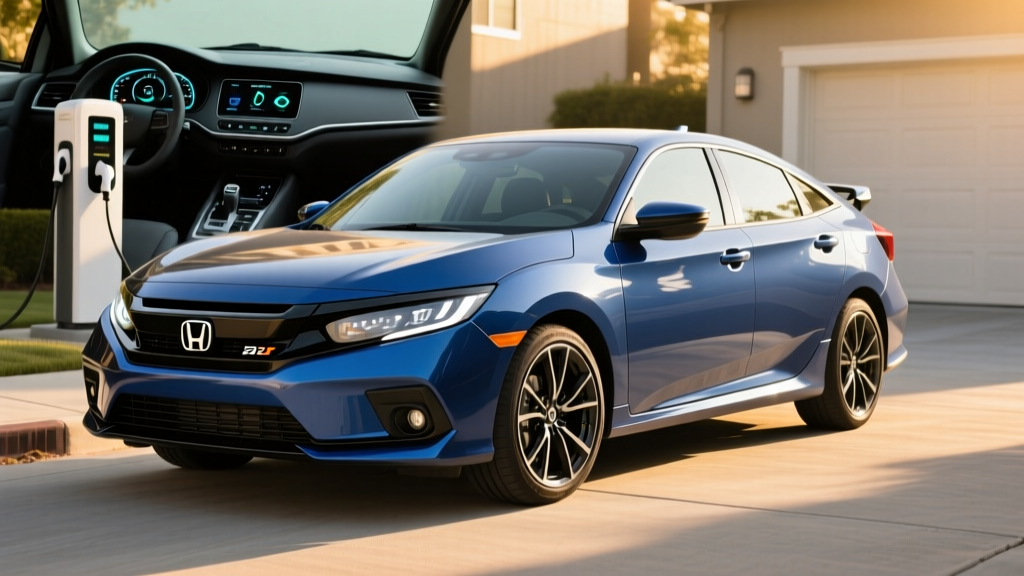
The 2026 Honda Civic Sport Hybrid Touring sits at the top of Honda's compact hybrid lineup, pairing the brand's fourth-generation two-motor hybrid system with the most feature-rich trim available. For buyers who want electrified efficiency without plugging in, this is one of the most compelling packages in the compact segment. Below, we break down every number that matters — fuel economy, powertrain output, pricing, battery longevity, and whether any tax incentives apply.
2026 Honda Civic Sport Hybrid Touring: Quick Verdict
The Civic Sport Hybrid Touring is a conventional hybrid (HEV), not a plug-in. It generates its own electricity through regenerative braking and the gasoline engine — no charging cable required. The trade-off is clear: you get outstanding fuel economy (up to 50 MPG combined) without any electric-only driving range. If you need plug-in electric miles, you'll want to look at a PHEV like the Toyota Prius Prime. If you want a set-it-and-forget-it efficiency upgrade over a gas car, the Civic Hybrid delivers.
| Specification | 2026 Civic Sport Hybrid Touring |
|---|---|
| Powertrain | 2.0L Atkinson-cycle I-4 + two electric motors |
| Combined Horsepower | 200 hp |
| Combined Torque | 232 lb-ft (electric motor) |
| Transmission | e-CVT (direct-drive with lock-up clutch) |
| Drivetrain | FWD (AWD not available on Sport Hybrid Touring) |
| EPA Fuel Economy | 50 city / 47 highway / 49 combined MPG |
| Fuel Tank | 10.6 gallons |
| Total Range | ~519 miles |
| 0–60 mph | ~7.2 seconds (est.) |
| Battery Type | Lithium-ion (under rear seat) |
| Base MSRP | $32,650 (incl. destination) |
| Federal Tax Credit | Not eligible (§30D requires plug-in) |
Fuel Economy: EPA Numbers vs. Real-World MPG
The EPA rates the 2026 Civic Sport Hybrid Touring at 50 MPG city, 47 MPG highway, and 49 MPG combined per fueleconomy.gov. These are among the best numbers in the compact class, trailing only the Toyota Prius (57 combined on the LE trim).
| Driving Scenario | EPA Estimate | Real-World Expectation |
|---|---|---|
| City / Stop-and-Go | 50 MPG | 50–55 MPG (hybrids excel here) |
| Highway (70–75 mph) | 47 MPG | 42–46 MPG (aero drag, less regen) |
| Combined Mixed | 49 MPG | 46–51 MPG |
| Cold Weather (below 32°F) | — | 38–44 MPG (engine runs more for heat) |
Conventional hybrids like the Civic tend to beat their EPA city estimate in real-world stop-and-go driving because regenerative braking recaptures energy that a gas car wastes as brake heat. Highway driving is the opposite story — at sustained 75 mph speeds, the gasoline engine does most of the work and the electric motors contribute less. In cold weather, expect a 10–15% drop because the engine must run more frequently to provide cabin heat and maintain battery temperature.
HEV vs. PHEV vs. EV: Which Powertrain Fits You?
The Civic Sport Hybrid Touring is a conventional hybrid. Understanding the distinction matters because it affects everything from daily routine to tax incentives.
| Factor | HEV (This Civic) | PHEV (e.g., Prius Prime) | BEV (e.g., Chevy Equinox EV) |
|---|---|---|---|
| Plug in to charge? | No — self-charging | Yes — for electric-only miles | Yes — always |
| Electric-only range | 0 miles (EV mode ~1 mi at low speed) | 25–44 miles typical | 250–350+ miles |
| Gasoline backup | Yes — 519 mi total | Yes — 400+ mi total | No |
| Home charging needed | No | Recommended (120V or 240V) | Essential (240V Level 2) |
| Federal tax credit (§30D) | Not eligible | Up to $7,500 (if eligible) | Up to $7,500 (if eligible) |
| Maintenance | Oil changes, standard | Oil changes, standard | Minimal — no oil, fewer fluids |
| Best for | No home charging access | Short commutes + home charging | Full commitment to electric |
Choose the Civic Hybrid if: You don't have access to home or workplace charging, you want maximum simplicity, and you drive a mix of city and highway miles. The Civic Hybrid requires zero behavioral change from a gas car — just fill up less often.
Consider a PHEV instead if: You can install a Level 2 charger at home and your daily commute is under 40 miles round-trip. A PHEV lets you drive most weekdays on electricity while keeping a gas engine for road trips.
Consider a full EV if: You have reliable home charging, your daily driving is under 250 miles, and you want the lowest per-mile energy cost and minimal maintenance.
Powertrain Deep Dive: 200 HP Two-Motor System
Honda's fourth-generation hybrid system pairs a 2.0-liter Atkinson-cycle four-cylinder engine with two electric motors. The combined system output is 200 horsepower and 232 lb-ft of torque. Unlike Toyota's planetary-gear hybrid system, Honda uses a clutch-based arrangement: at low speeds, the electric traction motor drives the wheels directly while the engine acts as a generator. At highway cruising speeds, a lock-up clutch connects the engine to the wheels for greater efficiency.
The result is a driving experience that feels more like an EV around town — instant torque, smooth acceleration, no rubber-band CVT drone — while retaining highway efficiency. The 0–60 mph time of approximately 7.2 seconds puts it ahead of the non-hybrid Civic (which runs closer to 8.5 seconds with the 2.0L engine) and makes highway merging effortless.
The lithium-ion hybrid battery is mounted under the rear seat, preserving the Civic's full 14.8 cubic feet of trunk space. This is a small-capacity battery (roughly 1 kWh) designed for frequent shallow cycling rather than long electric-only range.
Pricing, Trims, and Tax Credit Eligibility
The 2026 Honda Civic Sport Hybrid Touring carries a starting MSRP of approximately $32,650 including destination charges. As the top trim, it comes loaded with features that would be optional on lower grades: leather-trimmed seats, Bose premium audio, wireless Apple CarPlay/Android Auto, a 9-inch touchscreen, heated front and rear seats, and Honda Sensing (the brand's Level 2 driver-assistance suite with adaptive cruise, lane-keeping, and collision mitigation).
Federal tax credit status: The Civic Sport Hybrid Touring does not qualify for the IRS §30D Clean Vehicle Credit. Per IRS guidelines, the §30D credit applies only to plug-in electric vehicles (PHEVs and BEVs) with a minimum battery capacity of 7 kWh. Conventional hybrids like this Civic, which cannot be plugged in, are excluded regardless of price or buyer income.
Some states offer separate rebates or HOV-lane access for hybrids, but these vary by jurisdiction. Check your state's energy or environmental agency website for current programs.
Battery Warranty, Reliability, and Replacement Cost
Hybrid battery longevity is the top concern for buyers considering their first electrified vehicle. Here's what the data shows:
| Coverage Item | Term |
|---|---|
| Hybrid Battery Warranty | 8 years / 100,000 miles (10 yr / 150,000 mi in CARB states) |
| Powertrain Warranty | 5 years / 60,000 miles |
| Limited Vehicle Warranty | 3 years / 36,000 miles |
| Warranty Capacity Threshold | Below ~70% state of health triggers replacement under warranty |
Honda's hybrid systems have proven highly durable. The two-motor architecture uses a relatively small lithium-ion pack that undergoes shallow charge-discharge cycles, which is far less stressful on cells than the deep cycles in a full EV or PHEV. Real-world data from earlier Honda hybrid models (Insight, Accord Hybrid, CR-V Hybrid) shows most batteries lasting well beyond 150,000 miles with minimal degradation.
If replacement is needed out of warranty, expect a cost of $2,000–$4,000 for the hybrid battery pack, depending on whether you use a new OEM unit, a refurbished module, or an independent hybrid specialist. This is significantly less than a full EV battery replacement ($8,000–$20,000+) because the pack is much smaller.
According to IIHS, the Civic continues to earn top safety ratings, and Honda Sensing's Level 2 driver-assist features are standard across all trims including the Sport Hybrid Touring. Remember: Level 2 means the driver must remain fully engaged — this is not self-driving.
Who Should Buy the 2026 Civic Sport Hybrid Touring?
Pros
- 50 MPG city — among the best in the compact segment
- 200 hp provides confident acceleration (7.2s 0–60)
- No charging infrastructure required — works like a gas car
- Touring trim is fully loaded at a reasonable price
- Excellent reliability track record for Honda hybrid systems
- Strong safety ratings and standard Honda Sensing ADAS
Cons
- Not eligible for the $7,500 federal EV tax credit
- Highway MPG drops to ~42–46 in real-world driving
- AWD not available on Sport Hybrid Touring (available on Sport Hybrid AWD trim)
- No electric-only driving range for zero-emission commutes
- Cold-weather fuel economy drops 10–15%
- Competitors like Prius offer higher combined MPG (57)
Buy the Civic Sport Hybrid Touring if: You want a premium compact car with near-50 MPG efficiency, you lack home charging access, and you value Honda's reputation for reliability and resale value. The Touring trim justifies its price with standard features that would cost thousands as add-ons elsewhere.
Look elsewhere if: You want electric-only commuting (consider the Prius Prime or a BEV), you need AWD for snow-belt driving (look at the Civic Sport Hybrid AWD or a Subaru Crosstrek Hybrid), or you want to maximize federal tax incentives (PHEVs and BEVs qualify; this HEV does not).
Frequently Asked Questions
How many MPG does the 2026 Honda Civic Sport Hybrid Touring get?
The EPA rates it at 50 MPG city, 47 MPG highway, and 49 MPG combined. In real-world driving, expect 50–55 MPG in city conditions and 42–46 MPG on the highway at 70+ mph. Cold weather can reduce these figures by 10–15%.
Does the Civic Sport Hybrid Touring need to be plugged in?
No. This is a conventional hybrid (HEV), not a plug-in. The battery recharges through regenerative braking and the gasoline engine. You fuel it exactly like a standard gas car — just less frequently thanks to the ~519-mile total range.
How far can it drive on electric power alone?
Essentially zero miles in practical terms. The Civic Hybrid can creep short distances (under a mile) at very low speeds in EV mode, but the engine will start as soon as you need meaningful acceleration. If you want 25–40 miles of electric-only range, you need a plug-in hybrid like the Toyota Prius Prime.
Is the 2026 Civic Hybrid reliable, and what does a battery replacement cost?
Honda's hybrid systems have demonstrated strong reliability over multiple generations. The hybrid battery is covered by an 8-year/100,000-mile warranty (10 years/150,000 miles in CARB states). Out-of-warranty replacement runs $2,000–$4,000 — far less than a full EV battery. Most owners report no hybrid-related issues within the warranty period.
Does the 2026 Civic Sport Hybrid Touring qualify for any tax credit?
No. The IRS §30D Clean Vehicle Credit requires a plug-in vehicle with at least 7 kWh of battery capacity. The Civic Hybrid is a conventional HEV and does not qualify. Some states may offer minor incentives for hybrids — check your state energy office for current programs.
How does it compare to the Toyota Prius?
The 2026 Prius LE achieves 57 MPG combined — 8 MPG more than the Civic Hybrid. However, the Civic offers a more conventional driving feel, a premium Touring interior, and 200 hp versus the Prius's 196 hp. If pure efficiency is your priority, the Prius wins. If you want a more traditional compact sedan experience with strong efficiency, the Civic Hybrid is the pick.
What's the difference between the Sport Hybrid and Sport Hybrid Touring?
The Touring adds leather upholstery, Bose 12-speaker audio, heated rear seats, a power moonroof, wireless phone charging, and low-speed braking control. The mechanical hybrid powertrain, fuel economy, and 200 hp output are identical across all Civic Hybrid trims.
Sources: EPA Fuel Economy (fueleconomy.gov), IRS §30D Clean Vehicle Credit, IIHS Safety Ratings. Specifications based on Honda's published 2026 model-year data. Always verify current pricing and incentive eligibility before purchase.