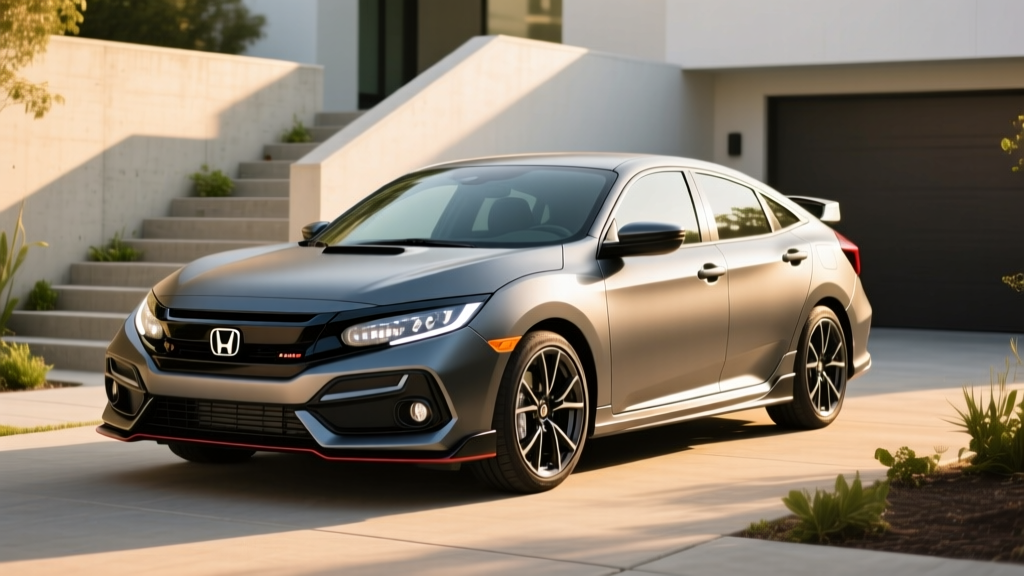
The 2026 Honda Civic Hybrid Sport Touring Sedan occupies a specific niche: it's the most fuel-efficient compact sedan you can buy that doesn't require a plug, doesn't demand range-charge planning, and still delivers genuine acceleration when merging onto a highway. Honda's two-motor hybrid system pairs a 2.0-liter Atkinson-cycle engine with dual electric motors for a combined 200 horsepower and an EPA-estimated 49 MPG combined — numbers that make it competitive with vehicles costing $10,000 more.
But spec sheets only tell part of the story. This guide covers what the 2026 Civic Hybrid Sport Touring Sedan actually delivers in real-world driving, how its battery warranty protects your investment, whether any federal or state incentives apply, and how it stacks up against plug-in hybrids and full EVs for different driving patterns.
HEV vs PHEV: What the Civic Hybrid Actually Is
Before examining specs, it's essential to classify this vehicle correctly. The 2026 Honda Civic Hybrid is a conventional hybrid electric vehicle (HEV), not a plug-in hybrid (PHEV). This distinction drives everything from daily operation to tax credit eligibility.
| Feature | HEV (Civic Hybrid) | PHEV (e.g., Toyota Prius Prime) | BEV (e.g., Tesla Model 3) |
|---|---|---|---|
| Plug-in charging | No — self-charging via regen & engine | Yes — Level 1/2 AC | Yes — Level 1/2/DC |
| Electric-only range | ~1 mile at low speed | 25–45 miles typical | 250–400+ miles |
| Gasoline engine | Yes — primary power + generator | Yes — backup after battery depletes | No |
| Federal tax credit (§30D) | Not eligible | Up to $7,500 if requirements met | Up to $7,500 if requirements met |
| Tailpipe emissions | Low (high MPG) | Zero on electric, low on gas | Zero at tailpipe |
| Home charging install | None needed | $500–$2,000 for Level 2 | $500–$2,500+ for Level 2 |
The Civic Hybrid's battery recharges through regenerative braking and the gasoline engine. You never plug it in. You fuel it at any gas station. There is no electric-only commute mode beyond low-speed parking-lot maneuvers. If you want 30+ miles of pure electric driving before the engine starts, you need a PHEV like the Toyota Prius Prime or a full battery-electric vehicle.
Fuel Economy: EPA Ratings vs Real-World MPG
The EPA rates the 2026 Honda Civic Hybrid Sport Touring Sedan at 49 MPG combined, split across 51 MPG city and 44 MPG highway. These figures come from fueleconomy.gov and apply to the Sport Touring trim with its standard 18-inch alloy wheels. The Sport trim (with the same hybrid powertrain but lighter wheels) achieves an identical 49 MPG combined.
| Driving Cycle | EPA Estimate | Real-World Expectation |
|---|---|---|
| City | 51 MPG | 50–55 MPG (hybrids often beat EPA in stop-and-go) |
| Highway | 44 MPG | 40–45 MPG (aero drag reduces hybrid advantage at 75+ mph) |
| Combined | 49 MPG | 45–52 MPG depending on driving mix |
Hybrids routinely exceed their EPA city estimates because stop-and-go traffic maximizes regenerative braking and electric-motor assist. Highway driving is the opposite: at 75 mph, aerodynamic drag dominates, and the gasoline engine does most of the work without the efficiency benefit of frequent regen captures.
Cold-weather impact: Expect a 5–10% MPG reduction in winter months (roughly 44–47 MPG combined). The engine runs more frequently to maintain cabin heat and catalytic converter temperature, and battery efficiency drops in cold conditions. This penalty is far smaller than the 20–30% range loss EVs experience in freezing weather, but it's measurable.
Total range: With a 10.6-gallon fuel tank and 49 MPG combined, you can expect roughly 500–520 miles between fill-ups in mixed driving. Some owners report 550+ miles on highway-heavy tanks where gentle driving and moderate speeds stretch efficiency.
Powertrain and Performance Specs
Honda's hybrid system uses a series-parallel architecture with two electric motors and a 2.0-liter direct-injected Atkinson-cycle four-cylinder engine. The electric motors handle most low-speed acceleration, while the engine either generates electricity for the motors or directly drives the wheels at highway cruising speeds via a lockup clutch.
| Specification | 2026 Civic Hybrid Sport Touring Sedan |
|---|---|
| Combined horsepower | 200 hp |
| Combined torque | 232 lb-ft |
| Engine | 2.0L DOHC Atkinson-cycle 4-cylinder |
| Electric motors | Dual-motor (propulsion + generator) |
| Hybrid battery | Lithium-ion, ~1.1 kWh (nominal) |
| Transmission | e-CVT (no traditional gears) |
| 0–60 mph | ~7.2 seconds |
| Drivetrain | Front-wheel drive |
| Curb weight | ~3,100 lbs |
| Cargo volume (trunk) | 14.8 cu ft |
The 200 hp and 232 lb-ft of torque figure is notable: that torque is available almost instantly from the electric motor, making the Civic Hybrid feel quicker off the line than its 7.2-second 0–60 time suggests. In daily driving, the electric motor's immediate response makes it feel more like a 250-hp turbocharged car in city acceleration, even though the peak horsepower number is modest.
The e-CVT is not a belt-and-pulley CVT like those in some competitors. Honda's system uses a fixed gear ratio for engine-direct-drive mode and electric motor ratio management for everything else. The result is smooth, linear acceleration without the "rubber-band" drone associated with conventional CVTs.
Battery Warranty, Lifespan, and Replacement Cost
Honda Hybrid Battery Warranty: 10 years / 150,000 miles (whichever comes first) for the hybrid battery pack and related components. This applies in all 50 states. In states that follow California Air Resources Board (CARB) emissions standards (CA, CO, CT, ME, MD, MA, NJ, NY, OR, RI, VT, WA, and others adopting CARB rules), the warranty extends to 10 years / 150,000 miles as well, with additional emissions-component coverage.
The Civic Hybrid's lithium-ion battery pack is compact (~1.1 kWh) because it doesn't need to store energy for extended electric-only driving — it serves as a buffer for regenerative capture and electric-motor assist. This small size works in its favor for longevity: the battery operates within a narrow state-of-charge window (roughly 40–80%), which dramatically reduces degradation compared to EV batteries that cycle from 10% to 90%.
Expected lifespan: Honda's hybrid systems have an excellent longevity track record. The previous-generation Civic Hybrid and Insight hybrid batteries routinely last 150,000–200,000+ miles before capacity loss becomes noticeable. Because the battery is small and lightly stressed, complete failure within the warranty period is uncommon.
Replacement cost if out of warranty: A new OEM hybrid battery pack for the Civic Hybrid runs approximately $2,000–$3,500 including parts and labor at a Honda dealer. Third-party rebuilt or refurbished packs are available for $1,200–$2,000. Compare this to EV battery replacements that can exceed $10,000–$15,000 — the Civic Hybrid's small battery is a financial advantage in the unlikely event of failure.
Pricing, Trims, and Tax Credit Eligibility
The 2026 Honda Civic Hybrid is available in two trims:
- Sport Hybrid: Starting at approximately $29,845 (including destination charge)
- Sport Touring Hybrid: Starting at approximately $32,845 (including destination charge)
The Sport Touring adds a Bose 12-speaker audio system, wireless phone charging, a 9-inch touchscreen with wireless Apple CarPlay and Android Auto, heated rear seats, leather-trimmed seats, a power moonroof, and Honda's full Honda Sensing suite with low-speed braking control and traffic jam assist.
Federal Tax Credit (§30D): The 2026 Honda Civic Hybrid does NOT qualify for the federal §30D Clean Vehicle Credit. This credit applies only to plug-in electric vehicles (PHEVs and BEVs) with a minimum battery capacity of 7 kWh and external charging capability. As a conventional HEV, the Civic Hybrid is ineligible regardless of buyer income or MSRP.
State incentives: Some states offer rebates or HOV-lane access for hybrids, but these vary widely and change frequently. Check your state's energy or environmental agency website for current programs. A few states (e.g., Colorado) have offered hybrid-specific credits in the past, but most incentive programs now prioritize PHEVs and BEVs.
For current federal incentive rules, always consult the IRS Clean Vehicle Tax Credits page before purchasing any electrified vehicle.
Who Should Choose the Civic Hybrid vs a PHEV or EV
Civic Hybrid Advantages
- No charging infrastructure needed — ideal for apartment dwellers and street parkers
- 500+ mile total range eliminates range anxiety on road trips
- Lower purchase price than equivalent PHEVs or EVs
- Proven reliability with 10-year/150,000-mile battery warranty
- 200 hp with instant electric torque feels responsive in daily driving
- No battery degradation anxiety — small pack, shallow cycling
Civic Hybrid Limitations
- No electric-only commute — engine runs in most conditions
- No federal tax credit eligibility
- Cannot drive in HOV/carpool lanes as a single occupant (in most states)
- Still burns gasoline — not a zero-emission solution
- Less cargo space than some crossover hybrids or EVs
Choose the Civic Hybrid if:
- You lack access to home or workplace charging (apartment, condo, street parking)
- Your commute is mixed city/highway and you want maximum MPG without behavior changes
- You take frequent long road trips and don't want to plan charging stops
- You want hybrid efficiency without paying the PHEV or EV premium
- You prefer the simplicity of gas-station refueling
Choose a PHEV instead if:
- You can charge at home and your daily commute is under 30–40 miles round trip
- You want electric-only daily driving with gas backup for road trips
- You want to qualify for the federal §30D tax credit (up to $7,500, subject to income, MSRP, and battery-sourcing rules)
- You live in a state with HOV-lane access for PHEVs
Choose a full EV instead if:
- You have reliable home Level 2 charging
- Your daily driving is under 200 miles and you rarely exceed 300 miles in a day
- You want zero tailpipe emissions and the lowest per-mile fuel cost
- You want maximum federal and state incentives
- You want minimal maintenance (no oil changes, no engine wear)
Honda Sensing and Safety Technology
The Sport Touring trim includes Honda's full Honda Sensing suite as standard equipment. This is a SAE Level 2 driver-assistance system — it provides steering and acceleration/braking support, but the driver must remain fully engaged and hands on the wheel at all times. This is not autonomous driving.
Standard Honda Sensing features on the 2026 Civic Hybrid Sport Touring include:
- Adaptive Cruise Control (ACC) with Low-Speed Follow
- Lane Keeping Assist System (LKAS)
- Road Departure Mitigation (RDM)
- Collision Mitigation Braking System (CMBS)
- Traffic Jam Assist (low-speed steering and braking support)
- Traffic Sign Recognition
- Blind Spot Information System (BSI) with Rear Cross Traffic Monitor
The Civic has historically earned top safety ratings. Check the latest results at IIHS and NHTSA for the current model year's crash-test scores.
Real-World Ownership: What to Expect
Living with the 2026 Civic Hybrid Sport Touring Sedan day-to-day is straightforward. Here's what ownership actually looks like:
Fueling: With 49 MPG combined and a 10.6-gallon tank, you'll visit the gas station roughly once every 500 miles. At $3.50/gallon (national average), that's about $37 per fill-up, or roughly $0.071 per mile in fuel cost. Compare this to a gas-only Civic (33 MPG combined) at $0.106/mile, or an EV charging at home at $0.04–$0.05/mile.
Maintenance: Honda recommends oil changes every 7,500–10,000 miles (the engine runs less than a conventional car, so oil degrades more slowly). The hybrid system requires no separate maintenance — there's no hybrid fluid to change, no electric motor service interval. Brake pads last longer than on gas-only cars because regenerative braking handles much of the deceleration.
Insurance: Hybrid vehicles typically carry insurance premiums 5–10% higher than their gas-only counterparts due to slightly higher repair costs for hybrid-specific components. However, the Civic Hybrid's premium is modest compared to EV insurance costs. Get quotes from multiple providers — some insurers offer hybrid-specific discounts.
Depreciation: Honda Civics hold their value well. The hybrid variant's strong fuel economy and Honda's reliability reputation should support strong resale values, particularly as fuel prices fluctuate. Kelley Blue Book and Edmunds project Civic Hybrid resale values at or above segment average.
Frequently Asked Questions
How many MPG does the 2026 Honda Civic Hybrid Sport Touring Sedan get?
The EPA rates it at 51 MPG city, 44 MPG highway, and 49 MPG combined. In real-world driving, owners typically see 45–52 MPG combined depending on driving style, terrain, and climate. City-heavy driving tends to yield higher MPG than highway-heavy driving due to regenerative braking efficiency.
Do I need to plug in the Civic Hybrid?
No. The 2026 Civic Hybrid is a conventional HEV, not a plug-in hybrid. The battery recharges automatically through regenerative braking and the gasoline engine. You fuel it at a standard gas station — no charging cable, no home charger installation, no public charging network needed.
Does the 2026 Civic Hybrid qualify for any tax credit?
No. The federal §30D Clean Vehicle Credit applies only to plug-in vehicles (PHEVs and BEVs) with a minimum battery capacity of 7 kWh. The Civic Hybrid's ~1.1 kWh battery does not meet this threshold. Some states may offer minor incentives for hybrids, but most have shifted incentive programs toward plug-in vehicles. Consult the IRS website and your state's energy office for current rules.
How long will the hybrid battery last and what does replacement cost?
Honda warranties the hybrid battery for 10 years or 150,000 miles. Based on Honda's track record with previous hybrid models, the battery typically lasts 150,000–200,000+ miles before significant degradation. If replacement is needed out of warranty, expect to pay $2,000–$3,500 for a new OEM pack at a Honda dealer, or $1,200–$2,000 for a refurbished unit.
Is the Civic Hybrid Sport Touring fast enough for highway merging?
Yes. The combined 200 hp and 232 lb-ft of torque (available almost instantly from the electric motor) provides confident acceleration. The 0–60 mph time of approximately 7.2 seconds is adequate for all normal driving situations. The electric motor's instant torque response makes it feel quicker in city and suburban driving than the peak horsepower number suggests.
How does the Civic Hybrid compare to the Toyota Prius?
The Toyota Prius (57 MPG combined, 196 hp) is slightly more fuel-efficient but offers less power and a different body style (hatchback vs sedan). The Civic Hybrid Sport Touring offers a more premium interior, more horsepower, and a traditional sedan trunk. The Prius wins on pure MPG; the Civic Hybrid wins on refinement and performance. Both are excellent choices with proven reliability.
Can the Civic Hybrid drive on electric power alone?
Only at very low speeds (under ~25 mph) for short distances (under 1 mile), such as creeping through a parking lot or in stop-and-go traffic. For any meaningful acceleration or sustained speed, the gasoline engine engages. If you want 30+ miles of electric-only driving, you need a PHEV like the Toyota Prius Prime or a full EV.
The 2026 Honda Civic Hybrid Sport Touring Sedan is a compelling choice for drivers who want hybrid efficiency without the complexity, cost, or infrastructure requirements of plug-in vehicles. It delivers nearly 50 MPG in real-world conditions, provides responsive acceleration, and carries a battery warranty that should outlast most ownership periods. If you can charge at home and want electric-only commuting, a PHEV or EV may serve you better. If you want maximum simplicity with excellent fuel economy, the Civic Hybrid Sport Touring is one of the strongest options on the market.