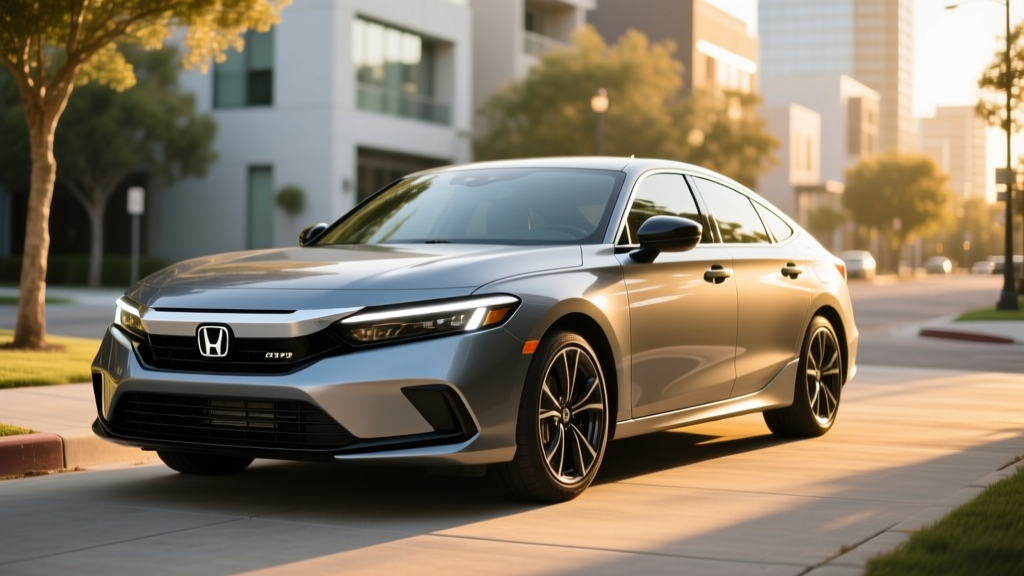
The 2026 Honda Civic Hybrid lands at a critical moment for compact-car shoppers: gasoline prices remain volatile, full EVs still carry a price premium, and many buyers want maximum fuel efficiency without plugging in. If you've been searching for 2026 Honda Civic Hybrid lease deals, you're likely weighing this car against the Toyota Corolla Hybrid, Hyundai Elantra Hybrid, and fully electric alternatives. This guide breaks down the exact EPA fuel economy, powertrain specs, battery warranty, lease pricing strategies, and ownership economics you need to make a data-driven decision.
2026 Honda Civic Hybrid at a Glance: Key Specs
Before we get into lease numbers, here are the hard specs that matter most for daily driving and long-term ownership.
| Specification | 2026 Civic Hybrid Sport | 2026 Civic Hybrid Sport Touring |
|---|---|---|
| Powertrain Type | Conventional Hybrid (HEV) — no plug required | |
| Combined Horsepower | 200 hp | |
| Engine | 2.0L Atkinson-cycle 4-cylinder + dual electric motors | |
| EPA MPG (City / Highway / Combined) | 50 / 47 / 49 | 49 / 46 / 48 |
| Fuel Tank Capacity | 10.6 gallons | |
| Total Driving Range | ~519 miles | ~509 miles |
| 0–60 mph | ~7.2 seconds (est.) | |
| Drivetrain | Front-wheel drive (e-CVT) | |
| Hybrid Battery Warranty | 8 years / 100,000 miles | |
| Starting MSRP (2026) | ~$30,950 | ~$34,550 |
Source: EPA Fuel Economy and Honda specifications. Final 2026 model-year figures may vary slightly; verify with your local dealer.
How Many MPG Does the 2026 Civic Hybrid Actually Get?
The EPA rates the 2026 Civic Hybrid Sport at 50 city / 47 highway / 49 combined MPG. The Sport Touring trim drops slightly to 49/46/48 due to additional weight from premium features and larger wheels.
| Trim | City MPG | Highway MPG | Combined MPG |
|---|---|---|---|
| Sport | 50 | 47 | 49 |
| Sport Touring | 49 | 46 | 48 |
Real-World MPG: What to Expect
Honda's two-motor hybrid system excels in city driving, where the electric motors handle low-speed propulsion and regenerative braking recaptures energy at every stop. In real-world testing, many Civic Hybrid owners report exceeding the EPA city estimate, regularly seeing 52–55 MPG in stop-and-go traffic.
Highway driving is a different story. At sustained speeds above 70 mph, the gasoline engine does most of the work, and real-world highway fuel economy tends to land in the 43–46 MPG range, slightly below the EPA sticker. Cold weather (below 40°F) can reduce overall efficiency by 5–10% due to increased engine warm-up time and reduced battery performance.
Hybrid (HEV) vs Plug-In Hybrid (PHEV) vs Full EV: Which Is Right for You?
The 2026 Civic Hybrid is a conventional hybrid (HEV). It does not plug in. There is no electric-only range to manage, no home charger to install, and no range anxiety. The gasoline engine and regenerative braking keep a small lithium-ion battery charged automatically.
This is fundamentally different from a plug-in hybrid (PHEV) like the Toyota Prius Prime or a full battery-electric vehicle (BEV) like the Chevrolet Bolt EV. Here's how they compare:
No plug needed. 49 MPG combined. ~$31K starting. Best for drivers without home charging access who want max efficiency with zero behavior change.
Plug for ~40 mi electric range, then 50+ MPG hybrid. ~$33K starting. Best for home-chargers with short commutes who want EV-like daily driving plus gas flexibility.
Full electric, 250+ mi range. ~$27K–$37K. Best for home-chargers committed to eliminating gasoline entirely with access to reliable charging.
The Civic Hybrid is the right choice if: you live in an apartment without charging access, regularly drive more than 300 miles between fill-ups, want a proven powertrain with minimal maintenance, and prefer not to change your fueling habits at all.
Powertrain Deep Dive: 200 HP Two-Motor Hybrid System
Honda's fourth-generation two-motor hybrid system pairs a 2.0-liter Atkinson-cycle four-cylinder engine with two electric motors and an electronically controlled continuously variable transmission (e-CVT). Combined system output is 200 horsepower and 232 lb-ft of torque — significantly more than the non-hybrid Civic's 158 hp from its 2.0L engine.
The system operates in three modes:
- EV Drive: Electric motors only, at low speeds and light loads — silent and emissions-free for short distances
- Hybrid Drive: Engine generates electricity to power the motors while simultaneously charging the battery; used in most acceleration scenarios
- Engine Drive: Engine directly drives the wheels via a lock-up clutch at efficient highway cruising speeds
The result is a car that feels surprisingly quick off the line (electric motors deliver instant torque) while achieving class-leading efficiency. The 0–60 mph time of approximately 7.2 seconds puts it ahead of most hybrid competitors and makes highway merging effortless.
Breaking Down 2026 Honda Civic Hybrid Lease Deals
Lease deals vary by region, dealer, and your credit tier, but here's the framework for evaluating any 2026 Civic Hybrid lease offer you encounter.
Typical Lease Structure (36 Months / 36,000 Miles)
| Lease Component | Sport Trim (Est.) | Sport Touring (Est.) |
|---|---|---|
| MSRP | $30,950 | $34,550 |
| Residual Value (est. 58%) | $17,951 | $20,039 |
| Depreciation (36 mo) | ~$12,999 | ~$14,511 |
| Est. Monthly Payment (Tier 1 Credit) | $329–$379/mo | $369–$429/mo |
| Due at Signing (typical) | $2,500–$3,500 | $2,500–$3,500 |
Note: These are estimates based on typical Honda Financial Services lease parameters. Actual offers depend on your region, dealer markup, credit score, and current incentive programs. Always verify with your local Honda dealer.
How to Get the Best Civic Hybrid Lease Deal
- Target end-of-month or end-of-quarter: Dealers are more motivated to hit volume targets and may offer lower money factors or additional dealer discounts.
- Check Honda's national lease offers: Honda periodically publishes subsidized lease deals on honda.com with below-market money factors. These are typically available to Tier 1 credit borrowers.
- Negotiate the capitalized cost, not the monthly payment: A low monthly payment can mask a high money factor or inflated cap cost. Get the full lease worksheet showing cap cost, residual, and money factor.
- Consider a 24-month lease: While monthly payments are higher, shorter leases can capture higher residual percentages and let you upgrade sooner — useful as hybrid technology evolves.
- Avoid excessive down payments: Putting $5,000+ down on a lease is risky; if the car is totaled, that equity is lost. Keep due-at-signing to $2,000–$3,500.
Battery Warranty, Reliability, and Replacement Cost
Hybrid battery longevity is the number-one concern for hybrid shoppers. Honda backs the 2026 Civic Hybrid's lithium-ion battery pack with an 8-year / 100,000-mile warranty (10 years / 150,000 miles in California and states that follow CARB emissions standards). This warranty covers battery capacity loss below a defined threshold and any manufacturing defects.
How Long Will the Battery Actually Last?
Honda's hybrid systems have a strong reliability track record. The Civic Hybrid's battery is relatively small (approximately 1.0 kWh usable capacity) and operates within a narrow state-of-charge window — typically between 40% and 80% — which significantly reduces stress and degradation compared to full EV batteries that cycle from 10% to 90%+.
Based on long-term data from previous-generation Civic and Accord Hybrids, most Honda hybrid batteries last well beyond the warranty period, with many reaching 150,000–200,000+ miles before any significant capacity loss. If replacement is needed out of warranty, expect to pay approximately $2,000–$3,500 for a new OEM battery pack, plus labor — a fraction of the $10,000–$20,000 EV battery replacements that make headlines.
Overall Reliability
Honda's hybrid powertrain eliminates the traditional transmission (using the e-CVT instead), which removes a major failure point. The regenerative braking system also reduces wear on the friction brakes, often extending brake pad life to 80,000+ miles. The Civic lineup has historically scored well in IIHS safety testing and reliability surveys.
Tax Credits and Incentives: What the Civic Hybrid Qualifies For
Here's where the distinction between HEV and PHEV matters most for your wallet:
- Federal §30D Clean Vehicle Credit ($7,500): The 2026 Civic Hybrid does NOT qualify. The federal tax credit under IRS §30D is available only for plug-in electric vehicles (PHEVs and BEVs) with sufficient battery capacity. Conventional hybrids like the Civic Hybrid are excluded. See IRS guidelines for full eligibility rules.
- Federal Used Clean Vehicle Credit (§25E, up to $4,000): Not applicable to new HEVs.
- State and local incentives: Some states offer rebates or HOV lane access for hybrids, though most have shifted incentives toward PHEVs and BEVs. Check your state's energy office or DMV for current programs.
- Insurance discounts: Some insurers offer modest discounts (5–10%) for hybrid vehicles. Check with your provider.
The lack of a federal tax credit is the Civic Hybrid's biggest financial disadvantage versus a PHEV or BEV. However, the lower purchase price, zero charging infrastructure cost, and strong fuel savings often close the gap over a 3-to-5-year ownership period.
Who Should Lease the 2026 Civic Hybrid?
- You drive 12,000–20,000 miles/year and want to cut fuel costs by 40–50% versus a gas Civic
- You live in an apartment or lack access to home/workplace charging
- You regularly take road trips exceeding 300 miles and don't want to plan around charging stops
- You want a proven, low-maintenance powertrain with strong resale value
- You have home Level 2 charging and a commute under 40 miles (a PHEV covers most trips on electricity)
- You want to access the $7,500 federal tax credit or point-of-sale rebate
- You want to eliminate gasoline purchases entirely
- 49 MPG combined — class-leading efficiency
- 200 hp — quickest in its hybrid segment
- No plug needed — zero behavior change
- 519-mile total range between fill-ups
- Strong reliability and 8-year battery warranty
- Lower monthly lease payment than most EVs
- No federal tax credit eligibility
- No all-wheel-drive option
- Highway MPG drops below EPA estimate
- Cargo space slightly reduced vs. gas Civic
- Cannot drive on electricity alone at highway speeds
Frequently Asked Questions
How many MPG does the 2026 Honda Civic Hybrid get?
The EPA rates the Civic Hybrid Sport at 50 city / 47 highway / 49 combined MPG. The Sport Touring trim is rated at 49/46/48. Real-world city driving often exceeds EPA estimates (52–55 MPG), while highway driving may fall slightly short (43–46 MPG).
Does the Civic Hybrid need to be plugged in?
No. The 2026 Civic Hybrid is a conventional hybrid (HEV). It charges its own battery through regenerative braking and the gasoline engine. You fuel it like any other car — at a gas station.
Does the 2026 Civic Hybrid qualify for any tax credit?
No federal tax credit is available for conventional hybrids. The IRS §30D Clean Vehicle Credit applies only to plug-in vehicles (PHEVs and BEVs). Some states may offer minor incentives for hybrids — check your local programs.
How long will the hybrid battery last, and what does replacement cost?
Honda's hybrid battery is warranted for 8 years/100,000 miles (10 years/150,000 miles in CARB states). Real-world data suggests most Honda hybrid batteries last 150,000–200,000+ miles. Out-of-warranty replacement costs approximately $2,000–$3,500.
Is leasing a hybrid better than buying?
Leasing makes sense if you want lower monthly payments, plan to upgrade every 3 years, and drive under 12,000–15,000 miles annually. Buying is better if you plan to keep the car 5+ years, drive high mileage, or want to avoid lease-end fees. The Civic Hybrid's strong reliability favors long-term ownership.
How does the Civic Hybrid compare to the Toyota Corolla Hybrid?
The Corolla Hybrid offers comparable MPG (50+ combined on LE trim) and standard all-wheel drive, but produces less horsepower (138 hp combined) and has a less engaging driving experience. The Civic Hybrid is quicker, more refined, and offers a more premium interior, though at a slightly higher starting price.