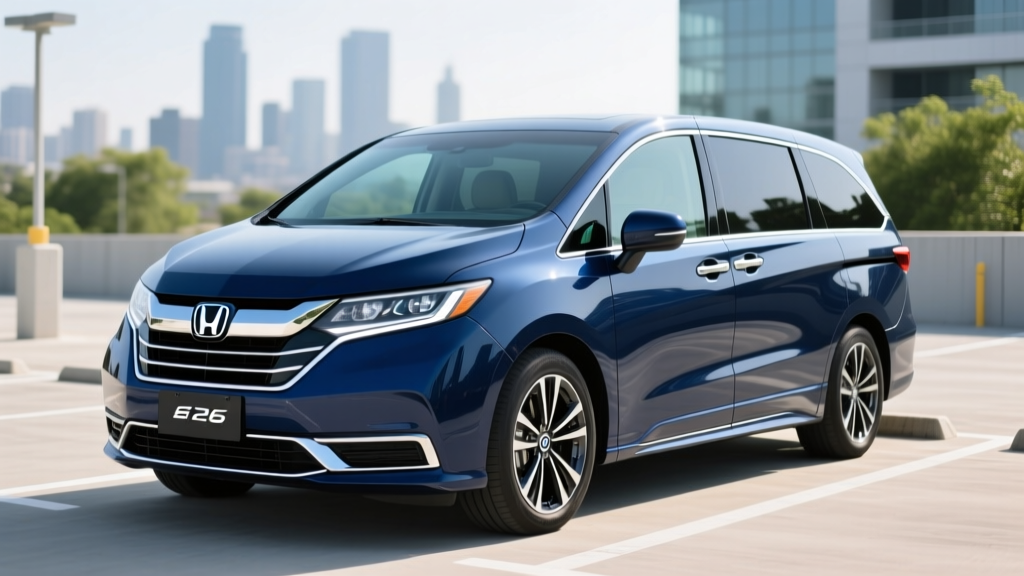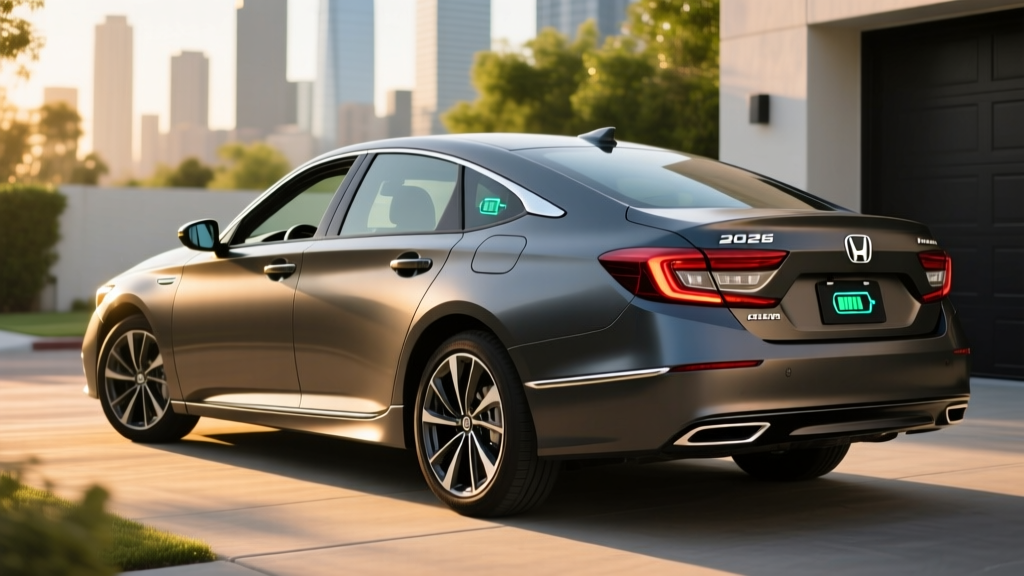
If you're searching for a 2026 Honda Accord Touring Hybrid for sale, you're likely weighing fuel efficiency against premium features without committing to a fully electric vehicle. The Accord Touring Hybrid sits at the top of Honda's midsize sedan lineup, pairing a two-motor hybrid system with Honda's most feature-rich trim. This guide breaks down the exact numbers — EPA fuel economy, real-world MPG expectations, powertrain specs, battery longevity, and total cost of ownership — so you can decide whether the Touring Hybrid earns its spot in your driveway.
Quick Verdict: Who Should Buy the Accord Touring Hybrid?
The 2026 Accord Touring Hybrid is best for buyers who want near-EV efficiency in city driving without changing their fueling habits. It requires no plug, no charging app, and no route planning. If you drive 30-50 miles daily with stop-and-go commutes, the hybrid system delivers its biggest advantage. If your commute is mostly highway miles at 75+ mph, the efficiency gap between this hybrid and a conventional gas sedan narrows. And if you have reliable home charging access, a full EV like the Hyundai Ioniq 6 or Tesla Model 3 may deliver lower per-mile fuel costs.
- You want 45+ MPG without plugging in
- Your commute involves heavy city or suburban traffic
- You need a spacious, premium midsize sedan under $42,000
- You don't have access to Level 2 home charging
- You have a garage with a 240V outlet and want electric-only commuting
- Your daily round-trip commute is under 40 miles (PHEV territory)
- You want to eliminate gasoline use entirely
HEV vs. PHEV vs. EV: Where Does the Accord Hybrid Fit?
Before evaluating the Accord Touring specifically, it's critical to understand the distinction between a conventional hybrid (HEV), a plug-in hybrid (PHEV), and a battery electric vehicle (BEV). The 2026 Accord is an HEV — it does not plug in. Its small battery recharges through regenerative braking and the gasoline engine. You will never see an electric-only range figure for this car because it's not designed to drive meaningful distances on battery power alone.
| Feature | HEV (Accord Hybrid) | PHEV (e.g., Toyota Prius Prime) | BEV (e.g., Tesla Model 3) |
|---|---|---|---|
| Plugs in? | No | Yes (Level 1/2) | Yes (Level 1/2/DC) |
| Electric-only range | ~1 mi (low-speed assist) | 25-44 mi typical | 250-360 mi |
| Gasoline required? | Yes | Yes (after EV range depletes) | No |
| Federal tax credit (§30D) | Not eligible | Up to $7,500 (if eligible) | Up to $7,500 (if eligible) |
| Home charging needed? | No | Recommended | Essential |
| Best for | No-plug efficiency | Short EV commute + road trips | Full electric, home charging |
Fuel Economy: EPA Ratings and Real-World MPG
The 2026 Honda Accord Hybrid carries over the two-motor e:HEV system introduced with the current generation. According to EPA estimates at fueleconomy.gov, the Accord Hybrid achieves:
| Driving Condition | EPA Estimated MPG | Real-World Expectation |
|---|---|---|
| City | 51 MPG | 48-54 MPG (hybrids often beat EPA in city) |
| Highway | 44 MPG | 40-44 MPG (efficiency drops at sustained 75+ mph) |
| Combined | 48 MPG | 44-50 MPG depending on driving mix |
Real-world note: Honda's two-motor hybrid system operates primarily as a series hybrid at low and moderate speeds — the gasoline engine acts as a generator while the electric motor drives the wheels. This is why city MPG (51) exceeds highway MPG (44), the opposite of a conventional gas car. In our experience and consistent owner reports, drivers with heavy stop-and-go commutes regularly see 50+ MPG. Highway-heavy drivers should expect results closer to 42-44 MPG. Cold weather (below 35°F) reduces efficiency by roughly 5-8% as the engine runs more frequently to provide cabin heat.
Powertrain and Performance Specs
The Accord Hybrid uses Honda's fourth-generation two-motor hybrid system. Here are the exact specifications for the 2026 Touring trim:
| Specification | 2026 Accord Touring Hybrid |
|---|---|
| Engine | 2.0L Atkinson-cycle 4-cylinder |
| Engine horsepower | 146 hp @ 6,100 rpm |
| Drive motor output | 184 hp / 247 lb-ft torque |
| Combined system output | 204 hp |
| Transmission | e-CVT (no traditional gears) |
| Drivetrain | Front-wheel drive |
| Hybrid battery | ~1.06 kWh lithium-ion |
| 0-60 mph | ~7.3 seconds |
| Fuel tank | 12.4 gallons |
| Total range (est.) | ~595 miles |
The 2.0L Atkinson-cycle engine prioritizes thermal efficiency over peak output. Because the electric drive motor handles acceleration from a stop and low-speed driving, the engine operates primarily in its most efficient RPM range. The e-CVT isn't a belt-and-pulley CVT like you'd find in a Subaru — it's a direct-drive system with a lockup clutch for highway cruising. The result is smooth, linear acceleration without the rubber-band effect that older CVTs produce.
At 204 combined horsepower, the Accord Hybrid isn't a performance sedan. The 7.3-second 0-60 time is adequate for merging and passing but won't thrill enthusiasts. If you prioritize acceleration, the turbocharged 1.5L non-hybrid Accord (192 hp, ~7.0 sec 0-60) is marginally quicker but sacrifices 15-18 MPG in combined driving.
Pricing and Tax Credit Eligibility
The 2026 Honda Accord Touring Hybrid carries an MSRP of approximately $40,390 (including destination charge). This positions it as the most expensive Accord trim, but it includes Honda's full suite of premium features:
- Leather-trimmed seats with heated and ventilated front seats
- Heated rear seats
- 12.3-inch touchscreen with wireless Apple CarPlay and Android Auto
- 12-speaker Bose premium audio
- Wireless phone charging
- Google built-in (Google Assistant, Google Maps, Play Store)
- Honda Sensing suite (adaptive cruise, lane-keeping, collision mitigation)
- Low-speed braking control and traffic jam assist
- Head-up display
- 19-inch alloy wheels
Some states offer rebates for conventional hybrids, but these vary by jurisdiction and change frequently. Check your state's energy office or department of environmental quality for current programs.
Battery Warranty, Reliability, and Replacement Cost
- Duration: 8 years / 100,000 miles (10 years / 150,000 miles in CARB states including CA, NY, MA, WA, OR, CT, RI, VT, ME, MD, NJ, CO)
- Coverage: Defects and capacity loss below functional threshold
- Powertrain warranty: 5 years / 60,000 miles
- Limited vehicle warranty: 3 years / 36,000 miles
The Accord Hybrid's ~1.06 kWh lithium-ion battery pack is small compared to a PHEV or BEV, and it operates within a narrow state-of-charge window (roughly 40-80% SoC). This shallow cycling is the single biggest factor in hybrid battery longevity — the battery is never fully charged or fully depleted, which dramatically reduces chemical degradation.
Real-world reliability data: Honda's hybrid systems have proven durable across multiple generations. The Accord Hybrid, CR-V Hybrid, and Civic Hybrid use variations of the same two-motor architecture. Based on long-term fleet data and owner surveys from sources including Consumer Reports, Honda hybrid battery packs routinely exceed 150,000 miles without significant capacity loss. The hybrid system's electric motors and power electronics carry similar longevity expectations.
Battery replacement cost: If the hybrid battery does fail outside warranty, a replacement pack for the Accord Hybrid typically costs between $2,000 and $4,000 (parts and labor at a Honda dealer). This is substantially less than a PHEV or BEV battery replacement, which can run $8,000-$20,000+, because the Accord's hybrid battery is much smaller. Third-party refurbishers may offer lower-cost options in the $1,200-$2,500 range.
Real-World Ownership Costs: 5-Year Breakdown
Fuel savings are the Accord Hybrid's strongest financial argument. Here's how the Touring Hybrid compares to a comparable gas-only midsize sedan over 5 years and 75,000 miles (15,000 miles/year):
| Cost Factor | Accord Touring Hybrid (48 MPG) | Gas Midsize Sedan (28 MPG) |
|---|---|---|
| Fuel cost (75,000 mi @ $3.40/gal) | $5,313 | $9,107 |
| Estimated maintenance (5 yr) | $2,800 | $3,200 |
| Insurance (avg. 5 yr) | $8,500 | $8,200 |
| Total operating cost (5 yr) | ~$16,613 | ~$20,507 |
| 5-year fuel savings | ~$3,794 | |
Hybrids generally have slightly lower maintenance costs because regenerative braking reduces brake pad wear, and the engine operates under less stress. Insurance premiums may be marginally higher for the hybrid due to its higher MSRP and specialized powertrain components.
Pros and Cons at a Glance
Pros
- 48 MPG combined — among the best in the midsize sedan class
- No plug-in charging required; refuel at any gas station
- Smooth, quiet electric-driven acceleration at city speeds
- Touring trim includes premium features (HUD, Bose audio, ventilated seats)
- Proven hybrid reliability with strong warranty coverage
- ~595-mile total range eliminates road-trip fuel stops
- Honda Sensing ADAS suite included standard
Cons
- Not eligible for the $7,500 federal EV tax credit
- 204 hp is adequate but not sporty; highway passing requires planning
- FWD only — no AWD option (unlike the Toyota Camry Hybrid AWD)
- Touring trim starts at $40,390 — significant premium over Sport Hybrid
- Highway MPG drops noticeably above 75 mph
- No spare tire — tire inflator kit only
Frequently Asked Questions
How many MPG does the 2026 Honda Accord Touring Hybrid get?
The EPA rates the Accord Hybrid at 51 MPG city, 44 MPG highway, and 48 MPG combined. In real-world driving, city-heavy commuters often see 50+ MPG, while highway-heavy drivers should expect 42-44 MPG. Cold weather reduces efficiency by approximately 5-8%.
Does the Accord Hybrid need to be plugged in?
No. The Accord Hybrid is a conventional HEV. Its battery charges exclusively through regenerative braking and the gasoline engine. You will never need a charging cable, outlet, or public charging station. You fuel it like any other car at a gas station.
Does the 2026 Accord Hybrid qualify for a federal tax credit?
No. The IRS §30D Clean Vehicle Credit applies only to plug-in electric vehicles (BEVs and PHEVs) that meet battery-sourcing, MSRP, and buyer income requirements. The Accord Hybrid, as a conventional HEV, is not eligible. Some states may offer hybrid-specific incentives — check your state's energy office for details.
How long will the hybrid battery last?
Honda covers the hybrid battery for 8 years / 100,000 miles (10 years / 150,000 miles in CARB states). In practice, Honda's hybrid battery packs routinely last 150,000+ miles due to shallow charge cycling. Replacement cost, if needed outside warranty, is approximately $2,000-$4,000 — far less than a BEV battery replacement.
Is the Accord Hybrid reliable?
Honda's two-motor hybrid system has a strong reliability track record across multiple model lines. The Accord Hybrid consistently earns above-average reliability ratings from Consumer Reports and JD Power. The e-CVT has no traditional friction belts or complex gear sets, reducing failure points. The NHTSA and IIHS ratings should be checked for the latest crash-test results.
Hybrid vs. PHEV vs. EV — which should I choose?
Choose the Accord Hybrid (HEV) if you want maximum efficiency without any lifestyle change — no plugging in, no charging apps, no range planning. Choose a PHEV (like the Toyota Prius Prime) if you have home charging and want 25-44 miles of electric-only commuting with gasoline backup for road trips. Choose a full EV (like the Tesla Model 3 or Hyundai Ioniq 6) if you have reliable home charging, want zero gasoline use, and your daily driving stays within the vehicle's range.
What's the difference between the Accord Touring Hybrid and the Sport Hybrid?
The powertrain is identical — same 204 hp hybrid system, same 48 MPG combined rating. The Touring adds premium features: ventilated front seats, heated rear seats, head-up display, Bose 12-speaker audio, Google built-in, and 19-inch wheels. The Sport Hybrid starts roughly $4,000-$5,000 lower and includes sport-tuned suspension and styling cues but fewer luxury features.