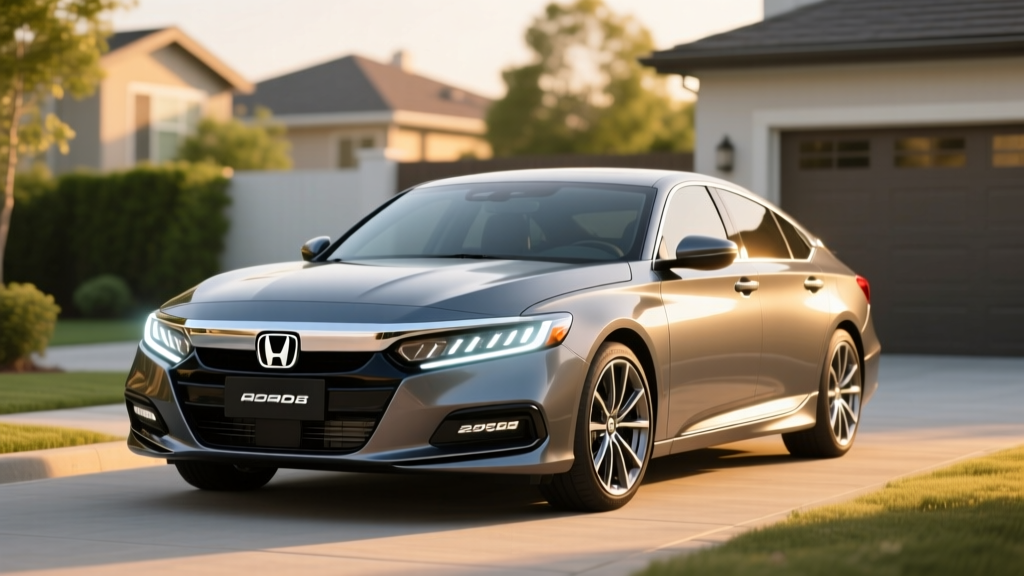
The 2026 Honda Accord Sport L Hybrid occupies a specific niche: a midsize sedan that delivers EV-like efficiency in city driving without requiring you to change a single habit. No plugs, no range anxiety, no charging apps — just a 204-horsepower two-motor hybrid system that sips fuel at a rate that would embarrass most compact cars. But with Honda also offering the Accord in non-hybrid turbo form, and plug-in hybrids proliferating across the segment, where exactly does the Sport L Hybrid fit? This guide breaks down every number that matters.
Quick Verdict: Who the Accord Sport L Hybrid Is For
The 2026 Accord Sport L Hybrid is best understood as a conventional hybrid electric vehicle (HEV). It generates all its electricity internally — through regenerative braking and its gasoline engine — and stores it in a small lithium-ion battery. You never plug it in. If you want electric-only driving with a plug, you need a PHEV like the Toyota Prius Prime or Hyundai Tucson PHEV, or a full battery-electric vehicle (BEV) like the Tesla Model 3 or Hyundai Ioniq 6.
For drivers who lack home charging access, cover 200+ miles weekly, or simply want a sedan that costs less to fuel than a Honda Civic without any behavioral adjustment, the Accord Sport L Hybrid is one of the strongest options on the market in 2026.
HEV vs PHEV vs EV: Where the Accord Hybrid Fits
Conventional Hybrid (HEV) — Honda Accord Hybrid: No plug. Small battery (~1.1 kWh). Engine + electric motors work together. You refuel only with gasoline. Best for drivers without reliable charging access.
Plug-in Hybrid (PHEV) — e.g., Toyota Prius Prime: Plugs in. Larger battery (~13.6 kWh). Offers 30-44 miles of electric-only range before the gas engine engages. Best for drivers with home charging who want short commutes on electricity but road-trip flexibility.
Battery Electric (BEV) — e.g., Tesla Model 3: Plugs in. Large battery (~60-82 kWh). Zero gasoline. 300+ miles of range. Best for drivers with home or reliable workplace charging who want the lowest per-mile energy cost.
The Accord Sport L Hybrid is strictly an HEV. Honda does not offer a plug-in Accord variant for the U.S. market in 2026. If electric-only commuting is a priority, look to PHEVs from Toyota, Hyundai, or Chrysler.
Fuel Economy: EPA Ratings and Real-World MPG
The 2026 Honda Accord Sport L Hybrid carries EPA fuel economy ratings that place it among the most efficient midsize sedans available:
| Driving Cycle | EPA Rating | Real-World Expectation |
|---|---|---|
| City | 51 MPG | 48–55 MPG (hybrids often exceed EPA in stop-and-go) |
| Highway | 44 MPG | 39–43 MPG (sustained 75+ mph reduces hybrid advantage) |
| Combined | 48 MPG | 44–50 MPG depending on driving mix |
Why real-world often beats EPA in the city: Honda's two-motor hybrid system operates primarily in electric-drive mode at low speeds, with the 2.0-liter engine acting as a generator rather than directly turning the wheels. This means stop-and-go traffic actually plays to the system's strengths — regenerative braking recaptures energy that a conventional car would waste as heat. On a 12-mile urban commute with frequent stops, owners routinely report 50+ MPG.
Highway reality check: At sustained speeds above 70 mph, the engine engages directly through a lock-up clutch. Aerodynamic drag dominates, and the hybrid system's regenerative advantage diminishes. Expect 39-43 MPG on a flat interstate at 75 mph. In cold weather (below 35°F), add a 3-5 MPG penalty as the engine runs more frequently to maintain cabin heat and battery temperature.
With a 12.8-gallon fuel tank, total range lands between 550 and 620 miles depending on conditions — enough for most drivers to visit a gas station once every two weeks.
Powertrain Specs: Two-Motor Hybrid System
| Specification | 2026 Accord Sport L Hybrid |
|---|---|
| Engine | 2.0L DOHC 4-cylinder Atkinson cycle |
| Electric Motors | Two-motor system (one drive, one generator) |
| Combined System Horsepower | 204 hp |
| Combined System Torque | 247 lb-ft (electric motor peak) |
| Transmission | e-CVT (no traditional gears) |
| Drivetrain | Front-wheel drive |
| Hybrid Battery | Lithium-ion, ~1.1 kWh (usable) |
| 0-60 mph | ~7.0 seconds (est.) |
| Drive Modes | Normal, ECON, Sport, Individual |
The fourth-generation Honda hybrid system prioritizes smoothness over raw acceleration. The primary drive motor delivers 247 lb-ft of torque from a standstill, giving the Accord a responsive feel off the line that belies its 204-hp combined rating. The e-CVT isn't a belt-and-pulley CVT — it's a direct-drive system that manages power flow between engine, motors, and wheels electronically. The result is linear, vibration-free acceleration with no gear hunting.
In Sport mode, the engine revs higher and the throttle mapping sharpens, but this is a comfort-oriented sedan, not a performance car. The 0-60 time of roughly 7.0 seconds is adequate for merging and passing but won't thrill. For context, the non-hybrid Accord 1.5T turbo hits 60 in about 7.2 seconds — the hybrid is marginally quicker and far more refined.
Pricing, Trims, and Tax Credit Eligibility
The 2026 Accord Sport L Hybrid is positioned as the sportier, feature-rich hybrid trim:
- Accord Sport Hybrid (base hybrid): ~$33,650 MSRP
- Accord Sport L Hybrid: ~$35,350 MSRP (adds leather-trimmed seats, heated rear seats, wireless phone charger, low-speed braking control)
- Accord EX-L Hybrid: ~$36,650 MSRP
All 2026 Accord Hybrid trims include Honda Sensing (adaptive cruise, lane-keeping, collision mitigation), a 12.3-inch touchscreen with wireless Apple CarPlay/Android Auto, and a 10.2-inch digital instrument cluster.
Federal Tax Credit (§30D): The conventional Accord Hybrid does not qualify for the federal plug-in vehicle tax credit. The §30D credit — up to $7,500 — applies only to plug-in electric vehicles (BEVs and PHEVs) that meet battery sourcing, critical mineral, MSRP cap, and buyer income requirements per IRS guidelines. Since the Accord Hybrid is a self-charging HEV with no plug, it is ineligible.
State incentives: A handful of states offer rebates for conventional hybrids, but these are increasingly rare as programs shift toward PHEVs and BEVs. Check your state energy office or AFDC incentive database for current local programs.
Battery Warranty, Reliability, and Replacement Cost
Honda Hybrid Battery Warranty: 10 years / 150,000 miles (whichever comes first) in all 50 states. This covers capacity loss below a Honda-defined threshold and defects. The warranty is fully transferable to subsequent owners.
Powertrain Warranty: 5 years / 60,000 miles.
Limited Vehicle Warranty: 3 years / 36,000 miles.
Honda's hybrid systems have a strong reliability track record. The fourth-generation two-motor system is simpler than a traditional automatic transmission — fewer moving parts, no torque converter, no clutch packs. The hybrid battery is compact (~1.1 kWh) and operates within a narrow state-of-charge window managed by the vehicle's thermal system, which significantly reduces degradation stress.
Battery replacement cost: If the hybrid battery fails outside warranty, replacement typically runs $2,000–$4,000 including labor at a Honda dealer. However, failures before 150,000 miles are uncommon based on historical data from Honda's hybrid lineup (Insight, CR-V Hybrid, Accord Hybrid). Third-party hybrid battery rebuilders offer refurbished units for $1,200–$2,000 for out-of-warranty vehicles.
Long-term reliability: Honda has been building two-motor hybrids since 2014. The system in the 2026 Accord is the fourth generation, with iterative improvements in cooling, motor efficiency, and software. According to long-term owner data and Consumer Reports reliability surveys, the Accord Hybrid consistently rates average or above average for predicted reliability.
What It's Like to Live With: Ownership Practicalities
The Accord Sport L Hybrid asks nothing of you that a standard gas car doesn't. You fill up with regular 87-octane gasoline. Oil changes are required at the maintenance minder intervals (typically every 7,500–10,000 miles). The hybrid system requires zero scheduled maintenance — no fluid changes, no filter replacements specific to the hybrid components.
Insurance: Hybrid insurance premiums for the Accord are typically within $50–$100/year of the non-hybrid turbo model. Insurers don't penalize hybrids the way some do for BEVs (where higher repair costs and parts scarcity can push premiums 15–25% higher).
Depreciation: The Accord Hybrid holds value well. Hybrid sedans are in demand among fleet buyers and cost-conscious consumers. Expect 3-year residual values of roughly 55–60% of MSRP, competitive with the non-hybrid Accord and stronger than most BEVs in the same price range.
Winter driving: The hybrid system's engine generates waste heat that warms the cabin quickly — an advantage over BEVs, which must use battery energy for heating. Cold-weather fuel economy drops 3–5 MPG, but you'll never face the 20–30% range loss that BEV owners experience in sub-freezing temperatures.
Pros and Cons
Pros
- 51 MPG city EPA — among the highest of any midsize sedan
- No plug-in required; zero behavioral change from a gas car
- 204 hp with 247 lb-ft of instant electric torque
- 10-year/150,000-mile hybrid battery warranty in all states
- Spacious cabin with 16.7 cu ft trunk (no battery intrusion)
- Honda Sensing ADAS suite standard on all trims
- Smooth, quiet e-CVT with no gear-hunt or drone
- 550–620 mile total range per tank
Cons
- No federal tax credit eligibility (HEV, not PHEV/BEV)
- Highway MPG drops to 39–43 at sustained 75+ mph
- FWD only — no AWD option (unlike Toyota Camry Hybrid)
- 0-60 in ~7.0 sec — adequate, not quick
- Sport L trim at ~$35,350 is $5,000+ above base Accord LX
- No electric-only driving mode of meaningful distance
- Rear visibility slightly compromised by roofline design
Decision Framework: Accord Hybrid vs Alternatives
Choose the Accord Sport L Hybrid if:
- You don't have access to home or workplace charging
- Your commute is city-heavy with frequent stops
- You want 500+ mile range without route-planning for chargers
- You prefer a traditional sedan with proven long-term reliability
- You want low fuel costs without any plug-in infrastructure
Choose a PHEV (e.g., Toyota Prius Prime) if:
- You have Level 2 home charging and a commute under 40 miles
- You want electric-only daily driving but gas flexibility for road trips
- You qualify for the §30D federal tax credit (income and sourcing requirements apply)
Choose a BEV (e.g., Tesla Model 3, Hyundai Ioniq 6) if:
- You have reliable home charging and want the lowest per-mile energy cost (~$0.04/mi on residential electricity vs ~$0.11/mi on gas for the Accord Hybrid)
- You want zero tailpipe emissions and minimal scheduled maintenance
- You qualify for the full $7,500 §30D credit, which can make a BEV price-competitive with the Accord Hybrid
Frequently Asked Questions
How many MPG does the 2026 Honda Accord Sport L Hybrid get?
The EPA rates it at 51 MPG city, 44 MPG highway, and 48 MPG combined. In real-world city driving, many owners see 48–55 MPG thanks to the hybrid system's regenerative braking efficiency. Highway driving at 75+ mph typically yields 39–43 MPG. Per fueleconomy.gov, the combined 48 MPG rating places it among the top midsize sedans for fuel efficiency.
Does the Accord Hybrid need to be plugged in?
No. The Accord Sport L Hybrid is a conventional hybrid (HEV), not a plug-in hybrid. It charges its small lithium-ion battery through regenerative braking and the gasoline engine. You refuel only with gasoline at any standard gas station.
How far can the Accord Hybrid drive on electric power alone?
Effectively zero miles in sustained electric-only mode. The hybrid system can operate the drive motor without the engine at very low speeds (under 25 mph, light throttle) for brief distances — perhaps a quarter mile in a parking lot. This is not comparable to a PHEV, which offers 30-44 miles of dedicated electric-only range. The Accord Hybrid's electric assist is designed to improve overall fuel economy, not to replace gasoline.
Is the Honda Accord Hybrid reliable, and what does a battery replacement cost?
Honda's fourth-generation two-motor hybrid system has a strong reliability record. The hybrid battery is covered by a 10-year/150,000-mile warranty in all 50 states. Out-of-warranty replacement costs $2,000–$4,000 at a dealer, or $1,200–$2,000 through a third-party rebuilder. Battery failures before 150,000 miles are uncommon based on historical data from Honda's hybrid fleet.
Does the 2026 Accord Hybrid qualify for any federal tax credit?
No. The federal §30D clean vehicle tax credit applies only to plug-in electric vehicles (BEVs and PHEVs). The Accord Hybrid is a conventional self-charging hybrid and does not qualify. Some states may offer small rebates for hybrids — check your state energy office or the Alternative Fuels Data Center for local programs.
How does the Accord Hybrid compare to the Toyota Camry Hybrid?
The Camry Hybrid offers similar fuel economy (up to 52 MPG combined on the LE trim) and is available with all-wheel drive — a meaningful advantage in snow-belt states. The Accord Hybrid counters with a more spacious rear seat, larger trunk (16.7 vs 15.1 cu ft), and a more refined ride quality. If AWD is essential, the Camry wins. If interior space and highway comfort matter more, the Accord has the edge.
What is the total cost of ownership over 5 years?
At 15,000 miles/year and $3.40/gallon regular gasoline, the Accord Hybrid's annual fuel cost is approximately $1,060 (based on 48 MPG combined). A comparable non-hybrid midsize sedan averaging 30 MPG combined would cost roughly $1,700/year — a savings of about $640/year, or $3,200 over five years. Factor in the Accord Hybrid's higher purchase price (~$3,000–$4,000 premium over a non-hybrid equivalent), and the fuel savings largely offset the upfront cost within 5 years, with the hybrid pulling ahead in years 6+.