Quick Verdict: The Accord Hybrid EX-L at a Glance
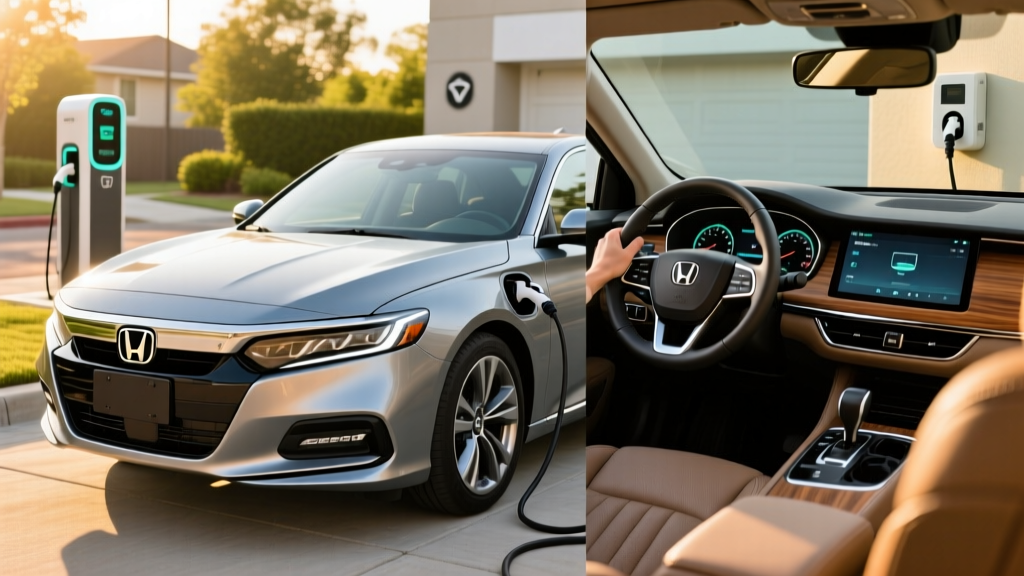
The 2026 Honda Accord Hybrid EX-L occupies a specific niche: a midsize sedan that delivers near-50 MPG without requiring a plug, a charging routine, or any change in driving habits. If you want electrified efficiency but lack home charging access or don't want to think about range, this is the powertrain to consider. The EX-L trim adds leather seating, a 12.3-inch infotainment display, wireless Apple CarPlay and Android Auto, and Honda's full Honda Sensing safety suite — making it the value sweet spot in the Accord Hybrid lineup.
This is a conventional hybrid (HEV), not a plug-in hybrid (PHEV). You never plug it in. The gasoline engine and regenerative braking handle all battery charging automatically. That distinction matters for buyers cross-shopping against PHEVs like the Toyota Prius Prime or full EVs like the Hyundai Ioniq 6.
| Specification | Value |
|---|---|
| Powertrain | 2.0L 4-cyl Atkinson + 2-motor hybrid system |
| Combined Horsepower | 204 hp |
| Combined Torque | 247 lb-ft (electric motor) |
| Transmission | e-CVT (no traditional gears) |
| EPA MPG (City / Hwy / Combined) | 51 / 44 / 48 |
| Fuel Tank Capacity | 12.4 gallons |
| Total Driving Range | ~595 miles |
| 0–60 mph (est.) | ~7.0 seconds |
| Drivetrain | Front-wheel drive |
| Hybrid Battery Type | Lithium-ion |
| MSRP (EX-L trim) | ~$35,545 (incl. destination) |
| Federal Tax Credit (§30D) | Not eligible |
| Hybrid Battery Warranty | 8 years / 100,000 miles (10 yr / 150k in CARB states) |
HEV vs. PHEV vs. EV: Where the Accord Hybrid Fits
Before evaluating the Accord Hybrid EX-L on its own merits, it's worth understanding the three electrified vehicle categories and which one matches your lifestyle. Honda does not currently offer a plug-in hybrid Accord in the U.S. market, so this comparison helps frame the decision.
| Factor | HEV (Accord Hybrid) | PHEV (e.g., Prius Prime) | BEV (e.g., Ioniq 6) |
|---|---|---|---|
| Plug-in Required? | No | Yes, for EV range | Yes, always |
| Electric-Only Range | ~1 mile at low speed | 30–45 miles typical | 250–360 miles |
| Total Range | ~595 miles | ~400–500 miles | 250–360 miles |
| Fuel Cost per Mile | ~$0.09 (at $3.50/gal) | ~$0.04 (EV mode) / $0.09 (gas) | ~$0.04 (home charging) |
| Home Charging Needed? | No | Recommended | Essential |
| Federal Tax Credit | None | Up to $7,500 (if eligible) | Up to $7,500 (if eligible) |
| Best For | No plug access, long commutes | Short EV commute + road trips | Home charging + daily driving |
Choose the Accord Hybrid EX-L if: You don't have access to home or workplace charging, you drive long highway miles regularly, and you want minimal complexity with strong fuel savings. You'll never think about charging — you just fill up at the gas station less often.
Choose a PHEV if: You have home charging, your daily commute is under 40 miles round-trip, and you still want gas-engine flexibility for road trips. A PHEV lets you drive most weekdays on electricity alone.
Choose a full EV if: You have reliable home Level 2 charging, your daily driving is under 250 miles, and you want the lowest per-mile fuel cost and zero tailpipe emissions. Tax credit eligibility can significantly reduce the purchase price.
Fuel Economy: EPA Ratings and Real-World MPG
The 2026 Honda Accord Hybrid carries an EPA-estimated 51 city / 44 highway / 48 combined MPG. These figures apply to the EX-L and Sport-L trims; the Sport Touring Hybrid, with its larger 19-inch wheels and stickier tires, drops slightly to 46 combined.
| Trim | City | Highway | Combined | Est. Annual Fuel Cost* |
|---|---|---|---|---|
| EX-L / Sport-L | 51 MPG | 44 MPG | 48 MPG | ~$1,100 |
| Sport Touring | 46 MPG | 41 MPG | 44 MPG | ~$1,200 |
*Based on 15,000 miles/year, $3.50/gallon regular unleaded, 55% city driving.
Real-World MPG: What to Actually Expect
Honda's two-motor hybrid system excels in city driving, where the electric motor handles most low-speed propulsion and the gasoline engine acts primarily as a generator. In real-world testing and owner reports, the Accord Hybrid frequently exceeds its EPA city rating in stop-and-go traffic — 52–55 MPG is achievable on suburban routes with moderate acceleration.
Highway driving tells a different story. At sustained 75–80 mph speeds, expect 40–43 MPG. The gasoline engine directly drives the wheels at highway speeds (Honda's system uses a clutch to engage direct drive above ~45 mph), and aerodynamic drag reduces efficiency. Cold weather further impacts fuel economy — in sub-freezing temperatures, the engine runs more frequently to provide cabin heat and maintain battery temperature, dropping city MPG into the low-to-mid 40s.
For a 40-mile round-trip commute split between city and highway, most owners report averaging 46–50 MPG combined, which aligns closely with the EPA sticker. Over 15,000 miles per year at $3.50/gallon, that translates to roughly $1,050–$1,140 in annual fuel cost — compared to approximately $1,875 for a comparable 30 MPG gas-only midsize sedan.
Powertrain Deep Dive: How Honda's Two-Motor Hybrid Works
The Accord Hybrid uses Honda's fourth-generation two-motor hybrid system, which is fundamentally different from Toyota's planetary-gear hybrid setup. Here's how it operates across driving scenarios:
- EV Drive: At low speeds and light loads, the propulsion motor drives the wheels using battery energy alone. The gasoline engine stays off. This mode provides roughly 1 mile of electric-only driving at low speeds — enough for creeping through parking lots or residential streets.
- Hybrid Drive: The gasoline engine starts and drives a generator motor, which produces electricity to power the propulsion motor. The engine is not mechanically connected to the wheels. This is the dominant mode in city and suburban driving.
- Engine Drive: At steady highway speeds (typically above 45 mph), a lock-up clutch engages, mechanically connecting the 2.0L engine directly to the front wheels. This is more efficient than converting mechanical energy to electrical and back again.
The 2.0-liter Atkinson-cycle four-cylinder produces 146 hp and 134 lb-ft of torque on its own, but the propulsion motor contributes 181 hp and 247 lb-ft. Combined system output is 204 horsepower. The lithium-ion hybrid battery pack is relatively small (approximately 1.1 kWh usable capacity) — it's designed for frequent shallow charge-discharge cycles rather than long electric-only range.
The e-CVT transmission isn't a traditional continuously variable transmission with belts and pulleys. It's a direct-drive system with a single fixed gear ratio, using the two motors and the lock-up clutch to manage power delivery. The result is smooth, linear acceleration without the "rubber band" drone associated with older CVTs.
Pricing, Trims, and Tax Credit Eligibility
The 2026 Honda Accord Hybrid is available in three trims. The EX-L sits in the middle of the lineup:
| Trim | MSRP (incl. destination) | Key Features |
|---|---|---|
| Sport-L | ~$34,395 | 18" wheels, heated front seats, leather-trimmed, dual-zone climate |
| EX-L | ~$35,545 | 17" wheels, leather seats, 12.3" display, wireless CarPlay/Android Auto, power passenger seat |
| Sport Touring | ~$39,245 | 19" wheels, Bose 12-speaker audio, navigation, heated rear seats, wireless charging |
Federal Tax Credit: Not Eligible
The 2026 Honda Accord Hybrid does not qualify for the federal §30D new clean vehicle tax credit. Under current IRS rules, only plug-in electric vehicles (BEVs and PHEVs) with sufficient battery capacity (≥7 kWh for PHEVs, ≥16 kWh for BEVs under revised sourcing requirements) are eligible. Conventional hybrids like the Accord Hybrid do not meet the plug-in and battery-capacity thresholds.
Some states offer their own incentives for hybrid vehicles, though these are less common than EV incentives. Check your state's energy or environmental agency for current programs. Honda does not currently offer manufacturer incentives specific to the Accord Hybrid.
Hybrid Battery Warranty & Replacement Cost
Honda covers the Accord Hybrid's lithium-ion battery pack under a 8-year / 100,000-mile warranty nationwide. In states that follow California Air Resources Board (CARB) emissions standards — including California, New York, Massachusetts, Colorado, Washington, and several others — coverage extends to 10 years / 150,000 miles.
The warranty covers defects and capacity loss below a specified threshold (typically 60–70% of original capacity). Honda's hybrid batteries have demonstrated strong longevity in real-world use: many owners of previous-generation Accord and Civic Hybrids report minimal degradation past 150,000 miles.
If replacement is needed outside warranty, expect a cost of approximately $2,000–$4,000 for a refurbished or aftermarket hybrid battery pack, or $4,000–$6,000 for a new OEM unit including labor. Third-party hybrid battery repair shops can often replace individual failed cells for $500–$1,500.
Reliability, Safety, and Long-Term Ownership
Honda's hybrid powertrain has matured over four generations, and the Accord Hybrid benefits from that development history. The two-motor system has fewer moving parts than a traditional automatic transmission — no torque converter, no gear sets to wear, no transmission fluid changes on a short interval. The e-CVT design is mechanically simple and has proven durable in Honda's fleet.
The Insurance Institute for Highway Safety (IIHS) has historically rated the Accord as a Top Safety Pick or Top Safety Pick+ across recent model years. The Honda Sensing suite on the 2026 Accord Hybrid includes:
- Collision Mitigation Braking System (CMBS)
- Adaptive Cruise Control with Low-Speed Follow
- Lane Keeping Assist System (LKAS)
- Road Departure Mitigation (RDM)
- Traffic Sign Recognition
- Blind Spot Information System with Cross Traffic Monitor (EX-L and above)
This is a SAE Level 2 driver-assistance system, meaning the driver must remain fully engaged — hands on the wheel, eyes on the road — at all times. It is not autonomous driving.
Maintenance Costs
The Accord Hybrid requires standard maintenance: oil changes (the 2.0L engine still uses conventional oil), tire rotations, brake fluid, and cabin air filters. One advantage of the hybrid system: regenerative braking significantly reduces brake pad wear. Many hybrid owners report original brake pads lasting 80,000–100,000 miles, compared to 30,000–50,000 miles on conventional vehicles.
Honda's maintenance schedule recommends oil changes every 7,500 miles or 12 months under normal driving conditions. Total estimated 5-year maintenance cost is approximately $2,500–$3,200, which is competitive with the midsize sedan segment.
Who Should Buy the 2026 Accord Hybrid EX-L?
Buy the Accord Hybrid EX-L if:
- You drive 15,000+ miles per year and want to minimize fuel costs without plugging in
- You don't have access to home or workplace EV charging
- You frequently take road trips exceeding 300 miles and don't want to plan charging stops
- You want a proven, low-complexity powertrain with strong resale value
- You value a comfortable, well-equipped midsize sedan under $40,000
Look elsewhere if:
- You want electric-only commuting (consider a PHEV like the Prius Prime or a BEV)
- You qualify for the $7,500 federal tax credit and want to maximize incentives (the Accord Hybrid gets $0)
- You need all-wheel drive (the Accord Hybrid is FWD only; consider the Toyota Camry AWD Hybrid)
- You want the lowest possible per-mile fuel cost (home-charged EVs cost roughly $0.04/mile vs. ~$0.09/mile for the Accord Hybrid at $3.50/gal)
Pros and Cons
Pros
- 48 MPG combined EPA; frequently exceeds 50 MPG in real-world city driving
- No plug-in required — zero behavior change from a gas car
- ~595 miles of total range between fill-ups
- Smooth, linear acceleration from the electric motor-dominant system
- Spacious interior with 16.7 cu-ft trunk (hybrid battery under rear seats, not in trunk)
- Strong reliability track record across Honda's hybrid lineup
- 8 yr / 100k mi battery warranty (10 yr / 150k in CARB states)
Cons
- No federal tax credit eligibility
- Front-wheel drive only — no AWD option
- Highway MPG drops to ~40–43 at sustained 75+ mph speeds
- Cold weather reduces city MPG by 5–8 MPG due to engine running for heat
- Engine noise under hard acceleration (though improved over prior generations)
- Not the quickest in the segment at ~7.0 seconds 0–60
Frequently Asked Questions
How many MPG does the 2026 Honda Accord Hybrid EX-L get?
The EPA rates the Accord Hybrid EX-L at 51 city / 44 highway / 48 combined MPG. In real-world driving, expect 46–50 MPG combined, with city driving often exceeding the EPA estimate and highway driving at 75+ mph falling slightly below.
Does the Honda Accord Hybrid need to be plugged in?
No. The Accord Hybrid is a conventional hybrid (HEV). The battery charges automatically through the gasoline engine and regenerative braking. There is no plug, no charging cable, and no electric-only range to manage.
How far can the Accord Hybrid go on electric power alone?
The Accord Hybrid can travel roughly 1 mile at very low speeds (under 25 mph) on battery power alone. This is not a plug-in hybrid — it does not offer meaningful electric-only range. For 30+ miles of EV driving, you'd need a PHEV like the Toyota Prius Prime.
Is the Honda Accord Hybrid reliable? What does battery replacement cost?
Honda's hybrid system is in its fourth generation with a strong reliability record. The hybrid battery is covered for 8 years/100,000 miles (10 years/150,000 in CARB states). Out-of-warranty replacement costs approximately $2,000–$4,000 for a refurbished pack or $4,000–$6,000 for new OEM, though many batteries last well past 150,000 miles with minimal degradation.
Does the 2026 Accord Hybrid qualify for any tax credit?
No. The federal §30D new clean vehicle tax credit applies only to plug-in electric vehicles (BEVs and PHEVs) meeting battery sourcing and capacity requirements. The Accord Hybrid, as a conventional HEV, is not eligible. Check your state's environmental agency for any local hybrid incentives.
How does the Accord Hybrid compare to the Toyota Camry Hybrid?
The 2026 Toyota Camry Hybrid offers a similar 44–52 MPG combined (depending on trim) and is available with all-wheel drive, which the Accord Hybrid lacks. The Accord Hybrid edges slightly ahead in city MPG (51 vs. 51 for Camry LE Hybrid) and offers a larger trunk and more rear-seat legroom. Both are excellent choices — the decision often comes down to AWD needs and styling preference.
What is the total driving range of the Accord Hybrid?
With a 12.4-gallon fuel tank and 48 MPG combined, the Accord Hybrid delivers approximately 595 miles of total range. In real-world mixed driving at 46–50 MPG, expect 570–620 miles between fill-ups — enough for most drivers to visit the gas station roughly once every two to three weeks.