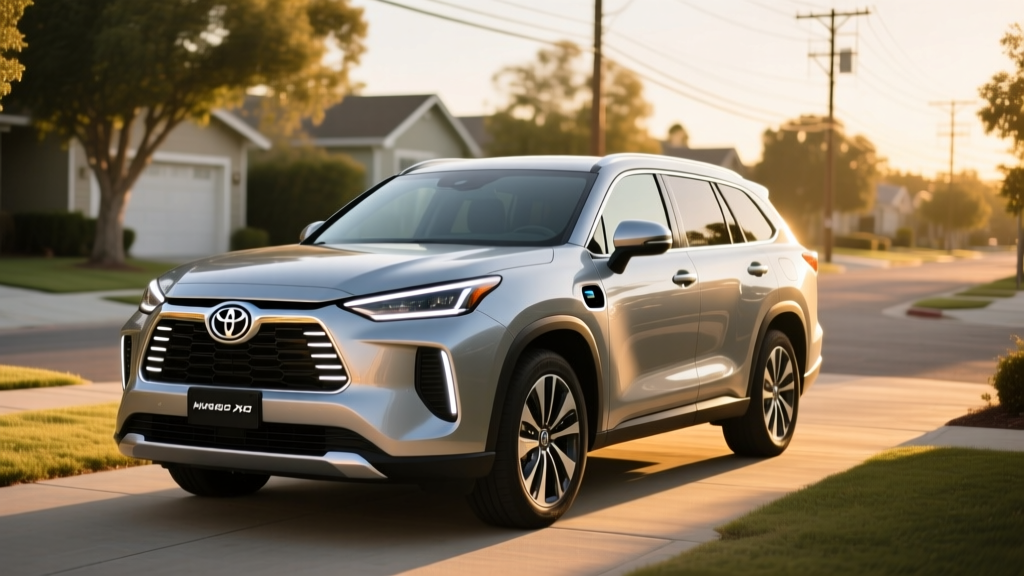
The 2026 Toyota Grand Highlander Hybrid XLE sits at the intersection of three-row family hauling and genuine fuel efficiency. Unlike a plug-in hybrid or a full battery-electric vehicle, this is a conventional hybrid (HEV) — meaning it never needs to be plugged in. Instead, Toyota's hybrid system recovers braking energy and optimizes engine load to deliver EPA-estimated 34 MPG combined in a package that seats up to eight. For families weighing a full EV against a gas-only SUV, the Grand Highlander Hybrid XLE eliminates range anxiety entirely while cutting fuel costs roughly in half versus its turbocharged gas sibling.
2026 Grand Highlander Hybrid XLE: Key Specifications
| Specification | 2026 Grand Highlander Hybrid XLE |
|---|---|
| Powertrain | 2.5L 4-cyl + 2 electric motors (eAWD available) |
| Combined Horsepower | 245 hp |
| Transmission | eCVT (electronically controlled continuously variable) |
| EPA MPG (City / Hwy / Combined) | 36 / 32 / 34 (FWD); 35 / 33 / 34 (eAWD) |
| Fuel Tank Capacity | 17.1 gallons |
| Total Driving Range | ~581 miles (FWD combined) |
| 0-60 mph | ~7.9 seconds |
| Cargo Volume (behind 3rd / 2nd / 1st) | 20.6 / 57.9 / 97.5 cu ft |
| Seating Capacity | 7 or 8 passengers |
| Towing Capacity | 3,500 lbs |
| Hybrid Battery Warranty | 10 years / 150,000 miles |
| Starting MSRP | $47,170 (FWD); $48,770 (eAWD) |
The XLE is the volume trim in the Grand Highlander Hybrid lineup, sitting above the LE and below the Limited and Platinum. It adds SofTex-trimmed seats, a power liftgate, heated front seats, and Toyota's 12.3-inch infotainment system — features most family buyers want without stepping into luxury pricing.
Fuel Economy: EPA Estimates vs. Real-World MPG
| Driving Scenario | FWD MPG | eAWD MPG |
|---|---|---|
| EPA City | 36 | 35 |
| EPA Highway | 32 | 33 |
| EPA Combined | 34 | 34 |
| Real-World City (observed) | 35-38 | 34-37 |
| Real-World Highway (70-80 mph) | 28-31 | 29-31 |
| Real-World Combined (mixed) | 31-34 | 31-33 |
Toyota's hybrid system excels in stop-and-go traffic, where the electric motors handle low-speed propulsion and regenerative braking recaptures energy that a conventional vehicle would waste as heat. In real-world city driving, many owners report matching or even exceeding the EPA city estimate — a rarity in the automotive world. The hybrid battery and motors shoulder the load at low speeds, letting the 2.5-liter Atkinson-cycle engine operate only in its most efficient RPM range.
Highway fuel economy is where hybrids lose their advantage relative to city driving. At sustained 70-80 mph speeds, the gasoline engine does most of the work, and the Grand Highlander's boxy three-row profile creates meaningful aerodynamic drag. Expect 28-31 MPG on extended highway trips — still competitive for a vehicle this size, but noticeably lower than the city figure. Cold weather (below freezing) typically reduces hybrid efficiency by 5-10% as the engine runs more frequently to provide cabin heat and maintain battery temperature.
Hybrid vs. Plug-In Hybrid vs. Full EV: Which Fits Your Family?
The Grand Highlander is currently offered as a conventional hybrid (HEV) only — there is no plug-in hybrid (PHEV) variant in Toyota's 2026 lineup for this model. Understanding the distinction matters for your buying decision:
| Factor | Conventional Hybrid (HEV) | Plug-In Hybrid (PHEV) | Battery Electric (BEV) |
|---|---|---|---|
| Needs to be plugged in? | No | Yes (for EV range) | Yes |
| Electric-only range | N/A (motor assists only) | 20-45 miles typical | 200-400+ miles |
| Total range | 500-580 miles | 400-550 miles | 200-400+ miles |
| Home charging needed? | No | Recommended (Level 2) | Essential |
| Gas engine | Yes — primary power | Yes — backup | No |
| Federal tax credit | No | Up to $7,500 (if eligible) | Up to $7,500 (if eligible) |
| Best for | No home charging access | Short commutes + road trips | Home charging + daily driving |
Choose the Grand Highlander Hybrid (HEV) if: You don't have reliable access to home or workplace charging, you regularly take long road trips where charging infrastructure is sparse, or you want the simplicity of a gas station fill-up with significantly better fuel economy than a conventional SUV. This is the zero-lifestyle-change path to lower fuel bills.
Consider a PHEV (like the Toyota RAV4 Prime or Kia Sorento PHEV) if: Your daily commute is under 30 miles, you have Level 2 charging at home, and you want electric-only driving for errands while retaining gas-engine range for road trips. Note that no three-row PHEV currently matches the Grand Highlander's interior volume.
Consider a full BEV (like the Kia EV9 or Rivian R1S) if: You have home charging, want zero tailpipe emissions, and your typical trips fall within the vehicle's range. Three-row EVs remain more expensive than the Grand Highlander Hybrid, and charging on road trips adds time.
Powertrain Deep Dive: How Toyota's Hybrid System Works
The 2026 Grand Highlander Hybrid uses Toyota's fourth-generation hybrid synergy drive, pairing a 2.5-liter four-cylinder Atkinson-cycle engine with two front-mounted electric motor-generators (and a third rear motor on eAWD models). The Atkinson cycle delays intake valve closing, reducing pumping losses and extracting more work from each combustion event — at the cost of peak power density. Combined system output is 245 horsepower.
The eCVT is not a belt-and-pulley CVT like those in some competitors. Instead, Toyota uses a planetary gearset that seamlessly blends engine and motor power without the rubber-band acceleration feel. The result is smooth, linear acceleration that, while not fast by EV standards (0-60 in roughly 7.9 seconds), is entirely adequate for merging and highway passing.
On eAWD models, a separate 40 kW electric motor powers the rear axle. There is no mechanical driveshaft connecting front and rear — the system engages the rear motor on demand for traction in rain, snow, or loose surfaces. This adds roughly 100 pounds and costs about $1,600 more than FWD, but the fuel economy penalty is minimal (only 1 MPG in the EPA city cycle).
Pricing, Trim Positioning, and Tax Credit Eligibility
The 2026 Grand Highlander Hybrid XLE starts at $47,170 for FWD and $48,770 for eAWD (including destination charge). This positions it roughly $4,000-$5,000 above the equivalent gas-only XLE, a premium that fuel savings can partially offset over ownership.
Federal Tax Credit: As a conventional hybrid (HEV), the Grand Highlander Hybrid does not qualify for the IRS §30D clean vehicle credit. That credit applies only to plug-in electric vehicles (PHEVs and BEVs) meeting battery sourcing, MSRP caps, and buyer income requirements. The Grand Highlander Hybrid's $7,500 credit eligibility is a common misconception — it does not apply here.
Some states and local utilities offer incentives for conventional hybrids, though these are increasingly rare as incentive programs shift toward plug-in vehicles. Check your state energy office or utility provider for current programs.
- ❌ Federal §30D Clean Vehicle Credit ($7,500): No — HEVs are not eligible
- ❌ Federal Used Clean Vehicle Credit (§25E): No — same plug-in requirement
- ⚠️ State/local hybrid incentives: Varies by jurisdiction — check dsireusa.org
- ✅ Potential fuel cost savings: ~$800-$1,200/year vs. gas-only Grand Highlander (15K mi/yr at $3.50/gal)
Battery Warranty, Longevity, and Replacement Cost
- Coverage: 10 years or 150,000 miles (whichever comes first)
- What's covered: Hybrid battery pack, hybrid control module, inverter
- Capacity threshold: Toyota warrants against defects and abnormal loss of capacity
- Transferable: Yes, warranty transfers to subsequent owners
Toyota's hybrid battery track record is among the best in the industry. The nickel-metal hydride (NiMH) battery pack in the Grand Highlander Hybrid is a mature technology — Toyota has deployed similar systems across millions of vehicles since the 1997 Prius. Real-world data from high-mileage Toyota hybrids consistently shows hybrid battery packs lasting 150,000-200,000+ miles before requiring replacement.
If replacement is eventually needed out of warranty, expect to pay between $3,000 and $5,000 for a new OEM hybrid battery pack installed at a dealership. Independent hybrid specialists and refurbished battery options can reduce that cost to $1,500-$3,000. This is substantially less than a full EV traction battery replacement, which can exceed $10,000-$20,000.
The hybrid battery in the Grand Highlander is relatively small (approximately 1.6 kWh usable) compared to PHEV or BEV packs. It functions as a buffer — storing recaptured braking energy and delivering it for acceleration assist — rather than as a primary energy source. This smaller size, combined with Toyota's conservative charge/discharge management (the system never fully charges or fully depletes the pack), is a key reason for the long service life.
Reliability and Safety Ratings
Toyota's hybrid powertrains have earned a reputation for exceptional reliability, and the Grand Highlander builds on that foundation. The 2.5-liter Atkinson-cycle engine is under-stressed compared to turbocharged alternatives, and the eCVT planetary gearset has no belts, clutches, or friction components to wear. NHTSA and IIHS ratings should be consulted when available for the 2026 model year, as the Grand Highlander platform earned strong scores in prior testing.
Toyota Safety Sense 3.0 comes standard on all Grand Highlander Hybrid trims, including the XLE. This suite provides:
- Pre-Collision System with Pedestrian Detection
- Lane Departure Alert with Steering Assist
- Full-Speed Range Dynamic Radar Cruise Control
- Lane Tracing Assist
- Automatic High Beams
- Road Sign Assist
Important note: Toyota Safety Sense is a Level 2 driver-assistance system under SAE classification. The driver must remain fully engaged, keep hands on the wheel, and monitor the road at all times. This is not autonomous or self-driving technology.
Pros and Cons at a Glance
- 34 MPG combined EPA — exceptional for a three-row SUV
- No plug-in required — zero lifestyle change from a gas vehicle
- 581-mile total range eliminates range anxiety
- 10-year / 150,000-mile hybrid battery warranty
- Strong reliability track record for Toyota hybrid systems
- XLE trim well-equipped at its price point
- 3,500-lb towing adequate for light trailers and boats
- No federal tax credit eligibility (HEV, not PHEV/BEV)
- Highway MPG drops to 28-31 at sustained speeds
- 245 hp is adequate, not quick — 0-60 around 7.9 seconds
- eCVT drone under hard acceleration
- No plug-in hybrid variant available for EV-range commuters
- Third row best suited for children on longer trips
- Higher starting price than gas-only Grand Highlander
Ownership Costs: 5-Year Fuel Savings vs. Gas-Only Model
| Cost Factor | Grand Highlander Hybrid XLE | Grand Highlander Gas XLE (Turbo) |
|---|---|---|
| MSRP | $47,170 | $43,070 |
| EPA Combined MPG | 34 | 24 |
| Annual fuel cost (15K mi @ $3.50/gal) | $1,544 | $2,188 |
| 5-year fuel cost | $7,720 | $10,940 |
| Federal tax credit | $0 | $0 |
| 5-year estimated total (MSRP + fuel) | $54,890 | $54,010 |
The hybrid premium of approximately $4,100 is nearly recovered through fuel savings alone over five years, with the gap closing further if gas prices rise. Beyond the break-even point, the hybrid continues to save roughly $644 per year. Insurance costs are generally comparable between hybrid and gas variants, though you should obtain quotes for your specific situation.
Frequently Asked Questions
How many MPG does the 2026 Grand Highlander Hybrid XLE get?
The EPA rates the FWD model at 36 city / 32 highway / 34 combined MPG. The eAWD model is rated at 35 city / 33 highway / 34 combined. In real-world mixed driving, expect 31-34 MPG combined, with city driving often exceeding the EPA estimate and sustained highway driving falling to 28-31 MPG.
Does the Grand Highlander Hybrid need to be plugged in?
No. This is a conventional hybrid (HEV), not a plug-in hybrid. The battery charges through regenerative braking and the gasoline engine. You fuel it exactly like any other gas vehicle — at a gas station.
Does the 2026 Grand Highlander Hybrid qualify for the $7,500 federal tax credit?
No. The IRS §30D Clean Vehicle Credit applies only to plug-in electric vehicles (PHEVs and BEVs) that meet battery sourcing, MSRP, and income requirements. Conventional hybrids like the Grand Highlander Hybrid are not eligible. Check IRS.gov for current rules.
How long will the hybrid battery last, and what does replacement cost?
Toyota warrants the hybrid battery for 10 years or 150,000 miles. Based on historical data from Toyota's hybrid fleet, these batteries commonly last 150,000-200,000+ miles. If replacement is needed out of warranty, expect $3,000-$5,000 for an OEM pack at a dealer, or $1,500-$3,000 through independent specialists using refurbished units.
Is the Grand Highlander Hybrid good for towing?
The hybrid model is rated for 3,500 pounds of towing capacity — adequate for a small boat, utility trailer, or a pair of personal watercraft. This is less than some body-on-frame SUVs but typical for unibody crossovers in this class. Towing will reduce fuel economy significantly; expect 18-22 MPG when pulling a loaded trailer.
How does the Grand Highlander Hybrid compare to a full EV like the Kia EV9?
The Kia EV9 offers 270-300+ miles of EPA range, zero tailpipe emissions, and lower per-mile energy costs, but starts above $54,000, requires home charging infrastructure, and adds time on road trips for DC fast charging. The Grand Highlander Hybrid costs less upfront, needs no charging setup, and offers 581 miles of total range — making it the practical choice for buyers without reliable home charging or those who frequently drive in areas with sparse charging infrastructure.
What is the difference between the Grand Highlander Hybrid XLE and the Limited/Platinum?
The XLE includes SofTex seats, heated front seats, power liftgate, and 12.3-inch infotainment. The Limited adds leather, ventilated front seats, heated second-row seats, and a panoramic roof. The Platinum tops the range with a head-up display, premium audio, and additional driver-assist features. All share the identical 245 hp hybrid powertrain and 34 MPG combined rating.
The 2026 Grand Highlander Hybrid XLE makes a compelling case as the default choice for families who want three rows, modern safety tech, and meaningful fuel savings without the complexity of plug-in charging. It won't satisfy buyers seeking EV-mode commuting or thrilling acceleration, but for the core task of moving a family efficiently and reliably, it delivers exactly what it promises — and the numbers back it up.