Quick Verdict: A Performance Hybrid for the Three-Row Family
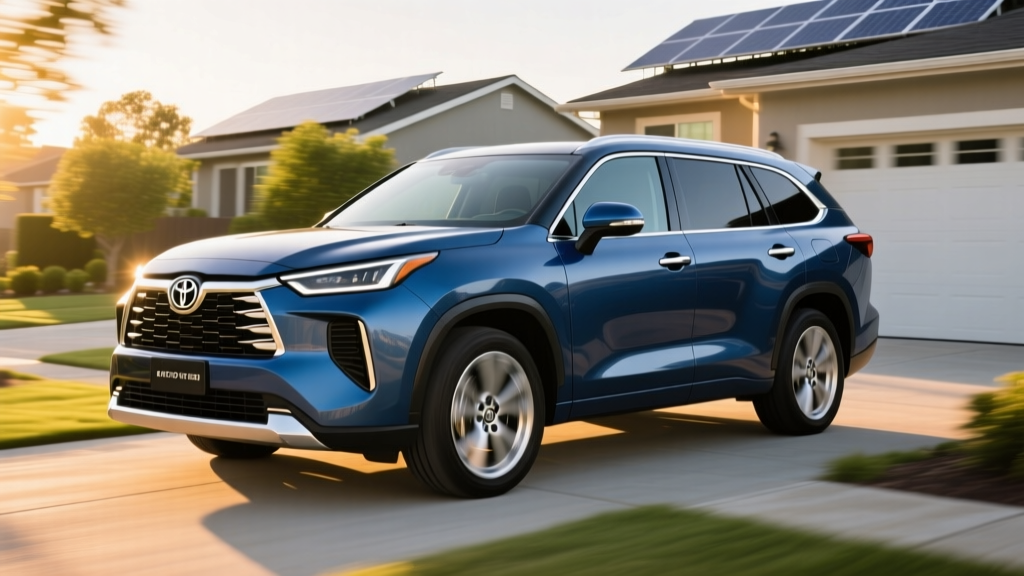
The 2026 Toyota Grand Highlander Hybrid MAX Limited occupies a specific niche in the three-row SUV market: it pairs a turbocharged 2.4-liter engine with electric motors for 362 combined horsepower, delivering the kind of acceleration most family haulers can't match while still returning a respectable 27 MPG combined. This is not the efficiency-focused Hybrid powertrain (that's the 2.5-liter four-cylinder variant rated at 36 MPG). The MAX is Toyota's answer to buyers who want hybrid fuel savings without sacrificing passing power or towing capability.
If you're cross-shopping the Grand Highlander Hybrid MAX Limited against plug-in hybrids or full electric SUVs, the calculus comes down to one question: do you prioritize maximum miles per gallon, or do you need the torque, 5,000-pound towing rating, and zero charging-plug dependency that a conventional turbo hybrid delivers?
Hybrid MAX vs. Standard Hybrid: Understanding the Powertrain Difference
Toyota offers two distinct hybrid systems in the Grand Highlander lineup. Confusing them at the dealership is easy — the naming is deliberately similar. Here's the breakdown:
| Attribute | Hybrid MAX (This Review) | Standard Hybrid |
|---|---|---|
| Engine | 2.4L Turbo 4-cylinder | 2.5L Naturally Aspirated 4-cylinder |
| Combined Horsepower | 362 hp | 245 hp |
| Combined Torque | 400 lb-ft | 173 lb-ft (engine) |
| Transmission | 6-speed automatic | eCVT |
| EPA Combined MPG | 27 MPG | 36 MPG |
| Max Towing Capacity | 5,000 lbs | 3,500 lbs |
| Drivetrain | AWD (standard) | AWD or FWD |
| Plug-in Required? | No (self-charging HEV) | No (self-charging HEV) |
Both are conventional hybrids (HEVs), meaning neither requires plugging in. The battery recharges through regenerative braking and the gasoline engine. If you need plug-in electric-only driving, Toyota does not currently offer a Grand Highlander Prime (PHEV) variant for 2026 — you'd need to look at the RAV4 Prime or the Sienna-based minivan segment for that.
Fuel Economy: EPA Ratings and Real-World MPG
The Hybrid MAX trades some efficiency for its power advantage. Here's what the EPA publishes and what you should actually expect:
| Driving Cycle | EPA Estimate | Real-World Expectation |
|---|---|---|
| City | 26 MPG | 27–29 MPG (hybrids excel in stop-and-go) |
| Highway | 27 MPG | 25–27 MPG (turbo works harder at speed) |
| Combined | 27 MPG | 26–28 MPG |
Hybrid vehicles typically exceed their EPA city rating in real-world urban driving because regenerative braking recaptures energy that a conventional car wastes as heat. Highway driving is where the Hybrid MAX's turbocharged engine and heavier curb weight (~4,900 lbs) work against it. On a flat, 70-mph cruise you'll see the mid-to-high 20s. Add mountain passes, a full load of passengers and cargo, or winter temperatures, and expect the low-to-mid 20s.
For context, the standard Grand Highlander Hybrid (245 hp) returns 36 MPG combined — a 9 MPG advantage. Over 15,000 miles per year at $3.50/gallon, that's roughly $485 in annual fuel savings for the standard hybrid. The MAX's value proposition isn't maximum efficiency; it's V6-like performance with V4-like fuel bills.
Performance, Towing, and Drivetrain Specs
| Specification | 2026 Grand Highlander Hybrid MAX Limited |
|---|---|
| Powertrain | 2.4L Turbo I4 + electric motor (Hybrid MAX) |
| Combined Horsepower | 362 hp |
| Combined Torque | 400 lb-ft |
| Transmission | Direct-shift 6-speed automatic |
| 0–60 mph | ~6.0 seconds (manufacturer est.) |
| Drivetrain | Electronic AWD (standard) |
| Max Towing | 5,000 lbs (with tow prep package) |
| Cargo Volume (behind 3rd row) | 20.6 cu ft |
| Cargo Volume (all rows folded) | 97.5 cu ft |
| Seating | 7-passenger (standard) / 8-passenger (bench option) |
The 400 lb-ft of torque is the headline figure. It's available low in the rev range thanks to the electric motor's instant delivery, making highway merges and trailer launches feel effortless. The 6-speed automatic is a deliberate choice over the eCVT in the standard hybrid — Toyota engineered it for drivers who prefer traditional shift feel and want to avoid the "drone" some associate with continuously variable transmissions under hard acceleration.
Hybrid Battery: Chemistry, Warranty, and Replacement Cost
Toyota Hybrid Battery Warranty: 10 years / 150,000 miles (whichever comes first), covering capacity below 70% of original. This applies in all 50 states as of the 2020 model year onward.
Hybrid System Warranty: 8 years / 100,000 miles for hybrid control modules, inverter, and related components.
The Hybrid MAX uses a compact nickel-metal hydride (NiMH) battery pack mounted beneath the rear seats. Unlike the large lithium-ion packs in full EVs or PHEVs, this battery is small — roughly 1.5 to 2 kWh of total capacity — because its job is to buffer energy for acceleration assist and regenerative capture, not to power the vehicle independently for extended distances.
Battery replacement cost: If the hybrid battery fails outside of warranty, a new OEM replacement runs approximately $3,000–$4,500 including labor at a Toyota dealer. Third-party refurbishment shops offer reconditioned packs for $1,500–$2,500. However, Toyota's NiMH hybrid batteries have an exceptional longevity track record. Data from fleet operators and long-term owners of the Prius and Highlander Hybrid shows the majority of packs lasting 150,000–200,000+ miles before significant degradation. The 10-year/150,000-mile warranty reflects Toyota's confidence in this chemistry.
For comparison, a full EV battery replacement (say, a 75 kWh NMC pack) can cost $10,000–$18,000. The hybrid's small, proven NiMH pack is one of the lowest-risk battery ownership scenarios in electrified vehicles.
Pricing, Trim Details, and Tax Credit Eligibility
The 2026 Toyota Grand Highlander Hybrid MAX Limited carries an MSRP starting at approximately $54,000 (including destination). Fully loaded with packages — panoramic roof, premium audio, head-up display, and the tow prep package — expect an as-tested price between $57,000 and $60,000.
Federal tax credit status: The Grand Highlander Hybrid MAX does not qualify for the federal §30D Clean Vehicle Credit. That credit is reserved for plug-in electric vehicles (BEVs and PHEVs) with battery capacities of at least 7 kWh. Because the Hybrid MAX is a conventional self-charging hybrid (HEV) with a small NiMH battery, it is ineligible. There is no federal tax credit for conventional hybrids as of 2026.
Some states and local utilities offer rebates for hybrid purchases, but these vary significantly by jurisdiction. Check your state's energy office or fueleconomy.gov's incentives database for location-specific programs.
Hybrid MAX vs. PHEV vs. Full EV: Which Powertrain Fits You?
Choose the Grand Highlander Hybrid MAX if:
- You need three rows, 5,000-lb towing, and strong acceleration
- You don't have reliable access to home or workplace charging
- You take frequent long road trips and don't want to plan around charging stops
- You want hybrid fuel savings with zero lifestyle change
Choose a PHEV (e.g., Kia Sorento PHEV, Mitsubishi Outlander PHEV) if:
- You can charge at home and want 30–40 miles of electric-only commuting
- Most daily driving is under 40 miles round-trip
- You want the §30D federal tax credit (up to $7,500, subject to income/MSRP/sourcing rules)
- You're willing to accept smaller cargo space or less third-row room
Choose a full EV (e.g., Kia EV9, Tesla Model X) if:
- You have Level 2 home charging and want the lowest per-mile fuel cost
- You want zero tailpipe emissions and minimal drivetrain maintenance
- Your road trips are planned around DC fast-charging corridors
- You qualify for the full §30D credit and want maximum total-cost-of-ownership savings
The honest trade-off: the Hybrid MAX gives you the most flexibility and the least range anxiety, but you'll spend roughly $1,800–$2,200/year on gasoline (at 15,000 miles and $3.50/gal). A comparable full EV charged mostly at home on a national-average electricity rate of $0.17/kWh would cost $700–$900/year to "fuel." Over five years, that's a $5,000–$6,500 gap — partially offset by the EV's higher purchase price and potentially higher insurance premiums.
Pros and Cons at a Glance
Pros
- 362 hp / 400 lb-ft from a hybrid — genuinely quick for a three-row SUV
- 27 MPG combined is solid for its size and power class
- 5,000-lb towing capacity (best in hybrid three-row segment)
- No plug-in dependency — fuel anywhere, no range anxiety
- 10-year / 150,000-mile hybrid battery warranty
- Spacious third row and 97.5 cu ft max cargo
- Toyota's hybrid reliability track record is industry-leading
Cons
- 9 MPG less efficient than the standard Grand Highlander Hybrid
- No federal tax credit eligibility (HEV, not PHEV/BEV)
- Starting near $54K — significantly above mainstream three-row pricing
- Turbo engine requires premium fuel for maximum output
- No electric-only driving mode (unlike PHEV competitors)
- Heavier curb weight affects tire and brake wear costs
Frequently Asked Questions
How many MPG does the 2026 Grand Highlander Hybrid MAX get?
The EPA rates it at 26 city / 27 highway / 27 combined. In real-world city driving with regenerative braking, many owners report 28–29 MPG. Highway-heavy commutes at 75+ mph will drop to the mid-20s.
Does the Grand Highlander Hybrid MAX need to be plugged in?
No. It is a conventional hybrid (HEV), not a plug-in hybrid (PHEV). The battery recharges automatically through regenerative braking and the gasoline engine. You fuel it like any other car.
Is the hybrid battery reliable, and what does replacement cost?
Toyota's NiMH hybrid batteries have an outstanding reliability record, with many lasting 150,000–200,000+ miles. The battery is warranted for 10 years / 150,000 miles. Out-of-warranty replacement costs $3,000–$4,500 for a new OEM pack, or $1,500–$2,500 for a reconditioned unit.
Does the Grand Highlander Hybrid MAX qualify for a federal tax credit?
No. The §30D Clean Vehicle Credit applies only to plug-in vehicles (BEVs and PHEVs) with battery capacities of 7 kWh or more. The Hybrid MAX is a self-charging HEV and is not eligible. Check your state for possible local hybrid incentives.
How does the Hybrid MAX compare to the standard Grand Highlander Hybrid?
The standard hybrid uses a 2.5L engine for 245 hp and 36 MPG combined, starting around $45,000. The MAX gives you 362 hp, 400 lb-ft, 27 MPG, and 5,000-lb towing — at a ~$9,000 premium. If efficiency and value are priorities, the standard hybrid wins. If you need power and towing, the MAX is the choice.
Can the Hybrid MAX tow a boat or camper?
Yes, up to 5,000 lbs when equipped with the tow prep package. That covers most small-to-medium travel trailers, boat trailers, and utility trailers. Expect fuel economy to drop to the low 20s or high teens while towing.
Sources: EPA fuel economy data via fueleconomy.gov, Toyota Motor Corporation specification sheets, IRS §30D Clean Vehicle Credit guidelines via irs.gov.