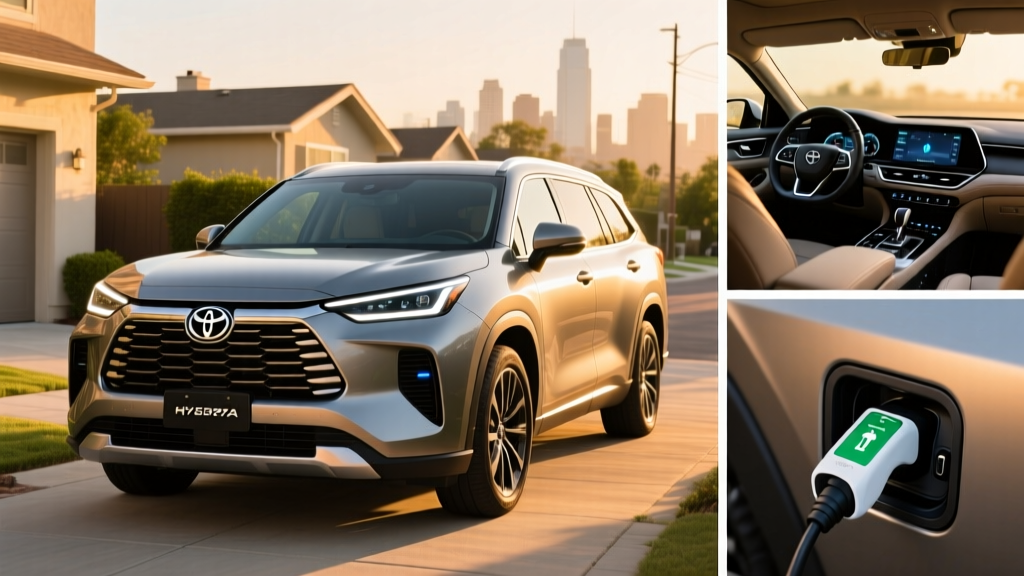
The 2026 Toyota Grand Highlander Hybrid Limited occupies a narrow but important lane in the family-SUV market: three rows, standard all-wheel drive, and fuel economy that embarrasses many compact crossovers — all without a plug in sight. For buyers who want to slash fuel costs without changing their refueling habits or managing charging logistics, this conventional hybrid (HEV) is worth a serious look.
But "hybrid" is a loaded word in 2026. Some shoppers mean plug-in hybrid (PHEV) with 30+ miles of electric-only range; others mean a self-charging HEV that never plugs in. The Grand Highlander Hybrid is the latter. Below, we break down exactly what the Limited trim delivers, what it costs to own, and how it stacks up against PHEV and full-EV alternatives.
HEV vs. PHEV: What the Grand Highlander Hybrid Actually Is
Conventional Hybrid (HEV) — The Grand Highlander Hybrid uses a gasoline engine paired with electric motors and a small battery that recharges through regenerative braking and the engine. You never plug it in. The battery assists the engine to reduce fuel consumption. Electric-only driving is limited to brief low-speed coasting.
Plug-in Hybrid (PHEV) — A PHEV has a larger battery (typically 10–25 kWh) that you plug in to charge, enabling 20–45 miles of electric-only driving before the gas engine kicks in. Toyota does not currently offer the Grand Highlander as a PHEV in the U.S. market.
This distinction matters for tax credits and daily driving patterns. If your goal is electric-only commuting, you'll need to look at a PHEV like the Toyota RAV4 Prime or a full BEV. If your goal is simply using far less fuel across all driving — city, highway, road trips — the HEV format is purpose-built for that.
Fuel Economy: EPA Numbers and Real-World MPG
The 2026 Grand Highlander Hybrid pairs Toyota's Hybrid MAX powertrain with standard electronic on-demand AWD. Here's how the EPA rates it:
| Driving Cycle | EPA Rating | Real-World Expectation |
|---|---|---|
| City | 36 MPG | 35–38 MPG (hybrids often exceed EPA in stop-and-go) |
| Highway | 34 MPG | 30–33 MPG (sustained 75+ mph reduces hybrid advantage) |
| Combined | 35 MPG | 32–36 MPG depending on driving mix |
Toyota's Hybrid MAX system uses a turbocharged 2.4-liter four-cylinder engine mated to electric motors front and rear. Unlike the base Hybrid's emphasis on maximum efficiency, Hybrid MAX prioritizes performance while still delivering strong fuel economy. The result is an SUV that returns mid-30s MPG in mixed driving — roughly 40% better than a comparably sized gas-only three-row SUV.
Real-world note: Hybrid fuel economy is highly sensitive to driving style and terrain. In city driving with frequent stops, regenerative braking keeps the battery charged and the engine off at low speeds — some owners report exceeding 38 MPG on urban commutes. On sustained highway cruises at 80 mph, expect the number to dip toward the low 30s. Cold weather (below 30°F) typically reduces hybrid efficiency by 5–10% due to increased engine runtime for cabin heat.
Powertrain Specs and Performance
| Specification | 2026 Grand Highlander Hybrid Limited |
|---|---|
| Engine | 2.4L turbocharged 4-cylinder + front/rear electric motors |
| Combined System Output | 362 hp / 400 lb-ft torque |
| Drivetrain | AWD (electronic on-demand, Hybrid MAX) |
| Transmission | 6-speed automatic |
| 0–60 mph | ~6.3 seconds (est.) |
| Towing Capacity | 3,500 lbs |
| Fuel Tank | 17.1 gallons |
| Total Range | ~598 miles (at combined EPA) |
| Seating | 7 or 8 passengers (trim-dependent) |
| Cargo (behind 3rd row) | 20.6 cu ft |
The Hybrid MAX powertrain is the performance-oriented hybrid system in the Grand Highlander lineup. The standard (non-MAX) Hybrid uses a 2.5L naturally aspirated engine with a CVT and achieves slightly better fuel economy (up to 37 MPG combined) but with 245 hp. The Limited trim with Hybrid MAX gives you the extra power for highway merging and loaded-up road trips while still delivering strong efficiency. It's a trade-off most three-row SUV buyers will accept gladly.
Pricing, Tax Credits, and Ownership Costs
The 2026 Toyota Grand Highlander Hybrid Limited carries a starting MSRP of approximately $51,490 (including destination charge). Add-ons like panoramic roof, premium audio, and advanced driver-assistance packages can push the as-tested price into the mid-$55,000s.
Federal Tax Credit Eligibility
Key point: The Grand Highlander Hybrid is a conventional hybrid (HEV), not a plug-in hybrid or battery electric vehicle. Under current IRS §30D rules, the federal Clean Vehicle Credit of up to $7,500 applies only to new plug-in electric vehicles (BEVs and qualifying PHEVs) with sufficient battery capacity. The Grand Highlander Hybrid does not qualify for the §30D federal EV tax credit.
Always verify current eligibility on IRS.gov, as rules around battery sourcing, MSRP caps, and buyer income limits apply to plug-in vehicles and are subject to change.
Some states offer separate incentives for conventional hybrids, though these are increasingly rare as state programs shift focus to plug-in vehicles. Check your state's energy or environmental agency for current programs.
Five-Year Fuel Cost Advantage
Where the Grand Highlander Hybrid earns its keep is at the pump. At 35 MPG combined versus a gas-only three-row competitor averaging 22 MPG, and assuming 15,000 miles/year at $3.50/gallon:
| 5-Year Fuel Cost | Grand Highlander Hybrid (35 MPG) | Gas-Only 3-Row SUV (22 MPG) |
|---|---|---|
| Annual fuel cost | $1,500 | $2,386 |
| 5-year fuel cost | $7,500 | $11,932 |
| 5-year savings | $4,432 saved with the Hybrid | |
That $4,400+ in fuel savings over five years partially offsets the higher upfront cost versus a base gas Grand Highlander and eliminates the need for any home charging infrastructure investment.
Battery Warranty, Reliability, and Replacement Costs
Hybrid battery longevity is the number-one concern for first-time hybrid buyers. Toyota addresses this directly:
Hybrid Battery Warranty: Toyota covers the Grand Highlander's hybrid battery for 10 years or 150,000 miles (whichever comes first) from the date of first use. This is among the longest hybrid battery warranties in the industry and applies to all 50 states.
Powertrain Warranty: The engine, transmission, and hybrid system components are covered for 5 years / 60,000 miles.
Toyota's hybrid systems have an extensive real-world track record stretching back to the 1997 Prius. Independent data from sources like Consumer Reports consistently rank Toyota hybrids among the most reliable vehicles on the road. The hybrid battery in modern Toyota systems rarely requires replacement within the warranty period under normal use.
Replacement cost if out of warranty: A hybrid battery replacement for the Grand Highlander is estimated at $3,000–$5,000 (parts and labor) based on comparable Toyota hybrid platforms. However, most Toyota hybrid batteries last well beyond 150,000 miles, and individual module replacement (rather than the full pack) can reduce costs further. The hybrid battery is also far smaller and less expensive than a full EV traction battery.
For context, the hybrid battery in the Grand Highlander is roughly 1–2 kWh — a fraction of the 70–100 kWh batteries in full EVs. This means lower material cost, less degradation concern, and cheaper replacement if ever needed.
Grand Highlander Hybrid vs. PHEV and Full EV Alternatives
Choose the Grand Highlander Hybrid (HEV) if:
- You don't have access to home or workplace charging
- You take frequent long road trips and don't want to plan around charging stops
- You want three rows, AWD, and strong fuel economy without behavioral changes
- You prefer a proven, low-complexity powertrain with minimal new infrastructure needs
Choose a PHEV (e.g., Toyota Sienna PHEV, if available; or Kia Sorento PHEV) if:
- You can charge at home (Level 2) and your daily commute is under 30 miles
- You want electric-only driving for most daily errands with gas backup for road trips
- You want to qualify for the federal §30D tax credit (up to $7,500 depending on eligibility)
Choose a full BEV (e.g., Kia EV9, Tesla Model X) if:
- You have reliable home Level 2 charging and access to DC fast chargers on road-trip routes
- You want zero tailpipe emissions and the lowest per-mile "fuel" cost
- You're comfortable with 250–320 miles of EPA range and 20–40 minute fast-charging stops on long trips
The Grand Highlander Hybrid makes the most sense for families who want immediate fuel savings without any lifestyle adjustment. No apps to manage, no chargers to install, no range to monitor. You fill up at the same gas stations — you just visit them 40% less often.
Limited Trim: What You Get for the Money
The Limited sits in the upper-middle of the Grand Highlander Hybrid lineup. Key standard features on the 2026 Limited include:
- 12.3-inch touchscreen with wireless Apple CarPlay and Android Auto
- Toyota Safety Sense 3.0 (pre-collision, lane tracing, adaptive cruise, road sign assist)
- Leather-trimmed heated and ventilated front seats
- Heated second-row seats
- Power-folding third row
- Wireless phone charging pad
- Panoramic view monitor (360° camera)
- 11-speaker JBL audio system (available with package)
Toyota Safety Sense 3.0 is a SAE Level 2 driver-assistance suite. This means the system can manage steering, acceleration, and braking under certain conditions, but the driver must remain fully attentive and hands on the wheel at all times. It is not autonomous driving.
Pros, Cons, and Bottom Line
Pros
- 35 MPG combined in a 3-row, 7/8-passenger AWD SUV
- 362 hp (Hybrid MAX) — responsive acceleration even when loaded
- 10-year / 150,000-mile hybrid battery warranty
- No plug, no charging infrastructure needed
- ~598 miles of total range per tank
- Strong Toyota reliability and resale value track record
Cons
- Does not qualify for the $7,500 federal EV tax credit
- Limited trim starting near $51,500 — a significant investment
- Hybrid MAX sacrifices ~2 MPG vs. the standard Hybrid powertrain
- 3,500-lb towing capacity (less than some body-on-frame competitors)
- No electric-only driving mode of meaningful distance
The 2026 Toyota Grand Highlander Hybrid Limited isn't trying to be an EV. It's trying to be the most efficient, most practical three-row family SUV you can buy without plugging in — and on those terms, it delivers. If your household isn't ready for the charging commitment of a PHEV or BEV, this is one of the smartest ways to cut fuel costs while keeping the flexibility of a gas tank.
Frequently Asked Questions
How many MPG does the 2026 Grand Highlander Hybrid get?
The EPA rates the Grand Highlander Hybrid (Hybrid MAX AWD) at 36 MPG city, 34 MPG highway, and 35 MPG combined. The standard (non-MAX) Hybrid achieves up to 37 MPG combined. Real-world results vary: expect 32–38 MPG depending on your driving mix, speed, and climate.
Does the Grand Highlander Hybrid need to be plugged in?
No. The Grand Highlander Hybrid is a conventional hybrid (HEV). The battery charges automatically through regenerative braking and the gasoline engine. There is no plug, no charging cable, and no home charger required.
Does the Grand Highlander Hybrid qualify for any tax credit?
The Grand Highlander Hybrid does not qualify for the federal §30D Clean Vehicle Credit, which is reserved for plug-in electric vehicles (BEVs and qualifying PHEVs). Some states may offer hybrid-specific incentives — check your state's energy agency. Always verify current rules at IRS.gov.
How long will the hybrid battery last, and what does replacement cost?
Toyota covers the hybrid battery for 10 years or 150,000 miles. Based on Toyota's extensive hybrid track record, most batteries last well beyond the warranty period. If replacement is ever needed out of warranty, expect $3,000–$5,000. Individual module repair can reduce this cost.
Hybrid vs. PHEV vs. EV — which is right for a 3-row family SUV?
If you lack home charging or take frequent long road trips, the HEV (Grand Highlander Hybrid) is the lowest-friction choice. If you can charge at home and commute under 30 miles daily, a PHEV lets you drive mostly on electricity with gas backup. If you have home charging and are comfortable with fast-charging stops on road trips, a full BEV like the Kia EV9 offers the lowest running costs and zero tailpipe emissions.
Is the Hybrid MAX worth it over the standard Hybrid?
The Hybrid MAX gives you 362 hp versus 245 hp in the standard Hybrid, along with a 6-speed automatic instead of a CVT. You trade roughly 2 MPG combined for significantly stronger acceleration. For a loaded family SUV merging onto highways or climbing mountain passes, the extra power is a meaningful upgrade.
How does the Grand Highlander Hybrid compare to the Toyota Sienna hybrid?
The Sienna minivan is hybrid-only and achieves an EPA-estimated 36 MPG combined — slightly better than the Grand Highlander Hybrid MAX. However, the Sienna is a minivan (lower ride height, sliding doors) while the Grand Highlander is an SUV with more traditional styling and available higher ground clearance. Choose based on body style preference; both are excellent hybrid family haulers.