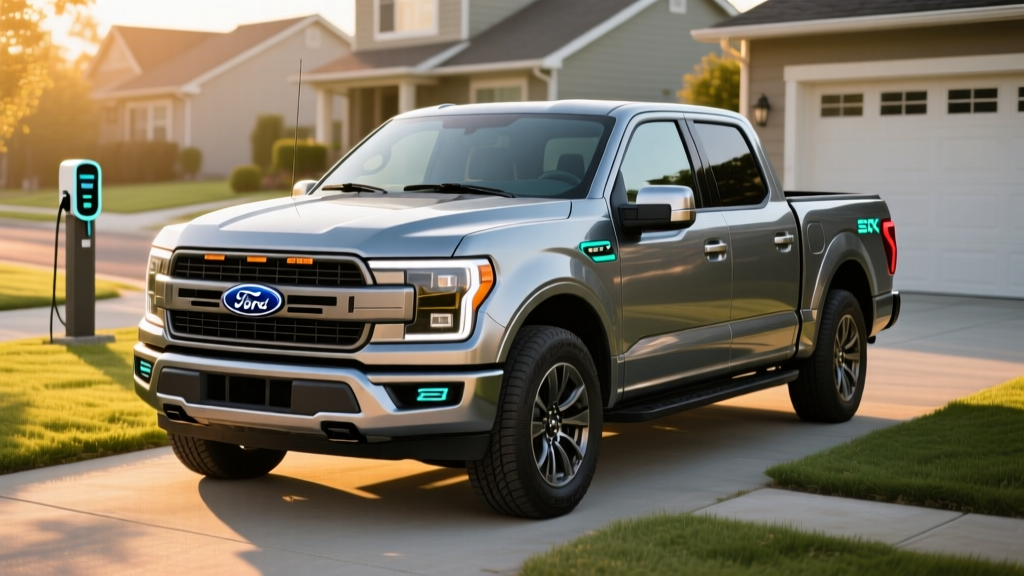
The 2026 Ford F-150 Hybrid STX sits at an unusual crossroads: it's one of the most affordable ways into Ford's PowerBoost hybrid powertrain, pairing a 3.5-liter V6 with an electric motor for 430 horsepower and a notably thirst-free daily commute for a full-size truck. The STX trim, traditionally a value-oriented appearance package, now serves as a gateway to hybrid truck ownership without stepping up to the Lariat or Platinum price brackets.
But does the STX's hybrid system actually save you fuel in real-world driving? What does the battery warranty look like? And does this truck qualify for any federal tax credits? This guide answers every question a hybrid-truck buyer needs resolved before signing paperwork.
HEV vs PHEV: What the F-150 Hybrid Actually Is
Let's clear up a common point of confusion before going further. The 2026 Ford F-150 PowerBoost is a conventional hybrid (HEV), not a plug-in hybrid (PHEV). You never plug it in. The 1.5 kWh lithium-ion battery charges exclusively through regenerative braking and the gasoline engine. This is a fundamentally different architecture from Ford's plug-in offerings (like the now-discontinued Escape PHEV) and from battery-electric trucks like the F-150 Lightning.
| Feature | F-150 PowerBoost (HEV) | Typical PHEV Truck/SUV | Battery-Electric (BEV) |
|---|---|---|---|
| Plug-in charging required? | No | Yes (for EV range) | Yes (always) |
| Electric-only driving range | ~1-2 mi at low speed | 25-45 mi typical | 230-400+ mi |
| Battery capacity | 1.5 kWh | 12-20 kWh | 75-135 kWh |
| Fuel required | Gasoline | Gasoline + electricity | Electricity only |
| DC fast charging | No | Rarely | Yes |
The PowerBoost system's electric motor is integrated between the engine and the 10-speed automatic transmission. It assists during acceleration, enables brief electric-only creep at low speeds (useful in stoplights and parking lots), and recovers energy under braking. The practical result: meaningful fuel savings without any change to your fueling routine.
Fuel Economy: EPA Ratings and Real-World MPG
Ford's 3.5L PowerBoost V6 hybrid is rated by the EPA at 25 MPG combined in the F-150 STX 4x2 configuration, with a city/highway split that favors urban driving — exactly where hybrid systems shine.
| Configuration | City MPG | Highway MPG | Combined MPG |
|---|---|---|---|
| F-150 Hybrid STX 4x2 | 25 | 26 | 25 |
| F-150 Hybrid STX 4x4 | 23 | 24 | 23 |
| F-150 3.5L Gas (non-hybrid) 4x4 | 18 | 23 | 20 |
| F-150 Lightning (BEV) | ~66 MPGe combined (varies by trim) | ||
Source: fueleconomy.gov — EPA estimates. Your mileage will vary with driving style, payload, and conditions.
Real-World MPG: What Owners Actually Report
In mixed suburban and highway driving, the F-150 PowerBoost consistently delivers close to its EPA rating — and frequently exceeds it in city traffic, where regenerative braking and electric-motor assist do their heaviest work. Owner forums and long-term tests commonly report:
- City/suburban (under 45 mph): 26-28 MPG — the hybrid system's sweet spot
- Highway (70-80 mph): 22-24 MPG — less hybrid advantage at sustained speed
- Towing (5,000+ lb trailer): 12-15 MPG — hybrid helps less under heavy load
- Cold weather (below 30°F): Expect a 2-3 MPG drop due to engine running more for cabin heat
Compared to the non-hybrid 3.5L EcoBoost V6, the PowerBoost hybrid typically saves 3-5 MPG in mixed driving. Over 15,000 annual miles at $3.40/gallon, that translates to roughly $350-$550 in annual fuel savings — not transformative, but meaningful over a 5-7 year ownership cycle.
Powertrain Specs: 430 HP and the PowerBoost System
| Specification | 2026 F-150 Hybrid STX |
|---|---|
| Engine | 3.5L PowerBoost V6 twin-turbo + electric motor |
| Combined Horsepower | 430 hp |
| Combined Torque | 570 lb-ft |
| Transmission | 10-speed automatic (modular hybrid) |
| Battery | 1.5 kWh lithium-ion (air-cooled) |
| 0-60 mph (est.) | ~5.7 seconds |
| Max Towing (properly equipped) | ~11,200 lb |
| Max Payload | ~1,860 lb |
| Drivetrain | RWD standard (4x4 available) |
The PowerBoost system produces more combined torque than Ford's 5.0L Coyote V8, making it a strong choice for drivers who want V8-like pulling power with V6-like fuel consumption. The electric motor fills in the torque curve at low RPM before the turbos fully spool, giving the truck a responsive, lag-free feel from a stop.
On the STX trim, the PowerBoost hybrid is available as an option (it's not standard — the base STX engine is the 2.7L EcoBoost V6). Expect the hybrid powertrain upgrade to add approximately $3,500-$4,500 to the STX's window price, depending on model-year pricing adjustments and whether 4x4 is selected.
Pricing, Trims, and Tax Credit Eligibility
The 2026 F-150 STX with the PowerBoost hybrid option starts in the mid-$50,000 range for a 4x2 SuperCrew configuration, with 4x4 adding roughly $3,500-$4,000. Exact MSRP depends on cab configuration, bed length, and installed packages.
Federal Tax Credit: Does the F-150 Hybrid Qualify?
No. The F-150 PowerBoost is a conventional hybrid (HEV), and under current IRS §30D rules, conventional hybrids do not qualify for the federal clean vehicle tax credit. The §30D credit (up to $7,500) is reserved for plug-in electric vehicles — battery-electric (BEV) and plug-in hybrid (PHEV) models that meet battery capacity, critical-mineral sourcing, MSRP, and buyer income thresholds.
Federal EV Tax Credit (§30D) Quick Checklist
- ❌ Conventional hybrids (HEV) — not eligible
- ✅ Plug-in hybrids (PHEV) with ≥7 kWh battery — may qualify
- ✅ Battery-electric vehicles (BEV) — may qualify
- MSRP cap: $80,000 (trucks/SUVs/vans), $55,000 (sedans)
- Income cap: $150K single / $300K joint (modified AGI)
- Battery sourcing and critical-mineral requirements apply
- Point-of-sale transfer available at participating dealers
Verify current rules at irs.gov. Tax credit eligibility changes with battery sourcing rules — consult a tax professional.
Some states offer their own incentives for hybrid vehicles, though these are far less common than EV incentives. Check your state's energy or environmental agency for current programs. Ford also periodically offers manufacturer incentives on hybrid trucks — ask your dealer about current Ford Credit or cash-back offers.
Battery Warranty, Reliability, and Replacement Cost
The hybrid battery is the component that makes buyers most nervous. Here's what Ford covers:
| Component | Warranty Coverage |
|---|---|
| Hybrid battery (1.5 kWh) | 8 years / 100,000 miles (10 yr/150,000 mi in CARB states*) |
| Hybrid system components | 8 years / 100,000 miles |
| Powertrain (engine + transmission) | 5 years / 60,000 miles |
| Bumper-to-bumper | 3 years / 36,000 miles |
*CARB states include CA, CO, CT, ME, MD, MA, NJ, NY, OR, RI, VT, WA, and others adopting California emissions standards. Check your state's classification.
How Long Does the PowerBoost Battery Last?
The 1.5 kWh battery in the PowerBoost system is small, air-cooled, and deliberately under-stressed — it never fully charges or fully depletes during normal operation. Ford's battery management system maintains a narrow state-of-charge window (roughly 40-60% SoC), which dramatically extends cycle life. This is a fundamentally different use case than a BEV battery that cycles between 10-90% daily.
Based on data from Ford's earlier hybrid systems (Fusion Hybrid, Escape Hybrid) and Toyota's decades-long hybrid track record, the PowerBoost battery should reliably last 150,000-200,000+ miles before significant degradation. Many first-generation Ford Escape Hybrids from 2005 are still running on original batteries past 200,000 miles.
Battery Replacement Cost
If the hybrid battery does fail outside warranty, replacement cost for the F-150 PowerBoost battery module is estimated at $2,500-$4,500 (parts and labor), significantly less than a BEV battery replacement because of the small 1.5 kWh capacity. Individual cell modules can sometimes be replaced rather than the full pack, further reducing cost.
The conventional 12V auxiliary battery (which the F-150 Hybrid still uses for accessories) will need replacement every 4-6 years at typical cost of $150-$250 — standard for any modern vehicle.
Who Should Buy the F-150 Hybrid STX?
✅ Choose the F-150 Hybrid STX If:
- You drive a truck daily and want to reduce fuel costs without plugging in
- You want V8-like torque (570 lb-ft) with V6 fuel economy
- You tow occasionally but commute frequently (city/suburban MPG benefit)
- You want the lowest entry price into Ford's hybrid truck powertrain
- You lack access to home or workplace charging (rules out PHEV/BEV)
- You value the Pro Power Onboard feature (available with PowerBoost) for job-site or camping use
❌ Look Elsewhere If:
- You want electric-only commuting range (consider a PHEV or the F-150 Lightning BEV)
- You primarily drive highway miles at 80+ mph (hybrid advantage shrinks)
- You tow heavy loads daily (diesel or high-output EcoBoost may serve better)
- You want the maximum available federal tax credit (only BEVs/PHEVs qualify)
- You want the STX's sport appearance with the most powerful engine standard (the 2.7L EcoBoost is the default STX engine)
F-150 Hybrid vs. F-150 Lightning vs. Gas F-150: Decision Framework
Choose the F-150 PowerBoost Hybrid if you want a do-everything truck with better fuel economy, no charging infrastructure needed, and the longest total driving range (~650+ miles on a tank).
Choose the F-150 Lightning (BEV) if you have reliable home Level 2 charging, drive under 300 miles daily, want the lowest per-mile fuel cost (~$0.04-$0.06/mi on home electricity vs. $0.15-$0.18/mi on gas), and qualify for the §30D tax credit.
Choose the gas-only F-150 EcoBoost if your budget is tight, you tow heavy loads frequently, or you drive so few annual miles that the hybrid fuel savings won't offset the powertrain upcharge.
Frequently Asked Questions
How many MPG does the 2026 F-150 Hybrid STX get?
The EPA rates the F-150 PowerBoost Hybrid at 25 MPG combined (25 city / 26 highway) in 4x2 configuration and 23 MPG combined (23 city / 24 highway) with 4x4. In real-world city driving, owners frequently report 26-28 MPG thanks to the hybrid system's regenerative braking advantage.
Does the F-150 Hybrid need to be plugged in?
No. The F-150 PowerBoost is a conventional hybrid (HEV). Its 1.5 kWh battery charges through regenerative braking and the gasoline engine. There is no plug, no charging cable, and no electric-only driving range beyond very low-speed parking-lot maneuvers.
Is the F-150 Hybrid reliable?
Ford's PowerBoost system has been in production since the 2021 model year and builds on hybrid architecture Ford has used since 2004 (Escape Hybrid). The hybrid battery carries an 8-year/100,000-mile warranty (10-year/150,000-mile in CARB states). The small 1.5 kWh battery operates in a narrow charge window that minimizes degradation. Based on Ford's hybrid track record and the conservative battery management strategy, long-term reliability is expected to be strong, though the PowerBoost's turbocharged V6 adds complexity compared to naturally aspirated hybrid systems from competitors.
Does the F-150 Hybrid qualify for a tax credit?
The F-150 PowerBoost does not qualify for the federal §30D clean vehicle tax credit because it is a conventional hybrid, not a plug-in vehicle. The F-150 Lightning (battery-electric) may qualify depending on your income, the vehicle's MSRP, and current battery-sourcing requirements. Check IRS.gov for current eligibility rules.
What is the F-150 Hybrid battery replacement cost?
Out-of-warranty replacement of the 1.5 kWh PowerBoost hybrid battery is estimated at $2,500-$4,500 including labor. Because the battery is small and operates in a narrow state-of-charge window, replacement is rarely needed — most hybrid batteries from major manufacturers last 150,000-200,000+ miles.
Can I get the PowerBoost hybrid on other F-150 trims?
Yes. For 2026, Ford offers the PowerBoost hybrid on multiple F-150 trims including XL (fleet), STX, XLT, Lariat, and Platinum. The STX represents one of the most affordable entry points. Higher trims like the Lariat include the hybrid as a more prominent option or near-standard feature depending on configuration.
How does the Pro Power Onboard feature work with the hybrid?
The PowerBoost hybrid enables Ford's available Pro Power Onboard system, which provides up to 7.2 kW of exportable 120V/240V AC power through bed-mounted outlets. This turns the truck into a mobile generator for job-site tools, tailgating, or emergency home backup power — a capability the gas-only F-150 doesn't match without an aftermarket inverter.