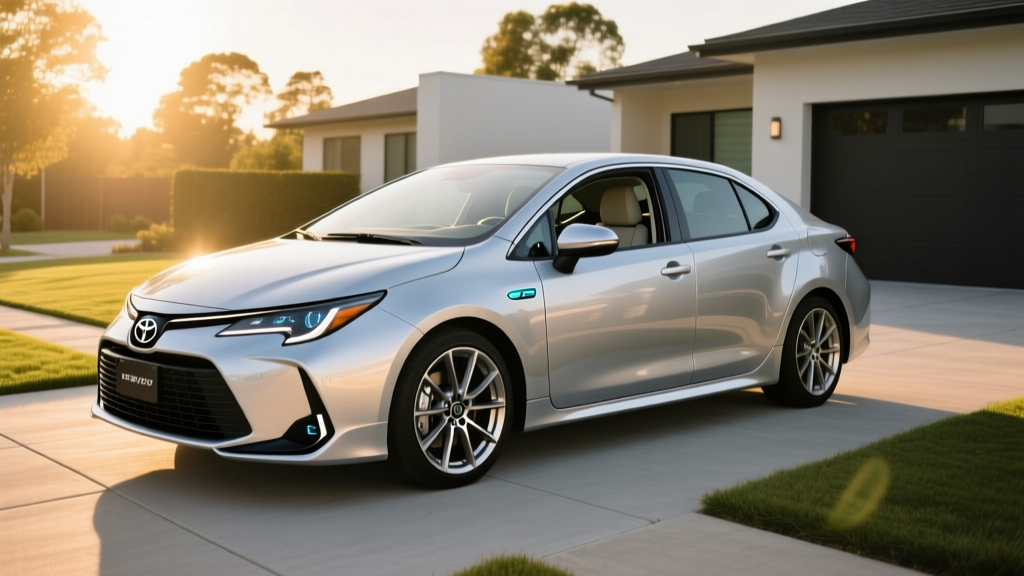
If you're researching the Toyota Corolla Hybrid, MSRP and fuel economy are likely top of mind. The Corolla Hybrid occupies a specific niche in Toyota's electrified lineup: it's a conventional hybrid electric vehicle (HEV), not a plug-in hybrid (PHEV) or a battery electric vehicle (BEV). That distinction matters for your wallet, your daily routine, and your expectations at the pump.
For 2026, Toyota continues the Corolla Hybrid with the fifth-generation Toyota Hybrid System (THS), pairing a 1.8-liter four-cylinder engine with dual electric motors for a combined 138 horsepower. The result is one of the most fuel-efficient compact sedans on the market — and one of the most affordable electrified vehicles you can buy new.
2026 Toyota Corolla Hybrid MSRP by Trim
The Corolla Hybrid is offered in three trims for 2026. Pricing below reflects the base MSRP before destination charges (typically $1,095) and before any applicable dealer adjustments.
| Trim | Drivetrain | MSRP (before destination) | EPA Combined MPG |
|---|---|---|---|
| LE | FWD | $24,795 | 53 MPG |
| LE AWD | AWD | $26,295 | 50 MPG |
| SE | FWD | $27,295 | 50 MPG |
| SE AWD | AWD | $28,795 | 47 MPG |
| XLE | FWD | $28,995 | 50 MPG |
Destination charges add approximately $1,095 to every trim. Fully loaded, a Corolla Hybrid XLE with options lands near $31,000 before taxes and fees — still well below most compact EVs and competitive with the Honda Civic Hybrid and Hyundai Elantra Hybrid.
EPA Fuel Economy and Real-World MPG
The Corolla Hybrid's headline number is its EPA-estimated fuel economy. Here's the full breakdown by configuration, sourced from fueleconomy.gov:
| Configuration | City MPG | Highway MPG | Combined MPG |
|---|---|---|---|
| LE FWD | 53 | 52 | 53 |
| LE AWD | 51 | 49 | 50 |
| SE FWD | 50 | 49 | 50 |
| SE AWD | 47 | 46 | 47 |
| XLE FWD | 50 | 49 | 50 |
HEV vs. PHEV vs. EV: Which Fits Your Life?
The Corolla Hybrid is a conventional HEV. It does not plug in. There is no electric-only driving range to speak of — the small battery (approximately 1.0 kWh usable) assists the gas engine and captures energy during braking, but it cannot propel the car on electricity alone for meaningful distances.
| Factor | Corolla Hybrid (HEV) | Plug-In Hybrid (e.g., Prius Prime) | Battery EV (e.g., Model 3) |
|---|---|---|---|
| Plugs in? | No | Yes (Level 1/2) | Yes (Level 1/2/DC) |
| Electric-only range | ~0 miles | 40–44 miles | 270–360 miles |
| Total range | 520–620 miles | 440–500+ miles | 270–360 miles |
| Home charging needed? | No | Recommended | Essential |
| Federal tax credit (§30D) | Not eligible | Up to $7,500 (if eligible) | Up to $7,500 (if eligible) |
| Best for | No home charging; budget-first | Short commute + road trips | Home charging access; lowest operating cost |
Choose the Corolla Hybrid (HEV) if: You don't have access to home or workplace charging, you want the lowest purchase price, you drive a mix of city and highway miles, and you want zero behavioral change from your current gas car.
Consider a PHEV like the Prius Prime instead if: You can charge at home, your daily commute is under 40 miles, and you want to drive mostly on electricity while keeping gas-engine range for road trips.
Go full EV if: You have reliable home Level 2 charging, your daily driving is under 250 miles, and you want the lowest per-mile fuel cost and minimal maintenance.
Powertrain and Performance Specs
| Specification | Detail |
|---|---|
| Engine | 1.8L 4-cylinder Atkinson-cycle |
| Hybrid System | 5th-gen Toyota Hybrid System (THS) |
| Combined Net Horsepower | 138 HP |
| Electric Motors | 2 (MG1 generator/starter + MG2 drive motor) |
| Hybrid Battery | ~1.0 kWh lithium-ion (not plug-in) |
| Transmission | Electronically controlled CVT (eCVT) |
| 0–60 mph | ~9.0 seconds (FWD) |
| Drivetrain Options | FWD or electronic AWD (rear motor) |
| Fuel Tank | 11.4 gallons |
| Cargo Volume | 13.1 cu ft (trunk) |
The AWD system on the Corolla Hybrid is not a traditional mechanical setup. Instead, a separate rear-mounted electric motor (41 HP) engages automatically when the front wheels slip — during acceleration from a stop, on wet pavement, or in light snow. It's not designed for off-roading, but it adds genuine all-weather confidence without the fuel-economy penalty of a conventional AWD system.
Performance is adequate rather than exciting. The 9-second 0–60 time trails the Civic Hybrid (~7.5 seconds) and Prius (~7.2 seconds), but the Corolla Hybrid prioritizes smoothness and efficiency over acceleration. The eCVT delivers seamless, shift-free power delivery that's well-suited to commuting.
Battery Warranty, Reliability, and Replacement Cost
Toyota's hybrid battery reliability record is among the best in the industry. The Corolla Hybrid uses a relatively small lithium-ion hybrid battery — not the large traction batteries found in EVs — and Toyota's hybrid system has been refined over 25+ years since the original Prius. Real-world data from Toyota's fleet and third-party surveys consistently show hybrid batteries lasting well beyond the warranty period, often reaching 200,000+ miles without replacement.
If replacement is needed out of warranty, expect the following costs:
- New OEM hybrid battery: $2,000–$3,500 (parts + labor at a Toyota dealer)
- Refurbished/reconditioned battery: $1,000–$2,000 (independent hybrid specialists)
- Individual cell/module replacement: $500–$1,200 (if only a portion of the pack has degraded)
For context, this is a fraction of EV battery replacement costs ($5,000–$20,000+), because the Corolla Hybrid's battery is roughly 1.0 kWh versus the 60–85 kWh packs in most EVs.
Beyond the hybrid battery, the Corolla Hybrid benefits from Toyota's reputation for long-term reliability. The 1.8L Atkinson-cycle engine is lightly stressed, the eCVT has no traditional transmission fluid or clutch packs to wear, and regenerative braking extends the life of the friction brake pads (many owners report original brake pads at 80,000+ miles). Toyota's basic new-vehicle warranty covers 3 years/36,000 miles, and the powertrain warranty covers 5 years/60,000 miles.
Tax Credit Eligibility: What You Need to Know
The Corolla Hybrid is a conventional HEV. It does not qualify for the federal §30D Clean Vehicle Credit, which is reserved for plug-in hybrids (PHEVs) and battery electric vehicles (BEVs) with a minimum battery capacity of 7 kWh and specific critical-mineral and battery-component sourcing requirements.
| §30D Requirement | Corolla Hybrid Eligibility |
|---|---|
| Vehicle type: PHEV or BEV | ❌ HEV — not eligible |
| Minimum battery capacity: 7 kWh | ❌ ~1.0 kWh — does not meet threshold |
| Plug-in capable | ❌ No plug-in capability |
| MSRP cap ($55,000 sedans) | ✅ Would pass, but moot |
| Buyer income cap | N/A — vehicle does not qualify |
Some states offer their own incentives for conventional hybrids, but these are increasingly rare as state programs shift toward PHEVs and BEVs. Check your state's energy or environmental agency website for current programs. For the latest federal rules, consult the IRS Clean Vehicle Credits page.
If a tax credit is a dealbreaker, consider the Toyota Prius Prime (PHEV, starts ~$33,445, up to $7,500 credit if eligible) or the Toyota bZ4X (BEV, starts ~$38,465). Both may qualify for the full or partial §30D credit depending on your income, the vehicle's sourcing compliance, and MSRP caps.
Who Should Buy the 2026 Corolla Hybrid?
- 53 MPG combined (LE FWD) — best in class for compact sedans
- Under $25,000 starting MSRP — most affordable hybrid sedan
- No plug-in required — zero lifestyle change
- 10-year/150,000-mile hybrid battery warranty
- Available electronic AWD for all-weather confidence
- Strong resale value and Toyota reliability reputation
- 520–620 miles of real-world range per tank
- Modest 138 HP — slower than Civic Hybrid and Prius
- No federal tax credit eligibility
- Small 13.1 cu ft trunk (no folding rear seat on some trims)
- No plug-in/electric-only driving option
- Infotainment is functional but not class-leading
- AWD trims lose 3–6 MPG vs. FWD
Buy the Corolla Hybrid if: You want maximum fuel economy at the lowest purchase price, you lack home charging access, you prioritize reliability and low maintenance costs, and you don't need rapid acceleration.
Look elsewhere if: You want electric-only commuting (consider Prius Prime or a BEV), you prioritize driving dynamics (Civic Hybrid is sportier), or you need a large trunk or hatchback versatility (Prius or Corolla Hatchback Hybrid).
Frequently Asked Questions
How many MPG does the 2026 Corolla Hybrid get?
The EPA rates the Corolla Hybrid LE FWD at 53 city / 52 highway / 53 combined MPG. AWD and sportier SE trims drop to 47–50 combined. In real-world city driving, many owners exceed the EPA estimate, seeing 55–58 MPG. Highway driving at 75+ mph typically returns 45–48 MPG.
Does the Corolla Hybrid plug in?
No. The Corolla Hybrid is a conventional hybrid (HEV). It charges its small battery through regenerative braking and the gas engine. You never plug it in. If you want plug-in capability with electric-only range, look at the Toyota Prius Prime (PHEV).
How far can the Corolla Hybrid go on a tank of gas?
With an 11.4-gallon fuel tank and real-world fuel economy of 47–53 MPG depending on trim and conditions, expect 520–620 miles between fill-ups. That's among the longest ranges of any compact sedan, gas or hybrid.
Is the Corolla Hybrid reliable, and what does a battery replacement cost?
Toyota's hybrid systems are among the most reliable electrified powertrains in production. The hybrid battery is covered for 10 years/150,000 miles. Out-of-warranty replacement runs $2,000–$3,500 for a new OEM pack or $1,000–$2,000 for a refurbished unit. Many hybrid batteries last 200,000+ miles without issue.
Does the 2026 Corolla Hybrid qualify for any tax credit?
No. The federal §30D Clean Vehicle Credit applies only to plug-in hybrids and battery electric vehicles. The Corolla Hybrid is a conventional HEV and does not qualify. Some states may offer minor incentives for hybrids — check your state's energy agency for current programs.
How does the Corolla Hybrid compare to the Prius?
The Prius (starting ~$28,545, 57 MPG combined) offers more horsepower (194 HP), a hatchback body style, and a more modern interior — but at a $3,500–$4,000 premium. The Corolla Hybrid is the budget-conscious choice; the Prius is for buyers who want more power and versatility alongside similar efficiency. The Toyota Corolla Hybrid spec page and Prius spec page provide current trim details.
Is the AWD system worth the MPG penalty?
If you live in a region with regular snow, ice, or heavy rain, the electronic AWD (an additional 41 HP rear motor) provides meaningful traction benefits. You sacrifice 3–6 MPG combined versus the FWD equivalent. For most mild-climate drivers, FWD is the more economical choice.