Quick Verdict: The 2026 Corolla Cross Hybrid XSE at a Glance
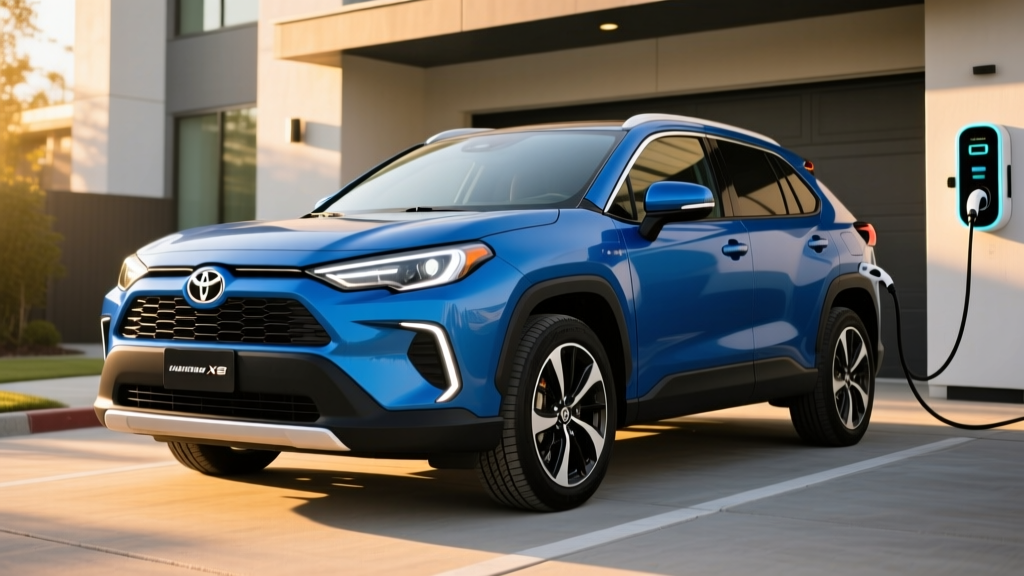
The 2026 Corolla Cross Hybrid XSE sits at the top of Toyota's compact hybrid crossover lineup, pairing a 196-horsepower all-wheel-drive powertrain with an EPA-estimated 42 MPG combined. It's a conventional hybrid (HEV) — not a plug-in — meaning you never need to search for a charger. You simply fuel up at any gas station and let Toyota's fifth-generation hybrid system recapture energy through regenerative braking. For buyers who want crossover utility, standard AWD, and Prius-rivaling efficiency without changing their refueling habits, the XSE trim adds sport-tuned suspension, 18-inch alloy wheels, and a more aggressive exterior treatment over the lower SE and S trims.
| Specification | 2026 Corolla Cross Hybrid XSE |
|---|---|
| Powertrain | 2.0L 4-cyl + 3 electric motors (AWD-i) |
| Combined Horsepower | 196 HP |
| EPA MPG (City / Hwy / Combined) | 45 / 38 / 42 |
| Fuel Tank Capacity | 10.6 gallons |
| Total Driving Range | ~445 miles |
| 0–60 MPH | ~7.5 seconds |
| Drivetrain | Electronic AWD (AWD-i) |
| Cargo Volume (rear seats up / down) | 21.5 / 63.2 cu ft |
| Hybrid Battery Warranty | 10 years / 150,000 miles |
| Base MSRP (XSE AWD) | $33,495 |
| Federal EV/PHEV Tax Credit | Not eligible (§30D applies to BEVs and PHEVs only) |
HEV vs. PHEV: What the Corolla Cross Hybrid Actually Is
Toyota offers the Corolla Cross Hybrid exclusively as a conventional hybrid (HEV). There is no plug-in hybrid (PHEV) variant in the 2026 lineup. This distinction matters because the two architectures serve fundamentally different use cases:
| Feature | HEV (Corolla Cross Hybrid) | PHEV (e.g., RAV4 Prime) |
|---|---|---|
| Plug-in charging required? | No — refuels at gas station only | Yes — plug in for electric-only miles |
| Electric-only range | None (motor assists engine) | Typically 30–42 miles |
| Battery capacity | ~1.0 kWh (small, self-charging) | ~18 kWh (larger, grid-chargeable) |
| Federal tax credit (§30D) | Not eligible | Up to $7,500 if criteria met |
| Best for | No home charging access, simplicity seekers | Home chargers, short commutes on electric |
The Corolla Cross Hybrid's nickel-metal hydride (NiMH) traction battery is small — roughly 1.0 kWh — and charges itself through regenerative braking and the gasoline engine. You'll never see a charge port on this vehicle. If you want electric-only commuting with a gas-engine safety net, you'd need to look at a PHEV like the Toyota RAV4 Prime or the Hyundai Tucson PHEV, both of which offer 30+ miles of electric range before the engine engages.
Fuel Economy: EPA Numbers and Real-World MPG
The EPA rates the 2026 Corolla Cross Hybrid at 45 MPG city, 38 MPG highway, and 42 MPG combined — identical across all Hybrid trims (S, SE, XSE) since they share the same powertrain. These figures are verified at fueleconomy.gov.
| Driving Scenario | EPA Estimate | Real-World Expectation |
|---|---|---|
| City (stop-and-go) | 45 MPG | 44–48 MPG (hybrids excel here) |
| Highway (70+ MPH) | 38 MPG | 35–38 MPG (aero drag reduces regen benefit) |
| Combined | 42 MPG | 39–44 MPG depending on mix |
| Cold weather (below 30°F) | Not rated | 36–40 MPG (engine runs more for cabin heat) |
Why city MPG exceeds highway: Conventional hybrids recapture kinetic energy during braking and low-speed driving. In stop-and-go traffic, the electric motor handles more propulsion while the engine shuts off at stops. On the highway, the gasoline engine does most of the work and aerodynamic drag dominates — the hybrid advantage shrinks. Owners who drive predominantly urban routes often report exceeding the 45 MPG city figure, while those with long highway commutes should expect numbers closer to 35–38 MPG.
With the 10.6-gallon fuel tank, real-world total range lands between 380 and 460 miles depending on driving conditions. That's roughly one fewer fuel stop per month compared to the non-hybrid Corolla Cross (rated at 30 MPG combined) for a driver covering 12,000 miles annually.
Powertrain Deep Dive: 196 HP and Standard AWD-i
Every Corolla Cross Hybrid uses Toyota's fifth-generation hybrid system built around a 2.0-liter Dynamic Force four-cylinder engine producing 150 HP and 139 lb-ft of torque on its own. Two front-mounted motor-generators handle propulsion and regeneration, while a dedicated rear-mounted electric motor (AWD-i) powers the rear axle when traction demands it. Combined system output is 196 HP.
The AWD-i system is fully electronic — there's no mechanical driveshaft connecting the front and rear axles. The rear motor engages automatically during acceleration, low-traction conditions, and cornering. It can send up to 50% of available torque to the rear wheels, then disconnect entirely during steady cruising to minimize parasitic losses.
Acceleration to 60 MPH takes approximately 7.5 seconds, which is meaningfully quicker than the non-hybrid Corolla Cross (169 HP, ~8.8 seconds to 60). The hybrid's electric motor delivers instant torque from a standstill, making it feel responsive in city driving even though peak horsepower isn't class-leading. The eCVT transmission keeps the engine in its optimal efficiency range, though it can produce the characteristic "rubber-band" drone under hard acceleration that Toyota hybrids are known for.
Pricing, Trims, and Tax Credit Eligibility
The 2026 Corolla Cross Hybrid is offered in three trims, all with standard AWD:
- S: $29,845 — 8-inch touchscreen, Toyota Safety Sense 3.0, LED headlights
- SE: $31,195 — Sport-tuned suspension, 18-inch wheels, SofTex seats
- XSE: $33,495 — Dual-zone climate, 10.5-inch display, heated front seats, JBL audio (optional)
Federal tax credit status: The Corolla Cross Hybrid does not qualify for the IRS §30D Clean Vehicle Credit. That credit applies exclusively to battery electric vehicles (BEVs) and plug-in hybrids (PHEVs) meeting specific battery sourcing, MSRP, and buyer income requirements. Conventional hybrids like this one have not been eligible for the federal purchase credit since the Energy Improvement and Extension Act of 2008 established the current framework. Some states may offer modest rebates for hybrid purchases — check your state energy office for current programs — but no federal incentive applies.
For buyers specifically seeking a tax-credit-eligible vehicle, the step up to a PHEV like the RAV4 Prime ($43,690 MSRP, up to $7,500 credit if eligible) narrows the effective price gap, though availability remains limited.
Battery Longevity, Warranty, and Replacement Costs
Toyota Hybrid Battery Warranty: 10 years or 150,000 miles (whichever comes first), covering defects and capacity loss below functional thresholds. This applies to all 2026 Toyota hybrids and is transferable to subsequent owners.
Toyota's hybrid battery warranty is among the strongest in the industry, matching the coverage offered by Hyundai and Kia. The Corolla Cross Hybrid uses a nickel-metal hydride (NiMH) pack — a chemistry Toyota has refined over 25+ years since the original Prius. NiMH is less energy-dense than the lithium-ion packs in BEVs, but it's proven exceptionally durable in the small-capacity, shallow-cycle application of a conventional hybrid.
Real-world lifespan data: Toyota hybrid batteries routinely last 150,000–200,000+ miles before significant degradation. Because the system never fully depletes or fully charges the pack (it operates in a narrow 40–80% state-of-charge window), stress on the cells is minimal. Taxi fleets using Toyota hybrids have reported original batteries lasting 300,000+ miles.
Replacement cost if needed out of warranty: A new OEM hybrid battery pack for the Corolla Cross Hybrid runs approximately $2,500–$3,500 including labor. Third-party remanufactured packs are available for $1,500–$2,200. Individual module replacement (only the degraded cells) can bring the cost down to $800–$1,200 at a hybrid specialist. Compare this to BEV battery replacements at $10,000–$20,000+, and the hybrid's long-term risk is substantially lower.
Who Should Choose the Corolla Cross Hybrid XSE?
Pros
- 42 MPG combined with no behavior change — no charging, no range planning
- Standard AWD across all hybrid trims at a modest price premium
- 196 HP is genuinely quick for the segment (7.5s 0–60)
- 10-year/150,000-mile hybrid battery warranty
- Toyota Safety Sense 3.0 standard (adaptive cruise, lane centering, AEB)
- Low long-term maintenance: no timing belt, regenerative braking extends pad life
Cons
- No federal tax credit — unlike comparable PHEVs or BEVs
- 10.6-gallon tank means more frequent fill-ups despite high MPG
- Cargo space (21.5 cu ft) trails the RAV4 Hybrid (37.6 cu ft)
- eCVT drone under hard acceleration
- XSE pricing pushes into RAV4 Hybrid LE territory ($33,495 vs. $34,000)
- No plug-in option if you want electric-only commuting
Choose the Corolla Cross Hybrid XSE if:
- You want crossover ride height and AWD without the fuel cost of a gas-only compact SUV
- You lack access to home or workplace charging, making a BEV or PHEV impractical
- Your commute is primarily urban or suburban, where the hybrid system shines
- You value Toyota's long-term reliability reputation and plan to keep the vehicle 8+ years
Look elsewhere if:
- You want electric-only commuting — consider the RAV4 Prime (42 miles EV range) or a BEV
- You need maximum cargo room — the RAV4 Hybrid offers 75% more space behind the rear seats
- You're chasing the $7,500 federal tax credit — only BEVs and PHEVs qualify under current IRS §30D rules
Hybrid vs. PHEV vs. EV: Which Powertrain Fits You?
| Factor | HEV (Corolla Cross Hybrid) | PHEV (RAV4 Prime) | BEV (bZ4X / Ioniq 5) |
|---|---|---|---|
| Home charging needed? | No | Recommended for EV miles | Essential |
| Fuel cost per mile (est.) | ~$0.09 | ~$0.05 (electric) / $0.09 (gas) | ~$0.04 |
| Maintenance cost | Low (no plug, standard engine service) | Moderate (engine + EV systems) | Lowest (no engine) |
| Federal tax credit | $0 | Up to $7,500 | Up to $7,500 |
| Best for | Apt dwellers, no charger access | Home chargers, short commutes | Home chargers, low running cost priority |
The Corolla Cross Hybrid occupies a specific niche: maximum efficiency with zero infrastructure requirements. If you can install a Level 2 charger at home, a PHEV unlocks 30–40 miles of daily electric driving while eliminating range anxiety for road trips. If your daily driving is under 250 miles and you have reliable charging access, a BEV offers the lowest operating cost. But if you park on the street, live in an apartment without charging, or simply don't want to think about plugging in, the HEV remains the most practical electrified option.
How many MPG does the 2026 Corolla Cross Hybrid get?
The EPA rates it at 45 MPG city, 38 MPG highway, and 42 MPG combined. Real-world results typically range from 39–48 MPG depending on driving mix. City-heavy drivers often exceed the EPA city number thanks to regenerative braking, while sustained highway driving at 75+ MPH may return 35–37 MPG.
Does the Corolla Cross Hybrid need to be plugged in?
No. It is a conventional hybrid (HEV), not a plug-in hybrid (PHEV). The small traction battery charges through regenerative braking and the gasoline engine. There is no charge port on the vehicle.
Is the hybrid battery reliable and what does replacement cost?
Toyota's hybrid batteries are among the most durable in the industry, with NiMH packs routinely lasting 150,000–200,000+ miles. The battery is covered by a 10-year/150,000-mile warranty. Out-of-warranty replacement runs $2,500–$3,500 for a new OEM pack, or $1,500–$2,200 for a remanufactured unit.
Does the 2026 Corolla Cross Hybrid qualify for a tax credit?
It does not qualify for the federal §30D Clean Vehicle Credit, which is limited to BEVs and PHEVs. Some states offer modest hybrid rebates — check your state energy office. The absence of a federal credit means the effective price is the sticker price minus any dealer discounts or local incentives.
How does the XSE trim compare to the SE and S?
The XSE adds a 10.5-inch infotainment display (vs. 8-inch), heated front seats, dual-zone automatic climate control, and available JBL premium audio. Mechanically, all three Hybrid trims are identical — same 196 HP powertrain, same AWD-i system, same EPA MPG. The XSE is a comfort and tech upgrade, not a performance one.
Corolla Cross Hybrid vs. RAV4 Hybrid — which should I buy?
The RAV4 Hybrid offers significantly more cargo room (37.6 vs. 21.5 cu ft), a larger fuel tank (14.5 gal), and slightly higher towing capacity (1,750 vs. 1,500 lbs). It's rated at 39 MPG combined — 3 MPG less than the Corolla Cross Hybrid. If cargo space and rear-seat room are priorities, the RAV4 Hybrid justifies its ~$2,500 higher starting price. If you prioritize maximum fuel economy and a smaller footprint for city parking, the Corolla Cross Hybrid is the better fit.