The Toyota Corolla Cross Hybrid occupies a narrow but valuable lane in the 2026 compact SUV market: it delivers all-wheel drive and crossover utility while returning fuel economy that embarrasses many compact sedans. For buyers researching the 2026 Toyota Corolla Cross Hybrid MPG figures before committing, this guide covers the EPA sticker numbers, real-world expectations, the hybrid powertrain beneath the hood, and how this HEV stacks up against plug-in hybrids and full EVs in the same price bracket.
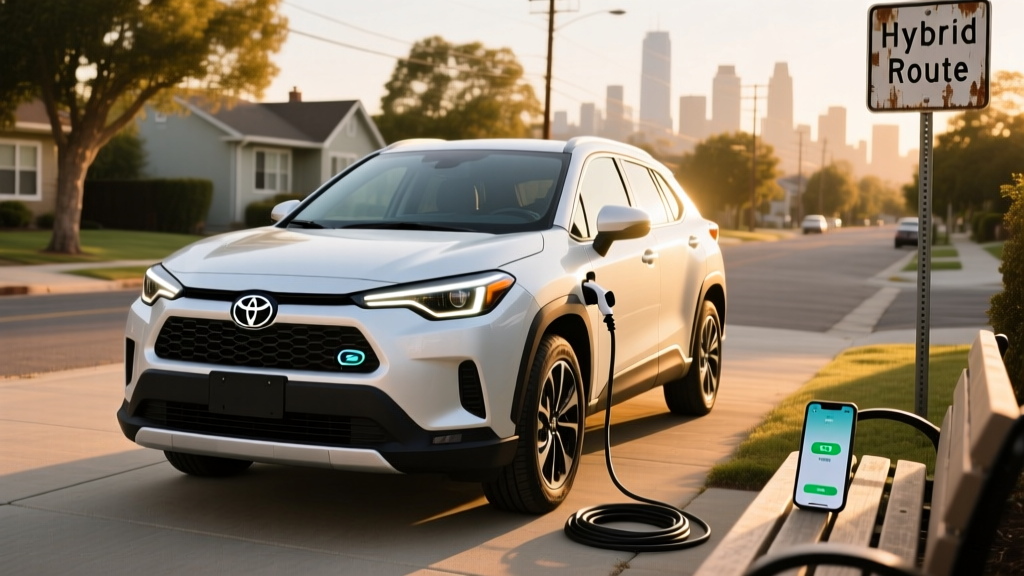
One critical distinction up front: the Corolla Cross Hybrid is a conventional hybrid (HEV), not a plug-in hybrid (PHEV). You never plug it in. It generates and recovers all its electricity internally through regenerative braking and the gasoline engine. If you're looking for electric-only driving or a federal tax credit, you'll need to look at a PHEV like the Toyota RAV4 Prime or a full BEV — more on that below.
2026 Toyota Corolla Cross Hybrid MPG: EPA Numbers and Real-World Results
The EPA rates the 2026 Corolla Cross Hybrid at 45 MPG city / 38 MPG highway / 42 MPG combined across all trims (S, SE, and XSE), all of which come with electronic all-wheel drive as standard. These figures are unchanged from the 2025 model year, as Toyota has carried over the fifth-generation hybrid powertrain without revision.
| Trim | Drivetrain | City MPG | Highway MPG | Combined MPG |
|---|---|---|---|---|
| S | AWD (eAWD) | 45 | 38 | 42 |
| SE | AWD (eAWD) | 45 | 38 | 42 |
| XSE | AWD (eAWD) | 45 | 38 | 42 |
For context, the non-hybrid 2026 Corolla Cross (gas-only, FWD) is rated at 31 MPG combined — meaning the hybrid delivers a 35% improvement in combined fuel economy while adding standard AWD, which the gas model charges extra for on higher trims.
How the Hybrid Powertrain Works: Engine, Motors, and Horsepower
The Corolla Cross Hybrid pairs Toyota's fifth-generation hybrid system with a 2.0-liter four-cylinder Dynamic Force engine. Here's how the hardware breaks down:
| Component | Specification |
|---|---|
| Engine | 2.0L 4-cylinder Dynamic Force (M20A-FXS) |
| Engine Output | 150 hp / 139 lb-ft torque |
| Front Electric Motor | 83 kW (111 hp) |
| Rear Electric Motor (eAWD) | 30 kW (40 hp) |
| Net Combined System Output | 196 hp |
| Transmission | Electronic Continuously Variable (eCVT) |
| Drivetrain | Electronic AWD (standard all trims) |
| Hybrid Battery | Lithium-ion, ~1.0 kWh (self-charging, not plug-in) |
| 0–60 MPH | ~7.5 seconds (est.) |
The 196 combined horsepower is a meaningful step up from the gas-only Corolla Cross's 169 hp, and it shows in everyday driving. The electric motor provides instant torque from a stop, making the hybrid feel noticeably quicker in city merging and passing situations than the non-hybrid model. The eAWD system uses the rear motor to send power to the rear wheels when needed — during acceleration, slippery conditions, or cornering — without a mechanical driveshaft, which saves weight and reduces drivetrain losses.
HEV vs. PHEV vs. EV: Which Electrified SUV Fits You?
The Corolla Cross Hybrid is an HEV. Understanding how it differs from PHEVs and full EVs is essential before you buy, because the ownership experience and cost structure are fundamentally different.
HEV vs. PHEV vs. BEV — Quick Comparison
| Factor | HEV (Corolla Cross Hybrid) | PHEV (e.g., RAV4 Prime) | BEV (e.g., Tesla Model Y) |
|---|---|---|---|
| Plug in to charge? | No — self-charging | Yes — Level 1 or Level 2 | Yes — Level 2 or DC fast |
| Electric-only range | None (EV assists at low speed) | ~42 mi (RAV4 Prime) | 260–330 mi |
| Fuel / energy source | Gasoline only | Gasoline + electricity | Electricity only |
| Federal tax credit (§30D) | Not eligible | Up to $7,500 (if eligible) | Up to $7,500 (if eligible) |
| Home charging needed? | No | Recommended for EV-mode benefit | Essential |
| Best for | Apartment dwellers, no charger access | Home chargers with short commutes | Home chargers, lower fuel cost |
Choose the Corolla Cross Hybrid (HEV) if: You don't have access to home or workplace charging, you want the simplicity of a gas station fill-up, you want better fuel economy without changing your habits, or you want AWD at an affordable price point. The HEV asks nothing of you except gasoline.
Choose a PHEV if: You can install a Level 2 charger at home, your daily commute is under 40 miles (so you can drive mostly on electricity), and you still want the freedom of a gas engine for road trips. The trade-off is a significantly higher purchase price — the RAV4 Prime starts around $44,000, roughly $14,000 more than the Corolla Cross Hybrid.
Choose a full EV if: You have reliable home charging, you want the lowest per-mile energy cost (electricity at $0.14/kWh averages ~$0.04–0.05/mile vs. $0.12–0.14/mile for gasoline at $3.40/gal and 42 MPG), and you want zero tailpipe emissions with minimal maintenance.
Pricing, Trims, and Tax Credit Eligibility
The 2026 Toyota Corolla Cross Hybrid is offered in three trims, with AWD standard across the lineup:
| Trim | MSRP (incl. destination) | Key Features |
|---|---|---|
| S | ~$30,550 | Toyota Safety Sense 3.0, 8" touchscreen, wireless CarPlay/Android Auto, LED headlights |
| SE | ~$32,050 | Sport-tuned suspension, 18" alloy wheels, SofTex seats, heated front seats |
| XSE | ~$34,200 | Two-tone roof, JBL 9-speaker audio, 10.5" infotainment, panoramic moonroof, power liftgate |
Even without a federal credit, the Corolla Cross Hybrid's fuel savings are meaningful. At 15,000 miles per year, 42 MPG combined, and $3.40/gallon, annual fuel cost is approximately $1,214. The gas-only Corolla Cross AWD (31 MPG combined) costs roughly $1,645 per year — a savings of about $431/year or $2,155 over five years with the hybrid. That nearly closes the gap between the hybrid's modest price premium and the gas model.
Battery Warranty, Reliability, and Replacement Cost
Hybrid battery longevity remains the number-one concern for first-time hybrid buyers. Toyota addresses this with one of the strongest hybrid battery warranties in the industry.
2026 Corolla Cross Hybrid — Battery & Hybrid System Warranty
- Hybrid Battery: 10 years / 150,000 miles (whichever comes first)
- Hybrid System Components (inverter, converter, ECU): 8 years / 100,000 miles
- Powertrain (engine, eCVT, motors): 5 years / 60,000 miles
- Battery Capacity Retention: Toyota warrants the hybrid battery against failure and abnormal degradation; unlike PHEVs and BEVs, there is no specific "below 70% capacity" threshold — if the battery fails or degrades to the point of impaired function, Toyota replaces it under warranty.
Source: Toyota Warranty Guide
How long do Toyota hybrid batteries actually last? Real-world data from millions of Toyota hybrids on the road (Prius, Camry Hybrid, RAV4 Hybrid) shows that modern lithium-ion hybrid batteries routinely last 150,000–200,000+ miles before requiring replacement. The Corolla Cross Hybrid's battery is relatively small (~1.0 kWh usable), and because Toyota's hybrid system never fully charges or fully depletes it (maintaining a roughly 40–80% state-of-charge window), the battery experiences far less stress than a full EV battery. Shallow cycling is the single biggest factor in hybrid battery longevity.
Replacement cost if out of warranty: A Toyota hybrid battery replacement for the Corolla Cross Hybrid is estimated at $2,500–$4,000 (parts and labor) based on comparable Toyota hybrid models. Refurbished batteries are available for $1,500–$2,500. Given the 10-year/150,000-mile warranty and typical ownership timelines, most original owners will never face this cost.
Reliability outlook: Toyota's hybrid powertrains have consistently earned top reliability marks. The eCVT has no traditional gears, belts, or clutch packs — it's a planetary gearset that is remarkably durable. The Corolla Cross platform benefits from shared architecture with the Corolla sedan, one of the most proven vehicles in Toyota's lineup.
Driving Experience, Cargo, and Practical Considerations
The Corolla Cross Hybrid is not trying to be a performance SUV. It's a practical, efficient daily driver with crossover ride height and cargo space. Here's what matters for ownership:
- Cargo Volume: ~25.5 cu ft behind rear seats, ~65 cu ft with rear seats folded — competitive with the Honda HR-V and Mazda CX-30, though smaller than the RAV4 (~37.5 cu ft).
- Towing: Not recommended / not rated for towing. If you need to tow, look at the RAV4 Hybrid (1,750 lb rating).
- Ground Clearance: 8.1 inches — adequate for light snow and gravel roads.
- Toyota Safety Sense 3.0: Standard on all trims, including pre-collision braking with pedestrian detection, lane departure alert with steering assist, full-speed adaptive cruise control, lane tracing assist, and automatic high beams. This is a Level 2 SAE driver-assist system — the driver must remain fully engaged and hands-on at all times.
- Infotainment: 8-inch touchscreen (S, SE) or 10.5-inch touchscreen (XSE) with wireless Apple CarPlay and Android Auto, Toyota's latest multimedia interface.
Pros
- 42 MPG combined with standard AWD — best-in-class for the segment
- 196 hp hybrid powertrain feels peppier than the gas model
- 10-year/150,000-mile hybrid battery warranty
- No plug-in charging required — zero lifestyle change
- Toyota Safety Sense 3.0 standard on every trim
- Low starting price (~$30,550) for a hybrid AWD SUV
Cons
- Not eligible for the $7,500 federal EV tax credit
- Cargo space (~25.5 cu ft) is tight vs. RAV4 Hybrid
- No DC fast charging capability (not a PHEV/EV)
- Highway MPG (~36 real-world) lags behind city MPG significantly
- Rear seat legroom is modest for taller passengers
- No tow rating
Who Should Buy the 2026 Corolla Cross Hybrid?
Decision Framework
Buy the Corolla Cross Hybrid if:
- You want 40+ MPG without plugging in anything
- You live in an apartment or lack home/workplace charging access
- You want AWD for snow or rain without a fuel-economy penalty
- Your budget is $30,000–$35,000 and you prioritize low running costs
- You plan to own the vehicle 8–10+ years (maximizing the hybrid battery warranty)
Look elsewhere if:
- You want electric-only driving or zero tailpipe emissions → consider a BEV
- You want federal tax credit savings → you need a PHEV or BEV that meets §30D sourcing and income requirements
- You need more than 25 cu ft of cargo space regularly → RAV4 Hybrid (37.5 cu ft, 39 MPG combined, ~$34,000)
- You tow a trailer → RAV4 Hybrid or larger SUV
- You do mostly highway driving → the city MPG advantage shrinks; a diesel or efficient gas sedan may match it on long trips
Frequently Asked Questions
How many MPG does the 2026 Toyota Corolla Cross Hybrid get?
The EPA rates it at 45 MPG city, 38 MPG highway, and 42 MPG combined. In real-world driving, expect 47–50 MPG in warm-weather city conditions and 34–37 MPG on the highway. A realistic year-round combined average is 39–43 MPG.
Does the Corolla Cross Hybrid need to be plugged in?
No. It is a conventional hybrid (HEV), not a plug-in hybrid. The small hybrid battery charges itself through the gasoline engine and regenerative braking. You fuel it like any regular gas car.
Can the Corolla Cross Hybrid drive on electric power only?
Only at very low speeds (under ~25 MPH) for short distances, such as creeping through a parking lot. It has no meaningful electric-only range like a PHEV. The electric motor primarily assists the gasoline engine rather than replacing it.
Does the 2026 Corolla Cross Hybrid qualify for any tax credit?
It does not qualify for the federal §30D clean vehicle credit (up to $7,500), which is reserved for plug-in vehicles (PHEVs and BEVs). Some states offer modest hybrid rebates — check the AFDC state incentive database for your area.
How long will the hybrid battery last, and what does replacement cost?
Toyota warrants the hybrid battery for 10 years or 150,000 miles. Based on data from millions of Toyota hybrids, these batteries typically last 150,000–200,000+ miles. Out-of-warranty replacement costs an estimated $2,500–$4,000.
How does the Corolla Cross Hybrid compare to the RAV4 Hybrid?
The RAV4 Hybrid offers 39 MPG combined (vs. 42 for the Corolla Cross Hybrid), significantly more cargo space (37.5 vs. 25.5 cu ft), a 1,750-lb tow rating, and more rear legroom — but starts about $3,500–$4,000 higher. If cargo space and towing matter, the RAV4 Hybrid is the better pick. If you want maximum MPG at the lowest price, the Corolla Cross Hybrid wins.
Is the Corolla Cross Hybrid AWD system good in snow?
The electronic AWD (eAWD) system automatically sends power to the rear wheels when it detects slip, providing confident traction in light to moderate snow. Combined with 8.1 inches of ground clearance and standard Toyota Safety Sense, it's a capable winter commuter — though it's not a substitute for dedicated winter tires in severe conditions.
Fuel economy data sourced from fueleconomy.gov. Pricing reflects manufacturer MSRP estimates at time of publication. Always verify current pricing and incentive eligibility with your local Toyota dealer and the IRS.