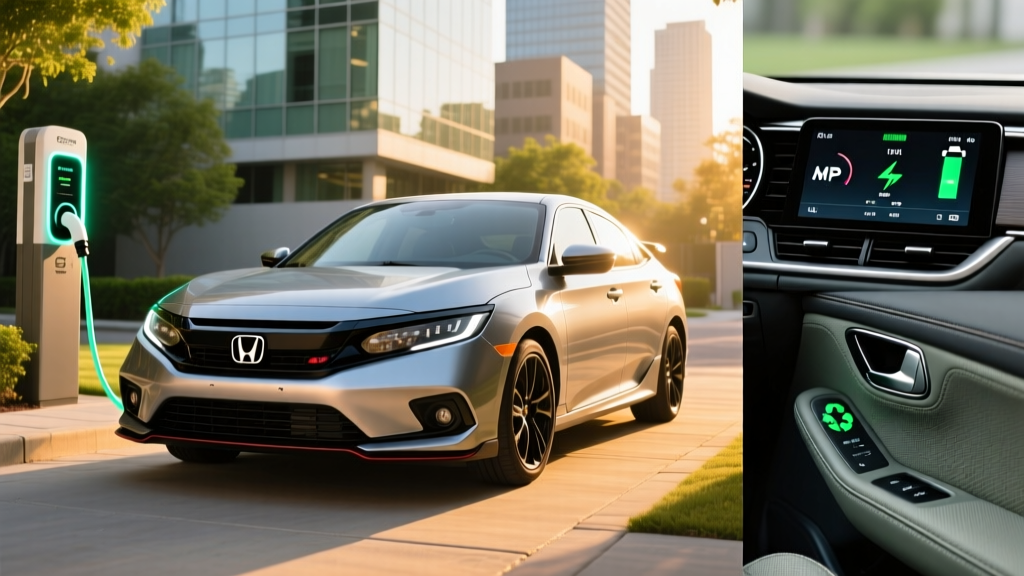
If you want electric-motor efficiency without plugging in, Honda's latest compact hybrid sedan is hard to ignore. The 2026 Civic Sport Hybrid pairs a 2.0-liter Atkinson-cycle engine with a dual-motor system for an EPA-estimated 50 MPG combined — and in real-world city driving, many owners report exceeding that number. This guide covers every spec that matters: fuel economy, powertrain output, battery warranty, pricing, and whether the Civic Sport Hybrid fits your daily commute better than a full EV or a conventional gas car.
How the 2026 Civic Sport Hybrid Powertrain Works
The Civic Sport Hybrid uses Honda's fourth-generation two-motor hybrid system. Unlike a traditional parallel hybrid where the engine and motor both drive the wheels through a transmission, this system operates primarily as a series hybrid in most driving conditions. The gasoline engine acts as a generator, producing electricity that powers the main drive motor. At steady highway speeds (roughly 55–75 mph), a lockup clutch connects the engine directly to the wheels for improved efficiency.
| Specification | 2026 Civic Sport Hybrid |
|---|---|
| Engine | 2.0L DOHC Atkinson-cycle 4-cylinder |
| Combined System Output | 200 hp / 232 lb-ft torque |
| Drive Motor | Permanent-magnet synchronous, 184 hp |
| Generator Motor | Integrated starter-generator |
| Transmission | e-CVT (no traditional gears) |
| Drivetrain | Front-wheel drive |
| Hybrid Battery | Lithium-ion, ~1.1 kWh (self-charging HEV) |
| 0–60 mph | ~7.2 seconds (est.) |
| Plug-In Required? | No — regenerative braking and engine recharge the battery |
The key takeaway: this is a conventional hybrid electric vehicle (HEV), not a plug-in hybrid (PHEV). You never plug it in. The battery recharges through regenerative braking and the gasoline engine. If you're looking for electric-only driving range, you'll want to look at a PHEV like the Toyota Prius Prime — we'll compare options later in this guide.
Fuel Economy: EPA Ratings vs. Real-World MPG
The EPA rates the 2026 Civic Sport Hybrid as follows:
| Driving Cycle | EPA Estimated MPG |
|---|---|
| City | 50 MPG |
| Highway | 47 MPG |
| Combined | 50 MPG |
What's notable here is the inverted city/highway split. Most gas cars get better mileage on the highway; the Civic Sport Hybrid actually excels in stop-and-go traffic. That's because regenerative braking recovers energy during deceleration, and the engine operates in its most efficient generator mode at low speeds. On the highway, aerodynamic drag and the direct-drive lockup clutch reduce the hybrid system's advantage.
Real-World MPG Expectations
Owner-reported data and independent testing suggest the Civic Sport Hybrid frequently matches or slightly exceeds its EPA city rating in mixed urban driving — 50–54 MPG is common. Highway-only trips at 75+ mph tend to drop to 42–45 MPG. In cold weather (below 35°F), expect a 5–10% reduction as the engine runs more often for cabin heat and battery conditioning. Over a 450-mile tank, that translates to roughly $30–$38 in fuel at $3.40/gallon — compared to $50–$58 for a 30-MPG gas compact.
HEV vs. PHEV vs. Full EV: Which Is Right for You?
Shopping for an electrified vehicle means choosing between three architectures. Here's how the Civic Sport Hybrid stacks up against the alternatives:
| Factor | HEV (Civic Sport Hybrid) | PHEV (e.g., Prius Prime) | Full EV (e.g., Chevy Equinox EV) |
|---|---|---|---|
| Plug-in charging needed? | No | Yes, for EV range | Yes, always |
| Electric-only range | N/A (motor assists engine) | ~39–44 miles | 250–319 miles |
| Total range | ~450 miles | ~420+ miles | 250–319 miles |
| Combined MPG / MPGe | 50 MPG | 52 MPG + 127 MPGe (EV mode) | ~100+ MPGe |
| Home charging install | Not needed | Level 2 recommended ($500–$1,500) | Level 2 required ($800–$2,500) |
| Federal tax credit (§30D) | Not eligible | Up to $7,500 (if eligible) | Up to $7,500 (if eligible) |
| Starting MSRP | ~$29,845 | ~$33,445 | ~$33,600 |
The Civic Sport Hybrid is the lowest-friction choice: no plug, no behavioral change, no home charging installation. It's ideal if you live in an apartment without charging access, take frequent long road trips, or simply don't want to think about charging infrastructure. A PHEV makes sense if you can charge at home and your daily commute is under 40 miles — you'd drive on electricity most days and only burn gas on longer trips. A full EV maximizes savings if you have reliable home charging and drive under 300 miles between stops.
Pricing, Trims, and Tax Credit Eligibility
The 2026 Civic Sport Hybrid is available in two trims:
- Sport Hybrid: Starting at approximately $29,845 (including destination). Includes 18-inch alloy wheels, 7-inch touchscreen with wireless Apple CarPlay/Android Auto, Honda Sensing ADAS suite, heated front seats, and dual-zone climate control.
- Sport Touring Hybrid: Starting at approximately $32,845. Adds 9-inch touchscreen with wireless navigation, Bose premium audio, leather-trimmed seats, wireless phone charging, heated rear seats, and low-speed braking control.
Federal Tax Credit: Not Eligible
Under IRS §30D rules, the federal clean vehicle credit applies only to plug-in electric vehicles (PHEVs and BEVs) with a battery capacity of at least 7 kWh. The Civic Sport Hybrid's ~1.1 kWh battery does not qualify. There is currently no federal tax credit for conventional HEVs. Some states may offer their own incentives for high-efficiency vehicles — check your state's energy or DMV website for current programs.
Without a federal credit, the Civic Sport Hybrid's value proposition rests on its low MSRP and fuel savings. Compared to the non-hybrid Civic Sport (which starts around $26,845 and gets ~35 MPG combined), the hybrid's ~$3,000 premium pays back in roughly 2.5–3 years at 15,000 miles per year and $3.40/gallon fuel.
Battery Warranty, Lifespan, and Replacement Cost
Hybrid battery longevity is the single most common concern among first-time hybrid buyers. Here's what Honda covers:
Hybrid Battery Warranty
- Coverage: 8 years / 100,000 miles (10 years / 150,000 miles in CARB states including California, New York, Massachusetts, and others)
- What's covered: Defects and capacity loss below a defined threshold (typically ~60–70% of original capacity)
- Powertrain warranty: 5 years / 60,000 miles (covers engine, transmission, and hybrid components)
In practice, Honda's hybrid batteries have proven highly durable. The lithium-ion pack in the Civic Sport Hybrid is small (~1.1 kWh) and operates within a narrow state-of-charge window — it never fully charges or fully depletes. This shallow-cycling strategy dramatically extends cell life. Based on data from prior-generation Honda and Toyota hybrids, these packs routinely last 150,000–200,000+ miles before significant degradation.
If replacement is needed outside of warranty, a new OEM hybrid battery for the Civic Hybrid typically costs between $2,000 and $3,500 installed. Third-party refurbishment services are emerging at $1,200–$2,000. Given the battery's track record, most owners will sell the vehicle before facing this expense.
Driving Impressions: Performance and Daily Usability
The 200-hp combined output makes the Civic Sport Hybrid the quickest Civic in the non-Si/Type R lineup. The electric motor delivers instant torque from a stop, giving it a responsive feel in city driving that the turbocharged 1.5L gas model can't quite match off the line. The e-CVT is smooth — there are no gear shifts to feel — though it does produce a drone under hard acceleration as the engine revs to its optimal RPM.
Ride quality on the Sport Hybrid's 18-inch wheels is firm but compliant. The steering is precise, and the sedan's lower center of gravity (thanks to the battery pack placement under the rear seats) gives it a planted feel through corners. Honda Sensing comes standard: adaptive cruise control, lane-keeping assist, collision mitigation braking, and traffic sign recognition. This is an IIHS-rated vehicle with top safety scores in prior model years.
Cargo space is essentially unchanged from the gas Civic at approximately 14.8 cubic feet in the trunk — the compact battery pack doesn't intrude on cargo or passenger room. The rear seats fold 60/40 for longer items.
Who Should Buy the 2026 Civic Sport Hybrid?
Pros
- 50 MPG combined — best-in-class for a compact sedan
- 200 hp with strong low-end electric torque
- No plug-in required; zero behavior change from a gas car
- 8–10 year hybrid battery warranty
- Sub-$30K starting price with full Honda Sensing safety suite
- Excellent reliability track record (Honda hybrid system)
Cons
- No federal tax credit eligibility
- Highway MPG drops to ~42–45 in real-world 75+ mph driving
- e-CVT drone under hard acceleration
- Not available with AWD (FWD only)
- No electric-only driving mode for zero-emission zones
Frequently Asked Questions
How many MPG does the 2026 Civic Sport Hybrid get?
The EPA rates it at 50 city / 47 highway / 50 combined MPG. In real-world driving, owners commonly report 50–54 MPG in city conditions and 42–45 MPG on highway-only trips at speeds above 75 mph.
Can I plug in the Civic Sport Hybrid to charge?
No. The Civic Sport Hybrid is a conventional HEV, not a plug-in hybrid (PHEV). The battery charges through regenerative braking and the gasoline engine. There is no charging port.
How far can the Civic Sport Hybrid drive on electric only?
It cannot drive on electric power alone at meaningful speeds. The electric motor assists the engine and can propel the car at very low speeds (under ~15 mph) for short distances, but the engine is always the primary power source. If you want 30–40 miles of electric-only range, consider a PHEV.
Is the hybrid battery reliable and what does replacement cost?
Honda's hybrid batteries are among the most reliable in the industry, routinely lasting 150,000–200,000+ miles. The battery is warrantied for 8 years/100,000 miles (10/150,000 in CARB states). Out-of-warranty replacement costs approximately $2,000–$3,500 for a new OEM pack.
Does the 2026 Civic Sport Hybrid qualify for any tax credit?
It does not qualify for the federal §30D clean vehicle credit, which requires a plug-in vehicle with at least 7 kWh of battery capacity. Some states offer separate incentives for high-MPG vehicles — check your state's energy office for details.
How does the Civic Sport Hybrid compare to the Toyota Corolla Hybrid?
The Corolla Hybrid is rated at 50 MPG combined (FWD) and starts slightly lower, around $24,000. However, it produces just 138 hp compared to the Civic's 200 hp, and its interior materials and technology are a step behind. The Corolla Hybrid is available with AWD (47 MPG), which the Civic is not. If power and refinement matter, the Civic wins; if lowest price and AWD are priorities, the Corolla Hybrid is worth a look.
What is the total cost of ownership over 5 years?
At 15,000 miles/year and $3.40/gallon fuel, the Civic Sport Hybrid burns roughly $3,400 in gasoline over five years (75,000 miles ÷ 50 MPG × $3.40). A comparable 30-MPG gas compact would cost about $5,667 — a fuel savings of roughly $2,267. Factor in the Civic Hybrid's ~$3,000 higher purchase price, and the net premium is approximately $733 over five years, with the hybrid pulling ahead in year six and beyond. Insurance costs are comparable between hybrid and gas Civic trims.