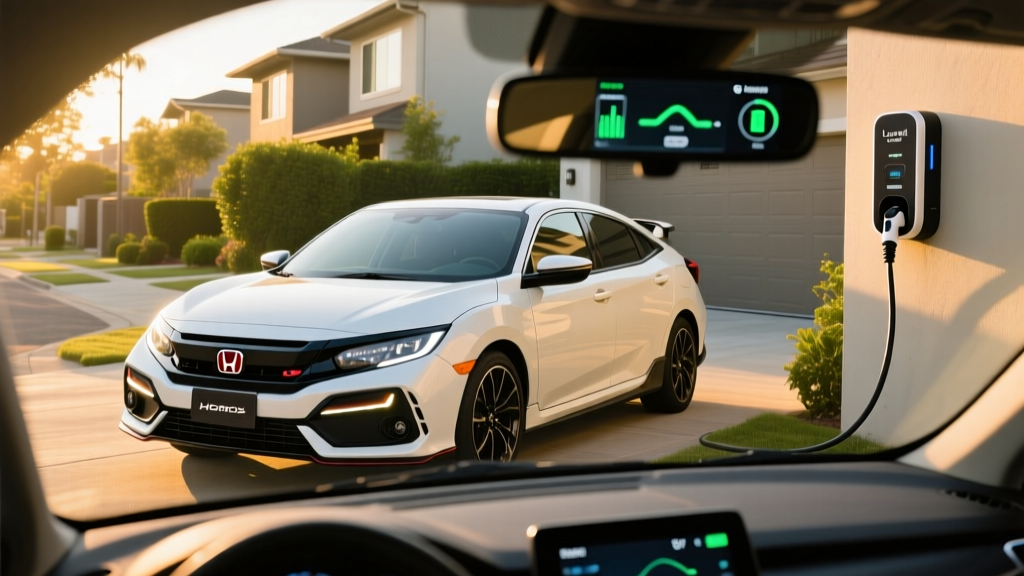
The 2026 Honda Civic Sport Hybrid Hatchback occupies a specific niche: it's a practical five-door hatchback that returns nearly 50 MPG combined without ever needing a plug. For buyers who want electrified efficiency but lack home charging access — or who simply don't want to change their fueling habits — this conventional hybrid (HEV) delivers meaningful fuel savings over a gas-only Civic while retaining the cargo versatility that makes hatchbacks popular.
This guide breaks down the exact EPA fuel economy figures, the two-motor hybrid powertrain, real-world MPG expectations, battery longevity and warranty coverage, pricing, and where the Civic Sport Hybrid Hatchback fits against plug-in hybrids and full battery-electric vehicles.
HEV vs PHEV: What the Civic Sport Hybrid Hatchback Actually Is
Before examining specs, it's essential to clarify what the 2026 Civic Sport Hybrid Hatchback is — and what it isn't.
Conventional Hybrid (HEV) — This Car
- No plug required. The battery recharges through regenerative braking and the gasoline engine.
- No electric-only range to speak of. The small battery assists the engine but cannot propel the car on electricity alone for meaningful distances.
- No federal tax credit. IRS §30D credits apply only to plug-in vehicles (PHEVs and BEVs) with sufficient battery capacity.
- Lower upfront cost compared to PHEVs and EVs, with fuel savings over a gas-only model.
Plug-In Hybrid (PHEV) — Not This Car
- Requires plug-in charging to access electric-only driving (typically 20-45 miles).
- Larger battery (typically 10-20 kWh) that can be charged at home on Level 1 or Level 2.
- May qualify for the federal §30D tax credit (up to $7,500) if MSRP, income, and battery-sourcing requirements are met.
- Higher purchase price; best for drivers with home charging and short commutes.
Honda does not currently offer a plug-in hybrid version of the Civic in the US market. If you see "Civic Hybrid" listed anywhere, it refers to this conventional HEV system — you fuel it with gasoline, and the hybrid system handles the rest.
Fuel Economy: EPA Ratings and Real-World MPG
Fuel economy is the primary reason buyers choose the Civic Sport Hybrid Hatchback over the gas-only variant. Here are the official EPA numbers as published on fueleconomy.gov:
| Metric | EPA Rating |
|---|---|
| City MPG | 50 MPG |
| Highway MPG | 47 MPG |
| Combined MPG | 48 MPG |
| Fuel Tank Capacity | 12.4 gallons |
| Total Driving Range (est.) | ~595 miles |
| Annual Fuel Cost (EPA est.) | ~$1,300 (15,000 mi/yr) |
Real-World MPG vs. EPA Sticker
Honda's two-motor hybrid system excels in city driving, where the electric motor handles low-speed propulsion and the engine acts primarily as a generator. In real-world conditions:
- City driving: Many owners report matching or slightly exceeding the 50 MPG city rating. Hybrids often beat EPA city estimates because stop-and-go traffic maximizes regenerative braking and electric-motor usage.
- Highway driving (65-75 mph): Expect 42-46 MPG. At sustained highway speeds, the engine engages directly through a lock-up clutch, and aerodynamic drag reduces efficiency — a pattern consistent across all hybrids.
- Cold weather (below 30°F): Plan for a 5-10% reduction, bringing combined MPG to approximately 43-45. The engine runs more frequently to provide cabin heat and maintain battery temperature.
- Mixed real-world combined: Most drivers can expect 45-49 MPG in typical mixed use across seasons.
The gas-only 2026 Civic Hatchback (2.0L CVT) rates at approximately 30 city / 38 highway / 33 combined. The hybrid's 48 MPG combined represents a roughly 45% improvement — meaningful for high-mileage commuters.
Powertrain: Two-Motor Hybrid System
The 2026 Civic Sport Hybrid Hatchback uses Honda's fourth-generation two-motor hybrid system, which differs fundamentally from the parallel-hybrid designs used by some competitors.
| Specification | Detail |
|---|---|
| Engine | 2.0L DOHC 4-cylinder (Atkinson cycle) |
| Engine Power | 143 hp @ 6,000 rpm |
| Drive Motor | AC permanent-magnet synchronous |
| Drive Motor Power | 184 hp / 232 lb-ft torque |
| Combined System Output | 200 hp / 232 lb-ft torque |
| Transmission | Direct-drive (no traditional transmission) |
| Drivetrain | Front-wheel drive |
| 0-60 mph (est.) | ~6.5 seconds |
| Hybrid Battery | Lithium-ion (small capacity, ~1 kWh) |
| Drive Modes | Econ, Normal, Sport, Individual |
In normal driving below approximately 45 mph, the gasoline engine does not drive the wheels directly. Instead, it powers a generator that feeds electricity to the drive motor — effectively operating as a series hybrid. At highway speeds, a lock-up clutch connects the engine directly to the wheels for efficiency. During hard acceleration, both the engine and motor contribute. This architecture gives the Civic Hybrid the smooth, torque-rich feel of an EV at city speeds while maintaining highway efficiency.
Pricing, Trims, and Tax Credit Eligibility
The 2026 Civic Sport Hybrid Hatchback is available in a single Sport Hybrid trim (Honda structures the hybrid as a distinct model rather than a trim of the standard Civic Hatchback). Pricing:
| Item | Amount |
|---|---|
| MSRP (Sport Hybrid Hatchback) | $31,450 (including destination) |
| Typical dealer pricing | MSRP to slight markup in high-demand markets |
| Federal §30D Tax Credit | Not eligible — conventional HEVs do not qualify |
| State hybrid incentives | Varies; some states offer rebates for hybrids (check local programs) |
Tax Credit Reality Check
Because the Civic Sport Hybrid Hatchback is a conventional hybrid (HEV) without plug-in capability, it does not qualify for the IRS §30D Clean Vehicle Credit. That credit — up to $7,500 for new vehicles — applies only to plug-in hybrids (PHEVs) and battery-electric vehicles (BEVs) that meet battery capacity, MSRP cap, buyer income cap, and critical-mineral/battery-sourcing requirements as detailed on irs.gov.
The Civic Hybrid's value proposition is straightforward: a ~$3,500 premium over a comparable gas-only Civic Hatchback Sport, recovered through fuel savings over approximately 3-4 years of average driving (at $3.40/gallon and 15,000 miles/year).
Battery Warranty, Longevity, and Replacement Cost
Hybrid battery longevity is consistently the top concern among first-time hybrid buyers. Here's what Honda provides:
2026 Civic Hybrid Battery Warranty
- Hybrid Battery (IMA System): 8 years / 100,000 miles (10 years / 150,000 miles in CARB states including CA, CT, ME, MA, NJ, NY, OR, RI, VT, WA)
- Hybrid System Components: 8 years / 100,000 miles
- Powertrain Warranty: 5 years / 60,000 miles
- Limited Vehicle Warranty: 3 years / 36,000 miles
The warranty covers capacity loss below a defined threshold (typically 70% of original capacity) and defects in hybrid-system components including the battery pack, inverter, and drive motor.
Real-World Hybrid Battery Lifespan
Honda's hybrid battery packs in the Civic are designed to last the life of the vehicle under normal use. Key data points:
- Honda's lithium-ion hybrid batteries are far more durable than the nickel-metal-hydride packs used in early-2000s hybrids. Degradation is minimal because the battery operates in a narrow state-of-charge window (roughly 20-80%), managed by the vehicle's battery management system.
- High-mileage Civic and Accord Hybrid owners routinely report 150,000-200,000+ miles on original hybrid battery packs.
- If replacement is needed out of warranty, a refurbished Honda hybrid battery pack costs approximately $2,000-$3,500 installed. A new OEM pack runs $3,500-$5,000 at a dealership.
- Independent hybrid-battery specialists in most metro areas offer replacement for $1,500-$2,500 using reconditioned modules.
For context, a full EV battery replacement (60-100 kWh) costs $8,000-$20,000+. The Civic Hybrid's small battery keeps this risk modest.
Who Should Choose the Civic Sport Hybrid Hatchback
Pros
- 48 MPG combined with no behavior change required — just fill up with gas
- Hatchback cargo versatility (25.0 cu ft behind rear seats, 47.0 cu ft with seats folded)
- 200 hp provides confident merging and passing
- Smooth, EV-like driving feel at city speeds
- No home charging installation needed
- Strong reliability reputation and long battery warranty
- ~595 miles of total range per tank
Cons
- No electric-only driving range — always uses gasoline
- Not eligible for the $7,500 federal §30D tax credit
- ~$3,500 premium over gas-only Civic Hatchback
- Highway MPG drops more noticeably than city (47 vs 50)
- No all-wheel-drive option (AWD available on some competing hybrid hatchbacks)
- Sport Hybrid is the only hybrid trim — limited feature customization
Decision Framework: Hybrid vs PHEV vs EV
Choose the 2026 Civic Sport Hybrid Hatchback if:
- You don't have access to home or workplace charging
- You want maximum fuel efficiency without changing your fueling routine
- You regularly take long road trips and don't want to plan around charging stops
- Your budget is under $35,000 and you want a practical hatchback
- You drive 12,000-20,000+ miles per year (higher mileage = faster payback on the hybrid premium)
Consider a PHEV (e.g., Toyota Prius Prime, Hyundai Tucson PHEV) if:
- You have home Level 2 charging and a commute under 40 miles round-trip
- You want some electric-only driving for daily errands
- You want to reduce gasoline consumption by 70-90% for local driving
Consider a full EV (e.g., Hyundai Ioniq 5, Tesla Model 3, Chevy Equinox EV) if:
- You have reliable home charging (Level 2 recommended)
- You want to eliminate gasoline entirely and qualify for the §30D tax credit
- Your daily driving is under 250 miles and you're comfortable with DC fast charging for road trips
Safety, Tech, and Daily Livability
The 2026 Civic Sport Hybrid Hatchback carries over Honda's well-regarded safety and technology suite:
- Honda Sensing: Standard adaptive cruise control, lane-keeping assist, collision mitigation braking, road departure mitigation, and traffic sign recognition. This is a Level 1 driver-assist system per SAE classification — it supports the driver but does not replace active supervision.
- Infotainment: 9-inch touchscreen with wireless Apple CarPlay and Android Auto, 10.2-inch digital instrument cluster, available Bose premium audio.
- Cargo: 25.0 cubic feet behind the rear seats; 47.0 cubic feet with the 60/40 split rear seats folded. The hybrid battery is packaged under the rear seats, preserving full cargo volume compared to the gas model.
- Safety Ratings: The Civic Hatchback has earned top marks from IIHS (Top Safety Pick+) and 5 stars overall from NHTSA in recent model years.
Frequently Asked Questions
How many MPG does the 2026 Civic Sport Hybrid Hatchback get?
The EPA rates it at 50 MPG city, 47 MPG highway, and 48 MPG combined. Real-world city driving often matches or slightly exceeds the 50 MPG figure, while sustained highway driving at 70+ mph typically returns 42-46 MPG. Cold weather reduces combined efficiency by approximately 5-10%.
Does the Civic Sport Hybrid Hatchback need to be plugged in?
No. This is a conventional hybrid (HEV), not a plug-in hybrid (PHEV). The battery recharges through regenerative braking and the gasoline engine. You fuel it exclusively at gas stations, just like a conventional car.
Can the Civic Sport Hybrid drive on electric power only?
Only for very brief, low-speed moments (e.g., creeping in a parking lot). The battery is small (~1 kWh) and designed to assist the engine, not to provide meaningful electric-only range. If electric-only commuting is a priority, look at a PHEV like the Toyota Prius Prime (44 miles electric-only) or a full EV.
Does the 2026 Civic Hybrid qualify for any tax credit?
It does not qualify for the federal §30D Clean Vehicle Credit, which is limited to plug-in hybrids and battery-electric vehicles. Some states offer modest incentives for conventional hybrids — check your state's energy or DMV website for current programs.
How long will the hybrid battery last, and what does replacement cost?
Honda warranties the hybrid battery for 8 years/100,000 miles (10 years/150,000 miles in CARB states). Real-world data from Honda's hybrid fleet shows most packs last 150,000-200,000+ miles. Out-of-warranty replacement costs $2,000-$5,000 depending on whether you use a refurbished or new OEM pack — far less than a full EV battery replacement.
Is the Civic Sport Hybrid Hatchback worth the premium over the gas model?
The hybrid carries roughly a $3,500 premium over a comparably equipped gas-only Civic Hatchback Sport. At 15,000 miles/year and $3.40/gallon, the fuel savings are approximately $900-$1,000 per year, yielding payback in about 3.5 years. If you keep the car 5+ years and drive above-average miles, the hybrid is the stronger financial choice — and you'll visit gas stations significantly less often thanks to the ~595-mile range.
Hybrid vs PHEV vs EV — which should I choose?
Choose the Civic Hybrid if you lack home charging or want zero change to your fueling habits. Choose a PHEV if you have home charging and a short commute (you'll drive mostly on electricity). Choose a full EV if you have home charging, want to eliminate gasoline, and can access the $7,500 federal tax credit to offset the higher purchase price.