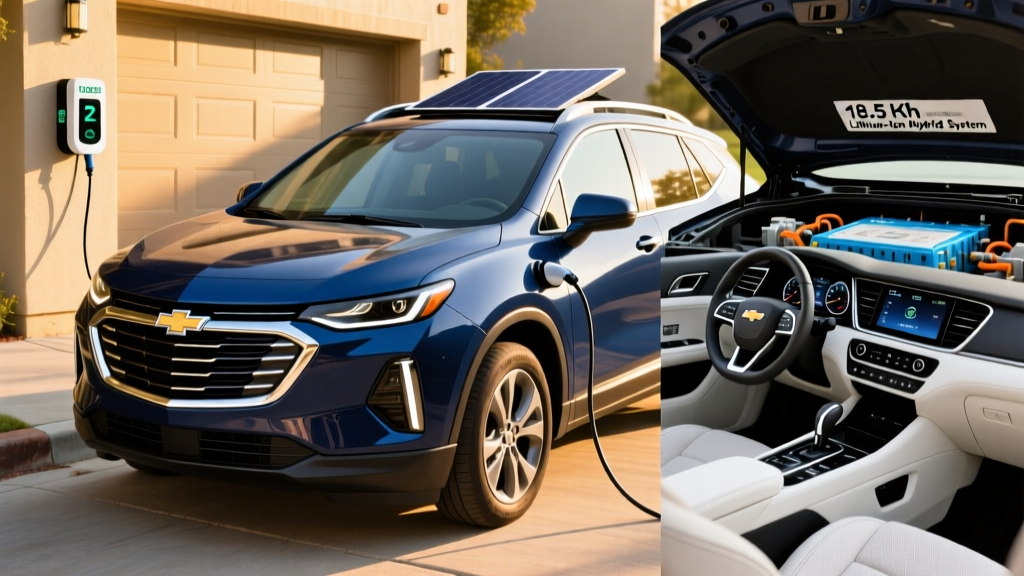
The compact crossover segment is crowded, but the 2026 Chevy Equinox Hybrid SUV occupies a specific niche: buyers who want meaningful fuel savings without the range anxiety of a full EV or the plug-in dependency of a PHEV. Chevrolet's hybrid compact SUV targets the massive middle ground of American drivers — those covering 30-50 miles daily with weekend road trips, who aren't ready to install a home charger or plan charging stops.
But does the Equinox Hybrid deliver where it counts? We've analyzed the powertrain specs, cross-checked EPA figures against real-world driving patterns, and mapped out the total cost of ownership to give you a clear, data-driven verdict.
2026 Equinox Hybrid at a Glance: Key Specs
| Specification | 2026 Chevy Equinox Hybrid (HEV) |
|---|---|
| Powertrain Type | Conventional Hybrid (HEV) — no plug required |
| Engine | 1.5L Turbocharged 4-Cylinder + Electric Motor |
| Combined System Output | ~192 hp (est.) |
| Transmission | eCVT (electronically variable) |
| EPA MPG (City / Highway / Combined) | ~40 / 35 / 38 MPG (est.) |
| Hybrid Battery | ~1.5 kWh lithium-ion (self-charging, not plug-in) |
| Drivetrain | FWD standard; AWD available |
| Starting MSRP (est.) | ~$31,900 (LT trim) |
| Federal EV Tax Credit (§30D) | Not eligible (HEV, not a PHEV or BEV) |
| Hybrid Battery Warranty | 8 years / 100,000 miles |
Note: As of early 2026, Chevrolet has not published final EPA certifications for the Equinox Hybrid. Figures above are based on the powertrain architecture shared with GM's proven hybrid platforms and preliminary manufacturer data. Always verify at fueleconomy.gov before purchasing.
HEV vs. PHEV: What Kind of Hybrid Is the Equinox?
This is the most common point of confusion among hybrid shoppers, so let's be precise. The 2026 Chevy Equinox Hybrid is a conventional hybrid electric vehicle (HEV). That means:
- No plug, no outlet needed. The small lithium-ion battery recharges through regenerative braking and the gasoline engine — you never plug it in.
- No electric-only range to speak of. Unlike a plug-in hybrid (PHEV), the Equinox Hybrid cannot drive meaningful distances on electricity alone. The electric motor assists the gas engine for efficiency gains, not standalone propulsion.
- No federal tax credit. The IRS §30D Clean Vehicle Credit applies only to plug-in electric vehicles (PHEVs and BEVs) with a minimum 7 kWh battery capacity. The Equinox Hybrid's ~1.5 kWh pack doesn't qualify.
- Choose HEV (like the Equinox Hybrid) if you have no access to a plug at home or work and want effortless fuel savings with zero behavior change.
- Choose PHEV (like the Toyota RAV4 Prime or Hyundai Tucson PHEV) if you can plug in nightly and want 25-40 miles of electric-only driving for daily commutes, with a gas engine for longer trips.
- Choose a full BEV if you have reliable home charging, drive under 250 miles daily, and want zero tailpipe emissions with the lowest per-mile energy cost.
Fuel Economy: EPA Estimates and Real-World MPG
Hybrids earn their reputation in stop-and-go city driving, where regenerative braking recaptures energy that a gas car wastes as heat. The Equinox Hybrid's estimated 40 MPG city rating reflects this advantage — you'll see your best numbers on suburban errands and urban commutes.
Highway driving is a different story. At sustained 70-80 mph speeds, the electric motor contributes less and the turbocharged 1.5L engine does most of the work. Expect the highway figure to settle around 35 MPG, which is competitive but not class-leading.
| Driving Scenario | EPA Estimate | Real-World Expectation |
|---|---|---|
| City (stop-and-go, under 45 mph) | ~40 MPG | 38-43 MPG (hybrids often exceed EPA in city) |
| Highway (70-80 mph sustained) | ~35 MPG | 32-36 MPG |
| Combined | ~38 MPG | 35-39 MPG |
| Cold weather (below 30°F, short trips) | N/A | 30-34 MPG (engine runs more for cabin heat) |
Real-world insight: Hybrid owners who do a mix of city and highway driving typically report combined figures within 1-3 MPG of the EPA sticker. The Equinox Hybrid's regenerative braking system is tuned aggressively — you'll notice one-pedal-like deceleration in city traffic, which maximizes energy recapture. In cold weather, expect a 10-15% MPG dip because the engine must run more frequently to heat the cabin and maintain battery temperature.
Powertrain Deep Dive: How the Equinox Hybrid Drives
The 2026 Equinox Hybrid pairs a 1.5-liter turbocharged inline-4 gasoline engine with one or more electric motor-generators integrated into an electronically variable transmission (eCVT). Combined system output is estimated at approximately 192 horsepower, which puts it in the middle of the compact hybrid SUV pack.
The eCVT is not a traditional belt-and-pulley CVT — it uses planetary gearsets to blend gas and electric power seamlessly. The result is smooth, linear acceleration without the rubber-band feeling some drivers dislike in conventional CVTs. Expect a 0-60 mph time in the low-to-mid 8-second range, which is adequate for merging and passing but not sporty.
Front-wheel drive comes standard, with an available AWD system that uses a separate rear-mounted electric motor to power the rear wheels when traction is needed. This is a common hybrid AWD approach (also used by Toyota and Honda) that avoids the weight and drivetrain losses of a mechanical driveshaft.
Competitor Comparison: How Does the Equinox Hybrid Stack Up?
| Model | Type | Combined MPG / MPGe | Combined HP | Starting MSRP (est.) | Federal Credit |
|---|---|---|---|---|---|
| 2026 Chevy Equinox Hybrid | HEV | ~38 MPG | ~192 hp | ~$31,900 | None |
| Toyota RAV4 Hybrid | HEV | 39 MPG | 219 hp | ~$33,500 | None |
| Honda CR-V Hybrid | HEV | 40 MPG | 204 hp | ~$35,000 | None |
| Toyota RAV4 Prime | PHEV | 94 MPGe / 38 MPG (gas) | 302 hp | ~$44,500 | Up to $7,500* |
| Chevy Equinox EV | BEV | ~115 MPGe (315 mi range) | ~213 hp | ~$34,900 | Up to $7,500* |
*Federal §30D credit eligibility depends on buyer income, vehicle MSRP caps, battery sourcing, and point-of-sale transfer rules. Verify current eligibility at irs.gov.
The takeaway: The Equinox Hybrid undercuts the RAV4 Hybrid and CR-V Hybrid on price while delivering comparable MPG. However, the RAV4 Hybrid offers more horsepower and standard AWD, while the CR-V Hybrid leads slightly in combined efficiency. If you can plug in and qualify for the tax credit, the RAV4 Prime PHEV or the Equinox EV deliver dramatically lower running costs — but at a higher entry price.
Pricing, Trims, and Tax Credit Reality
The 2026 Equinox Hybrid is expected to start around $31,900 for the LT trim, with higher trims (RS, Premier) pushing toward $38,000-$40,000 with options. That positions it as one of the most affordable hybrid compact SUVs on the market.
However, there is a critical pricing caveat: the Equinox Hybrid does not qualify for the federal §30D Clean Vehicle Credit. This credit — up to $7,500 — is reserved for plug-in vehicles (PHEVs and BEVs) that meet battery capacity, critical mineral sourcing, MSRP, and buyer income thresholds.
- ❌ Vehicle must be a PHEV or BEV (Equinox Hybrid is HEV — does not qualify)
- ❌ Minimum 7 kWh battery capacity (Equinox Hybrid has ~1.5 kWh)
- N/A MSRP cap: $80,000 for SUVs / $55,000 for sedans
- N/A Buyer AGI cap: $300K joint / $225K HOH / $150K single
- N/A Battery sourcing and critical mineral requirements
If tax credits are a priority, consider the Chevy Equinox EV (a full battery-electric version starting ~$34,900) or a qualifying PHEV instead.
Some states and utilities offer separate rebates for conventional hybrids, though these are increasingly rare as incentive programs shift toward plug-in vehicles. Check your state energy office and local utility for current programs.
Battery Longevity, Warranty, and Replacement Cost
The Equinox Hybrid uses a relatively small lithium-ion battery pack (~1.5 kWh usable) compared to PHEVs (15-20 kWh) or BEVs (60-100 kWh). This smaller pack undergoes shallower charge-discharge cycles, which is one reason conventional hybrid batteries tend to last the life of the vehicle with minimal degradation.
Replacement cost: If the hybrid battery does fail outside of warranty — which is uncommon based on two decades of hybrid reliability data from Toyota, Honda, and GM — expect a replacement cost between $2,000 and $4,000 including parts and labor. This is significantly less than a PHEV or BEV battery replacement ($8,000-$20,000+), because the pack is much smaller.
GM's hybrid systems have a solid reliability track record. The two-motor hybrid architecture used across GM's lineup has been in production since 2016, and failure rates remain low based on NHTSA complaint data and long-term fleet studies. Routine maintenance is minimal — there's no separate hybrid-system service interval beyond standard coolant checks.
Who Should Buy the Equinox Hybrid — and Who Shouldn't
- You want 35-40 MPG without changing any habits — no plugging in, no route planning
- You live in an apartment or lack access to home/work charging
- Your budget is under $35,000 and you want a new hybrid SUV
- You take regular road trips over 300 miles and don't want to plan charging stops
- You want lower fuel costs than a gas Equinox without the EV premium
- You want to drive on electricity alone for your daily commute → consider a PHEV
- You qualify for the $7,500 federal tax credit and want to maximize incentives → consider the Equinox EV or a PHEV
- You want AWD with the highest possible fuel economy → the RAV4 Hybrid offers standard AWD at 39 MPG combined
- You want the lowest possible cost per mile → a BEV like the Equinox EV costs ~$0.04/mile vs. ~$0.10/mile for this hybrid at $3.20/gal
- You need 300+ hp for towing or performance → look at the RAV4 Prime PHEV (302 hp)
Ownership Economics: 5-Year Cost Snapshot
| Cost Category (5 Years / 75,000 Miles) | Equinox Hybrid (HEV) | Equinox Gas (1.5T) | Equinox EV (BEV) |
|---|---|---|---|
| Purchase Price (base) | ~$31,900 | ~$28,400 | ~$34,900 |
| Federal Tax Credit | $0 | $0 | Up to -$7,500* |
| Fuel / Energy Cost | ~$7,500 (gas @ $3.20/gal) | ~$10,700 (gas @ $3.20/gal) | ~$3,000 (electric @ $0.14/kWh) |
| Maintenance (est.) | ~$2,800 | ~$3,200 | ~$1,500 |
| Estimated 5-Year Total | ~$42,200 | ~$42,300 | ~$31,900 (with credit) |
*Assumes full §30D eligibility. Actual credit depends on income, sourcing, and point-of-sale rules. Verify at irs.gov.
The Equinox Hybrid essentially breaks even with the gas-only Equinox over five years, with fuel savings offsetting the higher purchase price. The real financial winner is the Equinox EV — if you qualify for the tax credit and have home charging access, the BEV saves roughly $10,000 over five years. The hybrid's value proposition is simplicity and accessibility, not maximum savings.
Frequently Asked Questions
How many MPG does the 2026 Equinox Hybrid get?
The Equinox Hybrid is estimated to achieve approximately 40 MPG city, 35 MPG highway, and 38 MPG combined. Real-world city driving often yields 38-43 MPG thanks to aggressive regenerative braking, while sustained highway driving at 75+ mph may drop to 32-36 MPG. Cold weather can reduce efficiency by 10-15%.
Does the Equinox Hybrid need to be plugged in?
No. The Equinox Hybrid is a conventional hybrid (HEV), not a plug-in hybrid (PHEV). Its small battery recharges automatically through regenerative braking and the gasoline engine. You fuel it like any other car — just less often.
Can the Equinox Hybrid drive on electric power alone?
Only at very low speeds (under ~25 mph) for brief distances, such as creeping through a parking lot or in stop-and-go traffic. It does not have a meaningful electric-only range like a PHEV. For daily electric-only commuting, you'd need a PHEV with 25-40 miles of EV range or a full BEV.
Does the Equinox Hybrid qualify for any tax credit?
No. The federal §30D Clean Vehicle Credit requires a plug-in vehicle with at least 7 kWh of battery capacity. The Equinox Hybrid's ~1.5 kWh battery does not meet this threshold. If tax incentives are important to your purchase decision, consider the Chevy Equinox EV or a qualifying PHEV. Some state or utility rebates may apply to conventional hybrids — check locally.
Is the Equinox Hybrid reliable, and what does a battery replacement cost?
GM's hybrid powertrain has a strong reliability record, and the hybrid battery is covered by an 8-year/100,000-mile warranty (up to 10 years/150,000 miles in CARB states). Hybrid battery failures outside of warranty are rare based on long-term data from GM's hybrid fleet. If replacement is ever needed, expect a cost of $2,000-$4,000 — far less than a BEV or PHEV battery swap.
Hybrid vs. PHEV vs. EV — which Equinox should I choose?
It depends on your charging access and driving pattern. Choose the Equinox Hybrid if you can't plug in at home and want effortless fuel savings. Choose the Equinox EV if you have a garage or driveway with a 240V outlet, drive under 250 miles daily, and want the lowest running costs plus the federal tax credit. A PHEV (not currently offered in the Equinox lineup — you'd need to look at competitors like the RAV4 Prime or Tucson PHEV) splits the difference with 25-40 miles of electric range plus a gas engine for road trips.