Toyota made a bold move with the ninth-generation Camry: it dropped the gasoline-only powertrain entirely. For the 2026 model year, every Camry that rolls off the line is a hybrid. If you've been searching for the answer to are all 2026 Camry hybrid, the short answer is yes — no four-cylinder gas-only or V6 variants remain in the U.S. lineup. But what does that actually mean for your daily driving, fuel budget, and long-term ownership costs? This guide breaks down the exact specs, real-world MPG expectations, battery longevity, and how the 2026 Camry Hybrid stacks up against plug-in hybrids and full EVs.
Why Toyota Went All-Hybrid for the Camry
Starting with the 2025 redesign and continuing into 2026, Toyota standardized its fifth-generation hybrid system across the entire Camry range. The decision reflects both tightening CAFE (Corporate Average Fuel Economy) standards and Toyota's strategy to hybridize its highest-volume nameplates. The Camry has historically been America's best-selling sedan, and Toyota determined that the fuel-economy gains of a standard hybrid — without the price premium or charging requirements of a PHEV or EV — best serve the model's mainstream buyer.
The result: a 2.5-liter four-cylinder paired with Toyota's latest hybrid transaxle, delivering meaningful efficiency gains without asking buyers to change their refueling habits. You still fill up at any gas station. The hybrid system simply makes each gallon go further.
2026 Camry Hybrid Powertrain Specs at a Glance
| Specification | 2026 Camry Hybrid (FWD) | 2026 Camry Hybrid (AWD-e) |
|---|---|---|
| Engine | 2.5L 4-cyl + 2 electric motors | 2.5L 4-cyl + 3 electric motors |
| Combined Horsepower | 225 hp | 232 hp |
| EPA City MPG | 53 | 51 |
| EPA Highway MPG | 50 | 49 |
| EPA Combined MPG | 51 | 50 |
| 0–60 mph (est.) | ~7.2 sec | ~6.9 sec |
| Drivetrain | Front-wheel drive | Electronic AWD (rear motor) |
| Battery Type | Lithium-ion (sealed NiMH on base LE) | Lithium-ion |
| Fuel Tank | 13.2 gal | 13.2 gal |
| Total Range (est.) | ~673 miles | ~660 miles |
Source: fueleconomy.gov and Toyota Motor North America.
EPA MPG vs. Real-World Fuel Economy
The 2026 Camry Hybrid's EPA rating of 51 MPG combined (FWD trims) is exceptional for a midsize sedan. But hybrids behave differently than EPA testing suggests — and often in your favor for city driving.
City driving: Many owners report 52–56 MPG in stop-and-go traffic. Hybrids thrive in the city, where regenerative braking recaptures energy and the engine shuts off at stops.
Highway driving: Expect 44–48 MPG at sustained 70–80 mph speeds. The engine runs more continuously on the highway, reducing the hybrid advantage.
Cold weather (below 35°F): Plan for a 5–12% drop in MPG. The engine runs longer to warm the cabin and the battery operates less efficiently at low temperatures.
Combined real-world average: Most drivers see 47–52 MPG over mixed driving, closely tracking the EPA figure.
This is a case where the EPA sticker is genuinely achievable — and in city-heavy commutes, you'll likely beat it. That's a rarity in the auto world and a key reason Toyota chose hybridization over a turbocharged gas engine.
HEV vs. PHEV vs. EV: Which Powertrain Fits You?
The 2026 Camry is a conventional hybrid (HEV). It does not plug in. It has no electric-only driving range to speak of (the battery is too small for sustained EV mode). If you're cross-shopping, here's how the three electrified options compare for a midsize-sedan buyer:
| Factor | HEV (Camry Hybrid) | PHEV (e.g., Toyota Prius Prime) | BEV (e.g., Tesla Model 3 / Hyundai Ioniq 6) |
|---|---|---|---|
| Plugs in? | No | Yes (Level 1 or 2) | Yes (Level 2 or DC fast) |
| Electric-only range | N/A (~1 mi at low speed) | 35–44 mi typical | 270–360 mi (full battery) |
| Refueling/Recharging | Gas station only | Gas + plug-in | Plug-in only |
| EPA MPG / MPGe | 51 MPG combined | ~52 MPG + 120+ MPGe | 130–140 MPGe |
| Home charging needed? | No | Recommended (not required) | Essential |
| Federal tax credit (§30D) | Not eligible | Up to $7,500 (if eligible) | Up to $7,500 (if eligible) |
| Starting price range | ~$29,500 | ~$33,500–$40,000 | ~$38,000–$50,000+ |
| Best for | No home charging access; simplicity | Short commute + home charger | Home charger + daily EV driving |
A conventional hybrid (HEV) like the Camry uses a small battery recharged by the engine and regenerative braking. You never plug it in. A plug-in hybrid (PHEV) like the Prius Prime has a larger battery (~13.6 kWh) that you charge from a wall outlet, giving 35–44 miles of pure electric driving before the gas engine kicks in. The Camry is HEV only — Toyota does not offer a Camry PHEV in the U.S. market.
2026 Camry Hybrid Pricing by Trim
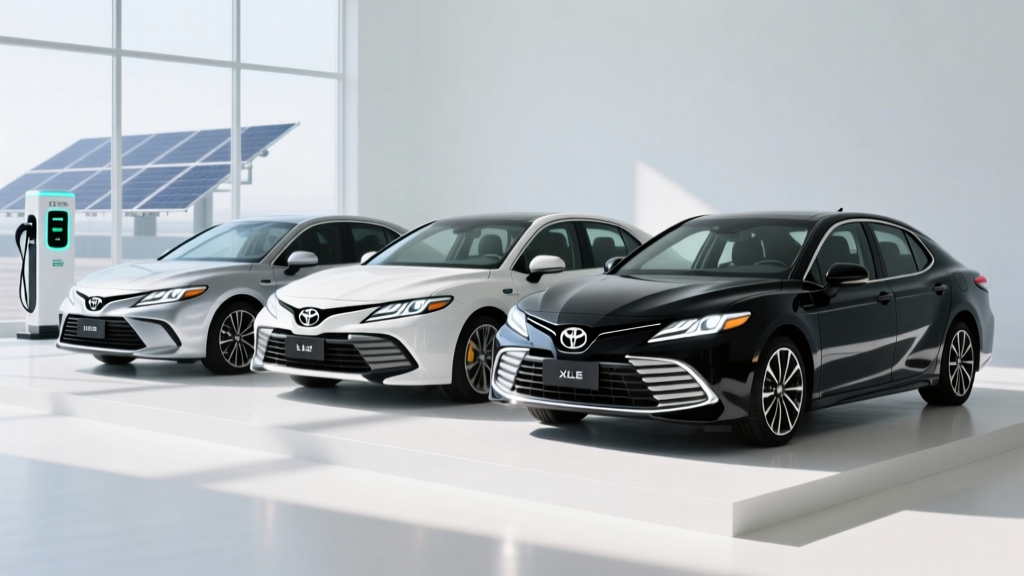
One of the Camry Hybrid's strongest selling points is that going hybrid doesn't mean paying a premium. Since every 2026 Camry is hybrid, the pricing reflects the standard lineup — not an upcharge over a gas model.
| Trim | Drivetrain | MSRP (incl. destination) |
|---|---|---|
| LE | FWD | $29,495 |
| LE | AWD-e | $30,995 |
| SE | FWD | $30,995 |
| SE | AWD-e | $32,495 |
| XSE | FWD | $33,495 |
| XSE | AWD-e | $34,995 |
| XLE | FWD | $34,495 |
| XLE | AWD-e | $35,995 |
Pricing based on Toyota's 2026 MSRP including $1,095 destination charge. Dealer markups or discounts may apply.
Federal Tax Credit Eligibility
The 2026 Camry Hybrid does not qualify for the federal §30D clean vehicle tax credit. Under current IRS rules, the §30D credit applies only to plug-in electric vehicles (PHEVs and BEVs) with a minimum battery capacity of 7 kWh. The Camry Hybrid's battery is far smaller (approximately 1.0–1.6 kWh depending on trim) and is not plug-in capable.
However, the Camry Hybrid's lower starting price — often $5,000–$10,000 less than a comparable PHEV or EV — means the total cost of ownership can still be very competitive, especially for buyers without access to home charging.
Battery Warranty, Longevity, and Replacement Cost
Battery reliability is the number-one concern for first-time hybrid buyers. Here's what you need to know about the 2026 Camry's hybrid battery:
Hybrid battery coverage: 10 years / 150,000 miles (whichever comes first) in all 50 states.
Hybrid system components: 8 years / 100,000 miles.
Capacity retention guarantee: Toyota warrants the hybrid battery against defects and excessive capacity loss. There is no published minimum SoH (State of Health) percentage trigger — claims are evaluated case-by-case under the warranty terms.
Basic vehicle warranty: 3 years / 36,000 miles.
Powertrain warranty: 5 years / 60,000 miles.
How Long Do Camry Hybrid Batteries Actually Last?
Real-world data from previous-generation Camry Hybrids (2007–2024) shows that Toyota's hybrid batteries routinely last 150,000–200,000+ miles before any significant degradation. The hybrid battery is never deeply discharged — the system keeps the State of Charge (SoC) between roughly 40% and 80%, which dramatically extends lithium-ion cycle life. Unlike a full EV battery that cycles from 10% to 90%, the Camry's small battery undergoes shallow, partial cycles that cause minimal wear.
Battery Replacement Cost
If your hybrid battery does fail outside of warranty:
- New OEM battery from Toyota: $2,500–$4,000 (parts) + $500–$1,000 (labor) = roughly $3,000–$5,000 total.
- Refurbished/remanufactured battery: $1,500–$2,500 installed from independent hybrid specialists.
- Individual cell replacement: Some shops replace only the failed modules for $800–$1,500, though this is less common on newer lithium-ion packs.
For context, a conventional gas car's transmission replacement often costs $3,000–$5,000. The hybrid battery is not the financial time bomb some fear — and the 10-year/150,000-mile warranty covers most original owners entirely.
Pros and Cons of the 2026 Camry Hybrid
✓ Pros
- 51 MPG combined — among the best in any midsize sedan
- No plug-in required; zero behavior change from a gas car
- Under $30,000 starting MSRP for a hybrid midsize sedan
- 10-year/150,000-mile hybrid battery warranty
- 673-mile total range — fewer fill-ups than most gas cars
- AWD-e available across all trims for ~$1,500 more
- Strong Toyota reliability and resale value track record
✗ Cons
- No PHEV variant — can't drive on electric-only for commutes
- No federal tax credit eligibility (HEV, not plug-in)
- 225 hp is adequate, not thrilling — slower than turbocharged rivals
- CVT-like driving feel under hard acceleration (e-CVT)
- Highway MPG drops to mid-40s at 80 mph
- Rear-seat headroom slightly tighter than some competitors
- Apple CarPlay/Android Auto are wireless but infotainment UI lags behind Hyundai/Kia
Who Should Buy the 2026 Camry Hybrid?
Choose the 2026 Camry Hybrid if:
- You don't have access to home or workplace charging (apartment, street parking)
- You want maximum MPG without changing your refueling habits
- Your budget is under $35,000 and you want a reliable midsize sedan
- You drive a mix of city and highway and want consistent 45–55 MPG
- You plan to own the car 8–10+ years and value Toyota's warranty and reliability
Look at a PHEV (like the Prius Prime) instead if:
- You have home Level 2 charging and a commute under 40 miles round-trip
- You want to drive on electricity daily and only use gas for road trips
- You qualify for the $7,500 federal tax credit (income and sourcing rules apply)
Look at a full EV (like the Model 3 or Ioniq 6) instead if:
- You have reliable home charging and want zero tailpipe emissions
- Your daily driving is under 250 miles and you want the lowest per-mile fuel cost
- You want the performance and quietness of a pure electric powertrain
Frequently Asked Questions
Are all 2026 Camry models hybrid?
Yes. Beginning with the 2025 redesign and continuing for 2026, every Toyota Camry sold in the United States uses Toyota's fifth-generation hybrid powertrain. There is no gas-only Camry available. All trims — LE, SE, XSE, and XLE — come with the 2.5-liter hybrid system producing 225 hp (FWD) or 232 hp (AWD-e).
How many MPG does the 2026 Camry Hybrid get?
The EPA rates the 2026 Camry Hybrid at 53 city / 50 highway / 51 combined MPG for front-wheel-drive trims, and 51/49/50 for AWD-e trims. In real-world city driving, many owners exceed the EPA city figure, seeing 52–56 MPG. Highway driving at sustained speeds typically yields 44–48 MPG.
Does the 2026 Camry Hybrid need to be plugged in?
No. The Camry Hybrid is a conventional hybrid (HEV), not a plug-in hybrid. Its small battery is recharged by the gasoline engine and regenerative braking. You refuel it at any gas station, exactly like a traditional car.
Does the 2026 Camry Hybrid qualify for a tax credit?
No. The federal §30D clean vehicle credit requires a plug-in vehicle with at least 7 kWh of battery capacity. The Camry Hybrid's battery is approximately 1.0–1.6 kWh and is not plug-in capable. Some states may offer small incentives for high-efficiency vehicles, but no federal credit applies. Check your state's energy office for local programs.
How long will the Camry Hybrid battery last?
Toyota covers the hybrid battery for 10 years or 150,000 miles. Based on historical data from prior Camry Hybrid generations, most batteries last 150,000–200,000+ miles before needing replacement. The system's shallow charge cycles (keeping SoC between ~40–80%) minimize degradation. Replacement cost, if needed out of warranty, runs $3,000–$5,000 for a new OEM pack.
Is the Camry Hybrid reliable compared to gas-only cars?
Toyota's hybrid system has been in production since 1997 (Prius) and is among the most proven powertrains in the industry. The e-CVT transaxle has no traditional gears, belts, or clutches to wear out — it's a planetary gearset with fewer moving parts than a conventional automatic transmission. Long-term reliability data consistently shows Toyota hybrids matching or exceeding the durability of their gas-only counterparts.
Can I still buy a non-hybrid Camry?
Not new. The last gas-only Camry was the 2024 model year with the 2.5L four-cylinder (203 hp) and the optional 3.5L V6 (301 hp). If you want a non-hybrid Camry, you'll need to shop the used market for a 2024 or earlier model. For 2025 and 2026, every new Camry is hybrid-only.