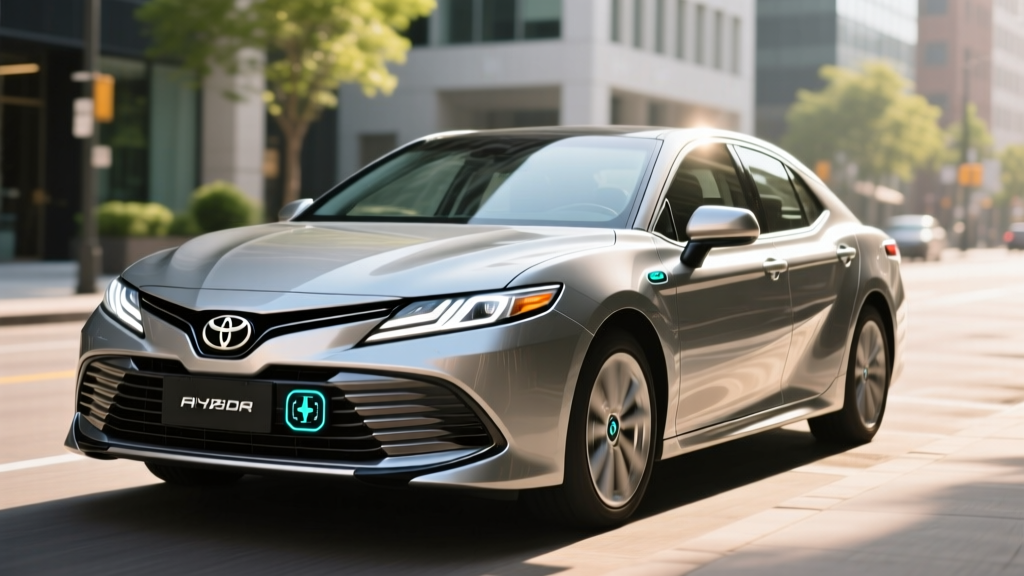
The Toyota Camry has been America's best-selling sedan for years, and since 2025, every Camry rolls off the line as a hybrid. That means the old question — "should I get the hybrid or the gas model?" — is settled. The real question now is which trim to pick, what you'll actually pay, and whether the Camry Hybrid's fuel economy holds up outside the EPA lab. This guide breaks down the 2026 Toyota Camry Hybrid MSRP across every trim, pairs it with real-world MPG expectations, and explains the powertrain, battery warranty, and ownership economics so you can buy with confidence.
2026 Camry Hybrid MSRP: Trim-by-Trim Pricing
For the 2026 model year, Toyota continues its hybrid-only Camry strategy introduced with the ninth-generation redesign. The lineup spans four core trims, with front-wheel drive (FWD) and available electronic on-demand all-wheel drive (AWD) on most. Here is the manufacturer's suggested retail price before destination charges:
| Trim | MSRP (FWD) | AWD MSRP | Combined MPG (EPA) | Key Additions |
|---|---|---|---|---|
| LE | $29,495 | $31,020 | 51 (FWD) / 47 (AWD) | 8-inch touchscreen, TSS 3.0, wireless CarPlay/Android Auto |
| SE | $31,090 | $32,615 | 47 (FWD) / 44 (AWD) | Sport-tuned suspension, 19-inch wheels, paddle shifters |
| XLE | $34,195 | $35,720 | 51 (FWD) / 47 (AWD) | Leather-trimmed seats, 12.3-inch display, ambient lighting |
| XSE | $35,495 | $37,020 | 47 (FWD) / 44 (AWD) | Sport styling + XLE luxury, panoramic roof available |
Destination and handling fees add approximately $1,150 to all trims. Dealer markups vary by region, though Toyota's high production volume for the Camry generally keeps prices close to MSRP compared to lower-volume models.
EPA MPG vs. Real-World Fuel Economy
The headline number for the Camry Hybrid LE and XLE is 51 MPG combined (53 city / 50 highway) according to fueleconomy.gov. The sport-tuned SE and XSE trims, with wider 19-inch tires and a firmer suspension, drop to 47 combined (48 city / 47 highway) in FWD form.
| Trim | City MPG | Highway MPG | Combined MPG | Annual Fuel Cost* |
|---|---|---|---|---|
| LE / XLE (FWD) | 53 | 50 | 51 | ~$950 |
| LE / XLE (AWD) | 49 | 46 | 47 | ~$1,050 |
| SE / XSE (FWD) | 48 | 47 | 47 | ~$1,050 |
| SE / XSE (AWD) | 46 | 43 | 44 | ~$1,150 |
*Based on 15,000 miles/year, 55% city driving, and $3.30/gallon regular unleaded. Your costs will vary with local fuel prices and driving patterns.
Powertrain: How the Fifth-Gen Hybrid System Works
The 2026 Camry uses Toyota's fifth-generation hybrid synergy drive, built around a 2.5-liter Dynamic Force four-cylinder engine running the Atkinson cycle for maximum thermal efficiency. Here are the key powertrain figures:
- Engine: 2.5L inline-4, 184 hp / 163 lb-ft torque
- Front electric motor: 134 hp / 155 lb-ft
- Combined system output: 225 hp (FWD), 232 hp (AWD with rear motor)
- Transmission: eCVT (planetary gearset, not a belt-driven CVT)
- AWD system: Electronic on-demand rear motor (40 hp), activates under acceleration or low-traction conditions
- 0–60 mph: ~7.1 seconds (FWD), ~6.9 seconds (AWD)
This is a conventional hybrid (HEV), not a plug-in hybrid. The Camry Hybrid charges its small traction battery exclusively through regenerative braking and the gasoline engine. There is no plug, no charging port, and no electric-only driving range to speak of — the battery assists the engine and enables brief low-speed electric creep, but the gas engine is always the primary energy source.
HEV vs. PHEV vs. EV: Which Powertrain Fits You?
The Camry Hybrid is an HEV. If you're cross-shopping, here is how it compares to the other electrified options:
| Factor | HEV (Camry Hybrid) | PHEV (e.g., Prius Prime) | BEV (e.g., Tesla Model 3) |
|---|---|---|---|
| Plug-in charging? | No | Yes (Level 1/2) | Yes (Level 1/2/DC) |
| Electric-only range | None (motor assist only) | 35–45 miles typical | 250–360+ miles |
| Uses gasoline? | Yes, always | Yes, after battery depletes | No |
| Federal tax credit | None | Up to $7,500 (§30D) | Up to $7,500 (§30D) |
| Starting price range | ~$29,500 | ~$33,000–$42,000 | ~$38,000–$55,000 |
| Best for | No home charging; simplicity | Short commute + road trips | Home charging access; lowest running cost |
Look at a PHEV or BEV instead if: You have Level 2 home charging and a commute under 40 miles (a PHEV like the Prius Prime can cover most daily driving on electricity alone) or you want zero tailpipe emissions and the lowest per-mile energy cost (a BEV, if your budget and charging situation allow).
Does the Camry Hybrid Qualify for a Tax Credit?
The conventional Camry Hybrid does not qualify for the federal §30D clean vehicle tax credit. Under current IRS rules, only plug-in electric vehicles (BEVs and PHEVs) with sufficient battery capacity are eligible. The Camry Hybrid's battery pack — approximately 1.0 kWh — is far below the threshold.
Some states offer their own incentives for high-efficiency hybrids, though these are uncommon and vary significantly by jurisdiction. Check your state's energy office or department of environmental quality for current programs. A few states have historically offered modest rebates for HEVs with combined MPG above 40, but these programs come and go with budget cycles.
Battery Warranty, Lifespan, and Replacement Cost
Hybrid battery longevity is consistently a top concern for buyers. Toyota addresses this with one of the strongest hybrid battery warranties in the industry:
- Coverage: 10 years / 150,000 miles (whichever comes first)
- Applies to: Hybrid traction battery and hybrid system components
- Transferable: Yes, to subsequent owners
- Capacity threshold: Warranty covers defects and significant capacity loss that impairs hybrid system function
Toyota also provides a 5-year / 60,000-mile powertrain warranty covering the engine, transaxle, and related drivetrain components.
In practice, Toyota's nickel-metal hydride (NiMH) and lithium-ion hybrid battery packs have demonstrated exceptional longevity. Data from fleet operators and long-term owners shows that Camry and Prius hybrid batteries routinely last 150,000–200,000+ miles before requiring service. The fifth-generation system in the 2026 Camry uses a bipolar nickel-metal hydride battery pack (on most trims), which Toyota has engineered for improved durability and faster charge/discharge cycling compared to earlier designs.
If a replacement is needed out of warranty, expect to pay between $2,500 and $4,000 for a new OEM hybrid battery pack including labor at a dealership. Refurbished and aftermarket options are available for $1,500–$2,500. Given the 10-year/150,000-mile warranty and the battery's demonstrated lifespan, most original owners will never face this expense.
Reliability and Safety Ratings
Toyota's hybrid powertrains have earned a reputation for exceptional reliability, and the Camry consistently ranks at or near the top of its segment in long-term dependability studies. The eCVT planetary gearset has no belts, clutches, or torque converter to wear out — it is mechanically simpler than a conventional automatic transmission.
The 2026 Camry comes standard with Toyota Safety Sense 3.0, which includes:
- Pre-Collision System with Pedestrian Detection
- Full-Speed Range Dynamic Radar Cruise Control
- Lane Departure Alert with Steering Assist
- Lane Tracing Assist
- Automatic High Beams
- Road Sign Assist
- Proactive Driving Assist (low-speed braking support)
The Camry has historically earned the IIHS Top Safety Pick+ designation and top marks from NHTSA. Expect the 2026 model to maintain these ratings; check both agencies for updated crash-test results as they are published.
Camry Hybrid Ownership Economics: 5-Year Snapshot
| Category | Estimated Cost |
|---|---|
| Purchase price (MSRP + destination) | $30,645 |
| Fuel (75,000 mi ÷ 51 MPG × $3.30/gal) | $4,853 |
| Insurance (national avg., varies by driver) | $7,500–$9,000 |
| Maintenance (oil changes, tires, brakes) | $2,200–$2,800 |
| Estimated depreciation (5 yr) | $12,000–$14,000 |
| Total estimated 5-year cost | $57,000–$61,000 |
Compared to a similarly priced gasoline-only midsize sedan averaging 30 MPG combined, the Camry Hybrid saves approximately $3,300 in fuel over 75,000 miles. That nearly covers the hybrid's modest price premium over what a comparable gas-only vehicle would cost (if one were still offered in this segment). Maintenance costs are slightly lower than a conventional gas car thanks to regenerative braking extending brake pad life and the engine operating under less stress in hybrid duty.
Pros, Cons, and Verdict
Pros
- 51 MPG combined (LE/XLE FWD) — among the highest of any non-plug-in sedan
- Under $31,000 to start with destination on the LE trim
- 10-year / 150,000-mile hybrid battery warranty
- No plug-in charging required — works with existing gas-station infrastructure
- Standard Toyota Safety Sense 3.0 across all trims
- AWD available on every trim for ~$1,525 additional
- Strong resale value and proven hybrid reliability
Cons
- No federal tax credit eligibility (HEV, not PHEV/BEV)
- Sport trims (SE/XSE) sacrifice 4–7 MPG for styling and handling
- eCVT drone under hard acceleration — not a performance sedan
- Rear-seat headroom slightly compromised vs. some competitors
- No plug-in variant in the Camry lineup (see Prius Prime for PHEV)
- AWD fuel economy penalty of 4 MPG combined
The 2026 Camry Hybrid occupies a sweet spot: it delivers exceptional fuel economy at a mainstream price without requiring any change in refueling behavior. If your priority is the lowest cost per mile in a reliable midsize sedan and you lack home charging infrastructure, the Camry Hybrid LE at $29,495 MSRP is difficult to beat. Buyers who can charge at home and want to eliminate gasoline for daily commuting should cross-shop the Toyota Prius Prime (PHEV) or a battery-electric sedan.
Frequently Asked Questions
How many MPG does the 2026 Camry Hybrid get?
The EPA rates the Camry Hybrid LE and XLE (FWD) at 53 city / 50 highway / 51 combined MPG. Sport trims (SE and XSE) are rated at 48 city / 47 highway / 47 combined. AWD reduces all figures by approximately 4 MPG combined. In real-world driving, city-heavy commuters often exceed EPA estimates, while sustained highway driving in cold weather may yield the low-to-mid 40s.
Is the Camry Hybrid a plug-in hybrid?
No. The Camry Hybrid is a conventional hybrid (HEV). It charges its battery through regenerative braking and the gasoline engine. There is no plug, no charging port, and no meaningful electric-only range. If you want a Toyota plug-in hybrid, look at the Prius Prime or the RAV4 Prime.
Does the Camry Hybrid qualify for any federal tax credit?
No. The federal §30D clean vehicle credit applies only to plug-in electric vehicles (BEVs and PHEVs) that meet battery sourcing, MSRP, and buyer income requirements. The Camry Hybrid, as an HEV, is not eligible. Check your state's energy office for any local hybrid incentives, though these are uncommon.
How long will the Camry Hybrid battery last and what does replacement cost?
Toyota warranties the hybrid battery for 10 years / 150,000 miles. Real-world data from Toyota's hybrid fleet shows batteries regularly lasting 150,000–200,000+ miles. If replacement is needed out of warranty, expect $2,500–$4,000 for a new OEM battery with labor, or $1,500–$2,500 for a refurbished unit.
Should I buy the Camry Hybrid or a full electric vehicle?
Choose the Camry Hybrid if you lack reliable home or workplace Level 2 charging, frequently drive long distances in areas with sparse charging infrastructure, or want the lowest upfront cost in an electrified vehicle. Choose a BEV if you have home charging, want the lowest per-mile energy cost, and are comfortable planning DC fast-charging stops on road trips. The Camry Hybrid's ~$30,000 starting MSRP is $8,000–$15,000 less than most comparable electric sedans before incentives.
Is the Camry Hybrid AWD system good in snow?
The electronic on-demand AWD adds a 40-hp rear electric motor that engages during acceleration and when the front wheels slip. It is effective for light snow and wet roads but is not a substitute for a dedicated AWD SUV in severe winter conditions. The AWD option costs approximately $1,525 and reduces combined fuel economy by about 4 MPG.