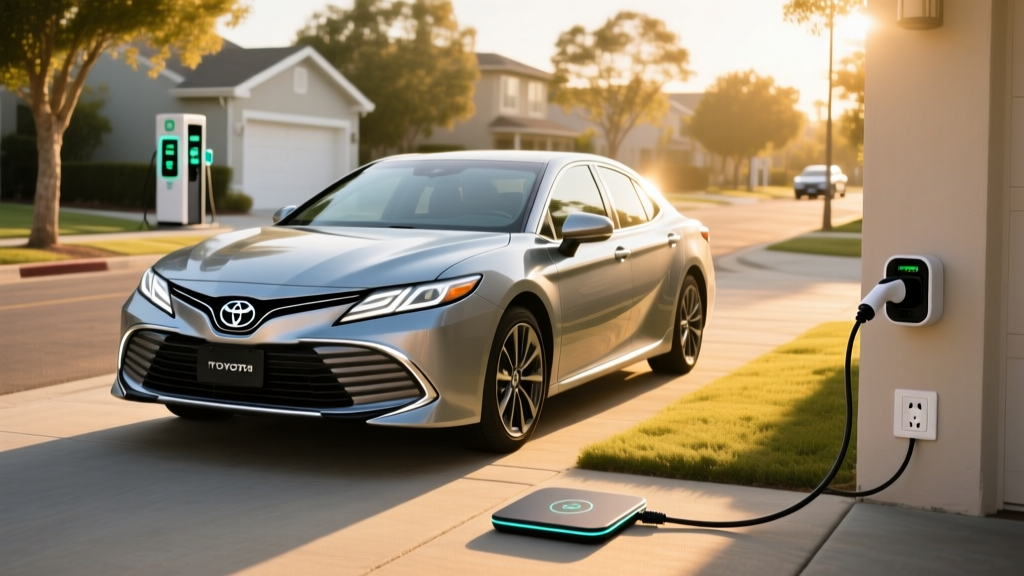
The 2026 Toyota Camry arrives as a hybrid-only midsize sedan — Toyota dropped the four-cylinder gas model entirely, making every Camry a hybrid electric vehicle (HEV). For shoppers researching hybrid Camry MPG, the headline is compelling: up to 52 MPG combined on front-wheel-drive trims, with all-wheel drive available across the lineup at a modest efficiency penalty. But EPA stickers don't tell the full story. This guide breaks down the real-world fuel economy, powertrain mechanics, battery longevity, and ownership costs you need to decide whether the Camry Hybrid fits your commute — or whether a plug-in hybrid or full EV makes more sense.
2026 Camry Hybrid MPG: EPA Ratings and Real-World Results
Every 2026 Camry Hybrid pairs a 2.5-liter four-cylinder engine with Toyota's fifth-generation hybrid system. Fuel economy varies by trim and drivetrain:
| Trim | Drivetrain | City MPG | Highway MPG | Combined MPG |
|---|---|---|---|---|
| LE | FWD | 53 | 50 | 52 |
| LE | AWD | 51 | 49 | 50 |
| SE / XLE | FWD | 48 | 43 | 46 |
| SE / XLE | AWD | 46 | 42 | 44 |
Source: fueleconomy.gov — 2026 Toyota Camry Hybrid listings.
Toyota's hybrid system excels in stop-and-go city driving, where regenerative braking and electric-motor assist dominate. Expect to meet or slightly exceed the EPA city rating (53 MPG on LE FWD) during urban commutes. Highway driving tells a different story: sustained 75+ MPH cruising reduces the hybrid advantage, and real-world highway MPG typically lands 2–4 MPG below the sticker. In cold weather (below 35°F), expect a 5–10% fuel-economy drop as the engine runs more frequently to heat the cabin and warm the catalytic converter. On a 400-mile highway road trip in an SE AWD, plan for roughly 40–42 MPG rather than the 42–44 EPA combined figure.
How the Camry Hybrid Powertrain Works
The 2026 Camry uses Toyota's fifth-generation Hybrid Synergy Drive, which is a conventional series-parallel hybrid — meaning it does not plug in. The system recovers energy during braking and deceleration, storing it in a small lithium-ion battery that assists the gas engine during acceleration and enables brief electric-only driving at low speeds.
| Specification | Detail |
|---|---|
| Engine | 2.5L inline-4 (Atkinson cycle) |
| Combined Net Horsepower | 225 hp (FWD) / 232 hp (AWD) |
| Electric Motors | 2 (FWD) / 3 (AWD — rear axle motor added) |
| Hybrid Battery | ~1.6 kWh lithium-ion (sealed, not plug-in) |
| Transmission | eCVT (electronically controlled continuously variable) |
| 0–60 MPH | ~7.1 seconds (FWD) |
| Fuel Tank | 13.2 gallons |
| Total Driving Range | ~630–686 miles (depending on trim) |
The AWD variant adds an independent rear electric motor (40 hp) that engages automatically for traction — there's no mechanical driveshaft connecting the engine to the rear wheels. This keeps weight down and preserves interior space while providing confident all-weather grip.
Camry Hybrid vs. Plug-In Hybrid vs. Full EV: Which Fits You?
The Camry is a conventional hybrid (HEV). It has no plug, no electric-only range to speak of (it can creep at low speed on battery alone for roughly half a mile), and requires zero behavioral change from a gas-car owner. But the electrified market offers two other paths:
| Factor | Conventional Hybrid (HEV) e.g., Camry Hybrid |
Plug-In Hybrid (PHEV) e.g., Toyota RAV4 Prime |
Battery Electric (BEV) e.g., Hyundai Ioniq 6 |
|---|---|---|---|
| Plug-in Required? | No | Yes (Level 1 or 2) | Yes (Level 2 recommended) |
| Electric-Only Range | ~0.5 mi at low speed | 25–42 mi (model dependent) | 250–360+ mi (EPA) |
| Fuel / Energy Cost | Gas only (~$0.09/mi) | Electric short trips, gas long trips (~$0.04–0.09/mi) | Electricity only (~$0.03–0.05/mi at home) |
| Federal Tax Credit | None | Up to $7,500 (§30D, if eligible) | Up to $7,500 (§30D, if eligible) |
| Best For | No home charging access; long highway commutes | Home charging + short daily commute; road trips on gas | Home charging + mostly under 250 mi/day |
- You park on the street or in a garage without an outlet — no charging infrastructure needed.
- Your commute is highway-heavy (40+ miles each way at 65–80 MPH), where PHEV electric range is depleted quickly.
- You want maximum simplicity: one fuel type, no apps, no charging cables, no range planning.
- Upfront price matters — the Camry LE Hybrid starts around $29,990, thousands less than a comparable PHEV or EV.
- You have Level 2 home charging and a commute under 30 miles — a PHEV like the RAV4 Prime (42 mi electric) could eliminate gas use on weekdays entirely.
- You want the lowest per-mile energy cost and qualify for the §30D federal tax credit (not available on conventional hybrids).
- You're chasing zero tailpipe emissions in your daily driving — a BEV delivers that; an HEV never will.
2026 Camry Hybrid Pricing by Trim
The 2026 Camry Hybrid lineup keeps things simple with four core trims. Pricing below includes the destination charge:
| Trim | FWD MSRP | AWD MSRP |
|---|---|---|
| LE | $29,990 | $31,390 |
| SE | $32,190 | $33,590 |
| XLE | $34,590 | $35,990 |
| XSE | $35,990 | $37,390 |
Tax Credit Eligibility
The conventional Camry Hybrid does not qualify for the federal §30D Clean Vehicle Credit. That credit applies only to plug-in vehicles (BEVs and PHEVs) meeting battery-sourcing, MSRP, and buyer-income requirements. Some states offer hybrid-specific rebates or reduced registration fees, but these vary widely — check your state energy office or Alternative Fuels Data Center for local programs.
Battery Longevity, Warranty, and Replacement Cost
Hybrid battery anxiety is the single most common concern among first-time hybrid buyers. Here's what the data shows for Toyota's hybrid system:
- Hybrid Battery Coverage: 10 years / 150,000 miles (whichever comes first)
- Hybrid System Components: 8 years / 100,000 miles
- Capacity Retention Threshold: Toyota warrants the hybrid battery against defect and abnormal loss of capacity — if the battery fails to function within normal parameters during the warranty period, Toyota replaces it at no cost.
Real-World Lifespan
Toyota's hybrid battery packs are deliberately small (~1.6 kWh) and are managed conservatively — the system never fully charges or fully depletes the pack, keeping it in a narrow state-of-charge window (roughly 40–80%) that dramatically extends cell life. Data from Toyota Prius fleets and high-mileage Camry Hybrids shows the vast majority of hybrid batteries last 150,000–200,000+ miles without replacement. Failures within the warranty period are covered; out-of-warranty failures are uncommon before 200,000 miles.
Replacement Cost if Needed
Should the hybrid battery require replacement outside the warranty window, expect:
- OEM replacement (dealer): $2,500–$4,000 installed
- Refurbished/remanufactured pack: $1,500–$2,500 installed
- Individual cell module replacement: $500–$1,200 (specialist hybrid shops can replace only the degraded modules)
For context, a conventional gas car's transmission replacement or timing-chain service often costs as much or more — the hybrid battery is not the financial liability many buyers fear.
Reliability Ratings and Ownership Costs
The Camry nameplate has decades of reliability data behind it, and the fifth-generation hybrid system is now in its fourth year of production (introduced for 2023 on the Prius, 2025 on the Camry). Toyota consistently ranks at or near the top in J.D. Power and Consumer Reports reliability surveys, and the hybrid powertrain has fewer moving parts than a conventional automatic transmission (no torque converter, no traditional gear shifts).
Maintenance costs are low: the hybrid system requires no separate fluid changes, the regenerative braking system extends pad and rotor life significantly (60,000–80,000+ miles on original brake pads is common), and the gasoline engine operates under less stress thanks to electric-motor assist during high-load acceleration.
Insurance premiums for the Camry Hybrid are competitive with other midsize sedans — typically $1,200–$1,600 annually depending on location and driving record. The hybrid designation does not carry the insurance surcharge that some EVs do.
Who Should Buy the 2026 Camry Hybrid?
- Best-in-class combined MPG (52 on LE FWD)
- No plug-in required — zero infrastructure dependency
- 630+ mile total range on a single tank
- AWD available across all trims
- 10-year/150,000-mile hybrid battery warranty
- Strong resale value and proven reliability
- Competitive starting price (~$29,990)
The 2026 Camry Hybrid is the default midsize sedan for buyers who want maximum fuel efficiency without changing their habits. If you don't have — or don't want — home charging, and your priority is low cost-per-mile with zero range planning, the Camry LE Hybrid at 52 MPG combined is among the most efficient non-plug-in vehicles sold in the United States. The AWD option adds year-round confidence at a minor 2-MPG penalty.
However, if you have Level 2 charging at home and a short commute, a PHEV delivers a meaningfully better daily experience (electric-only weekday driving, gas for road trips) and may qualify for up to $7,500 in federal credits. And if your daily driving stays under 250 miles, a full BEV like the Hyundai Ioniq 6 or Tesla Model 3 offers lower per-mile energy costs and zero tailpipe emissions. The Camry Hybrid is the right tool for a specific job — and it does that job exceptionally well.
Frequently Asked Questions
How many MPG does the 2026 Camry Hybrid get?
The LE FWD trim achieves an EPA-estimated 53 city / 50 highway / 52 combined MPG. The AWD LE drops to 51/49/50. Sportier SE and XLE trims are rated at 48/43/46 (FWD) and 46/42/44 (AWD). Real-world city driving often meets or exceeds EPA city figures; highway driving typically returns 2–4 MPG less than the sticker.
Does the Camry Hybrid need to be plugged in?
No. The 2026 Camry is a conventional hybrid (HEV). Its small lithium-ion battery recharges through regenerative braking and the gasoline engine. There is no plug, no charging cable, and no electric-only driving range of any practical distance.
Is there a plug-in hybrid (PHEV) Camry?
Toyota does not offer a Camry PHEV in the US market. If you want a Toyota plug-in hybrid, the RAV4 Prime (42 miles electric-only, 94 MPGe) is the closest alternative, though it's an SUV with a higher starting price (~$44,000).
How long will the Camry Hybrid battery last?
Toyota's hybrid batteries are engineered for 150,000–200,000+ miles of service life, backed by a 10-year/150,000-mile warranty. The system's conservative charge management (never fully charging or depleting the pack) is the primary reason for this longevity.
What does it cost to replace the hybrid battery?
Out-of-warranty OEM replacement runs $2,500–$4,000 installed. Refurbished packs cost $1,500–$2,500. However, most Toyota hybrid batteries outlast 200,000 miles, and many vehicles are retired before the battery needs service.
Does the Camry Hybrid qualify for any tax credit?
The federal §30D Clean Vehicle Credit does not apply to conventional hybrids — only plug-in vehicles (BEVs and PHEVs) are eligible. Some states offer hybrid-specific incentives; check the Alternative Fuels Data Center for your state's programs.
Is the Camry Hybrid reliable compared to a gas Camry?
Toyota's hybrid system has fewer wear-prone components than a conventional automatic powertrain (no torque converter, no multi-speed gear shifts, extended brake pad life from regen). Long-term reliability data consistently shows the hybrid variant is at least as reliable as the gas-only model it replaced.
How does the Camry Hybrid compare to the Honda Accord Hybrid?
The 2026 Accord Hybrid achieves an EPA-estimated 48 combined MPG (EX-L) to 44 combined (Sport), making the Camry LE Hybrid's 52 combined MPG the class leader. The Accord Hybrid starts slightly lower (~$29,390) and offers a more engaging drive feel, but trails on peak fuel economy. Both carry 10-year/150,000-mile hybrid battery warranties.