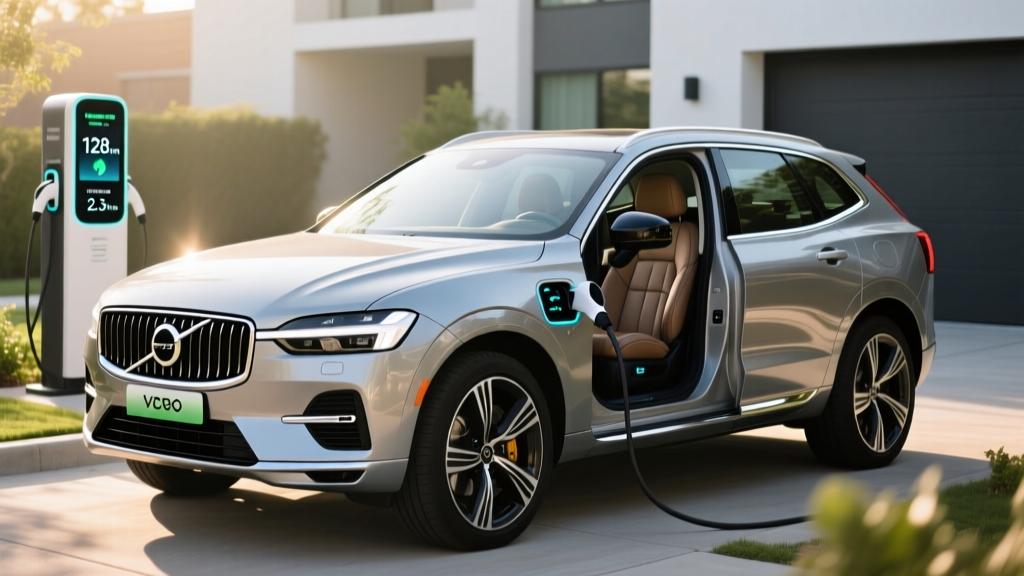
The 2025 Volvo XC60 Recharge T8 sits in a specific sweet spot of the electrified SUV market: it offers genuine daily electric-only commuting without the range anxiety of a full battery-electric vehicle. With 35 miles of EPA-rated electric range, a combined 455 horsepower, and Scandinavian design, it competes directly with the BMW X3 xDrive50e, Lexus NX 450h+, and Lincoln Corsair Grand Touring. But does the real-world efficiency match the sticker, and who is this PHEV actually for?
HEV vs PHEV: Where the XC60 Recharge Fits
Before evaluating the XC60 Recharge, it is critical to distinguish between conventional hybrids and plug-in hybrids — Volvo sells both under the XC60 nameplate, and the difference in daily ownership is substantial.
| Feature | XC60 B5 (Mild Hybrid / HEV) | XC60 Recharge T8 (PHEV) |
|---|---|---|
| Powertrain | 2.0L turbo + 48V mild-hybrid system | 2.0L turbo + rear electric motor + 18.8 kWh battery |
| Combined Output | 247 hp | 455 hp |
| Electric-Only Range | None (cannot plug in) | 35 miles EPA |
| Plugs In? | No — regenerative braking only | Yes — Level 2 AC charging |
| EPA Combined | 26 MPG | 63 MPGe / 28 MPG (gas-only) |
| Starting MSRP | ~$47,000 | ~$52,900 |
The B5 mild hybrid recovers energy during braking to assist the engine and smooth stop-start events. It never drives on electricity alone. The Recharge T8, by contrast, carries a large traction battery and a rear-axle electric motor capable of propelling the vehicle at highway speeds with zero engine use — provided you plug it in regularly.
Electric Range, MPGe, and Fuel Economy
The 2025 XC60 Recharge T8 carries an 18.8 kWh lithium-ion battery pack (usable capacity approximately 14.9 kWh). The EPA rates it at 35 miles of electric-only range and 63 MPGe when operating in electric mode. Once the battery is depleted and the vehicle operates as a conventional hybrid, the EPA rates it at 28 MPG combined.
| Mode | City | Highway | Combined |
|---|---|---|---|
| Electric-Only (MPGe) | 65 MPGe | 61 MPGe | 63 MPGe |
| Gas-Only Hybrid (MPG) | 27 MPG | 29 MPG | 28 MPG |
Real-World Range Expectations: The 35-mile EPA electric range is achievable in mixed city/suburban driving at moderate temperatures (55–75°F). Expect approximately 28–32 miles on the highway at 70+ mph due to higher aerodynamic drag. In cold weather (below 32°F), cabin heating and battery thermal losses can reduce electric-only range to 22–27 miles. The XC60 Recharge uses a resistive PTC heater rather than a heat pump, which increases winter electricity consumption noticeably.
Total combined range (electric + full 18.8-gallon gas tank) exceeds 520 miles, eliminating any range anxiety for road trips. In practice, owners who charge nightly and commute under 30 miles round-trip report using gasoline only on longer weekend trips, achieving effective monthly consumption well above 80 MPGe.
Powertrain and Performance
The Recharge T8 powertrain pairs a 2.0-liter turbocharged four-cylinder engine (310 hp, 295 lb-ft) driving the front wheels with a rear-axle electric motor (143 hp, 228 lb-ft). Combined system output is 455 horsepower and 523 lb-ft of torque. An 8-speed automatic transmission handles the front powertrain; the rear motor uses a single-speed reduction gear.
This makes the XC60 Recharge one of the quickest compact luxury PHEV SUVs available. Volvo quotes a 0–60 mph time of 4.5 seconds. The electric motor provides instant torque from a stop, and all-wheel drive is standard via the split-axle configuration — there is no mechanical driveshaft connecting front and rear.
Driving modes include Pure (electric-only, rear-drive), Hybrid (default blended operation), and Power (maximum combined output). A Hold mode preserves battery charge for later use, and a Charge mode uses the engine to recharge the battery — useful if you want electric driving in an upcoming low-emission zone or city center.
Charging: Speed, Time, and Home Setup
The 2025 XC60 Recharge supports Level 2 AC charging at up to 3.7 kW via its onboard charger. It uses a standard J1772 connector (or NACS with an adapter on newer builds transitioning to the Tesla-standard port). There is no DC fast-charging capability — this is typical for PHEVs in this class, as the battery is small enough that overnight Level 2 charging is sufficient.
| Charging Method | Power | 0–100% Time | Notes |
|---|---|---|---|
| Level 1 (120V household outlet) | ~1.4 kW | ~10–12 hours | Adequate for overnight if commute is light |
| Level 2 (240V home charger) | 3.7 kW | ~5 hours | Full charge overnight; recommended setup |
| DC Fast Charge | Not supported | N/A | CCS/NACS DC stations cannot charge this vehicle |
A dedicated 240V Level 2 home charger is strongly recommended. While a standard 120V outlet will technically replenish the battery overnight, the 10–12 hour timeline means you may not reach a full charge if you plug in late. A Level 2 charger (such as a ChargePoint Home Flex or Emporia Level 2) installed on a 240V/20A circuit delivers a full charge in roughly 5 hours — easily covering an evening-to-morning cycle.
Home Level 2 installation typically costs $800–$2,000 depending on panel proximity and local permitting. If your electrical panel requires an upgrade to 200A service, costs can reach $3,000–$5,000. Consult a licensed electrician for a site-specific quote.
Pricing, Trims, and Tax Credit Eligibility
The 2025 Volvo XC60 Recharge T8 is offered across several trims. Pricing starts at approximately $52,900 for the Core trim and climbs to roughly $62,000 for the Ultra trim with optional packages (destination fee additional). Key trim differentiators include wheel size, leather vs. wool-blend upholstery, the Bowers & Wilkins premium audio system, a head-up display, and Pilot Assist with adaptive cruise and lane-centering.
Federal §30D Tax Credit — XC60 Recharge Eligibility:
- Credit amount: Up to $7,500 if all requirements are met
- MSRP cap: SUVs must be under $80,000 — the XC60 Recharge qualifies
- Buyer income cap: AGI must not exceed $150,000 (single), $225,000 (head of household), or $300,000 (joint filers)
- Battery sourcing: Critical minerals and battery components must meet phased percentage thresholds from US or FTA-partner countries — verify current-year compliance on IRS eligible vehicle list
- Point-of-sale transfer: You may transfer the credit to the dealer at purchase for an immediate price reduction, or claim it on your tax return
- Final assembly: Must occur in North America — the XC60 is assembled in Ghent, Belgium, which disqualifies it from the federal §30D new-vehicle credit
This is a critical point for buyers: because the XC60 is manufactured in Belgium, it does not qualify for the federal §30D new-vehicle tax credit under current rules requiring North American final assembly. However, it may still qualify for certain state-level incentives — for example, some states offer rebates for PHEVs regardless of assembly location. Check your state's energy or environmental agency for current programs. Additionally, the used-EV credit (§25E) of up to $4,000 may apply if you purchase a qualifying pre-owned XC60 Recharge from a dealer, subject to price and income caps.
Battery Warranty, Reliability, and Replacement Cost
Volvo PHEV Battery Warranty: The 18.8 kWh traction battery is covered for 8 years or 100,000 miles (whichever comes first), with a capacity retention threshold of approximately 70%. If the battery degrades below this level within the warranty period, Volvo will repair or replace it at no cost. The hybrid powertrain components (electric motor, power electronics, wiring) carry the same 8-year/100,000-mile coverage. The conventional powertrain warranty is 4 years/50,000 miles.
Regarding long-term reliability: Volvo's T8 powertrain has been in production since 2016 (with a significant battery and motor refresh for 2022+), giving it a substantial track record. The larger 18.8 kWh battery introduced in late 2021 has shown minimal degradation in early owner reports — most PHEV batteries of this size experience 1–2% annual capacity loss under normal use. At that rate, the battery should retain approximately 85–90% of its original capacity at the 8-year mark.
Out-of-warranty battery replacement cost is estimated at $8,000–$12,000 including parts and labor, based on current Volvo PHEV service pricing. This is significantly less than full BEV battery replacements (which can exceed $15,000–$20,000) because the pack is smaller. However, it remains a factor for second- or third-owner planning.
Volvo's overall reliability ratings have been mid-pack in recent Consumer Reports surveys, with the XC60 performing near the segment average. Common PHEV-specific service items are minimal — there is no transmission fluid to change on the rear motor, and regenerative braking reduces brake pad wear substantially. The primary maintenance difference from a gas-only XC60 is the additional cooling system for the battery pack.
Who Should Choose the XC60 Recharge — and Who Shouldn't
Choose the XC60 Recharge PHEV if:
- Your daily round-trip commute is under 35 miles and you can charge at home nightly
- You want electric daily driving but take regular road trips where charging infrastructure is sparse
- You need AWD for snow or mountain driving
- You value the 455-hp performance without the fuel cost of a conventional performance SUV
- You are not ready to commit to a full BEV due to apartment/condo charging limitations
Choose a full EV (e.g., Tesla Model Y, Volvo EX40, BMW iX3) if:
- You have reliable home or workplace charging
- Your daily driving is under 250 miles and you can plan DC fast-charge stops on road trips
- You want zero tailpipe emissions and minimal powertrain maintenance
- You want federal tax credit eligibility (many EVs assembled in North America qualify)
Choose the XC60 B5 mild hybrid (HEV) if:
- You cannot install a home charger and have no workplace charging access
- You want a simpler ownership experience with no plug-in routine
- Your budget is tighter and the ~$6,000 PHEV premium is not justified by your driving pattern
The XC60 Recharge is fundamentally a commuter optimization vehicle. If you can plug in every night, it operates as an electric car Monday through Friday and a hybrid on weekends. If you never plug it in, you are carrying 400+ pounds of dead battery weight and paying a premium for capability you are not using — the B5 mild hybrid would be the smarter buy.
Pros
- 35-mile electric range covers most daily commutes
- 455 hp / 4.5s 0–60 — among the quickest in its class
- Standard AWD via dual-motor layout
- 520+ mile total range eliminates road-trip anxiety
- Premium Scandinavian interior with Google-based infotainment
- 8-year/100,000-mile battery warranty
Cons
- Does not qualify for federal §30D credit (Belgium assembly)
- No DC fast-charging capability
- 3.7 kW onboard charger is slow for public Level 2
- No heat pump — cold-weather electric range drops significantly
- $52,900+ starting price is steep for the segment
- Gas-only MPG (28 combined) is unremarkable once battery depletes
Frequently Asked Questions
How many MPG does the 2025 Volvo XC60 plug-in hybrid get?
The EPA rates the XC60 Recharge T8 at 63 MPGe in electric mode and 28 MPG combined (27 city / 29 highway) when operating on gasoline alone after the battery is depleted. Real-world gas-only MPG tends to align closely with EPA estimates, though aggressive driving or heavy cargo can push it to 24–26 MPG.
How far can the XC60 Recharge go on electric power alone?
The EPA rates it at 35 miles of electric-only range. In real-world conditions, expect 28–32 miles at highway speeds and 22–27 miles in freezing temperatures. For a commute under 30 miles round-trip with nightly charging, most owners report using gasoline only a few times per month.
Does the XC60 Recharge qualify for a federal tax credit?
No. Under current IRS §30D rules, the vehicle must undergo final assembly in North America to qualify. The XC60 is assembled in Ghent, Belgium, making it ineligible. State-level incentives may still apply depending on your jurisdiction. A pre-owned purchase may qualify for the §25E used-vehicle credit of up to $4,000.
Is the Volvo XC60 plug-in hybrid reliable?
The T8 powertrain has been in production since 2016 with a major update in 2022. Volvo covers the battery and hybrid components for 8 years/100,000 miles. Long-term degradation data on the 18.8 kWh pack is still accumulating, but early reports suggest 1–2% annual capacity loss — in line with industry norms for NMC chemistry. Volvo reliability ratings are mid-segment per Consumer Reports.
What does a replacement battery cost?
Out-of-warranty, expect $8,000–$12,000 for a complete traction battery replacement including labor. Within the 8-year/100,000-mile warranty window, replacement is covered if capacity drops below approximately 70%.
Can the XC60 Recharge DC fast charge?
No. The vehicle supports AC Level 2 charging only, at up to 3.7 kW. A full 0–100% charge takes approximately 5 hours on a 240V home charger. DC fast-charging connectors (CCS, NACS) will not communicate with the vehicle. This is standard for PHEVs in this segment — the small battery does not require rapid charging.
Hybrid vs PHEV vs EV — which should I choose?
If you have home charging and a sub-35-mile commute, the PHEV gives you electric daily driving with gas backup for road trips. If you have reliable charging and want the lowest operating cost and maintenance burden, a full EV is the better long-term play. If you have no charging access at all, a conventional HEV (like the XC60 B5) avoids the PHEV premium and dead-weight penalty of an unplugged plug-in.