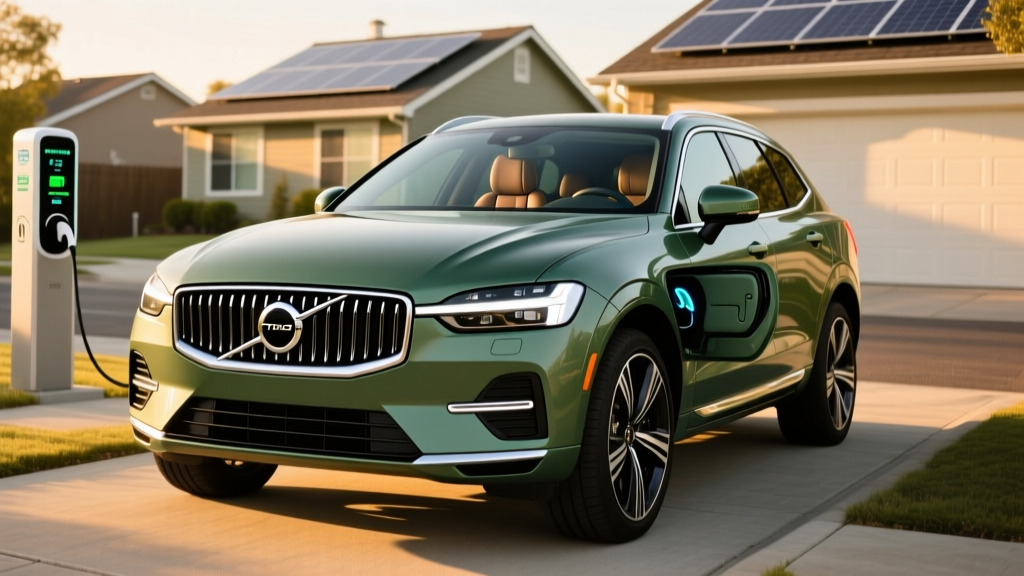
If you want a luxury compact SUV with electric-only commuting but aren't ready to commit to a full battery-electric vehicle, the 2025 Volvo XC60 Recharge plug-in hybrid occupies a compelling middle ground. With 35 miles of EPA-rated electric range, 455 combined horsepower, and standard all-wheel drive, it targets buyers who want daily EV driving with gas-engine backup for road trips. But does the math work? This guide breaks down real-world efficiency, charging logistics, battery longevity, and tax credit eligibility so you can decide whether the XC60 Recharge fits your driving life — or whether a conventional hybrid or full BEV serves you better.
HEV vs PHEV: What the XC60 Recharge Actually Is
Volvo sells the XC60 in two electrified flavors, and confusing them is easy. Here's the distinction:
XC60 Mild Hybrid (B5/B6) — Conventional HEV
- 48-volt mild-hybrid system assists the gas engine
- Cannot plug in; regenerates energy during braking
- No electric-only driving — the gas engine always runs
- EPA fuel economy: ~25 city / 30 hwy / 27 combined MPG
- No federal tax credit eligibility
XC60 Recharge (T8) — Plug-In Hybrid (PHEV)
- 18.8 kWh lithium-ion battery pack with a 143-hp electric motor on the rear axle
- Plugs in via Level 1 (120V) or Level 2 (240V) charging
- 35 miles of electric-only range before the gas engine engages
- EPA: 63 MPGe (electric + gas combined) / 28 MPG gas-only
- Potentially eligible for federal and state incentives
This article focuses on the XC60 Recharge T8 PHEV. If you don't have access to home or workplace charging, the mild-hybrid B5 is simpler and cheaper upfront — but you'll never drive on electricity alone.
Electric Range, MPG, and Real-World Efficiency
The EPA rates the 2025 XC60 Recharge at 35 miles of electric-only range and 63 MPGe when operating in blended electric-gas mode. Once the battery is depleted, the turbocharged and supercharged 2.0-liter four-cylinder engine delivers an EPA-estimated 28 MPG combined (26 city / 30 highway).
| Metric | EPA Rating | Real-World Expectation |
|---|---|---|
| Electric-only range | 35 miles | 28–33 mi (highway/cold weather); up to 38 mi (city, mild temps) |
| MPGe (blended) | 63 MPGe | 55–70 MPGe depending on charge frequency |
| Gas-only MPG (combined) | 28 MPG | 25–30 MPG (city favors regen; highway less efficient) |
| Gas-only city | 26 MPG | 24–28 MPG |
| Gas-only highway | 30 MPG | 27–32 MPG |
| Total combined range | ~440 miles | ~380–460 mi depending on driving conditions |
The PHEV advantage is charge frequency. If your daily commute is under 30 miles round-trip and you plug in nightly, you might visit a gas station once a month. If you never plug in, you're simply driving a heavy, slightly less efficient hybrid — the 28 MPG gas-only figure is respectable but not class-leading. A conventional Toyota RAV4 Hybrid returns 39 MPG combined without ever plugging in.
Powertrain Specs: 455 Horsepower, Standard AWD
The XC60 Recharge pairs a turbocharged and supercharged 2.0-liter four-cylinder engine with a rear-axle electric motor for a combined 455 horsepower and 523 lb-ft of torque. Power routes through an 8-speed automatic transmission with Volvo's eAWD system — the gas engine drives the front wheels, the electric motor drives the rear.
| Specification | 2025 Volvo XC60 Recharge T8 |
|---|---|
| Combined horsepower | 455 hp |
| Combined torque | 523 lb-ft |
| Gas engine | 2.0L turbo + supercharged I-4 (312 hp / 295 lb-ft) |
| Electric motor | Rear-axle P4 (143 hp / 228 lb-ft) |
| Battery capacity | 18.8 kWh (gross), ~14.9 kWh usable |
| Battery chemistry | NMC (nickel manganese cobalt) |
| 0–60 mph | 4.5 seconds |
| Transmission | 8-speed automatic |
| Drivetrain | eAWD (standard) |
| Towing capacity | 3,500 lbs |
| Cargo volume (rear seats up) | 25.8 cu ft |
| Cargo volume (rear seats folded) | 63.3 cu ft |
The 4.5-second 0–60 time makes the XC60 Recharge one of the quickest vehicles in its class. The electric motor provides instant torque from a standstill, and the transition between electric and gas power is nearly imperceptible in normal driving. Three driving modes — Pure (electric only), Hybrid (blended), and Power (maximum output) — let you tailor the powertrain to conditions.
Charging the XC60 Recharge: Level 1, Level 2, and What to Expect
The XC60 Recharge uses a standard J1772 connector for AC charging. There is no DC fast charging capability — a limitation shared with most PHEVs due to their smaller battery packs and cost packaging.
| Charging Level | Power (kW) | Time to Full (0–100%) | Miles of Range Added per Hour |
|---|---|---|---|
| Level 1 (120V household outlet) | ~1.4 kW | ~11–13 hours | ~3–4 miles |
| Level 2 (240V, home wallbox or public) | 3.7 kW (onboard charger limit) | ~5 hours | ~7–8 miles |
| DC Fast Charging | Not supported | N/A | N/A |
The onboard charger is limited to 3.7 kW, which means even a 48-amp Level 2 home charger won't speed things up — the car caps intake at 3.7 kW. A full charge from empty on Level 2 takes about 5 hours. For most PHEV owners, this is perfectly adequate: plug in when you get home, and the battery is full by morning. The 18.8 kWh battery is small enough that a standard 120V outlet can replenish it overnight if you're only using 15–20 miles of range daily.
Home charging setup cost: If you already have a 240V outlet (like a dryer outlet) near your parking spot, a portable Level 2 cord runs $200–$400. A hardwired Level 2 wallbox installation typically costs $500–$1,500 including equipment and electrician labor, depending on panel proximity and local permit requirements. For a PHEV with a 3.7 kW onboard limit, a basic 16-amp Level 2 unit is all you need — no need to invest in a 48-amp charger.
Pricing, Trims, and Tax Credit Eligibility
The 2025 Volvo XC60 Recharge starts at $58,950 (including destination) for the Core trim and climbs to $67,050 for the Ultimate trim. Volvo also offers Plus and Ultra trims in between.
| Trim | Starting MSRP | Key Additions |
|---|---|---|
| Core | $58,950 | 19" wheels, panoramic roof, Google built-in, Pilot Assist |
| Plus | $62,450 | 20" wheels, Harman Kardon audio, 360° camera, heated rear seats |
| Ultimate | $67,050 | 21" wheels, Nappa leather, head-up display, air purifier, crystal gear selector |
- Credit amount: Up to $3,750 for the XC60 Recharge. The vehicle's battery sourcing and critical-mineral content determine whether it qualifies for the full $7,500 or the partial $3,750. As of the 2025 model year, the XC60 Recharge typically qualifies for $3,750 (half-credit) due to battery component sourcing rules. Verify current status at IRS.gov clean vehicle credits.
- MSRP cap: SUVs must be under $80,000 — the XC60 Recharge qualifies across all trims.
- Buyer income cap: AGI must not exceed $150,000 (single), $225,000 (head of household), or $300,000 (joint filing).
- Point-of-sale transfer: You can transfer the credit to the dealer at purchase to reduce your out-of-pocket cost immediately, rather than waiting to claim it on your tax return.
- Assembly requirement: Must be assembled in North America. The XC60 is built in Sweden — this may disqualify it from the federal credit. Confirm with your dealer and a tax professional before relying on credit eligibility.
The Sweden assembly point is critical. Under §30D, vehicles must undergo final assembly in North America to qualify for the new clean vehicle credit. Because the XC60 is manufactured in Torslanda, Sweden, it may not qualify for the federal §30D credit. Some state-level incentives (such as those in California, Colorado, or New York) may still apply regardless of assembly location — check your state's energy office for current programs.
Battery Warranty, Reliability, and Replacement Cost
- Hybrid battery coverage: 8 years or 100,000 miles (whichever comes first)
- Capacity retention threshold: Volvo warrants the battery will retain at least 70% of original capacity during the warranty period
- Powertrain warranty: 4 years / 50,000 miles
- Basic vehicle warranty: 4 years / 50,000 miles
- Complimentary maintenance: 3 years / 36,000 miles (scheduled service included)
Volvo's hybrid battery warranty aligns with the industry standard for PHEVs. The 8-year/100,000-mile coverage and 70% capacity threshold mean Volvo will repair or replace the battery if it degrades below that benchmark during the warranty window. In practice, the 18.8 kWh NMC pack in the XC60 Recharge is relatively small and lightly stressed — it rarely sees full 0–100% cycles because the software maintains a buffer at both ends. Most PHEV batteries outlast their warranty periods with 85–90% capacity retention at year 8.
If you do need an out-of-warranty battery replacement, expect a cost between $8,000 and $12,000 including parts and labor. This is a significant expense, but it's rare before 150,000+ miles on a well-maintained PHEV. The smaller battery in a PHEV also means lower replacement cost compared to a full BEV's 75–100 kWh pack.
Reliability-wise, Volvo's PHEV powertrain has proven robust in recent model years. The T8 system has been in production since 2016 with iterative improvements. The most common owner complaints involve software glitches in the infotainment system (Google Automotive OS) rather than powertrain failures. IIHS has awarded the XC60 top safety ratings, and NHTSA gives it a 5-star overall score.
XC60 Recharge vs Full EV vs Conventional Hybrid: Which Fits You?
The XC60 Recharge makes sense for a specific buyer profile. Here's how to decide:
Choose the XC60 Recharge PHEV if:
- Your daily commute is under 35 miles round-trip and you can charge at home nightly
- You want electric commuting but need gas-engine flexibility for frequent road trips or towing
- You live in an area with sparse DC fast charging infrastructure
- You want luxury features and 455 hp without range anxiety
Choose a full EV (like the Volvo EX40 or BMW iX) if:
- You have reliable home Level 2 charging
- Your daily driving rarely exceeds 200 miles, and you're comfortable planning DC fast-charge stops on road trips
- You want to eliminate oil changes, spark plugs, and gas-engine maintenance entirely
- You want maximum federal tax credit eligibility ($7,500 on qualifying models)
Choose a conventional hybrid (like the XC60 B5 or Lexus NX 350h) if:
- You cannot charge at home or at work
- You want the lowest purchase price and simplest ownership experience
- Your priority is maximizing MPG without plug-in logistics
- You drive mostly highway miles (where PHEV electric range offers little benefit)
The PHEV's value proposition collapses if you don't plug it in. Data from the International Council on Clean Transportation shows that PHEVs driven without regular charging achieve real-world fuel economy 20–40% worse than their EPA ratings suggest. The XC60 Recharge is a fantastic vehicle when charged daily and an expensive, heavy hybrid when neglected.
Pros, Cons, and the Bottom Line
Pros
- 35 miles of electric range covers most daily commutes
- 455 hp and 4.5-second 0–60 — genuinely quick for a luxury SUV
- Standard AWD with capable eAWD torque vectoring
- Premium interior with Google Automotive OS
- 5 hours to full charge on Level 2 — easy overnight routine
- 8-year / 100,000-mile hybrid battery warranty
- 3,500-lb towing capacity (best in PHEV class)
Cons
- No DC fast charging — road trips run on gas only
- 3.7 kW onboard charger limits Level 2 speed
- Built in Sweden — likely ineligible for federal §30D tax credit
- $58,950 starting price is steep vs non-luxury PHEVs
- 28 MPG gas-only is unremarkable for a hybrid SUV
- Electric range drops to ~25 mi in freezing weather
- Rear cargo space slightly reduced vs non-hybrid XC60
The 2025 Volvo XC60 Recharge is a compelling package for luxury buyers who want electric daily driving without range anxiety. Its 455-hp powertrain, premium cabin, and standard AWD make it one of the most capable PHEV SUVs available. The main caveats are the likely federal tax credit ineligibility (due to Swedish assembly), the lack of DC fast charging, and the premium price. If you can charge at home and your commute fits within 35 miles, the XC60 Recharge delivers a near-EV daily experience with the security blanket of a gas engine.
Frequently Asked Questions
How many MPG does the 2025 Volvo XC60 Recharge get?
The EPA rates it at 63 MPGe in blended electric-gas operation and 28 MPG combined (26 city / 30 highway) on gas alone. Real-world gas-only MPG typically falls between 25–30 depending on driving style and conditions. If you charge daily and commute under 35 miles, your effective fuel consumption can drop to near zero for weekday driving.
How far can the XC60 Recharge go on electric only?
The EPA rates it at 35 miles of electric-only range. In real-world conditions, expect 28–33 miles on the highway or in cold weather, and up to 38 miles in city driving during mild temperatures. The 18.8 kWh battery (14.9 kWh usable) powers a 143-hp rear electric motor for genuine zero-emission commuting.
Does the 2025 Volvo XC60 Recharge qualify for the federal EV tax credit?
Likely not under §30D. The federal new clean vehicle credit requires final assembly in North America, and the XC60 is built in Sweden. Some buyers may qualify for state-level PHEV incentives regardless of assembly location. Always verify current eligibility on fueleconomy.gov and consult a tax professional before purchase.
Is the XC60 hybrid reliable, and what does battery replacement cost?
Volvo's T8 PHEV powertrain has proven reliable since its 2016 introduction, with most issues confined to infotainment software rather than the hybrid system. The battery is warranted for 8 years / 100,000 miles at 70% capacity retention. Out-of-warranty replacement costs approximately $8,000–$12,000, though most PHEV batteries last well beyond their warranty periods.
Can the XC60 Recharge DC fast charge?
No. The XC60 Recharge supports only AC charging — Level 1 (120V) at ~1.4 kW and Level 2 (240V) at up to 3.7 kW. A full Level 2 charge takes about 5 hours. This is typical for PHEVs, whose smaller batteries don't justify the cost and weight of DC fast-charging hardware.
How long does it take to charge the XC60 Recharge at home?
On a standard 120V outlet (Level 1), a full charge takes 11–13 hours. On a 240V Level 2 charger, it takes approximately 5 hours. Most owners plug in overnight and wake up to a full battery every morning — sufficient for the 35-mile electric range.
Should I buy the XC60 Recharge PHEV or the mild-hybrid B5?
If you can charge at home and your daily driving is under 35 miles, the Recharge PHEV lets you commute on electricity while keeping gas-engine flexibility. If you can't charge at home, or if most of your driving is highway, the B5 mild hybrid offers simpler ownership and comparable fuel economy at a lower purchase price — without the plug-in routine.