Quick Verdict: The 2025 Sienna's MPG Story
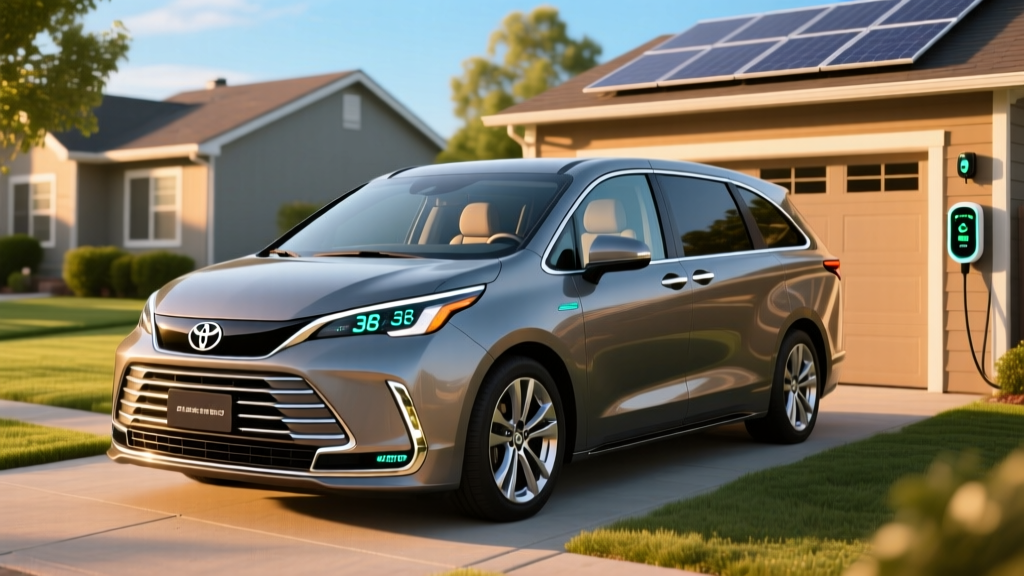
The 2025 Toyota Sienna is a hybrid-only minivan — every trim uses Toyota's fourth-generation hybrid powertrain with no conventional gas variant available. That decision pays off at the pump: the front-wheel-drive (FWD) Sienna returns an EPA-estimated 36 MPG combined, while the available all-wheel-drive (AWD) model drops only slightly to 35 MPG combined. For a three-row family hauler seating up to eight, those numbers rival compact sedans and undercut every non-hybrid minivan competitor by 10-15 MPG.
But EPA stickers only tell part of the story. Hybrid minivans behave differently in real-world driving than their ratings suggest — city MPG often exceeds the highway figure thanks to regenerative braking, and cold weather hits efficiency harder than buyers expect. This guide breaks down every trim's fuel economy, the powertrain behind it, battery longevity data, and whether the Sienna hybrid makes more sense for your family than a plug-in hybrid or full EV alternative.
2025 Toyota Sienna Hybrid MPG: EPA Ratings by Trim and Drivetrain
The 2025 Sienna lineup spans six trims — LE, XLE, XSE, Limited, Platinum, and Woodland Edition — but the fuel economy split comes down to one variable: front-wheel drive versus all-wheel drive. Toyota does not offer a plug-in hybrid Sienna in the US market, so every model is a conventional self-charging hybrid (HEV).
| Drivetrain | City MPG | Highway MPG | Combined MPG | Available Trims |
|---|---|---|---|---|
| FWD (245 hp) | 36 | 36 | 36 | LE, XLE, XSE, Limited, Platinum |
| AWD (245 hp) | 35 | 35 | 35 | LE, XLE, XSE, Limited, Platinum, Woodland Edition |
Source: EPA / fueleconomy.gov
The Sienna's EPA city and highway figures are identical (36/36 FWD), which is unusual and reflects how the hybrid system recovers energy in stop-and-go traffic. In real-world testing by owners and automotive journalists, the Sienna regularly achieves 38-42 MPG in city and suburban driving. Highway cruising at 75+ MPH typically yields 30-33 MPG — the electric motor assists less at sustained high speeds, and aerodynamic drag dominates.
Cold-weather note: Expect a 10-15% efficiency drop in sub-freezing temperatures. The gasoline engine runs more frequently to provide cabin heat and maintain battery temperature, pushing real-world winter combined MPG into the 28-32 range for FWD models.
Powertrain Breakdown: What Powers the Sienna's Efficiency
The 2025 Sienna uses Toyota's Hybrid Synergy Drive with a 2.5-liter inline-4 Atkinson-cycle engine paired with two electric motor-generators (one for FWD, plus a rear-mounted motor for AWD trims). The system produces a combined 245 horsepower.
| Specification | Detail |
|---|---|
| Engine | 2.5L 4-cylinder Atkinson-cycle |
| Combined System Output | 245 hp |
| Transmission | Electronic Continuously Variable (eCVT) |
| Hybrid Battery | 1.9 kWh nickel-metal hydride (NiMH) |
| Drivetrain Options | FWD or electronic AWD (rear motor) |
| 0-60 MPH (est.) | ~7.1 seconds (FWD) |
| Towing Capacity | 3,500 lbs (all trims) |
| Fuel Tank | 14.5 gallons |
| Total Driving Range (FWD) | ~522 miles per tank |
The 1.9 kWh battery pack is small by electrified-vehicle standards — it exists to buffer energy from regenerative braking and allow brief electric-only operation at low speeds (typically under 25 MPH for short distances). Unlike a plug-in hybrid, this battery recharges exclusively through regenerative braking and the gasoline engine. There is no plug, no charging port, and no electric-only driving range to speak of beyond parking-lot maneuvers.
The AWD system is worth a closer look: rather than a mechanical driveshaft, Toyota uses an independent rear electric motor that engages automatically when front-wheel slip is detected or during hard acceleration. This "electronic AWD" adds roughly 54 lbs and costs only 1 MPG combined compared to FWD — a negligible trade-off for buyers in snow-belt states.
HEV vs. PHEV vs. EV: Which Minivan Fits Your Family?
The Sienna occupies the conventional hybrid (HEV) category. Understanding where it sits relative to plug-in hybrids and full battery-electric vehicles is essential before you buy.
HEV (Sienna)
- No plug required
- 35-36 MPG combined
- ~522-mile total range
- No electric-only highway driving
- No federal tax credit
- Lowest upfront cost
PHEV (Chrysler Pacifica Hybrid)
- Plug in for 32 mi electric range
- 30 MPG combined after battery depletes
- ~430-mile total range
- Electric-only around town possible
- May qualify for used-EV credit
- Higher upfront cost
BEV (Kia EV9 / VW ID. Buzz)
- Full electric, no gas
- 230-270 mi EPA range
- Home + public charging required
- Zero tailpipe emissions
- Up to $7,500 federal credit (new)
- Highest upfront cost
The decision framework: Choose the Sienna HEV if you want maximum range without lifestyle changes — no charging habits, no range planning, just significantly better fuel economy than a gas minivan. Choose the Chrysler Pacifica Hybrid (PHEV) if you have home charging access, a short commute under 30 miles, and want to drive most weekdays on electricity while keeping gas for road trips. Choose a full BEV like the Kia EV9 if you have reliable home Level 2 charging, want to eliminate gas entirely, and your typical trips stay within ~200 miles between charge stops.
Real-World Ownership: MPG Patterns and Fuel Costs
Hybrid minivans reward a specific driving pattern. Owners who do mostly suburban and city driving — school runs, grocery trips, stop-and-go commutes — consistently report exceeding the EPA combined rating. The Sienna's regenerative braking system recovers kinetic energy that a conventional minivan would waste as brake heat, and the engine shuts off at stops.
Here's what annual fuel costs look like for a typical family driving 15,000 miles per year (60% city/suburban, 40% highway), assuming $3.40/gallon regular unleaded:
| Vehicle | Combined MPG | Gallons/Year | Annual Fuel Cost | 5-Year Fuel Cost |
|---|---|---|---|---|
| 2025 Toyota Sienna Hybrid (FWD) | 36 (real-world ~37) | 405 | $1,378 | $6,890 |
| 2025 Honda Odyssey (gas) | 22 | 682 | $2,318 | $11,590 |
| 2025 Chrysler Pacifica (gas V6) | 22 | 682 | $2,318 | $11,590 |
The Sienna hybrid saves roughly $940 per year and $4,700 over five years in fuel compared to its non-hybrid minivan competitors. Those savings partially offset the Sienna's higher starting price.
Pricing by Trim and Tax Credit Eligibility
The 2025 Toyota Sienna starts at an MSRP of approximately $39,485 (LE FWD, including destination) and climbs to roughly $55,000+ for the Platinum AWD and Woodland Edition trims. Here's the approximate trim pricing:
| Trim | FWD MSRP | AWD MSRP | EPA MPG (Combined) |
|---|---|---|---|
| LE | ~$39,485 | ~$40,285 | 36 / 35 |
| XLE | ~$43,285 | ~$44,085 | 36 / 35 |
| XSE | ~$45,285 | ~$46,085 | 36 / 35 |
| Limited | ~$50,435 | ~$51,235 | 36 / 35 |
| Platinum | ~$53,635 | ~$54,435 | 36 / 35 |
| Woodland Edition | N/A | ~$48,135 | 35 |
The 2025 Toyota Sienna is a conventional hybrid (HEV), not a plug-in hybrid or battery-electric vehicle. Under IRS §30D rules, the federal Clean Vehicle Credit of up to $7,500 applies only to new plug-in electric vehicles (BEVs and qualifying PHEVs) that meet battery-sourcing and critical-mineral requirements. The Sienna does not qualify for any federal purchase incentive.
Some states offer rebates or reduced registration fees for conventional hybrids, but these vary widely by jurisdiction. Check your state's energy or environmental agency for current programs. A tax professional can confirm any local incentives you may be eligible for.
Source: IRS.gov — Clean Vehicle Credits
Hybrid Battery Warranty, Lifespan, and Replacement Cost
The single most common question from hybrid buyers: how long will the battery last, and what happens when it fails?
- Hybrid Battery: 10 years / 150,000 miles (whichever comes first)
- Hybrid System Components: 8 years / 100,000 miles
- Basic Vehicle Warranty: 3 years / 36,000 miles
- Powertrain Warranty: 5 years / 60,000 miles
California-emissions states (CA, CT, ME, MA, NJ, NY, OR, RI, VT, WA) may have extended coverage requirements — check with your dealer for specifics.
Toyota's NiMH hybrid battery packs have an exceptional longevity track record. The Prius, which uses a chemically similar pack, routinely reaches 200,000+ miles on the original battery. The Sienna's 1.9 kWh pack operates within a narrow state-of-charge window (roughly 40-80%) managed by the hybrid control system, which significantly reduces degradation compared to the deep cycling seen in full EVs.
Replacement cost if out of warranty: A new Toyota hybrid battery pack for the Sienna typically runs $3,000-$5,000 installed at a dealership, though independent hybrid specialists can often perform the work for $2,000-$3,500. Refurbished or reconditioned packs are available for $1,500-$2,500. Given the 10-year/150,000-mile warranty and the pack's proven durability, most original owners will never face this expense.
Reliability, Safety, and Long-Term Ownership Data
Toyota's hybrid powertrain is among the most proven in the industry, with over 25 million hybrid vehicles sold globally since the original Prius in 1997. The Sienna, which transitioned to hybrid-only for the 2021 model year, inherits this mature system with minimal changes.
The IIHS has rated the Sienna a Top Safety Pick+ in prior model years, and the 2025 carries over the same structure and Toyota Safety Sense 2.5+ suite (pre-collision with pedestrian detection, full-speed adaptive cruise, lane-departure alert with steering assist, lane-tracing assist, and automatic high beams).
NHTSA has awarded the Sienna 5 stars overall in crash testing. The hybrid battery is mounted under the second-row seats, contributing to a low center of gravity without compromising cargo volume — the Sienna offers 33.5 cubic feet behind the third row and 101.0 cubic feet with the third row folded, identical to its pre-hybrid predecessor.
Pros
- Best-in-class minivan fuel economy (36/35 MPG)
- No plug required — zero lifestyle adjustment
- AWD available with only 1 MPG penalty
- Standard Toyota Safety Sense 2.5+
- 10-year/150,000-mile hybrid battery warranty
- 3,500-lb towing capacity across all trims
- Proven hybrid reliability track record
Cons
- No plug-in hybrid or EV variant available
- No federal tax credit eligibility
- 245 hp feels adequate but not quick for a loaded minivan
- Highway MPG drops to ~30-33 real-world at 75+ MPH
- Third-row seat does not fold into the floor (unlike some competitors)
- Higher starting price than base gas-only minivans
Who Should Buy the 2025 Sienna Hybrid?
- You want minivan space with sedan-like fuel economy and no charging infrastructure
- Your driving is a mix of city, suburban, and highway — the hybrid system excels everywhere
- You live in an area without reliable public charging and can't install a home charger
- You regularly take long road trips and don't want to plan around charging stops
- You want AWD for snow without the fuel-economy penalty of a conventional AWD minivan
- You have a short commute and home charging — the Pacifica Hybrid PHEV can do 32 miles electric-only
- You want zero tailpipe emissions and have charging access — consider the Kia EV9 or VW ID. Buzz
- You need more than 245 hp for mountain towing — the Sienna is adequate, not powerful
- You need a fold-flat third row for maximum cargo flexibility — Honda Odyssey's Magic Slide seats offer more configurations
Frequently Asked Questions
How many MPG does the 2025 Toyota Sienna hybrid get?
The FWD Sienna is EPA-rated at 36 MPG city / 36 MPG highway / 36 MPG combined. The AWD version rates 35/35/35. In real-world city and suburban driving, owners commonly report 38-42 MPG thanks to regenerative braking. Highway driving at 75+ MPH typically yields 30-33 MPG.
Does the Toyota Sienna hybrid need to be plugged in?
No. The 2025 Sienna is a conventional hybrid (HEV), not a plug-in hybrid. The 1.9 kWh battery recharges through regenerative braking and the gasoline engine. There is no charging port. You fuel it exactly like a conventional minivan — just less often.
Is the Sienna hybrid reliable, and what does battery replacement cost?
Toyota's hybrid system has over 25 years of proven reliability. The Sienna's hybrid battery is warrantied for 10 years/150,000 miles. If replacement is needed out of warranty, expect $3,000-$5,000 at a dealer or $2,000-$3,500 at an independent hybrid specialist. Most owners will never need a replacement based on historical Toyota hybrid data.
Does the 2025 Sienna qualify for any tax credit?
The Sienna does not qualify for the federal §30D Clean Vehicle Credit because it is a conventional hybrid, not a plug-in vehicle. Some states offer modest hybrid incentives — check your state energy office for current programs.
How does Sienna MPG compare to the Honda Odyssey and Chrysler Pacifica?
The gas-only Honda Odyssey and Chrysler Pacifica (non-hybrid V6) are EPA-rated around 22 MPG combined. The Sienna hybrid's 36 MPG combined represents a 64% improvement. Over 15,000 miles per year, that's roughly $940 in annual fuel savings.
Can the Sienna hybrid tow, and does towing affect MPG?
Yes — all 2025 Sienna trims are rated to tow 3,500 lbs when properly equipped. Towing a loaded trailer will significantly reduce fuel economy, likely into the 18-22 MPG range depending on weight and terrain. This is comparable to gas minivans under tow, but the Sienna still benefits from hybrid efficiency during lighter loads.
What is the total driving range on a full tank?
With a 14.5-gallon fuel tank and 36 MPG combined (FWD), the Sienna can travel approximately 522 miles between fill-ups. Real-world range varies with driving conditions — expect 435-480 miles on mostly highway trips and 550+ miles in city-heavy driving.