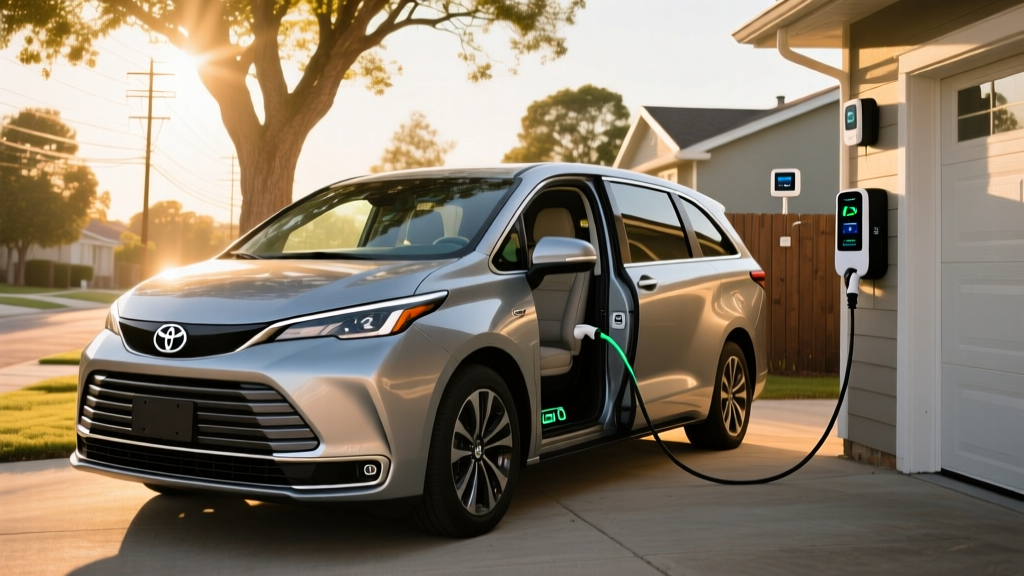
The 2025 Toyota Sienna Hybrid LE is the base trim of a minivan lineup that comes exclusively as a hybrid — no gasoline-only variant exists. For families weighing a three-row vehicle against full-electric SUVs or plug-in hybrid alternatives, the Sienna Hybrid LE occupies a specific niche: a self-charging hybrid (HEV) that delivers minivan space with midsize-sedan fuel economy, zero plug-in infrastructure required, and a starting MSRP that undercuts most electric rivals by $15,000 or more.
This guide breaks down the exact specs, real-world efficiency expectations, battery longevity data, and ownership economics you need before signing the paperwork.
HEV vs PHEV vs EV: Where the Sienna Fits
Before diving into numbers, it is critical to understand what the Sienna is not. It is a conventional hybrid electric vehicle (HEV), sometimes called a "self-charging hybrid." It has no plug, no electric-only driving range to speak of, and no eligibility for the federal §30D clean vehicle tax credit. If you are looking for a plug-in hybrid (PHEV) minivan with 30+ miles of electric commuting, the Sienna does not offer that — the Chrysler Pacifica Hybrid is the only PHEV minivan currently sold in the U.S.
| Factor | HEV (Sienna) | PHEV (Pacifica Hybrid) | BEV (e.g., Kia EV9) |
|---|---|---|---|
| Plug-in required? | No | Yes (Level 2 recommended) | Yes (Level 2 essential) |
| Electric-only range | ~0.5 mi at low speed | 32 mi (EPA) | 230–300 mi (EPA) |
| Total range | ~610 mi | ~520 mi combined | 230–300 mi |
| Fuel / energy cost | Gas only | Gas + electricity | Electricity only |
| Federal tax credit (§30D) | Not eligible | Not eligible (PHEV minivans phase out) | Up to $7,500 (varies) |
| Home charging install | None | $500–$2,000 (Level 2) | $800–$3,000+ (Level 2) |
| Starting MSRP (2025) | ~$39,485 | ~$51,095 | ~$54,900 |
The Sienna Hybrid LE is for you if: You want a three-row family hauler with low running costs, no charging logistics, road-trip flexibility, and a lower entry price. You do not have reliable home charging access, or you frequently drive 400+ miles in a day where charging stops would be disruptive.
Fuel Economy: EPA Ratings and Real-World MPG
The 2025 Toyota Sienna Hybrid LE carries EPA fuel economy ratings that put it in a class of its own among three-row vehicles. With front-wheel drive (FWD), the LE trim achieves:
| Drivetrain | City MPG | Highway MPG | Combined MPG | Fuel Tank (gal) | Total Range (mi) |
|---|---|---|---|---|---|
| FWD | 36 | 36 | 36 | 14.5 | ~522 |
| AWD (available) | 35 | 36 | 35 | 14.5 | ~508 |
Source: fueleconomy.gov
Real-World MPG: What Owners Actually See
Toyota's fourth-generation hybrid system excels in stop-and-go city driving, where the electric motor handles low-speed propulsion and regenerative braking recaptures energy. In real-world ownership:
- City/suburban driving: Many owners report 37–40 MPG in warm weather, slightly exceeding the EPA city rating. The Sienna can creep at low speeds on electric power alone for short distances, reducing fuel consumption in school-drop-off lines and traffic jams.
- Highway cruising (70–80 mph): Expect 32–34 MPG. Aerodynamic drag on a minivan body limits highway efficiency more than city efficiency, which is the inverse of most gas-only vehicles.
- Cold weather (below 30°F): Plan for 30–33 MPG combined. The engine runs more frequently to generate cabin heat and warm the catalytic converter, reducing electric-motor assist time.
- Loaded/towing: With a full cabin of passengers and cargo, or towing near the 3,500-lb max rating, expect 27–30 MPG.
For a vehicle this size — 203.7 inches long with seating for up to eight — averaging 36 MPG combined is genuinely remarkable. A comparable gas-only V6 minivan would return roughly 22 MPG combined, meaning the Sienna Hybrid saves approximately 230 gallons of fuel per year at 15,000 miles driven, or roughly $800–$1,000 annually at current fuel prices.
Powertrain and Performance Specs
| Specification | Detail |
|---|---|
| Engine | 2.5L 4-cylinder Atkinson cycle |
| Engine horsepower | 189 hp @ 6,000 rpm |
| Electric motor (front) | 134 hp, 199 lb-ft torque |
| Combined net horsepower | 245 hp |
| AWD rear motor (if equipped) | 40 hp (rear axle only) |
| Transmission | Continuously Variable (eCVT) |
| 0–60 mph (est.) | ~7.1 seconds |
| Towing capacity | 3,500 lbs |
| Drivetrain | FWD standard; electronic AWD available |
| Hybrid battery | 1.6 kWh (net), Nickel-Metal Hydride (NiMH) |
The Sienna's eCVT is not a belt-driven CVT like those in some competitors — it uses Toyota's planetary gearset to blend engine and motor power seamlessly. Acceleration is smooth and adequate for merging, though 245 hp in a 4,600-lb vehicle won't feel quick. The AWD system adds a dedicated rear electric motor (no mechanical driveshaft) that engages only when slip is detected, preserving most of the FWD fuel economy advantage.
The 1.6 kWh NiMH hybrid battery is small by PHEV or BEV standards — it cannot power the van for meaningful distances on electricity alone. Its role is to buffer regenerative energy and provide torque fill during acceleration. Because it cycles in shallow charge/discharge windows (typically staying between 40–80% state of charge), degradation is minimal over the vehicle's lifespan.
Pricing, Trims, and Tax Credit Eligibility
The 2025 Toyota Sienna Hybrid LE starts at an MSRP of approximately $39,485 (including destination charge). As the base trim, it includes:
- Toyota Safety Sense 2.5+ (adaptive cruise control, lane-keeping assist, automatic emergency braking, blind-spot monitoring)
- 8-inch touchscreen with wireless Apple CarPlay and Android Auto
- Tri-zone automatic climate control
- Power-sliding rear doors
- 7-passenger seating (8-passenger available on some trims)
Federal Tax Credit Status
The Sienna Hybrid LE does not qualify for the federal §30D Clean Vehicle Credit. Under current IRS rules, the §30D credit applies only to plug-in electric vehicles (BEVs and PHEVs) that meet battery capacity thresholds, critical-mineral sourcing requirements, MSRP caps, and buyer income limits. Conventional hybrids like the Sienna are excluded entirely.
Some states offer their own incentives for hybrid vehicles, though these are less common than EV incentives. Check your state's energy or environmental agency website for current programs. No federal incentive is available at the point of sale for this vehicle.
Battery Warranty, Reliability, and Replacement Cost
Toyota Hybrid Battery Warranty
Toyota covers the Sienna's hybrid battery for 10 years or 150,000 miles (whichever comes first) under its Hybrid Battery Warranty. This coverage applies in all 50 states and is transferable to subsequent owners. Toyota also provides a 10-year/150,000-mile Hybrid System Component warranty covering the inverter, converter, and ECU.
Long-Term Reliability Data
Toyota's hybrid system is among the most proven in the industry. The Prius fleet has accumulated billions of real-world miles since 2000, and the fourth-generation hybrid architecture in the Sienna shares core engineering principles. Key reliability indicators:
- NiMH battery longevity: Toyota's NiMH hybrid batteries routinely last 150,000–200,000+ miles before significant capacity loss. Unlike the larger lithium-ion batteries in PHEVs and BEVs, the Sienna's small NiMH pack is rarely stressed — it never deep-cycles and operates in a narrow state-of-charge window managed by the vehicle's computer.
- Replacement cost: If the hybrid battery does fail outside warranty, a new OEM replacement costs approximately $3,000–$4,500 installed at a Toyota dealer. Refurbished/reconditioned packs are available for $1,500–$2,500. For context, this is far less than a BEV battery replacement ($8,000–$20,000+).
- No plug-in infrastructure costs: Unlike PHEVs and BEVs, there is zero home charging equipment to purchase or install — saving $500–$3,000 upfront.
- Brake wear: Regenerative braking significantly reduces pad wear. Many Sienna hybrid owners report original brake pads lasting 80,000–100,000 miles.
Toyota's hybrid vehicles consistently earn top reliability scores from Consumer Reports and strong owner-satisfaction ratings. The Sienna specifically benefits from a relatively simple powertrain — no turbocharger, no traditional automatic transmission with clutch packs, and no high-voltage charging system to maintain.
Sienna Hybrid LE vs the Alternatives
How does the Sienna Hybrid LE stack up against the other minivans and three-row electrified vehicles on the market?
| Vehicle | Type | Combined MPG / MPGe | Starting MSRP | Electric Range |
|---|---|---|---|---|
| Toyota Sienna Hybrid LE | HEV | 36 MPG | $39,485 | N/A |
| Honda Odyssey | Gas | 22 MPG | $38,540 | N/A |
| Chrysler Pacifica Hybrid | PHEV | 30 MPG + 82 MPGe | $51,095 | 32 mi |
| Kia EV9 (Land) | BEV | 88 MPGe | $54,900 | 230 mi (EPA) |
| Hyundai Santa Fe Hybrid | HEV | 34 MPG | $40,550 | N/A |
The Sienna Hybrid LE wins on combined fuel economy among non-plug-in minivans and offers the lowest entry price among electrified three-row options. The Pacifica Hybrid makes sense only if you have home Level 2 charging and a short commute that fits within its 32-mile electric range. The EV9 eliminates gasoline entirely but costs $15,000+ more and requires reliable charging access.
Who Should Buy the Sienna Hybrid LE — And Who Shouldn't
Choose the Sienna Hybrid LE If:
- You need three rows and want the lowest possible fuel cost without plugging in
- You lack home charging access (apartment, street parking, no garage outlet)
- You regularly take 400+ mile road trips and don't want to plan charging stops
- You want a lower purchase price — $10,000–$15,000 less than PHEV or BEV alternatives
- You prioritize proven reliability and low long-term maintenance costs
- You want standard Toyota Safety Sense without paying extra for ADAS features
Look Elsewhere If:
- You want electric-only commuting (consider the Pacifica Hybrid or a BEV)
- You want to qualify for the $7,500 federal tax credit (HEVs are excluded)
- You need more than 3,500 lbs of towing capacity
- You want a sporty driving experience — the Sienna is tuned for comfort, not engagement
- You want captain's chairs in the second row (not available on the base LE; step up to XLE or Limited)
Quick Decision Framework
Sienna Hybrid LE: No charger at home, drive 30+ miles daily, need 3 rows, want lowest total cost.
Pacifica Hybrid (PHEV): Have Level 2 charging, commute under 30 miles, want some electric-only driving.
Kia EV9 or BEV: Have reliable home + destination charging, want zero tailpipe emissions, qualify for tax credit, budget is flexible.
Ownership Costs Over 5 Years
At 15,000 miles per year and $3.50/gallon regular unleaded, the Sienna Hybrid LE's fuel cost works out to approximately $1,458/year — roughly $950 less per year than the gas-only Honda Odyssey at 22 MPG combined. Over five years, that fuel savings totals about $4,750, partially offsetting the Sienna's slightly higher purchase price versus the Odyssey.
Insurance costs for the Sienna Hybrid tend to be moderate — typically $1,400–$1,800/year depending on your profile and state. Maintenance is minimal: oil changes every 10,000 miles, cabin air filter replacements, and tire rotations. There is no spark plug replacement interval to worry about in the short term (Toyota rates them at 120,000 miles), and the eCVT has no transmission fluid changes on the standard schedule.
Frequently Asked Questions
How many MPG does the 2025 Toyota Sienna Hybrid LE get?
The EPA rates the FWD Sienna Hybrid LE at 36 MPG city, 36 MPG highway, and 36 MPG combined. In real-world driving, owners commonly see 37–40 MPG in city conditions and 32–34 MPG on the highway. Cold weather reduces combined efficiency to roughly 30–33 MPG.
Does the Toyota Sienna Hybrid need to be plugged in?
No. The Sienna is a conventional hybrid (HEV), not a plug-in hybrid (PHEV). It charges its small battery entirely through regenerative braking and the gasoline engine. There is no plug, no charging cable, and no need for any home electrical work.
Can the Sienna Hybrid drive on electric power alone?
Only at very low speeds (under ~25 mph) for very short distances (roughly half a mile). The 1.6 kWh NiMH battery is too small to provide meaningful electric-only range. If electric-only commuting is a priority, you need a PHEV or BEV.
Is the Sienna Hybrid battery reliable, and what does replacement cost?
Toyota's NiMH hybrid batteries are among the most durable in the industry, routinely lasting 150,000–200,000+ miles. Toyota covers the battery for 10 years/150,000 miles. Out-of-warranty replacement costs approximately $3,000–$4,500 for a new OEM pack, or $1,500–$2,500 for a refurbished unit.
Does the 2025 Sienna Hybrid LE qualify for any tax credit?
No. The federal §30D Clean Vehicle Credit applies only to plug-in vehicles (BEVs and qualifying PHEVs). The Sienna, as a conventional hybrid, is not eligible. Some states may offer minor hybrid incentives — check your state energy office. Per IRS guidelines, only vehicles with plug-in charging capability and qualifying battery sourcing can receive the credit.
How does the Sienna Hybrid compare to the Chrysler Pacifica Hybrid?
The Pacifica Hybrid is a PHEV with 32 miles of electric-only range and an EPA rating of 82 MPGe when running on electricity. However, it starts at roughly $11,600 more than the Sienna LE and requires home Level 2 charging to realize its efficiency advantage. If you can charge at home and commute under 30 miles, the Pacifica Hybrid can run mostly on electricity. If you lack charging access or take frequent long trips, the Sienna's simpler HEV system is more practical and more affordable.
What is the Sienna Hybrid LE's towing capacity?
The 2025 Sienna Hybrid is rated to tow up to 3,500 lbs when properly equipped. This is adequate for a small boat trailer, light camping trailer, or utility trailer but less than some body-on-frame SUVs. Toyota does not offer a heavy-duty towing package for the Sienna.
The 2025 Toyota Sienna Hybrid LE makes a compelling case as the default family vehicle for buyers who want three-row practicality without the complexity, cost, or infrastructure demands of plug-in electrification. Its 36 MPG combined rating is not a marketing aspirational number — it is a realistic, achievable figure in everyday driving, and many owners exceed it in city conditions. With a 10-year/150,000-mile hybrid battery warranty, proven NiMH longevity, and a starting price under $40,000, it remains the most cost-effective way to move a family efficiently.