Quick Verdict: The RAV4 Prime Still Sets the PHEV Benchmark
The 2025 Toyota RAV4 Plug-In Hybrid — sold under Toyota's "Prime" badge — remains one of the most compelling electrified SUVs on the market. With an EPA-rated 42 miles of electric-only range, 302 combined horsepower, and standard all-wheel drive, it threads the needle between daily EV commuting and gas-powered road-trip freedom. For buyers who want electric driving without range anxiety, the RAV4 Prime is a proven, data-backed choice.
But how does it stack up in real-world driving? What does charging actually look like? And does it still qualify for any federal tax incentives in 2025? This guide covers every number that matters.
The standard RAV4 Hybrid (HEV) charges its small battery through regenerative braking and the gas engine — you never plug it in. The RAV4 Prime (PHEV) has a much larger battery you can plug in to charge, giving it a substantial electric-only driving range before the gas engine kicks in. Both are "hybrids," but the ownership experience is fundamentally different.
Spec Sheet: 2025 Toyota RAV4 Prime at a Glance
| Specification | Value |
|---|---|
| EPA Electric-Only Range | 42 miles |
| EPA MPGe (electric + gas) | 94 MPGe combined |
| EPA MPG (gas-only, after battery depletes) | 38 MPG combined (40 city / 36 highway) |
| Total Combined Range | ~600 miles (electric + 14.5-gal tank) |
| Battery Capacity | 18.1 kWh (gross), ~14.5 kWh usable |
| Battery Chemistry | Lithium-ion (NMC) |
| Combined Horsepower | 302 hp |
| 0–60 mph | 5.7 seconds |
| Drivetrain | AWD (standard, electronic rear motor) |
| Level 2 Charge Time (0–100%) | ~2.5 hours at 6.6 kW |
| DC Fast Charging | Not supported |
| Base MSRP (SE trim) | $43,865 |
| XSE Trim MSRP | $47,075 |
| Federal Tax Credit (§30D) | Not eligible (Japan-assembled) |
Sources: EPA fueleconomy.gov, Toyota.com
Fuel Economy: EPA Numbers vs. Real-World MPG
| Driving Mode | City | Highway | Combined |
|---|---|---|---|
| Electric-Only (MPGe) | 94 MPGe | 94 MPGe | 94 MPGe |
| Hybrid (Gas-Only after depletion) | 40 MPG | 36 MPG | 38 MPG |
Real-world expectations: The RAV4 Prime's 38 MPG combined gas-only rating is already strong for a 4,200-lb AWD SUV. In practice, many owners report exceeding the EPA city figure — hybrids recapture energy through regenerative braking in stop-and-go traffic, so 42–45 MPG in city driving is common. Highway cruising at 75+ mph will pull numbers closer to 33–35 MPG.
On electric power alone, the EPA's 42-mile rating assumes moderate speeds and temperatures. Expect 35–38 miles in real-world mixed driving, and potentially as low as 28–30 miles in freezing weather with cabin heat running. The heat pump is not standard on all trims, so cold-weather range loss is a genuine factor for northern-climate owners.
Powertrain and Performance: 302 HP Is No Accident
The RAV4 Prime pairs a 2.5-liter four-cylinder Atkinson-cycle engine (177 hp, 165 lb-ft) with two electric motors — a front motor producing 134 kW and a rear motor producing 40 kW. Combined system output is 302 horsepower, making it the most powerful RAV4 variant Toyota sells.
The result is a 0–60 mph time of 5.7 seconds — quicker than many sport sedans, let alone compact SUVs. The electronic AWD system engages the rear motor on demand, providing traction without a mechanical driveshaft. In EV mode, the Prime runs purely on electric power up to approximately 84 mph before the engine engages.
Driving modes include EV (electric-priority), HV (hybrid), and Auto EV/HV, which lets the system decide based on navigation data and driving conditions. A Charge mode can run the engine to replenish the battery — useful if you need electric range later in a trip, such as for a zero-emission zone or quiet neighborhood arrival.
Charging the RAV4 Prime: What You Need to Know
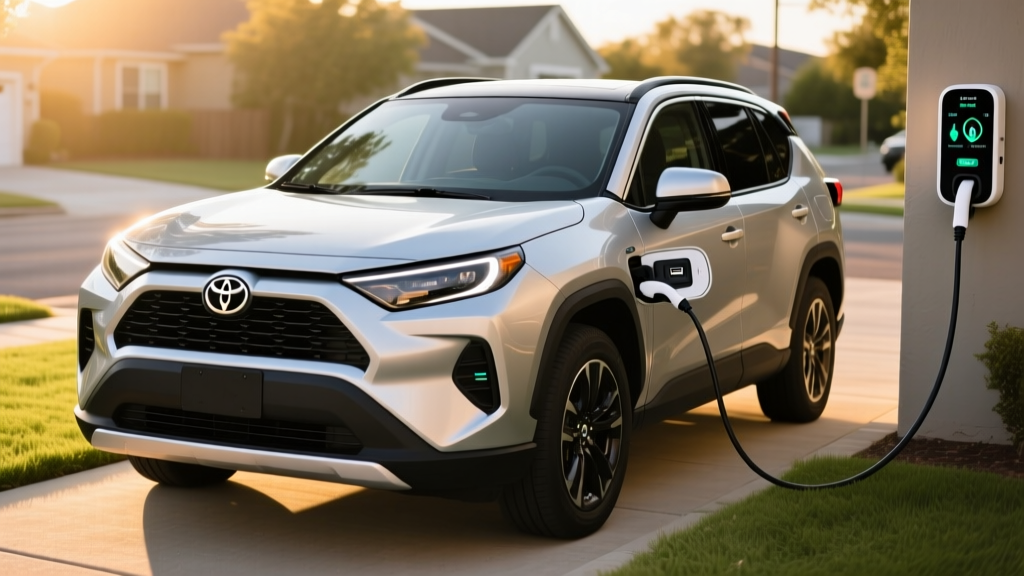
The RAV4 Prime uses a J1772 connector for Level 1 and Level 2 AC charging. It does not support DC fast charging — there's no CCS or CHAdeMO port. This is typical for PHEVs, which have smaller batteries that don't require rapid replenishment.
| Charging Level | Power | 0–100% Time | Practical Use |
|---|---|---|---|
| Level 1 (120V outlet) | ~1.4 kW | ~12 hours | Overnight top-up, partial refill |
| Level 2 (240V, 32A) | 6.6 kW (onboard max) | ~2.5 hours | Home wall charger, workplace |
Key charging insight: The onboard charger caps at 6.6 kW, so even a 48-amp Level 2 station won't charge it faster. A standard 240V/32A home charger is the sweet spot — it fully refills the battery in roughly 2.5 hours, meaning you can easily recharge during the workday or between errands.
Level 1 charging from a standard household outlet will add roughly 4–5 miles of electric range per hour. If your daily commute is under 20 miles round-trip, Level 1 alone may suffice, though a Level 2 home installation (~$500–$1,200 for a basic setup) unlocks the full PHEV experience.
Battery Longevity, Warranty, and Replacement Cost
Toyota covers the RAV4 Prime's hybrid battery for 10 years or 150,000 miles (whichever comes first) in all 50 states. This warranty guarantees the battery will retain sufficient capacity to function as designed. The broader hybrid system (inverter, control module, motors) carries the same 10-year/150,000-mile coverage.
Toyota's hybrid battery track record is among the best in the industry. The Prius, which has used similar battery technology for over two decades, routinely sees original batteries lasting 200,000+ miles with gradual capacity loss rather than sudden failure. The RAV4 Prime's 18.1 kWh pack uses proven NMC lithium-ion cells with conservative thermal management — Toyota prioritizes longevity over maximum energy density.
Battery replacement cost: If the battery does need replacement outside warranty, expect a dealer-installed pack to cost between $4,000 and $6,500 depending on labor rates. Third-party refurbishment shops offer reconditioned packs for $2,500–$4,000. Given the 10-year/150,000-mile warranty and Toyota's reliability history, most original owners will never face this expense.
Pricing, Trims, and Tax Credit Eligibility
The 2025 RAV4 Prime comes in two trims:
- SE: $43,865 MSRP — includes 18-inch wheels, SofTex seats, 9-inch touchscreen, wireless Apple CarPlay/Android Auto, heated front seats, power liftgate
- XSE: $47,075 MSRP — adds 19-inch wheels, panoramic moonroof option, ambient lighting, paddle shifters, upgraded interior accents
Popular option packages (Premium Package, Advanced Technology Package) can push a fully loaded XSE above $55,000.
The 2025 Toyota RAV4 Prime does not qualify for the $7,500 federal EV tax credit under IRS §30D. The credit requires final assembly in North America, and the RAV4 Prime is built in Japan. Per IRS eligible vehicle lists, Toyota's plug-in offerings do not currently meet the assembly requirement.
Some states offer their own PHEV incentives (California, Colorado, and others). Check your state's energy office or DMV for current programs.
RAV4 Prime vs. Full EV vs. Gas RAV4: Which Fits You?
Choose the RAV4 Prime (PHEV) If:
- Your commute is under 40 miles round-trip and you can charge at home
- You take road trips and don't want to plan around chargers
- You want EV-like daily driving without full EV commitment
- You need AWD and a proven reliability record
Choose a Full EV If:
- You have reliable home Level 2 charging
- Your daily driving is under 200 miles
- You want zero tailpipe emissions and minimal maintenance
- You want to qualify for the $7,500 federal credit (on eligible models)
Choose the Gas RAV4 or Standard Hybrid If:
- You can't install a home charger (apartment, street parking)
- You want the lowest purchase price
- Your daily mileage is unpredictable or very high
- You don't want to think about plugging in at all
The standard RAV4 Hybrid (HEV) gets an EPA 41 MPG combined and starts around $33,000 — a strong choice if charging access is a barrier. But if you can plug in, the Prime's 42 miles of electric range means many owners burn almost no gasoline on weekdays.
Pros and Cons
Pros
- 42 miles electric-only — longest of any compact PHEV SUV
- 302 hp with 5.7s 0–60 — genuinely quick
- 38 MPG gas-only after battery depletes — no efficiency penalty
- Standard AWD with dedicated rear electric motor
- 10-year/150,000-mile hybrid battery warranty
- Proven Toyota reliability and strong resale value
Cons
- No DC fast charging — limits road-trip electric replenishment
- Does not qualify for the $7,500 federal tax credit
- Premium pricing — $44K+ before options
- Real-world EV range drops to ~30 mi in cold weather
- Limited dealer inventory — waitlists remain common
- Infotainment interface lags behind competitors
Frequently Asked Questions
How many MPG does the 2025 RAV4 Prime get?
Once the battery is depleted, the RAV4 Prime operates as a conventional hybrid and achieves an EPA-rated 38 MPG combined (40 city / 36 highway). In real-world city driving with frequent regenerative braking, many owners report 42–45 MPG. Highway driving at sustained speeds yields closer to 33–35 MPG.
How far can the RAV4 Prime go on electric only?
The EPA rates it at 42 miles on a full charge. Real-world mixed driving typically yields 35–38 miles. In cold weather (below 32°F) with cabin heating, expect 28–30 miles. The total combined range (electric + 14.5-gallon gas tank) exceeds 600 miles.
Does the 2025 RAV4 Prime qualify for a tax credit?
It does not qualify for the federal §30D clean vehicle credit because it is assembled in Japan, not North America. State-level incentives may apply — California's CVRP, Colorado's innovative motor vehicle credit, and utility-company rebates are worth checking. Consult IRS.gov for the current eligible vehicle list.
Is the RAV4 Prime reliable, and what does a battery replacement cost?
Toyota's hybrid powertrains have an exceptional reliability record spanning two decades. The hybrid battery is warrantied for 10 years/150,000 miles. Out-of-warranty replacement runs $4,000–$6,500 at a dealer, or $2,500–$4,000 through independent hybrid specialists. Most owners never need a replacement.
Can I charge the RAV4 Prime at a public DC fast charger?
No. The RAV4 Prime only accepts AC charging via a J1772 connector, up to 6.6 kW on Level 2. There is no DC fast-charge port. This is standard for plug-in hybrids — the battery is small enough that Level 2 fully replenishes it in about 2.5 hours.
Should I buy the RAV4 Prime or a full EV like the Tesla Model Y?
If you can charge at home and your daily driving stays under 40 miles, the Prime lets you commute on electricity while keeping a gas engine for road trips. A full EV like the Model Y offers lower running costs, faster acceleration, and access to the Supercharger network — but requires planning for longer trips. The Prime is the lower-risk entry point to electric driving; a full EV is the higher-reward commitment.