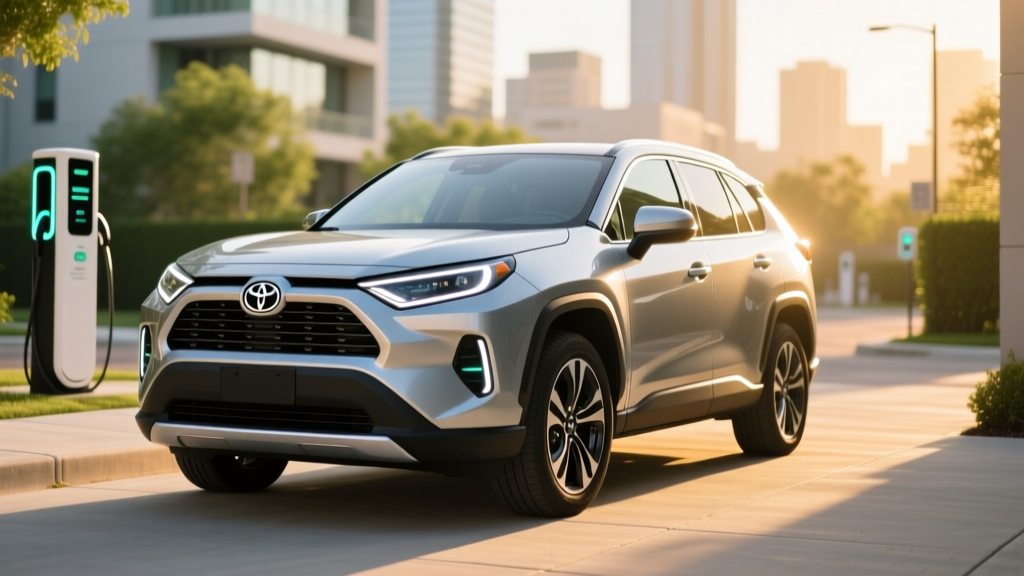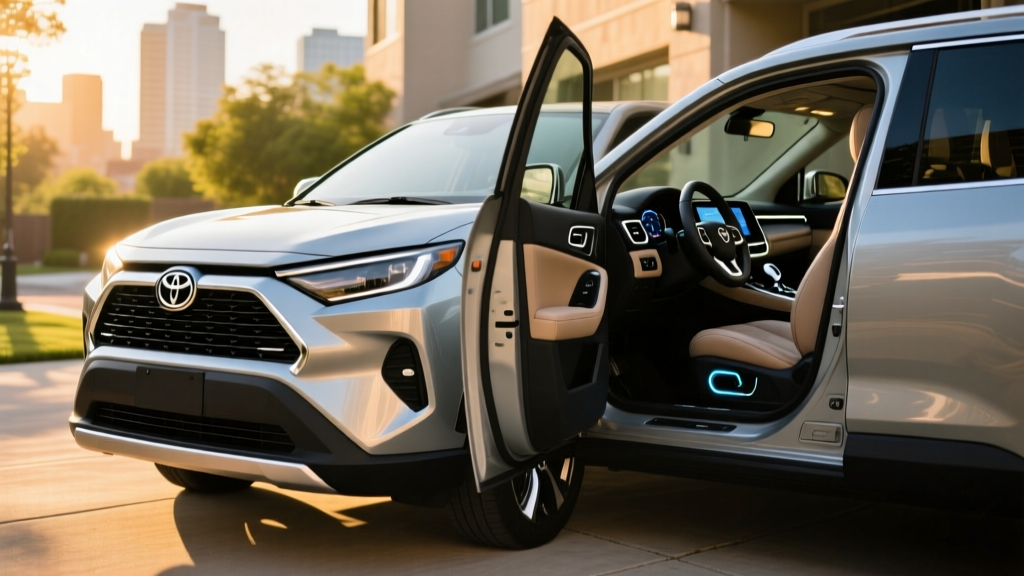
The 2025 Toyota RAV4 Hybrid XLE sits in a rare sweet spot for hybrid SUV buyers: it offers standard all-wheel drive, proven reliability, and nearly 40 MPG combined without ever needing a plug. At a starting MSRP of $33,445 (including destination), it undercuts the RAV4 Prime plug-in hybrid by over $10,000 while still delivering meaningful fuel savings over a gas-only compact SUV. This guide covers everything a research-driven buyer needs — from EPA fuel economy to real-world MPG, battery longevity, and how the XLE trim stacks up against both the RAV4 Prime PHEV and a full battery-electric alternative.
2025 Toyota RAV4 Hybrid XLE: Key Specifications
| Specification | Value |
|---|---|
| Powertrain | 2.5L 4-cyl + 3 electric motors (AWD-i) |
| Combined Horsepower | 219 hp (net) |
| EPA Fuel Economy (City / Hwy / Combined) | 41 / 38 / 39 MPG |
| Fuel Tank Capacity | 14.5 gallons |
| Total Driving Range | ~565 miles |
| Drivetrain | Electronic On-Demand AWD |
| 0–60 mph | ~7.4 seconds |
| Cargo Volume (behind rear seats) | 37.5 cu ft |
| Towing Capacity | 1,750 lbs |
| Hybrid Battery Warranty | 10 years / 150,000 miles |
| Starting MSRP (incl. destination) | $33,445 |
Fuel Economy: EPA Ratings vs. Real-World MPG
The EPA rates the 2025 RAV4 Hybrid XLE at 41 MPG city, 38 MPG highway, and 39 MPG combined, per fueleconomy.gov. These figures apply across all RAV4 Hybrid trims because they share the same powertrain and weight class.
| Driving Condition | EPA MPG | Real-World Expectation |
|---|---|---|
| City | 41 MPG | 42–45 MPG (regenerative braking favors stop-and-go) |
| Highway (70 mph) | 38 MPG | 35–37 MPG (aerodynamic drag reduces hybrid advantage) |
| Combined | 39 MPG | 38–42 MPG (depends on city/highway mix) |
| Cold Weather (below 32°F) | N/A | 33–36 MPG combined (engine runs more for cabin heat) |
Toyota's hybrid synergy drive excels in city driving, where the electric motors handle low-speed propulsion and regenerative braking recovers energy at every stop. Owners consistently report beating the EPA city estimate by 2–4 MPG in warm-weather urban commuting. Highway driving tells a different story: sustained high speeds reduce the electric motor's contribution, and the 2.5-liter engine carries most of the load. Expect 35–37 MPG on long interstate trips at 70–75 mph.
Cold weather is the hybrid's biggest efficiency penalty. Below freezing, the gasoline engine runs more frequently to generate cabin heat (since there's no waste heat from an electric motor like in a BEV), dropping combined MPG into the low-to-mid 30s. This is a known characteristic of all conventional hybrids and is worth factoring in if you live in northern climates.
HEV vs. PHEV: RAV4 Hybrid vs. RAV4 Prime
Toyota offers the RAV4 in two electrified flavors: the conventional RAV4 Hybrid (HEV) and the plug-in RAV4 Prime (PHEV). The XLE trim is available only on the HEV. Understanding the distinction is critical before you buy.
Conventional Hybrid (HEV) — RAV4 Hybrid XLE
- No plug required. The 1.6 kWh nickel-metal hydride (NiMH) battery charges itself through regenerative braking and the gasoline engine.
- Electric-only driving is limited to brief low-speed bursts (typically under 1 mile at speeds below 25 mph).
- Fuel economy: 39 MPG combined at all times, regardless of driving pattern.
- Lower upfront cost: $33,445 starting MSRP.
Plug-In Hybrid (PHEV) — RAV4 Prime
- Requires plug-in charging to access its full electric range. Features an 18.1 kWh lithium-ion battery.
- EPA-rated 42 miles of electric-only driving — enough for most daily commutes without using gas.
- Once the battery depletes, it operates as a conventional hybrid at ~38 MPG combined.
- Higher upfront cost: starts at $44,515 for the SE trim (2025 model year).
- 302 hp combined — significantly quicker than the HEV (0–60 in ~5.7 seconds).
| Attribute | RAV4 Hybrid XLE (HEV) | RAV4 Prime SE (PHEV) |
|---|---|---|
| Powertrain | 2.5L + 3 motors, 219 hp | 2.5L + 2 motors, 302 hp |
| Battery | 1.6 kWh NiMH | 18.1 kWh Li-ion |
| Electric-Only Range | ~1 mile (low speed) | 42 miles (EPA) |
| Combined MPG / MPGe | 39 MPG | 94 MPGe (elec) / 38 MPG (gas) |
| Total Range | ~565 miles | ~600 miles |
| Plug-In Charging | No | Yes — Level 2 (~2.5 hrs) |
| DC Fast Charging | N/A | No |
| 0–60 mph | ~7.4 sec | ~5.7 sec |
| Starting MSRP | $33,445 | $44,515 |
| Federal Tax Credit (§30D) | Not eligible | Not eligible (assembled in Japan) |
Powertrain and Driving Dynamics
The RAV4 Hybrid XLE uses Toyota's fifth-generation Hybrid Synergy Drive. A 2.5-liter Atkinson-cycle four-cylinder engine produces 176 hp and 163 lb-ft of torque on its own, supplemented by two front-mounted electric motors and one rear motor for AWD. Combined net output is 219 horsepower.
The AWD-i system is fully electronic — there is no mechanical driveshaft connecting the front and rear axles. Instead, the rear electric motor engages the back wheels when slip is detected or during hard acceleration. This means AWD is available on demand without the constant parasitic loss of a traditional mechanical system, which is a key reason the hybrid achieves better fuel economy than the gas RAV4 AWD (28 MPG combined).
Acceleration to 60 mph takes approximately 7.4 seconds. That's adequate for highway merging and confident enough for most daily driving, though it won't feel sporty. The continuously variable transmission (eCVT) is smooth but can produce a drone under hard acceleration — a characteristic of all Toyota hybrids. The XLE trim rides on 18-inch wheels with a compliant ride quality that prioritizes comfort over cornering agility.
XLE Trim: What You Get for $33,445
The XLE is the mid-range RAV4 Hybrid trim and the most popular among buyers. For the $33,445 MSRP, Toyota includes:
- 8-inch touchscreen with wireless Apple CarPlay and Android Auto
- Toyota Safety Sense 2.5+ (pre-collision, lane-departure, adaptive cruise, blind-spot monitor)
- Dual-zone automatic climate control
- Smart Key with push-button start
- 18-inch alloy wheels
- LED headlights and taillights
- Fabric-trimmed heated front seats
- Five USB-C ports
Notable omissions at this price point: no panoramic sunroof (available on higher trims), no ventilated seats, no JBL premium audio, and no heated steering wheel (available as a $195 standalone option). The XLE also lacks the 10.5-inch infotainment upgrade found on the Limited and Woodland Edition trims.
Tax Credits and Incentives
The 2025 RAV4 Hybrid XLE does not qualify for the federal §30D Clean Vehicle Credit. The §30D credit applies only to plug-in electric vehicles (BEVs and PHEVs), and conventional hybrids are excluded by statute. This is confirmed by the IRS Clean Vehicle Credit guidelines.
The RAV4 Prime PHEV also fails to qualify for the federal credit despite being a plug-in vehicle, because it is assembled in Japan and does not meet the §30D North American final assembly requirement. Buyers should not expect any federal incentive for either RAV4 variant.
State and Local Incentives
Some states offer rebates or tax credits for hybrid vehicles, though these programs vary widely and change frequently. California's Clean Fuel Reward, for example, has historically included hybrid models but amounts and eligibility shift annually. Check your state's energy office or DMV website for current programs. Your tax professional can advise on any local credits that may apply to your specific situation.
Battery Longevity, Warranty, and Replacement Cost
Hybrid Battery Warranty
Toyota covers the RAV4 Hybrid's high-voltage battery for 10 years or 150,000 miles (whichever comes first) across all 50 states. This warranty guarantees the battery will retain sufficient capacity to operate the hybrid system. Toyota also covers hybrid system components (inverter, control module, electric motors) under the same 10-year/150,000-mile hybrid system warranty.
Source: Toyota Warranty Guide
The RAV4 Hybrid uses a relatively small 1.6 kWh nickel-metal hydride (NiMH) battery pack. NiMH chemistry is less energy-dense than the lithium-ion cells used in BEVs and PHEVs, but it has a well-documented track record for longevity. Toyota's hybrid batteries in the RAV4, Camry, and Prius have demonstrated low degradation rates — typically losing 5–10% capacity over 150,000+ miles of real-world use.
Replacement cost: If the hybrid battery does fail outside warranty, a new OEM replacement battery for the RAV4 Hybrid costs approximately $3,000–$4,000 including parts and labor at a Toyota dealership. Third-party refurbished batteries are available for $1,500–$2,500. However, premature hybrid battery failure in the RAV4 is uncommon — most reports of replacement occur well beyond 200,000 miles, and many original batteries last the vehicle's lifetime.
The standard 12-volt auxiliary battery (which powers electronics, not the drivetrain) is a separate component with a typical 3–5 year lifespan and replacement cost of $150–$250.
Reliability and Ownership Costs
The RAV4 Hybrid consistently earns top reliability ratings. The current-generation model (introduced for 2019, refreshed for 2023) has accumulated several years of real-world data showing low defect rates for both the hybrid powertrain and the vehicle as a whole. The eCVT transmission has no traditional gears, clutch packs, or torque converter — fewer wear items than a conventional automatic.
Estimated 5-year ownership costs:
| Category | Estimated Cost |
|---|---|
| Fuel (39 MPG avg, $3.50/gal) | ~$6,730 |
| Insurance (national avg) | ~$8,500 |
| Maintenance (oil, filters, tires, brakes) | ~$3,200 |
| Depreciation (est. 40% over 5 yrs) | ~$13,400 |
| Total Estimated 5-Year Cost | ~$31,830 |
The hybrid's regenerative braking system reduces brake pad wear significantly — many owners report original brake pads lasting 80,000+ miles. Oil changes are still required (the 2.5L engine runs frequently), typically every 10,000 miles or 12 months with synthetic oil. Overall maintenance costs are modestly lower than a comparable gas-only SUV.
Who Should Choose the RAV4 Hybrid XLE?
Choose the RAV4 Hybrid XLE if:
- You want a fuel-efficient SUV without changing your refueling habits (no plug, no charging apps, no range planning).
- Your daily driving is a mix of city and highway, and you value the city MPG advantage.
- You need AWD for snow or rain but don't want the fuel penalty of a traditional mechanical AWD system.
- You plan to own the vehicle 8–10+ years and want the security of Toyota's hybrid warranty.
- Your budget is $33,000–$38,000 (with options) and you want maximum value per dollar.
Consider the RAV4 Prime (PHEV) instead if:
- Your daily commute is under 40 miles round-trip and you have home Level 2 charging — you could drive months without using gasoline.
- You want the 302 hp performance upgrade (0–60 in ~5.7 seconds).
- You're willing to pay the $11,000+ premium for electric-only commuting capability.
Consider a full BEV (e.g., Tesla Model Y, Hyundai Ioniq 5) instead if:
- You have reliable home Level 2 charging and rarely drive more than 250 miles in a single day.
- You want to eliminate gasoline costs entirely and your electricity rates are favorable.
- You qualify for the $7,500 federal §30D tax credit on an eligible BEV, narrowing the price gap.
- You want zero tailpipe emissions and lower long-term maintenance (no oil changes, fewer moving parts).
Frequently Asked Questions
How many MPG does the 2025 RAV4 Hybrid XLE get?
The EPA rates it at 41 MPG city, 38 MPG highway, and 39 MPG combined. In real-world driving, expect 42–45 MPG in city conditions and 35–37 MPG on the highway. Cold weather (below 32°F) can drop combined MPG to 33–36.
Does the RAV4 Hybrid need to be plugged in?
No. The RAV4 Hybrid is a conventional hybrid (HEV). Its small battery recharges through regenerative braking and the gasoline engine. You fuel it exclusively at a gas station, just like a non-hybrid vehicle. Only the RAV4 Prime (PHEV) requires plug-in charging to access its electric-only range.
How far can the RAV4 Hybrid drive on electric power alone?
Less than 1 mile at speeds below approximately 25 mph. The hybrid system uses electric power for initial acceleration and low-speed maneuvering, but the gasoline engine engages quickly. This is fundamentally different from the RAV4 Prime PHEV, which offers 42 miles of electric-only range.
Is the RAV4 Hybrid reliable, and what does battery replacement cost?
The RAV4 Hybrid has a strong reliability record, with the hybrid powertrain covered by a 10-year/150,000-mile warranty. Battery replacement (if needed outside warranty) costs approximately $3,000–$4,000 at a dealership, but premature failure is rare — most hybrid batteries last well beyond 200,000 miles.
Does the 2025 RAV4 Hybrid qualify for any federal tax credit?
No. The federal §30D Clean Vehicle Credit applies only to plug-in vehicles (BEVs and PHEVs). Conventional hybrids like the RAV4 Hybrid are not eligible. The RAV4 Prime PHEV also does not qualify because it is assembled outside North America. Some states may offer separate hybrid incentives — check your state's current programs.
How does the RAV4 Hybrid compare to the gas-only RAV4?
The gas-only 2025 RAV4 LE AWD gets 30 MPG combined (27 city / 34 highway) and starts at $31,425. The Hybrid XLE costs $2,020 more upfront but gains 9 MPG combined — saving roughly $650 per year in fuel at 15,000 miles/year and $3.50/gallon. The hybrid also delivers more low-end torque for smoother city driving. Payback on the price premium is approximately 3 years for an average driver.