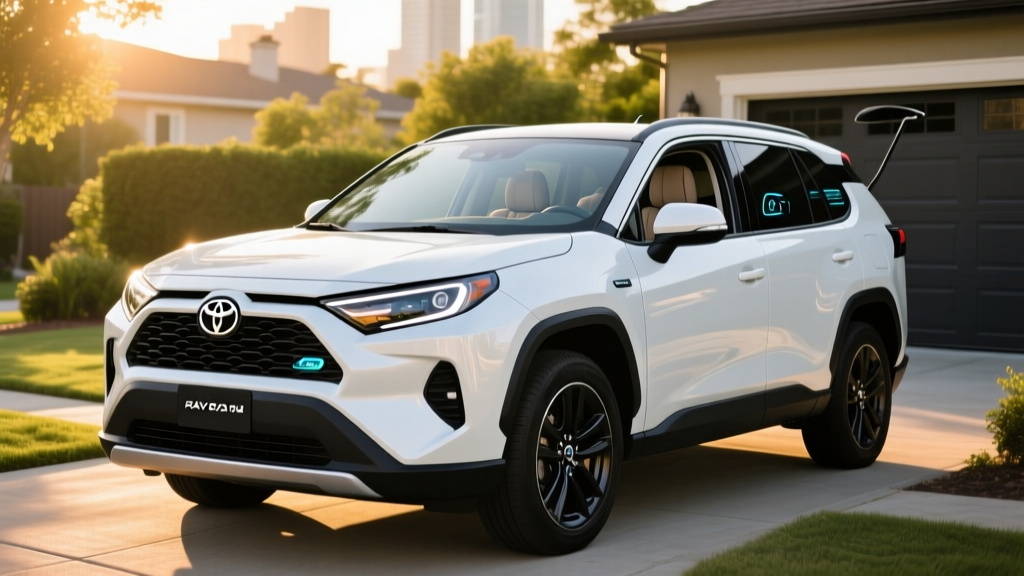
If you're searching for a compact crossover that slashes fuel costs without requiring a plug, the 2025 Toyota RAV4 Hybrid SUV remains one of the most data-backed choices on the market. With standard all-wheel drive, a 219-horsepower hybrid powertrain, and EPA-estimated ratings that real drivers frequently exceed in city commuting, it sits at the intersection of practicality and efficiency. This guide breaks down every number that matters — from MPG and powertrain specs to battery longevity and tax-credit eligibility — so you can decide whether the RAV4 Hybrid, its PHEV sibling (the RAV4 Prime), or a full battery-electric vehicle is the right fit.
2025 Toyota RAV4 Hybrid SUV: Quick Verdict
The 2025 RAV4 Hybrid is a conventional self-charging hybrid (HEV). You never plug it in. A 2.5-liter four-cylinder engine works with front and rear electric motors to deliver 219 combined horsepower and standard electronic all-wheel drive. EPA estimates land at 41 MPG city / 38 MPG highway / 39 MPG combined — numbers that hold up remarkably well in real-world driving, especially in stop-and-go traffic where regenerative braking does the heavy lifting.
Starting at $33,595 for the LE trim and climbing to roughly $41,000 for the fully loaded Woodland Edition, the RAV4 Hybrid undercuts most PHEV and EV competitors on price while offering cargo space, ground clearance, and reliability credentials that have made it Toyota's best-selling model line. It does not qualify for the federal §30D EV tax credit because it lacks a plug, but its lower purchase price and strong fuel economy often produce a faster payback than the credit-adjusted math of a PHEV or BEV for buyers without home charging access.
HEV vs PHEV: RAV4 Hybrid vs RAV4 Prime
Toyota sells two electrified RAV4 variants, and confusing them is the most common mistake shoppers make. Here's the fundamental split:
| Attribute | RAV4 Hybrid (HEV) | RAV4 Prime (PHEV) |
|---|---|---|
| Plug-in required? | No — self-charging | Yes — plug in to charge battery |
| Electric-only range | ~1 mile at low speed | 42 miles (EPA) |
| Battery capacity | 1.6 kWh (NiMH) | 18.1 kWh (lithium-ion) |
| Combined horsepower | 219 hp | 302 hp |
| EPA combined MPG / MPGe | 39 MPG | 94 MPGe (electric) / 38 MPG (gas-only) |
| DC fast charging | N/A | No — Level 2 AC only (~2.5 hr) |
| Base MSRP (2025) | $33,595 | $44,515 |
| Federal §30D tax credit | Not eligible | Eligible up to $7,500* |
*RAV4 Prime §30D eligibility depends on current-year battery sourcing, critical-mineral, MSRP, and buyer-income requirements. Verify at IRS.gov qualified vehicle list.
If you can charge at home and your daily commute falls under 42 miles round-trip, the RAV4 Prime lets you drive almost entirely on electricity with a gas engine as backup. If you lack reliable charging access — apartment dwellers, street parkers, frequent road-trippers — the standard RAV4 Hybrid delivers excellent efficiency with zero lifestyle change.
Fuel Economy: EPA Ratings and Real-World MPG
The EPA rates the 2025 RAV4 Hybrid at 41 MPG city, 38 MPG highway, and 39 MPG combined across all trims with standard AWD. These figures come from fueleconomy.gov and apply to the LE, XLE, XLE Premium, SE, XSE, and Limited trims.
| Driving Scenario | EPA Estimate | Real-World Expectation |
|---|---|---|
| City / stop-and-go | 41 MPG | 40–44 MPG (regen-heavy routes often exceed sticker) |
| Highway (70–75 mph) | 38 MPG | 34–37 MPG (aero drag and sustained speed reduce hybrid advantage) |
| Combined (mixed) | 39 MPG | 37–41 MPG |
| Cold weather (below 32°F) | — | 33–36 MPG (engine runs more for cabin heat) |
Hybrids shine in city driving. The electric motor handles low-speed acceleration, regenerative braking recovers energy at every stoplight, and the gas engine only kicks in when needed. On highway-heavy commutes, the advantage narrows because the engine runs continuously and aerodynamic drag dominates. In sub-freezing temperatures, expect a 10–15% MPG drop — the engine runs longer to heat the cabin and keep the catalytic converter warm, and battery efficiency dips slightly.
For context, a comparably equipped gas-only RAV4 AWD returns about 30 MPG combined. The hybrid's 30% efficiency improvement translates to roughly 130 fewer gallons per year at 15,000 miles — a savings of approximately $450–$550 annually at $3.50/gallon.
Powertrain and Performance Specs
| Specification | 2025 RAV4 Hybrid |
|---|---|
| Engine | 2.5L Dynamic Force 4-cylinder (176 hp, 163 lb-ft) |
| Front electric motor | 88 kW (118 hp) |
| Rear electric motor | 40 kW (54 hp) |
| Combined system output | 219 hp |
| Transmission | eCVT (planetary gearset, no fixed gears) |
| Drivetrain | Electronic AWD (eAWD) — standard all trims |
| 0–60 mph | 7.4 seconds |
| Towing capacity | 1,750 lbs |
| Battery type | Nickel-metal hydride (NiMH), 1.6 kWh |
| Fuel tank | 14.5 gallons |
| Total range (est.) | ~565 miles |
The eCVT isn't a traditional belt-driven CVT — it's a planetary gearset that blends engine and motor power seamlessly with no shifting feel. Acceleration is linear and adequate for merging, though the 7.4-second 0–60 time trails the RAV4 Prime's 5.7-second sprint. The rear motor activates automatically for traction, providing confident launches in rain and light snow without a mechanical driveshaft.
Pricing, Trims, and Tax Credit Eligibility
The 2025 RAV4 Hybrid lineup spans six trims. All include standard AWD, Toyota Safety Sense 2.5+ (adaptive cruise, lane-keeping, automatic emergency braking), an 8-inch touchscreen, and wireless Apple CarPlay/Android Auto.
| Trim | MSRP (incl. destination) | Key Features |
|---|---|---|
| LE | $33,595 | Base hybrid, 18" alloy wheels, LED headlights |
| XLE | $35,095 | Dual-zone climate, blind-spot monitor, power liftgate |
| XLE Premium | $37,195 | SofTex seats, sunroof, 19" wheels |
| SE | $37,595 | Sport-tuned suspension, 19" black alloys |
| XSE | $39,195 | Bi-tone paint, heated seats, 9" touchscreen |
| Limited | $41,095 | Leather, JBL audio, panoramic roof, digital rearview mirror |
Federal Tax Credit Status
The RAV4 Hybrid (HEV) does not qualify for the IRS §30D Clean Vehicle Credit because it cannot be plugged in. The §30D credit applies exclusively to battery-electric vehicles (BEVs) and plug-in hybrids (PHEVs) that meet battery-sourcing, critical-mineral, MSRP, and buyer-income thresholds. If tax-credit eligibility is a priority, consider the RAV4 Prime PHEV (potentially eligible for up to $7,500 depending on current-year sourcing rules) or a qualifying BEV. Always confirm eligibility on the IRS qualified vehicles page and consult a tax professional.
Battery Warranty, Lifespan, and Replacement Cost
Hybrid battery longevity is the single most common concern among first-time hybrid buyers. Here's what the data shows:
- Warranty: Toyota covers the hybrid battery for 10 years or 150,000 miles (whichever comes first) in all 50 states. This was extended from the prior 8-year/100,000-mile coverage starting with the 2020 model year.
- Chemistry: The RAV4 Hybrid uses a nickel-metal hydride (NiMH) pack — proven, durable, and less sensitive to thermal stress than some lithium-ion chemistries.
- Real-world lifespan: NiMH hybrid batteries in Toyota vehicles routinely last 150,000–200,000+ miles before significant capacity loss. Failures before 100,000 miles are rare and covered under warranty.
- Replacement cost: If the battery fails outside warranty, a new OEM hybrid battery runs approximately $3,000–$4,500 installed. Refurbished or reconditioned packs are available for $1,500–$2,500. Independent hybrid shops in most metro areas now offer replacements.
For comparison, the RAV4 Prime's 18.1 kWh lithium-ion PHEV battery carries the same 10-year/150,000-mile warranty but would cost significantly more to replace ($6,000–$9,000 estimated) due to its larger capacity and chemistry.
The broader hybrid system — inverter, electric motors, eCVT — is covered under Toyota's 8-year/100,000-mile hybrid system warranty. These components have proven extremely reliable across millions of Toyota hybrids on the road.
Who Should Buy the RAV4 Hybrid vs a PHEV or Full EV?
Choose the RAV4 Hybrid (HEV) if:
- You don't have access to home or workplace charging
- Your budget tops out around $35,000–$41,000
- You want a simple ownership experience — no charging apps, no plug-in routine
- You frequently take long road trips and don't want to plan charging stops
- You live in an area with limited public charging infrastructure
Choose the RAV4 Prime (PHEV) if:
- You can install a Level 2 charger at home
- Your daily commute is under 42 miles round-trip (you'll rarely use gas)
- You want 302 hp and a 5.7-second 0–60 time
- You qualify for the §30D tax credit, narrowing the price gap with the HEV
Choose a full BEV (e.g., Tesla Model Y, Hyundai Ioniq 5) if:
- You want zero tailpipe emissions and minimal maintenance
- You have reliable home charging and access to DC fast-charging networks
- You're comfortable with 250–320 miles of range and route planning on road trips
- You want maximum federal and state incentives
The RAV4 Hybrid's strongest argument is its universality. It asks nothing of the driver beyond filling up with gas — yet still delivers nearly 40 MPG in a practical, safe, all-wheel-drive package. For buyers transitioning from a conventional gas car, it's the lowest-friction step toward electrification.
Pros and Cons
Pros
- 39 MPG combined with standard AWD — excellent for the class
- Real-world city MPG often exceeds EPA estimate
- No plug-in required — zero lifestyle change from a gas car
- 10-year/150,000-mile hybrid battery warranty
- Strong resale value and proven reliability track record
- Toyota Safety Sense 2.5+ standard on all trims
- Spacious cargo area (37.5 cu ft behind rear seats)
Cons
- No federal tax credit eligibility
- 7.4-second 0–60 is adequate but not quick
- 1,750-lb towing capacity trails some turbocharged competitors
- Road noise noticeable at highway speeds
- Infotainment interface lags behind rivals in responsiveness
- No DC fast-charging option (not applicable for HEV, but limits PHEV Prime comparison)
Frequently Asked Questions
How many MPG does the 2025 Toyota RAV4 Hybrid get?
The EPA rates it at 41 MPG city, 38 MPG highway, and 39 MPG combined. In real-world city driving with frequent stops, many owners report 40–44 MPG thanks to regenerative braking. Highway-only driving at 75 mph typically yields 34–37 MPG.
Does the RAV4 Hybrid need to be plugged in?
No. The RAV4 Hybrid is a conventional self-charging hybrid. The battery charges through regenerative braking and the gas engine. You simply fill it with gas like any other car.
How far can the RAV4 Prime go on electric only?
The RAV4 Prime PHEV delivers an EPA-estimated 42 miles of electric-only range. Once depleted, it operates as a conventional hybrid at 38 MPG combined. Total range with a full charge and full tank exceeds 600 miles.
Is the RAV4 Hybrid reliable, and what does battery replacement cost?
Toyota's hybrid system has an extensive reliability record spanning over two decades. The hybrid battery is warranted for 10 years/150,000 miles. Out-of-warranty replacement costs approximately $3,000–$4,500 for a new OEM pack. Most hybrid batteries last well beyond 150,000 miles.
Does the 2025 RAV4 Hybrid qualify for a federal tax credit?
No. The federal §30D Clean Vehicle Credit applies only to plug-in vehicles (BEVs and PHEVs). The RAV4 Hybrid, as a conventional HEV, does not qualify. The RAV4 Prime PHEV may qualify for up to $7,500 depending on current-year IRS sourcing and income requirements.
What's the difference between the RAV4 Hybrid and the RAV4 Prime?
The Hybrid (HEV) is self-charging with 219 hp and 39 MPG combined, starting at $33,595. The Prime (PHEV) is plug-in with 302 hp, 42 miles of electric range, a higher starting price of $44,515, and potential federal tax credit eligibility. The Prime is faster and more efficient on short commutes; the Hybrid is simpler and more affordable upfront.
How does AWD work on the RAV4 Hybrid?
The RAV4 Hybrid uses electronic AWD (eAWD). A dedicated rear electric motor powers the rear wheels when the system detects slip or during hard acceleration. There's no mechanical driveshaft connecting the front and rear axles, reducing weight and drivetrain loss.