Quick Verdict: The Sporty Hybrid Compact SUV That Doesn't Need a Plug
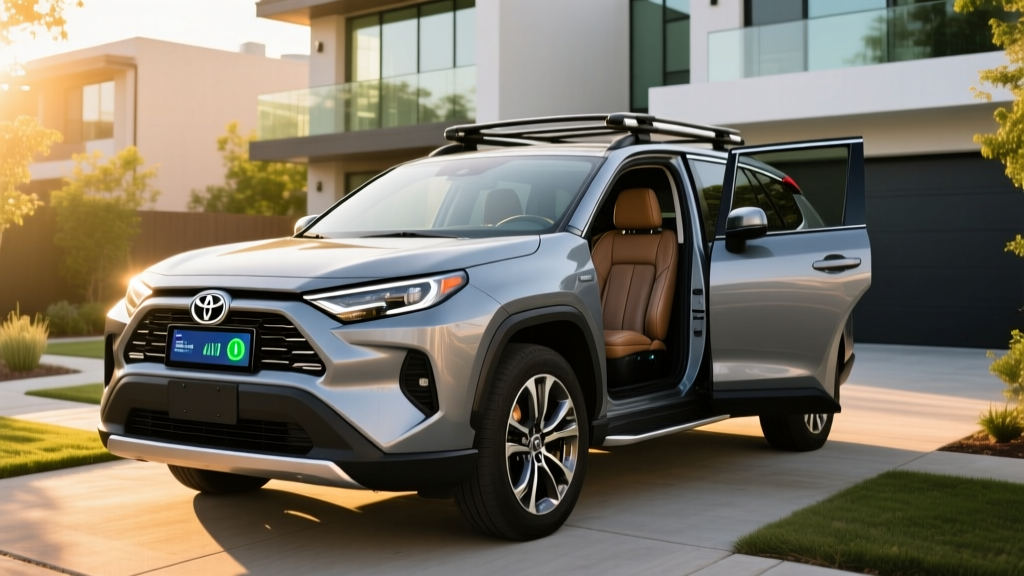
The 2025 Toyota RAV4 Hybrid SE sits at an interesting crossroads in Toyota's lineup. It pairs the proven 219-horsepower hybrid all-wheel-drive powertrain with a sport-tuned suspension, 18-inch wheels, and a more aggressive exterior treatment — all without requiring you to install a home charger or change your fueling habits. For buyers who want the efficiency of electrification without the infrastructure demands of a plug-in hybrid or full EV, the SE trim delivers a compelling middle ground.
At a starting MSRP of approximately $35,560 (including destination), the RAV4 Hybrid SE undercuts the RAV4 Prime PHEV by over $8,000 while offering cargo versatility and reliability credentials that have made the RAV4 Hybrid one of the best-selling electrified vehicles in America. Let's break down exactly what you get, what it costs to own, and whether the SE trim is the right call for your next vehicle.
HEV vs. PHEV: What the RAV4 Hybrid SE Actually Is
Before diving into specs, it's critical to understand where this vehicle sits in the electrification spectrum. The RAV4 Hybrid SE is a conventional hybrid electric vehicle (HEV) — it cannot be plugged in, has no electric-only driving range to speak of, and generates all its electricity from the gasoline engine and regenerative braking.
| Feature | RAV4 Hybrid (HEV) | RAV4 Prime (PHEV) |
|---|---|---|
| Plugs in? | No — self-charging | Yes — Level 1/Level 2 |
| Electric-only range | N/A (motor assists engine) | 42 miles EPA |
| Battery capacity | ~1.6 kWh (small buffer) | 18.1 kWh usable |
| Combined horsepower | 219 hp | 302 hp |
| EPA combined MPG/MPGe | 39 MPG | 94 MPGe (electric) / 38 MPG (gas) |
| Starting MSRP (2025) | ~$33,360 | ~$44,460 |
| Federal tax credit (§30D) | Not eligible | Not currently eligible (sourcing) |
If you're looking for a vehicle you can plug in and drive 42 miles on electricity alone before the gas engine kicks in, you want the RAV4 Prime (PHEV). The Hybrid SE, by contrast, is a no-plug solution: you fill it with gas like any conventional vehicle, and the hybrid system handles energy recuperation and electric motor assist behind the scenes. The trade-off is simplicity and lower upfront cost versus the ability to do short commutes on electricity alone.
Fuel Economy: EPA Ratings and Real-World MPG
The 2025 RAV4 Hybrid SE carries EPA ratings of 41 MPG city / 38 MPG highway / 39 MPG combined, according to fueleconomy.gov. These figures are shared across most RAV4 Hybrid AWD trims, though slight variations can occur based on wheel size and weight.
| Driving Scenario | EPA Estimate | Real-World Expectation |
|---|---|---|
| City | 41 MPG | 40–44 MPG (hybrids excel in stop-and-go) |
| Highway (70 mph) | 38 MPG | 34–37 MPG (aero drag, less regen benefit) |
| Combined | 39 MPG | 36–41 MPG (depends on driving mix) |
| Cold weather (below 32°F) | — | 33–36 MPG (engine runs more for cabin heat) |
Real-world context: Toyota's hybrid system is one of the few powertrains that routinely matches or slightly exceeds its EPA city rating in actual driving. The reason is physics: regenerative braking recaptures energy during deceleration, and frequent stops in city traffic give the system more opportunities to recharge the small battery and operate in electric-motor-assist mode. On sustained highway drives at 75+ mph, expect efficiency to dip below the EPA highway number — this is true of all hybrids, as aerodynamic drag dominates and regenerative braking opportunities are minimal.
In cold weather, the gasoline engine runs more frequently to provide cabin heat (since there's no large battery to power a resistive heater, as a full EV would). Owners in northern climates should budget for a 10–15% efficiency penalty in winter months. Even with that reduction, you're still looking at mid-30s MPG — a significant improvement over the gas-only RAV4 AWD's 30 MPG combined.
Powertrain and Performance Specs
| Specification | 2025 RAV4 Hybrid SE |
|---|---|
| Engine | 2.5L 4-cylinder Dynamic Force (176 hp, 163 lb-ft) |
| Front electric motor | 118 hp / 149 lb-ft |
| Rear electric motor (AWD) | 54 hp / 89 lb-ft |
| Net combined system output | 219 hp |
| Transmission | eCVT (planetary gearset, not belt-driven) |
| Drivetrain | Electronic On-Demand AWD |
| 0–60 mph | 7.4 seconds (est.) |
| Towing capacity | 1,750 lbs |
| Fuel tank | 14.5 gallons |
| Total driving range | ~565 miles (14.5 gal × 39 MPG) |
| Hybrid battery | ~1.6 kWh, nickel-metal hydride (NiMH) |
The SE trim distinguishes itself from the LE and XLE with a sport-tuned suspension calibration, paddle shifters (which simulate stepped gear ratios through the eCVT), and a slightly more aggressive throttle mapping. You won't mistake it for a performance SUV, but the 219 hp on tap provides confident highway merging and passing — a meaningful upgrade over the 203 hp gas-only RAV4.
The electronic on-demand AWD system uses the rear electric motor to power the rear wheels only when needed (acceleration from a stop, slippery conditions, or when the system detects front-wheel slip). This means there's no mechanical driveshaft to the rear axle, reducing weight and parasitic loss compared to a traditional AWD system.
Pricing, Trims, and Tax Credit Eligibility
The 2025 RAV4 Hybrid SE starts at approximately $35,560 (including $1,490 destination charge). Key standard equipment includes:
- Toyota Safety Sense 2.5+ (pre-collision, lane departure, full-speed adaptive cruise, lane tracing)
- 8-inch Toyota Audio Multimedia touchscreen with wireless Apple CarPlay/Android Auto
- SofTex-trimmed heated front seats
- 18-inch alloy wheels
- Smart Key with push-button start
- LED headlights and taillights
Adding options like the Convenience Package (power liftgate, moonroof) or upgrading to the SE's available premium audio and navigation can push the as-tested price toward $39,000–$41,000.
Federal Tax Credit: What You Need to Know
§30D Federal Tax Credit Status: The conventional RAV4 Hybrid (HEV) does not qualify for the IRS §30D Clean Vehicle Credit. That credit applies only to plug-in electric vehicles (BEVs and PHEVs) meeting battery sourcing, MSRP cap, and buyer income requirements. Standard hybrids are not eligible for the federal purchase incentive.
Some states and utilities offer separate rebates for conventional hybrids, but these vary widely by jurisdiction. Check your state energy office or utility provider for current programs. For federal credit rules, consult IRS.gov §30D guidelines.
Battery Warranty, Reliability, and Replacement Costs
Hybrid battery longevity is the single most common concern among first-time hybrid buyers. Here's what the data shows:
Toyota Hybrid Battery Warranty: 10 years / 150,000 miles (whichever comes first), covering defects and capacity loss below a defined threshold. This applies to all 50 states. Toyota extended this from the previous 8-year/100,000-mile standard beginning with 2020 model-year hybrids.
The RAV4 Hybrid uses a relatively small nickel-metal hydride (NiMH) battery pack — approximately 1.6 kWh. Unlike the large lithium-ion packs in full EVs, this battery isn't asked to deliver long electric-only range; it serves as a buffer for regenerative braking energy and short bursts of electric motor assist. Because the battery is small and the hybrid system carefully manages its state of charge (never fully depleting or fully charging it), NiMH hybrid batteries have demonstrated exceptional longevity in the field.
Real-world reliability data: Toyota's hybrid powertrain is among the most proven in the industry, with over two decades of deployment since the original Prius. Independent fleet data and owner surveys consistently show hybrid battery failure rates well below 1% within the warranty period. Many first-generation Prius and Camry Hybrid batteries have exceeded 200,000 miles without replacement.
Out-of-warranty replacement cost: If a hybrid battery does require replacement after the warranty expires, expect to pay between $2,000 and $4,000 for a new OEM battery pack installed at a Toyota dealer. Refurbished or aftermarket options can reduce this to $1,000–$2,000. For context, this is a fraction of the $10,000–$20,000+ that large EV battery replacements can cost, and the failure rate is very low.
Who Should Choose the RAV4 Hybrid SE?
Choose the RAV4 Hybrid SE if:
- You want 39 MPG combined without changing how you refuel — no plug, no charging apps, no route planning around chargers
- You drive 15,000+ miles per year and want to reduce fuel spend (at $3.50/gal, you'd save roughly $600–$800/year vs. the gas RAV4 AWD)
- You need AWD for snow or rain but don't want the fuel penalty of a conventional AWD system
- You plan to own the vehicle 8–10+ years and value Toyota's long-term reliability track record
- Your home doesn't have easy access to a Level 2 charging circuit, making a PHEV or EV impractical
Look elsewhere if:
- You want to drive on electricity alone for your commute — consider the RAV4 Prime (PHEV) or a full BEV like the Tesla Model Y or Hyundai Ioniq 5
- You need more than 1,750 lbs of towing capacity — the gas RAV4 Adventure trim tows up to 3,500 lbs
- You want the absolute lowest per-mile fuel cost — a full EV charging at home at $0.13/kWh costs roughly $0.04/mile vs. the Hybrid SE's ~$0.09/mile at $3.50/gal
- You want access to HOV lane stickers — most states reserve these for PHEVs and BEVs, not conventional hybrids
Pros
- 39 MPG combined with no plug-in requirement
- Proven hybrid powertrain with 10yr/150k-mile battery warranty
- Standard AWD with no fuel-economy penalty vs. FWD
- Strong resale value — RAV4 Hybrids hold value among best in segment
- 565+ mile total range between fill-ups
- Toyota Safety Sense 2.5+ standard on all trims
Cons
- No federal tax credit eligibility
- eCVT drone under hard acceleration (no traditional gear shifts)
- 1,750-lb towing limit (lower than gas RAV4 Adventure)
- SE sport suspension is firmer — some buyers may prefer XLE ride comfort
- Infotainment screen is 8-inch (competitors offer 10–12 inch)
- No DC fast charging (not applicable to HEV, but PHEV Prime also lacks DC)
Hybrid vs. PHEV vs. EV: Which RAV4 Fits Your Life?
The RAV4 lineup offers three distinct powertrain philosophies. Here's how to decide:
| Factor | RAV4 Hybrid (HEV) | RAV4 Prime (PHEV) | Full EV Alternative (e.g., bZ4X, Model Y) |
|---|---|---|---|
| Upfront cost | $33K–$40K | $44K–$50K | $42K–$55K |
| Home charging needed? | No | Recommended (Level 2) | Essential (Level 2) |
| Daily electric driving | None (motor assist only) | Up to 42 miles | 100% electric |
| Road trip flexibility | Gas station anywhere | Gas + electric | DC fast charger planning |
| Fuel cost per mile | ~$0.09 | ~$0.04 (electric) / $0.09 (gas) | ~$0.04 (home charging) |
| Maintenance | Oil changes, low overall | Oil changes, low overall | No oil changes, lowest |
| Federal tax credit | None | Varies by sourcing/year | Up to $7,500 (if eligible) |
| Best for | No-plug simplicity, high mileage | Short commute + road trips | Home charging access, low running cost |
For buyers who average under 40 miles of daily driving and have access to Level 2 home charging, the RAV4 Prime PHEV offers the best of both worlds — electric commuting with gas-engine backup. But the Prime carries an $8,000–$10,000 price premium, and if you don't plug it in regularly, you're simply carrying around a heavy battery you never use, reducing efficiency.
The RAV4 Hybrid SE makes the most sense for buyers who can't or don't want to install a charger, who drive a mix of city and highway miles, and who value a lower purchase price and proven reliability over the ability to drive on electricity alone. It's the pragmatic choice — and for many households, the pragmatic choice is the right one.
Ownership Costs: 5-Year Projection
| Cost Category (5 years / 75,000 miles) | RAV4 Hybrid SE AWD | RAV4 Gas AWD (LE) |
|---|---|---|
| Purchase price (MSRP + dest.) | $35,560 | $32,060 |
| Fuel (at $3.50/gal avg) | $6,730 (1,923 gal) | $8,750 (2,500 gal) |
| Maintenance (est.) | $2,800 | $3,200 |
| Insurance (est. avg) | $7,500 | $7,200 |
| Estimated depreciation | $14,200 (40%) | $14,400 (45%) |
| 5-year total cost | $38,390 | $40,810 |
| Cost per mile | $0.51 | $0.54 |
The Hybrid SE's higher purchase price is offset within roughly 3–4 years by fuel savings and slightly lower maintenance costs (the hybrid system reduces brake wear through regenerative braking, and the engine runs less in city driving). Toyota RAV4 Hybrids also tend to depreciate less than their gas-only counterparts, further closing the gap. Over a 10-year ownership period, the Hybrid becomes significantly cheaper to own.
Frequently Asked Questions
How many MPG does the 2025 RAV4 Hybrid SE get?
The EPA rates the RAV4 Hybrid SE at 41 MPG city, 38 MPG highway, and 39 MPG combined. In real-world driving, many owners report matching or exceeding the city figure thanks to regenerative braking, while highway-only driving at 75+ mph typically yields 34–37 MPG. Cold weather reduces efficiency by roughly 10–15%.
Does the RAV4 Hybrid SE need to be plugged in?
No. The RAV4 Hybrid is a conventional (self-charging) hybrid. It generates electricity through the gasoline engine and regenerative braking. You fuel it exclusively at gas stations, just like a non-hybrid vehicle.
How long will the hybrid battery last, and what does replacement cost?
Toyota warranties the hybrid battery for 10 years or 150,000 miles. Real-world data shows failure rates well below 1% within that period, and many Toyota hybrid batteries exceed 200,000 miles. Out-of-warranty replacement costs $2,000–$4,000 for a new OEM pack, or $1,000–$2,000 for refurbished options.
Does the RAV4 Hybrid qualify for any federal tax credit?
No. The IRS §30D Clean Vehicle Credit applies only to plug-in vehicles (BEVs and qualifying PHEVs). Conventional hybrids like the RAV4 Hybrid are not eligible. Check your state and local utility for possible hybrid-specific rebates, as these vary by jurisdiction.
What's the difference between the RAV4 Hybrid SE and the XLE?
The SE adds sport-tuned suspension, paddle shifters, 18-inch wheels, SofTex heated front seats, and a blacked-out exterior appearance package. The XLE offers a softer ride, cloth seats, and a slightly lower price. Both share the identical 219-hp hybrid AWD powertrain and 39 MPG combined rating.
Is the RAV4 Hybrid SE good in snow?
Yes. The electronic on-demand AWD system engages the rear electric motor automatically when front-wheel slip is detected. Combined with the hybrid system's smooth torque delivery, the RAV4 Hybrid performs well in moderate snow and ice. For severe winter conditions, dedicated winter tires provide a larger improvement than any AWD system alone.
How does the RAV4 Hybrid compare to the Honda CR-V Hybrid?
Both are strong competitors. The RAV4 Hybrid offers 219 hp vs. the CR-V Hybrid's 204 hp, and 39 MPG combined vs. the CR-V Hybrid AWD's 40 MPG combined. The RAV4 carries a longer hybrid battery warranty (10yr/150k vs. Honda's 8yr/100k). The CR-V Hybrid offers slightly more rear-seat legroom. Both are excellent choices; the decision often comes down to styling preference and dealer experience.
Sources: EPA fuel economy data from fueleconomy.gov; federal tax credit rules from IRS.gov; vehicle specifications from Toyota Motor Corporation press materials. Pricing and incentive rules are subject to change; verify current figures with your dealer and tax professional.