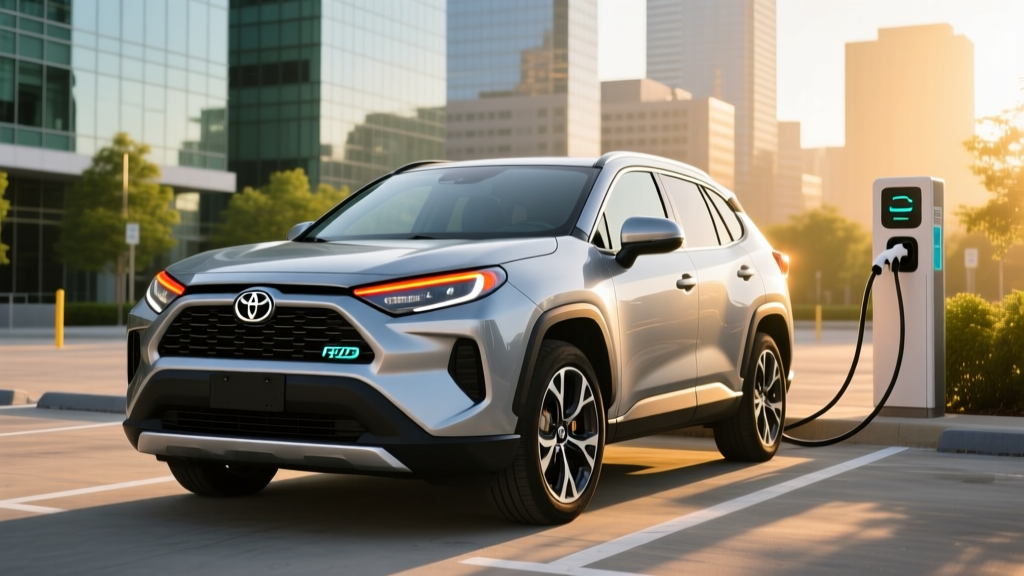
The Toyota RAV4 Hybrid has held the top spot in the compact SUV segment for years, and the 2025 model continues that dominance. If you have been searching for the fueleconomy.gov 2025 Toyota RAV4 Hybrid MPG figures, you have likely seen the headline number — 39 MPG combined — but the real story involves a split between two distinct powertrains: the conventional RAV4 Hybrid (HEV) and the plug-in RAV4 Prime (PHEV). Both wear the RAV4 badge, but their fuel economy, pricing, and ownership experiences diverge sharply.
This guide walks through the official EPA ratings, real-world fuel economy behavior, powertrain mechanics, battery warranties, and tax-credit eligibility for the 2025 RAV4 Hybrid lineup — so you can decide whether the standard hybrid or the Prime plug-in better matches your driving routine.
2025 Toyota RAV4 Hybrid: EPA MPG Ratings and Real-World Numbers
The standard 2025 RAV4 Hybrid pairs a 2.5-liter four-cylinder engine with two electric motors (one front, one rear for AWD) through Toyota's eCVT transmission. Every trim — LE, XLE, XLE Premium, SE, XSE, Woodland Edition, and Limited — comes with electronic all-wheel drive as standard.
| Metric | LE Trim | XLE / XLE Premium / SE / XSE / Woodland / Limited |
|---|---|---|
| City MPG | 41 | 41 |
| Highway MPG | 38 | 38 |
| Combined MPG | 39 | 39 |
| Fuel Tank Capacity | 14.5 gal | 14.5 gal |
| Total Range (est.) | ~565 mi | ~565 mi |
Source: EPA / fueleconomy.gov
Real-World MPG vs. EPA Sticker
Hybrids consistently outperform their EPA city ratings in stop-and-go driving because regenerative braking recovers energy that gas-only vehicles waste as heat. Owner-reported data on fueleconomy.gov's "My MPG" tracker shows many 2025 RAV4 Hybrid drivers averaging 37–42 MPG combined in mixed driving. Highway-dominant commuters should expect figures closer to 35–37 MPG, since the electric motor assists less at sustained high speeds and the gasoline engine carries more of the load.
RAV4 Prime PHEV: Electric-Only Range and Combined Efficiency
The RAV4 Prime is not simply a RAV4 Hybrid with a plug — it is a fundamentally different powertrain with a larger battery, more powerful electric motors, and significantly more total output. For the 2025 model year, the Prime continues with an 18.1 kWh lithium-ion battery pack (gross capacity) and a combined system output of 302 horsepower.
| Metric | SE Trim | XSE Trim |
|---|---|---|
| Electric-Only Range | 42 miles | 42 miles |
| MPGe (Electric + Gas) | 94 MPGe | 94 MPGe |
| Gas-Only Combined MPG | 38 MPG | 38 MPG |
| Total Combined Range | ~600 miles | ~600 miles |
| Battery Capacity (gross) | 18.1 kWh | 18.1 kWh |
| Combined Horsepower | 302 hp | 302 hp |
| 0–60 mph | 5.7 sec | 5.7 sec |
Source: EPA / fueleconomy.gov
Charging the RAV4 Prime
The RAV4 Prime charges via a J1772 connector (standard for non-Tesla Level 1 and Level 2 charging). It does not support DC fast charging — a common limitation among PHEVs, since the battery is too small to benefit meaningfully from high-power DC infrastructure.
| Charging Level | Power | Time (0–100%) |
|---|---|---|
| Level 1 (120V household) | ~1.4 kW | ~12 hours |
| Level 2 (240V, 16A) | ~3.3 kW | ~5.5 hours |
| Level 2 (240V, 32A) | ~6.6 kW | ~2.5 hours |
The 6.6 kW onboard charger is standard on the XSE and available on the SE. If you opt for the SE with the 3.3 kW charger, plan for longer Level 2 sessions — a meaningful difference if you charge mid-day between errands.
HEV vs. PHEV: Which RAV4 Hybrid Fits Your Driving?
Toyota offers the RAV4 in three electrification tiers for 2025: the standard Hybrid (HEV), the Prime (PHEV), and the gas-only RAV4 (which we will not cover in depth here, as this site focuses on electrified vehicles). The decision between the HEV and PHEV comes down to three factors: charging access, daily mileage, and budget.
| Attribute | RAV4 Hybrid (HEV) | RAV4 Prime (PHEV) |
|---|---|---|
| Powertrain | 2.5L I4 + 2 electric motors, eCVT | 2.5L I4 + 2 electric motors (larger), eCVT |
| Combined Horsepower | 219 hp | 302 hp |
| Battery | ~1.6 kWh (self-charging) | 18.1 kWh (plug-in) |
| Plug Required? | No — regenerative braking charges it | Yes — for EV range; drives as hybrid without plug |
| Electric-Only Range | N/A (EV assist only) | 42 miles EPA |
| Combined MPG / MPGe | 39 MPG combined | 94 MPGe (charge-depleting); 38 MPG (gas-only) |
| AWD | Standard (electronic) | Standard (electronic) |
| Starting MSRP | ~$33,575 (LE) | ~$44,415 (SE) |
| Federal Tax Credit | Not eligible (§30D excludes HEVs) | Not eligible for 2025 (battery sourcing) |
Who Should Choose the RAV4 Hybrid (HEV)?
- Drivers without reliable access to a plug at home or work
- Commuters with variable daily mileage who want consistent efficiency without thinking about charging
- Buyers prioritizing lower purchase price and simpler ownership
- Those who want AWD fuel efficiency without the $10,000+ price premium of the Prime
Who Should Choose the RAV4 Prime (PHEV)?
- Drivers with a home garage or driveway where a Level 2 charger can be installed
- Commuters with round trips under 42 miles who could drive months without visiting a gas station
- Enthusiasts who want the 302 hp powertrain — the Prime is the quickest RAV4 Toyota makes
- Households that want EV-like daily driving with the safety net of a gas engine for road trips
Powertrain Deep Dive: How Toyota's Hybrid System Delivers 39 MPG
The RAV4 Hybrid uses Toyota's fourth-generation Hybrid Synergy Drive (THS IV). The 2.5-liter Dynamic Force engine (A25A-FXS) produces 176 hp and 163 lb-ft of torque on its own, but the combined system output with the front electric motor (88 kW) and rear electric motor (40 kW) totals 219 hp.
The eCVT is not a traditional continuously variable transmission with belts or pulleys — it is a planetary gearset that blends engine and motor power seamlessly. This design eliminates the "rubber-band" feel that older CVTs exhibit and contributes to the RAV4 Hybrid's reputation for smooth, linear acceleration.
The rear motor enables electronic AWD (eAWD) without a mechanical driveshaft, reducing weight and parasitic loss. In low-traction situations, the rear motor engages in milliseconds — faster than a mechanical system can react.
The RAV4 Prime uses the same architecture but with a more powerful front motor (134 kW) and the larger 18.1 kWh battery, enabling the 42-mile EV-only range and the 302 hp combined output. When the battery depletes below its buffer threshold, the Prime operates as a conventional hybrid at 38 MPG combined — still excellent for a 302-hp AWD SUV.
Pricing, Trims, and Tax Credit Reality for 2025
The 2025 RAV4 Hybrid lineup spans a wide price range. Here is a trim-by-trim breakdown:
| Trim | MSRP (approx.) | Key Features |
|---|---|---|
| LE | $33,575 | Toyota Safety Sense 2.5+, 8" touchscreen, wireless CarPlay/Android Auto |
| XLE | $35,060 | Dual-zone climate, blind-spot monitor, Smart Key |
| XLE Premium | $37,100 | SofTex seats, moonroof, power liftgate |
| SE | $37,300 | Sport-tuned suspension, 19" wheels, paddle shifters |
| XSE | $38,700 | Two-tone paint, heated front seats, 9" touchscreen |
| Woodland Edition | $37,400 | TRD-tuned suspension, all-terrain tires, roof rails |
| Limited | $41,600 | Ventilated seats, panoramic moonroof, JBL audio, digital rearview mirror |
| Trim | MSRP (approx.) | Key Features |
|---|---|---|
| SE | $44,415 | 302 hp, 42 mi EV range, 6.6 kW charger (with package) |
| XSE | $47,915 | 6.6 kW charger standard, premium interior, 9" display |
Does the RAV4 Hybrid or Prime Qualify for a Federal Tax Credit?
This is where buyers often encounter confusion. Under current IRS §30D rules:
- Conventional hybrids (HEVs) do NOT qualify for the federal clean vehicle credit. The §30D credit applies only to plug-in electric vehicles (BEVs and PHEVs) with a minimum battery capacity of 7 kWh.
- The RAV4 Prime (PHEV) would normally qualify based on battery size (18.1 kWh) and MSRP caps ($80,000 for SUVs). However, the Prime's battery cells are manufactured in Japan (Panasonic), and under the critical-mineral and battery-component sourcing requirements enacted by the Inflation Reduction Act, the 2025 RAV4 Prime does not currently meet the threshold for the full $7,500 credit. Toyota has not announced a shift to North American battery sourcing for the Prime as of the 2025 model year.
- Vehicle must be a plug-in (BEV or PHEV) with ≥ 7 kWh battery — HEVs excluded
- MSRP must be ≤ $80,000 for SUVs, vans, pickups; ≤ $55,000 for sedans
- Buyer AGI must be ≤ $150,000 (single) / $300,000 (joint) / $225,000 (head of household)
- Battery components must meet North American manufacturing thresholds (phasing in annually)
- Critical minerals must meet sourcing requirements (increasing percentages yearly)
- Credit can now be transferred to the dealer as a point-of-sale discount
Source: IRS.gov — Clean Vehicle Credits. Consult a tax professional for your specific eligibility.
State incentives may still apply. Several states offer rebates or HOV-lane access for PHEVs regardless of federal credit status. Check your state's energy or environmental agency website for current programs.
Battery Warranty, Reliability, and Replacement Cost
Hybrid battery longevity is consistently the top concern for first-time hybrid buyers. Toyota addresses this with one of the strongest hybrid battery warranties in the industry.
- Coverage: 10 years or 150,000 miles (whichever comes first)
- Applies to: Both the RAV4 Hybrid (HEV) and RAV4 Prime (PHEV) traction batteries
- Transferable: Yes — warranty transfers to subsequent owners
- What it covers: Battery capacity loss below a defined threshold, cell failure, and related hybrid system components
Real-World Reliability Data
Toyota's hybrid system has been in production since the 1997 Prius, and the RAV4 Hybrid has been on sale in the U.S. since the 2016 model year. Long-term reliability data from owners and independent surveys consistently rank Toyota hybrids among the most dependable vehicles on the road. The hybrid battery in the standard RAV4 Hybrid (HEV) is relatively small (~1.6 kWh) and operates within a narrow state-of-charge window (roughly 40–80%), which dramatically reduces degradation compared to full EVs that cycle through wider ranges.
The RAV4 Prime's 18.1 kWh battery sees deeper cycling when driven in EV mode, but Toyota engineers a substantial buffer (typically 15–20% at the bottom and a cap at the top) to protect long-term health.
Battery Replacement Cost
If a hybrid battery fails outside of warranty, replacement costs for the RAV4 Hybrid (HEV) typically range from $3,000 to $5,000 including labor, based on current dealer and independent-shop pricing. The RAV4 Prime's larger battery pack is more expensive — estimated at $6,000 to $9,000 for a full replacement. However, out-of-warranty failures in Toyota hybrids are statistically rare; many original Prius batteries have exceeded 200,000 miles without replacement.
Refurbished and reconditioned battery packs are also available from third-party suppliers at lower cost ($1,500–$3,000 for the HEV), though these come with shorter warranties and variable quality.
Spec Summary: 2025 RAV4 Hybrid vs. RAV4 Prime
| Specification | RAV4 Hybrid (HEV) | RAV4 Prime (PHEV) |
|---|---|---|
| Powertrain | 2.5L I4 + dual electric motors, eCVT | 2.5L I4 + dual electric motors (larger), eCVT |
| Combined Horsepower | 219 hp | 302 hp |
| 0–60 mph | 7.4 sec | 5.7 sec |
| Battery | ~1.6 kWh NiMH | 18.1 kWh Li-ion |
| Plug Required | No | Yes (for EV mode) |
| EV-Only Range | N/A | 42 miles |
| EPA Combined MPG | 39 MPG | 38 MPG (gas) / 94 MPGe (EV+gas) |
| Fuel Tank | 14.5 gal | 14.5 gal |
| Total Range | ~565 mi | ~600 mi |
| AWD | Standard (eAWD) | Standard (eAWD) |
| Max Charge Rate | N/A | 6.6 kW (Level 2) |
| DC Fast Charge | No | No |
| Starting MSRP | $33,575 | $44,415 |
| Federal Tax Credit | Not eligible | Not eligible (2025 sourcing) |
| Hybrid Battery Warranty | 10 yr / 150,000 mi | 10 yr / 150,000 mi |
RAV4 Hybrid vs. a Full EV: Which Is Right for You?
The RAV4 Hybrid (HEV) and Prime (PHEV) sit between the gas-only RAV4 and a full battery-electric vehicle like the Tesla Model Y, Hyundai Ioniq 5, or Toyota bZ4X. Here is a practical decision framework:
- You cannot install a home charger (apartment, street parking, condo restrictions)
- You want zero behavioral change — no plugging in, no route planning around chargers
- Your budget is under $40,000 and you need AWD
- You regularly take long road trips and want the simplest refueling experience
- You can install a Level 2 charger at home and your commute is under 42 miles round-trip
- You want EV-like daily driving but need a gas engine for weekend trips
- You value the 302 hp performance upgrade (5.7-second 0–60)
- You want to reduce gasoline consumption by 70–90% without range anxiety
- You have reliable home charging and your daily driving rarely exceeds 250 miles
- You want the lowest per-mile "fuel" cost (electricity is typically $0.04–$0.06/mile vs. $0.12–$0.16/mile for the RAV4 Hybrid)
- You want to qualify for the full $7,500 federal tax credit (many BEVs still qualify)
- You want zero tailpipe emissions and minimal maintenance (no oil changes, fewer moving parts)
Ownership Economics: 5-Year Cost Snapshot
To put the fuel savings in perspective, here is a simplified 5-year fuel-cost comparison assuming 15,000 miles/year, $3.50/gallon regular gasoline, and $0.14/kWh electricity:
| Vehicle | Efficiency | Est. 5-Year Fuel Cost |
|---|---|---|
| Gas-only RAV4 (28 MPG combined) | 28 MPG | ~$9,375 |
| RAV4 Hybrid (39 MPG combined) | 39 MPG | ~$6,730 |
| RAV4 Prime (80% EV / 20% gas driving) | ~90 MPGe effective | ~$2,800 (electricity) + ~$1,170 (gas) = ~$3,970 |
| Full EV (3.5 mi/kWh) | 118 MPGe | ~$2,140 |
The RAV4 Hybrid saves roughly $2,645 in fuel over five years compared to the gas-only RAV4. The Prime, driven mostly in EV mode, saves nearly $5,400. A full EV saves over $7,200 — but comes with higher purchase prices, charging logistics, and different depreciation curves.
Frequently Asked Questions
How many MPG does the 2025 Toyota RAV4 Hybrid get?
The EPA rates the 2025 RAV4 Hybrid at 41 MPG city, 38 MPG highway, and 39 MPG combined across all trims. Real-world owner reports cluster between 35 and 42 MPG depending on driving mix and climate.
How far can the RAV4 Prime go on electric only?
The 2025 RAV4 Prime achieves an EPA-rated 42 miles of electric-only range. This covers most daily commutes without using gasoline. When the battery depletes, it seamlessly transitions to hybrid mode at 38 MPG combined.
Does the RAV4 Hybrid need to be plugged in?
No. The standard RAV4 Hybrid (HEV) charges its small battery entirely through regenerative braking and the gasoline engine. You never plug it in. The RAV4 Prime (PHEV) does need to be plugged in to access its 42-mile EV range, but it can still be driven as a conventional hybrid without charging.
Is the RAV4 Hybrid reliable, and what does a battery replacement cost?
Toyota's hybrid system has over 25 years of proven reliability. The hybrid battery is covered by a 10-year/150,000-mile warranty. Out-of-warranty replacement costs approximately $3,000–$5,000 for the HEV and $6,000–$9,000 for the Prime, though failures are statistically rare.
Does the 2025 RAV4 Hybrid or Prime qualify for a federal tax credit?
The standard RAV4 Hybrid (HEV) is not eligible for the §30D federal clean vehicle credit — it applies only to plug-in vehicles. The RAV4 Prime (PHEV) meets the battery-size and MSRP requirements but does not currently satisfy the battery-component sourcing rules for 2025, making it ineligible for the federal credit. State-level incentives may still apply.
What is the difference between MPGe and MPG?
MPGe (miles per gallon equivalent) is the EPA's way of expressing electric-mode efficiency in gasoline-equivalent terms. One gallon of gasoline contains roughly 33.7 kWh of energy, so MPGe lets you compare EV-mode efficiency to gas vehicles. The RAV4 Prime's 94 MPGe means it uses the energy equivalent of one gallon of gas to travel 94 miles when operating in EV mode. Once the battery depletes, standard MPG (38 combined) applies.
Should I get the RAV4 Hybrid or a full EV like the Tesla Model Y?
If you have home charging, drive under 250 miles daily, and want the lowest operating cost plus tax-credit eligibility, a full EV is the more forward-looking choice. If you lack home charging, regularly exceed 300 miles between stops, or want a lower purchase price with no charging behavior change, the RAV4 Hybrid is the pragmatic pick. The RAV4 Prime splits the difference — EV for daily driving, gas for road trips.